They laughed when the Black man in the worn charcoal coat said he had an appointment with command.
No one asked his name.
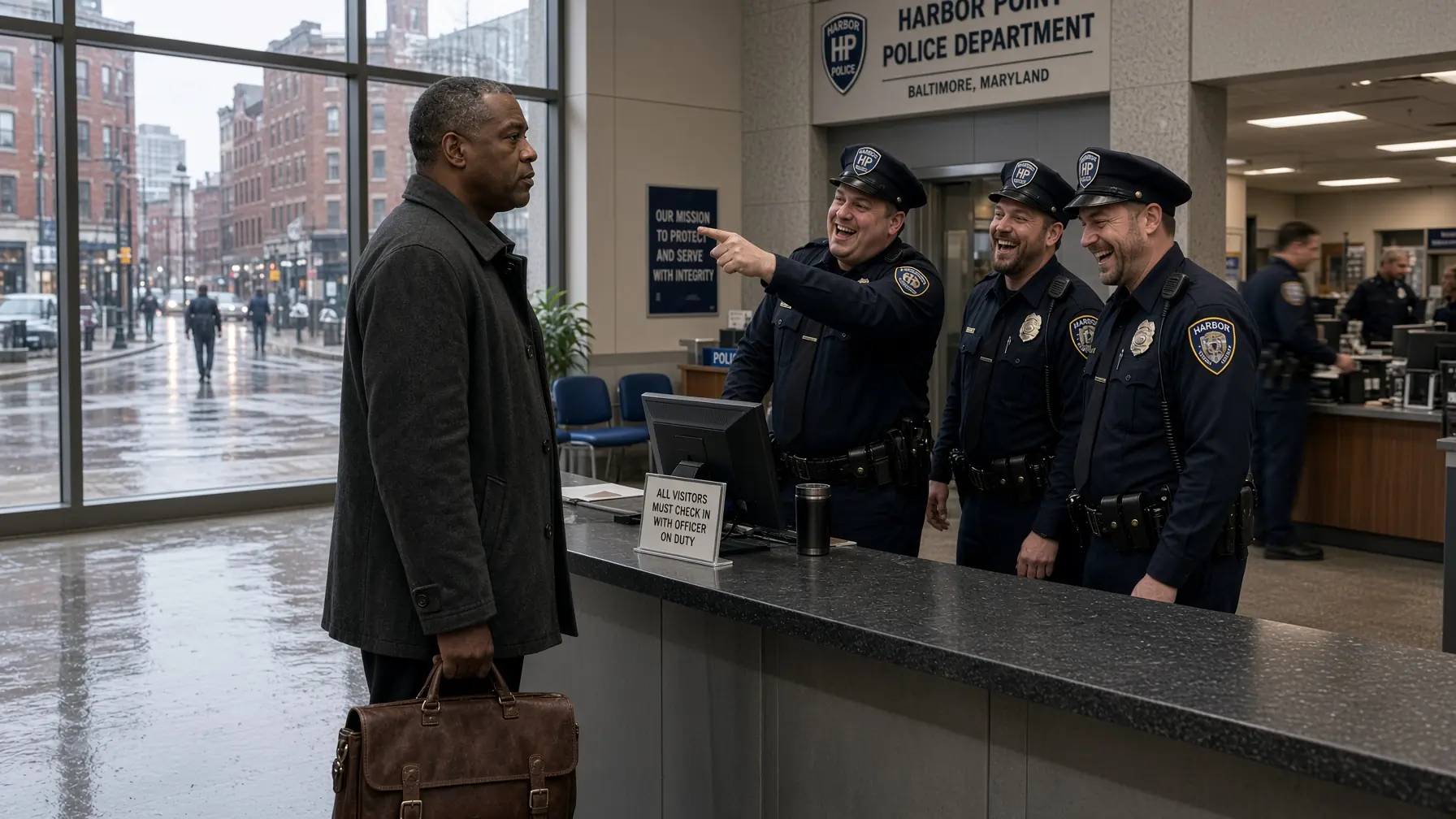
Then the elevator doors opened, and the chief said one word that made every officer in the lobby go silent.
My name is Rachel Brooks.
I was sitting behind a workstation at Harbor Point Police Department the morning Marcus Reed walked through our glass doors.
It was raining hard before sunrise, the kind of cold Baltimore rain that turned every window gray and left dark patches across the shoulders of every patrol officer who entered.
By 7:15, the lobby was already loud.
Phones ringing.
Radios crackling.
Wet boots crossing tile.
A printer groaning beside my desk.
Coffee that had been sitting on the warmer long enough to qualify as a workplace hazard.
Officer Tyler Grant stood behind the front counter telling a story to two patrol officers.
Tyler was thirty-four, white, broad-shouldered, and confident in the particular way men become confident when nobody has corrected them in a long time.
I don't remember his story.
I remember the laughter.
Then the front doors opened.
Marcus Reed stepped inside.
He was fifty-two.
Tall.
Broad through the shoulders.
Close-cropped black hair graying heavily at the temples.
A neatly trimmed beard.
His charcoal overcoat was clean but worn at the cuffs. His brown leather case had scratches along both corners. His shoes were polished, though clearly old.
Nothing about him demanded attention.
That seemed to be exactly why nobody gave him any.
Marcus approached the counter.
“Good morning.”
Tyler kept talking.
Marcus waited.
One of the officers beside Tyler glanced at him, then turned back.
A dispatcher hurried through the secured gate.
Marcus tried again.
“Excuse me.”
Tyler finally looked over.
His eyes traveled slowly from Marcus’s coat to the leather case to his face.
“Yeah?”
“I was instructed to report upstairs this morning.”
Tyler frowned.
“For what?”
“I have an appointment with command.”
The officer beside Tyler looked over again.
Tyler’s mouth curled.
“Hiring applications are online.”
A laugh came from behind the desk.
Marcus did not react.
“I’m not here for an application.”
“Public complaints are downstairs,” Tyler said. “Records is around the corner. Command doesn’t take walk-ins.”
“I was instructed to report upstairs.”
Something about Marcus’s calm irritated Tyler more than an argument would have.
Near the security gate, Sergeant Paul Mercer looked up from his coffee.
Mercer had nineteen years on the job.
He heard everything.
He could have asked one question.
Could have walked ten feet over.
Could have checked the visitor list.
Instead, he drank his coffee.
Tyler noticed.
And smiled wider.
“If somebody upstairs is expecting you,” he said, “they can come get you.”
Marcus studied him.
No anger.
No embarrassment.
Just stillness.
“All right.”
He picked up his leather case and walked to the row of hard plastic chairs beneath the lobby windows.
Behind him, Tyler muttered:
“Guess the chief forgot to send the limousine.”
The officers laughed.
Not everyone laughed because it was funny.
Some laughed because Tyler expected them to.
That distinction would matter later.
I stared at Marcus longer than I should have.
Most people ignored at that desk became angry.
They paced.
Demanded supervisors.
Pulled out phones.
Marcus did none of it.
He set the leather case beside his shoe.
Rested both hands over one knee.
And watched.
Not nervously.
Carefully.
He watched who Tyler greeted immediately.
Who was made to wait.
Which officers spoke to the custodian cleaning near the vending machines.
Which walked around her without acknowledging she existed.
He watched Mercer.
He watched me.
That made me uncomfortable.
Because I suddenly felt less like an employee behind a workstation and more like part of whatever he was observing.
Then something slipped from his fingers.
A small dark-blue coin hit the tile.
It rolled beneath the chair.
Marcus bent and picked it up.
For perhaps two seconds, it rested open in his palm.
An eagle.
A shield.
A ring of lettering.
A number engraved near the bottom.
My breath caught.
I had seen that emblem before.
Not on a souvenir.
Not on one of the generic challenge coins officers traded.
I had seen it upstairs.
Inside a display case in Chief Evelyn Whitaker’s conference room.
The command coin was given to senior commanders upon appointment.
Before I could place the memory completely, Marcus closed his hand and slipped it into his pocket.
“Sir,” I said.
He looked at me.
I almost stood.
Almost asked his name.
Then Sergeant Mercer shifted beside the gate.
Just one glance.
A warning without words.
Don't involve yourself.
My courage folded before it could stand.
“Nothing,” I said quietly.
Marcus nodded once.
He did not look disappointed.
That was worse.
And as he sat under the fluorescent lights, I understood something that made my stomach tighten.
Marcus Reed did not look like a man waiting for permission to belong upstairs.
He looked like a man waiting to learn what kind of department Harbor Point was before anyone learned who he was.
At 7:31, the elevator doors opened.
Chief Evelyn Whitaker stepped out.
Everything changed immediately.
Chief Whitaker was fifty-eight and had run Harbor Point for almost five years.
She was not physically imposing.
Five-foot-five, silver beginning to show through dark hair, narrow-framed glasses.
But an entire room changed posture when she entered it.
That morning, she came out of the elevator with Deputy Chief Thomas Hale and two civilian administrators behind her.
She was saying something about the command briefing when she looked toward the waiting area.
Then stopped.
“Captain Reed.”
Tyler Grant’s smile disappeared.
Sergeant Mercer slowly lowered his coffee.
Marcus stood.
Chief Whitaker crossed the lobby quickly.
“I’m sorry. We expected you upstairs fifteen minutes ago.”
Marcus picked up his case.
“I’ve been here.”
Whitaker’s expression changed.
Not dramatically.
But I saw it.
“So I see.”
She extended her hand.
“Welcome to Harbor Point, Captain.”
Marcus shook it.
“Chief.”
Every officer behind the desk was silent.
Tyler looked from Whitaker to Marcus.
Then to the elevator.
Then back to Marcus.
It was almost painful to watch his mind rearranging the last fifteen minutes.
Chief Whitaker turned toward the front desk.
“Was Captain Reed not on the arrival notice?”
Tyler’s mouth opened.
Mercer answered first.
“I believe there may have been some confusion, Chief.”
Marcus looked at him.
That was the first time I saw anything close to irritation in Marcus Reed’s face.
Not anger.
Precision.
“There wasn’t any confusion.”
Mercer went still.
Marcus continued.
“I said I had been instructed to report upstairs and had an appointment with command.”
Whitaker looked at Tyler.
“Did he give you his name?”
Tyler swallowed.
“He didn't—”
Marcus interrupted.
“You didn't ask.”
Silence.
Tyler looked at him.
The entire lobby was listening now.
Marcus’s voice stayed even.
“You asked what I wanted. You assumed I was here for hiring. Then complaints. Then records.”
Tyler’s face reddened.
“I was just trying to determine—”
“No.”
Marcus shook his head.
“You determined first.”
That line stopped him.
Chief Whitaker looked toward Sergeant Mercer.
“You were here?”
Mercer hesitated.
“Yes, Chief.”
“You heard the exchange?”
Another hesitation.
“Yes.”
“And you did what?”
Mercer had no answer that sounded good.
Marcus picked up his leather case.
Whitaker’s jaw tightened.
“We’ll address this upstairs.”
Marcus looked at her.
“Eventually.”
Then he turned toward Tyler.
“Officer Grant?”
Tyler straightened.
“Yes, sir.”
The sir arrived remarkably fast.
Marcus noticed that too.
“So you know how to use that word.”
Tyler’s face flushed darker.
Marcus let the silence sit.
Then he looked at all three officers behind the desk.
“If my rank is what made your behavior wrong, then it wasn’t wrong until the elevator opened.”
Nobody moved.
“It was wrong before that.”
Chief Whitaker watched him carefully.
Marcus turned toward her.
“Now I’m ready for the briefing.”
They entered the elevator.
The doors closed.
No one behind the desk laughed for the rest of the morning.
That was how Captain Marcus Reed began his first day as commander of Patrol Operations at Harbor Point Police Department.
I learned his history over the next few weeks.
Twenty-seven years in law enforcement.
Started patrol in Prince George’s County.
Detective.
Sergeant.
Lieutenant.
Then commander of a district with one of the highest service-call volumes in the region.
He had also spent three years attached to a professional-standards reform team after a federal review of another department.
That last part was why Chief Whitaker recruited him.
Harbor Point had a problem.
Not the kind that made dramatic headlines yet.
The quieter kind.
Citizen complaints that vanished into classifications.
Supervisors resolving things informally.
Body-camera reviews performed inconsistently.
Arrests for vague charges like obstruction or disorderly conduct that disappeared before prosecution but remained in people’s memories long afterward.
Chief Whitaker knew it.
The mayor’s office knew it.
The police union knew rumors were circulating.
Marcus’s assignment sounded simple on paper:
Improve patrol accountability.
Standardize supervision.
Rebuild trust.
Inside a police department, those words could start wars.
For the first month, Marcus changed almost nothing.
That confused people.
Officers expected an outsider to arrive with policies, speeches, and punishments.
Instead, Marcus watched.
Roll calls.
Traffic stops.
Supervisor reviews.
Arrest paperwork.
Complaint routing.
He rode overnight shifts without warning.
Sat beside dispatchers.
Visited evidence.
Talked to custodians.
Talked to civilian clerks.
Talked to officers with two years on and officers with twenty-five.
He asked everyone some version of the same question:
“What happens here when somebody makes a mistake?”
The answers were different.
That interested him.
Good organizations usually had similar answers to important questions.
Harbor Point did not.
Some officers said:
“You report it.”
Others:
“Depends who it is.”
A patrolman with seven years whispered:
“You fix it before command hears.”
One sergeant joked:
“You make sure your camera had a technical problem.”
Marcus did not laugh.
By his sixth week, he asked Internal Affairs for five years of citizen-complaint data.
That request started making people nervous.
I still worked downstairs.
I was a civilian records coordinator, not an officer.
Before Marcus arrived, that meant I had trained myself not to speak outside my lane.
The first morning proved it.
I recognized something unusual.
I almost spoke.
Then Mercer looked at me.
And I folded.
Marcus remembered.
Two weeks later, he stopped beside my workstation.
“Ms. Brooks.”
I looked up.
“Captain.”
“You were going to say something my first morning.”
My stomach dropped.
“I…”
“You recognized the coin.”
I stared at him.
“Yes.”
“Why didn't you finish?”
I could have lied.
Instead, I glanced toward Sergeant Mercer’s office.
Marcus followed my eyes.
Then looked back.
“I see.”
“I’m sorry.”
“For what?”
“For not saying something.”
Marcus leaned one hand against the counter.
“Would it have changed what Grant did before that?”
“No.”
“Then don't apologize to me.”
I waited.
He continued.
“But next time you see something that matters, say it.”
“What if I’m wrong?”
“Then be wrong honestly.”
That sentence stayed with me.
The complaint review produced numbers nobody in command liked.
Seventy-three cases caught Marcus’s attention.
Not seventy-three proven misconduct cases.
He was careful about that distinction.
Seventy-three complaint-related incidents where documentation, video review, classification, or supervisory follow-up appeared incomplete.
Of those, fifty-one had never reached Professional Standards for formal review.
Some legitimately did not need to.
Others clearly should have.
Marcus asked why.
The answer was not one corrupt officer sitting in a back room shredding complaints.
The truth was messier.
Supervisors used different standards.
Some considered complaints about tone too minor.
Some resolved problems verbally.
Some classified accusations as “service concerns” rather than misconduct.
Some officers discouraged people from filing formal reports by telling them nothing would happen.
And sometimes complainants simply gave up.
No conspiracy.
Just habits.
Marcus once told a command meeting:
“You don't need a conspiracy when everybody already knows which paperwork is inconvenient.”
That line traveled through the building by lunchtime.
Sergeant Paul Mercer hated him after that.
Not openly.
Mercer was too experienced for open hostility.
But his unit had one of the highest rates of locally resolved complaints.
Marcus began reviewing his supervisory files.
Mercer began calling Marcus a micromanager in private.
Tyler Grant stayed quieter.
He had received a formal counseling memorandum over the lobby incident, largely for unprofessional conduct and failure to appropriately screen a command visitor.
Marcus had refused to demand harsher punishment.
Some people found that surprising.
He explained why at a supervisors’ meeting.
“I don't want Grant disciplined because I was Captain Reed.”
Everyone listened.
“I want the behavior addressed because any citizen entering this building deserves professional treatment.”
He looked around.
“If the punishment increases because of my rank, then you're teaching officers to identify powerful people faster.”
No one argued.
Then came Jordan Miles.
Jordan was twenty-two.
Black.
College student.
Part-time warehouse worker.
He was arrested on a Friday night outside a convenience store.
The report said officers responded to a disturbance involving a group blocking the sidewalk.
According to Tyler Grant’s written account, Jordan repeatedly interfered with officers and refused commands to move back.
Charge:
Obstruction.
The arrest landed in my queue Monday morning because the prosecutor’s intake system rejected one attachment.
I opened the report.
Something bothered me.
A note said:
Subject repeatedly recording officers within immediate enforcement area despite direction to stop interfering.
I remembered Marcus.
Next time you see something that matters, say it.
So I called the arresting unit.
Tyler answered.
“Harbor Point.”
“Officer Grant, it’s Rachel in records. I’m reviewing Jordan Miles.”
“What about him?”
“Was his recording reviewed before we book the obstruction charge?”
Silence.
Then:
“Why?”
“The narrative focuses heavily on him filming.”
“So?”
“Recording police isn't automatically obstruction.”
Tyler’s voice hardened.
“Rachel, you doing legal review now?”
My instinct told me to retreat.
Then I thought of Marcus sitting beneath the lobby windows.
“No.”
I swallowed.
“I’m asking whether the body-camera footage was reviewed before the charge was submitted.”
Tyler sighed.
“Sergeant signed it.”
“Which sergeant?”
“Mercer.”
Of course.
I hung up.
Then did something I would not have done six months earlier.
I went upstairs.
Marcus was in his office.
His door was open.
I knocked anyway.
“Captain?”
He looked up.
“What’ve you got?”
That question helped.
Not what do you want?
What’ve you got?
I handed him the arrest report.
“I might be wrong.”
“Good start.”
I almost smiled.
“The obstruction narrative is mostly about Jordan filming.”
Marcus read.
“Body cam?”
“I don't know if it was reviewed.”
He looked up.
“Who approved?”
“Mercer.”
Marcus stood.
“Come on.”
We went to Professional Standards.
The footage took nine minutes to locate.
The important part took less than three to watch.
Jordan Miles stood on a public sidewalk holding a phone.
He was loud.
Annoying, maybe.
He repeatedly asked why his friend was being detained.
Officer Grant ordered him backward twice.
Jordan complied both times.
He continued recording.
Then Grant walked toward him.
“You want to join him?”
Jordan answered:
“I’m standing back. I’m recording.”
Grant reached for the phone.
Jordan pulled it toward his chest.
“Don't touch my stuff.”
Grant grabbed his wrist.
Arrested him for obstruction.
The footage showed no physical interference before Grant initiated contact.
Marcus watched it twice.
Then called the prosecutor’s liaison.
The obstruction charge was withdrawn before arraignment.
Jordan was released.
Then Marcus called Tyler Grant and Sergeant Mercer upstairs.
I was not in the room.
But everyone eventually heard pieces.
Marcus asked Mercer whether he reviewed the video.
Mercer admitted he had reviewed only the first portion.
“Why sign the arrest?”
“Grant is experienced.”
“That’s not review.”
“The subject was argumentative.”
“That isn't obstruction.”
“He was creating tension.”
“That isn't obstruction either.”
Then Marcus asked Tyler:
“What specifically did Jordan Miles prevent you from doing?”
Tyler reportedly gave three answers.
None matched the video.
That incident became the point when Harbor Point stopped treating Marcus’s review as an abstract reform project.
Now there was a name.
A young man had spent a weekend in custody on a charge that collapsed as soon as someone bothered to watch the camera.
And the person who asked the first useful question had been a civilian employee downstairs.
Me.
Marcus came to my desk afterward.
I stood when I saw him.
“You don't need to stand.”
“Sorry.”
He placed the report beside my keyboard.
“You were right.”
I looked at him.
“About the footage?”
“About asking.”
That distinction mattered.
“What happens to Tyler?”
“Review.”
“Mercer?”
“Review.”
I hesitated.
“Captain?”
“Yes?”
“What if the footage had supported them?”
Marcus shrugged.
“Then we'd know.”
He started walking away.
Then turned back.
“Accountability isn't assuming officers are wrong, Rachel.”
“What is it?”
“Refusing to be afraid of the answer.”
The Jordan Miles review opened several more files.
Not because every previous arrest was improper.
Most were not.
But Marcus compared similar obstruction cases across three years.
A pattern emerged.
Officers in Mercer’s squad used obstruction charges more frequently than comparable units.
Many involved people recording, questioning, or verbally challenging police rather than physically interfering.
Several charges were later dropped.
Marcus ordered a broader legal and policy review.
The union complained.
Mercer called it a witch hunt.
Chief Whitaker publicly disagreed.
“This is what supervision is supposed to look like,” she told command staff.
Mercer was eventually removed from his supervisory role after the review found repeated failures to adequately examine body-camera evidence before approving reports.
He remained with the department at a lower rank.
Tyler Grant received a significant suspension, mandatory constitutional-policing retraining, and twelve months of enhanced supervisory review.
People outside the department expected Marcus to fire him.
Marcus did not.
Not then.
The evidence showed poor judgment, arrogance, and repeat procedural problems.
It did not establish every accusation people made once Tyler’s name became public.
Marcus refused to turn accountability into revenge simply because revenge was satisfying.
That decision angered people on both sides.
Tyler’s supporters said the suspension was too harsh.
Critics said it was too light.
Marcus’s answer was the same.
“The evidence decides.”
Something changed in Tyler afterward.
Not immediately.
For weeks, he barely spoke when Marcus entered a room.
Then one afternoon, almost a year after their first encounter, Tyler asked for a meeting.
Marcus agreed.
Tyler sat across from his desk.
No audience.
No union representative.
He looked older than he had in the lobby.
“I owe you an apology.”
Marcus waited.
“For the first day.”
Still waiting.
Tyler exhaled.
“I was an ass.”
“Yes.”
“I thought you were…”
He stopped.
Marcus leaned back.
“Say it.”
Tyler looked uncomfortable.
“I thought you were somebody who didn't belong upstairs.”
“Why?”
Tyler stared at the floor.
“I don't know.”
Marcus said nothing.
Finally Tyler looked up.
“That’s the worst answer, isn't it?”
“It’s an honest one.”
Tyler rubbed his hands together.
“I keep thinking about what you said.”
“What?”
“If your rank made it wrong.”
Marcus remembered.
Tyler continued.
“I was embarrassed because you were the new captain.”
He paused.
“Later I realized I should've been embarrassed before I knew.”
Marcus watched him for a moment.
“That realization doesn't erase what happened.”
“I know.”
“Or Jordan Miles.”
“I know.”
Tyler nodded.
“I’m not asking it to.”
For the first time, Marcus believed him.
Not completely.
Trust did not arrive through one conversation.
But enough to keep listening.
The department changed slowly.
Much slower than newspaper stories liked to suggest.
Complaint forms were simplified.
Citizens could submit directly to Professional Standards without first persuading a front-desk officer that the complaint was serious enough.
Supervisors had to document body-camera review for certain arrests and use-of-force events.
Obstruction arrests received additional scrutiny.
Duty-to-intervene training changed from a yearly slide presentation into scenario-based instruction.
Patterns of complaints were reviewed, not only individual cases.
Marcus insisted on one more change.
Civilian employees could flag reports for policy or documentation review without going through the officer’s immediate chain of command.
That one made me nervous.
Because suddenly people like me had a responsibility we had spent years being told was not ours.
Marcus told us:
“You don't decide guilt.”
He stood in front of twenty civilian employees during training.
“You identify questions.”
That I could do.
Two years after Marcus arrived, another incident happened in the Harbor Point lobby.
A homeless veteran came in during afternoon shift carrying three plastic bags.
He smelled strongly of rain and cigarette smoke.
The officer behind the counter looked uncomfortable.
Before he could say anything dismissive, Tyler Grant stepped over.
“Afternoon, sir. What do you need?”
The man explained that he was trying to recover identification held from an arrest months earlier.
Tyler checked the system.
Could not find it.
The veteran became frustrated.
Started raising his voice.
Old Tyler would have matched the volume.
Instead Tyler said:
“I get why you're frustrated. Give me five minutes.”
He called property.
Then records.
Then walked downstairs himself.
Ten minutes later, he returned with the man’s identification card.
The veteran stared.
“That's it?”
“That’s it.”
He left.
I had watched the whole thing.
Tyler caught me staring.
“What?”
“Nothing.”
He narrowed his eyes.
“You’re doing the Captain Reed thing.”
“What thing?”
“Watching.”
I smiled.
“How’d it feel?”
“What?”
“Being professional.”
He rolled his eyes.
Then laughed.
“Go back to work, Rachel.”
I did.
But I wrote down the date.
Maybe Marcus had infected me with notebooks without ever owning one.
Three years after his arrival, Marcus Reed was promoted to deputy chief.
The announcement happened in the same lobby.
Chief Whitaker stood beside him.
Officers gathered around.
This time Marcus wore a dark dress uniform.
Gold trim.
Command insignia.
Perfectly polished shoes.
Nothing worn.
Nothing ambiguous.
Everyone knew who he was before he entered.
I stood near my old workstation watching.
After the ceremony, Marcus came over.
“You still here?”
“Unfortunately.”
He smiled.
Then looked toward the row of plastic chairs beneath the windows.
The exact place he had waited on his first morning.
“You remember?” I asked.
“Yes.”
“All of it?”
“Enough.”
I hesitated.
“I should’ve spoken up.”
Marcus looked at me.
“We covered that three years ago.”
“I know.”
“Then why bring it up?”
I looked toward the desk.
“Because I think about it every time somebody comes through those doors.”
Marcus nodded.
“That’s useful.”
“Still feels bad.”
“Those can both be true.”
We stood there for a moment.
Then I asked:
“Did you really sit there on purpose after Tyler told you to wait?”
Marcus smiled faintly.
“I had an appointment.”
“That’s not what I meant.”
“I know.”
“Were you testing us?”
He looked toward the lobby.
“Not exactly.”
“What were you doing?”
Marcus thought.
Then answered:
“Learning.”
“About Tyler?”
“About everybody.”
That included me.
He did not need to say it.
Chief Whitaker retired the following year.
Marcus became one of the finalists to replace her.
By then, Harbor Point was different.
Not perfect.
No police department ever became perfect because one commander arrived.
Complaints still happened.
Officers still made mistakes.
Some reforms worked better on paper than in practice.
There were lawsuits.
Union fights.
Budget problems.
Bad arrests.
Excellent arrests.
Officers who embodied everything the badge was supposed to mean.
Others who needed to leave.
Marcus never pretended otherwise.
But there was one difference I could feel from my workstation.
People asked more questions.
That sounds small.
It wasn't.
Before approving a questionable arrest:
“Did we review the camera?”
Before dismissing a complaint:
“Has this happened before?”
Before ordering somebody from the lobby:
“What do you actually need?”
Before backing another officer automatically:
“What happened?”
Questions created friction.
Marcus liked friction.
“Friction means somebody slowed down long enough to think,” he once told us.
Years later, the story of Marcus’s first morning still circulated among recruits.
It changed with every retelling.
Somebody eventually claimed Tyler had thrown Marcus’s briefcase across the room.
Never happened.
Another version said Mercer threatened to arrest him.
Also false.
One recruit told me Marcus secretly arrived dressed like a homeless man to conduct an undercover test.
Absolutely not.
He wore a decent coat and polished shoes.
People simply decided it was not enough.
That was the point.
So whenever I heard the story becoming too dramatic, I corrected it.
Because the truth was stronger.
A Black man entered a police station.
Said good morning.
Said he had an appointment with command.
Nobody asked his name.
An officer mocked him.
A sergeant heard it and chose not to intervene.
A civilian employee recognized a clue and became too afraid to speak.
Then the elevator opened.
Chief Evelyn Whitaker walked out.
And said:
“Captain Reed.”
That one word did not transform Marcus.
It transformed everyone else.
Tyler’s posture changed.
Mercer’s face changed.
My courage suddenly returned when it was no longer needed.
That was what Marcus understood before any of us did.
Rank had not made him more deserving of respect.
It had simply made disrespect dangerous.
And an organization where people behave properly only when consequences are visible is not a healthy organization.
The last time I heard Marcus tell the story himself was at a recruit graduation.
He almost never mentioned it publicly.
A young officer asked during a question session:
“Sir, is it true Officer Grant didn't recognize you on your first day?”
Marcus smiled.
“Yes.”
The room laughed.
Marcus did not.
“So what did you do?”
“I sat down.”
More laughter.
“Were you angry?”
Marcus considered it.
“No.”
That surprised them.
“Why not?”
“I’d been called worse things by more talented people.”
The recruits laughed again.
Then Marcus became serious.
“What concerned me was how quickly people changed once they knew my rank.”
The room quieted.
He looked across nearly sixty new officers.
“Most of you will learn very quickly how to identify important people.”
He pointed toward the badges on their uniforms.
“Judges. Prosecutors. Commanders. Politicians. Department heads.”
A pause.
“That is not a skill I’m interested in teaching you.”
No one moved.
“The harder skill is treating the person whose name means nothing to you with the same professionalism.”
He looked toward the front row.
“The frightened teenager.”
“The angry mother.”
“The man sleeping at the bus stop.”
“The woman who speaks slowly.”
“The person who walks into your station wearing an old coat.”
Then he smiled faintly.
“Even if he turns out to be your new captain.”
That got another laugh.
Marcus let it fade.
Then he said:
“Because if you need the elevator doors to open before you remember how people deserve to be treated, the problem isn’t that you failed to recognize rank.”
He paused.
“The problem is that you forgot the badge belongs to the public before it belongs to you.”
No one laughed after that.
Neither did I.
Because I remembered that rainy morning.
The wet coat.
The old leather case.
The dark-blue coin resting in Marcus’s palm.
My own voice beginning:
“Sir…”
Then stopping.
I remembered Tyler laughing.
Mercer drinking his coffee.
Marcus sitting quietly beneath the lobby windows.
Watching us.
Learning us.
Waiting.
Then the elevator doors opening.
And Chief Whitaker saying the word that suddenly made everyone see the man who had been sitting in front of them all along.
“Captain.”
Marcus Reed had not changed in those fifteen minutes.
We had.
That was the part of the story Harbor Point needed years to understand.