"Get your hands off that door, or I'll tell the police you're reaching for a gun!" The woman stood at the bottom of the porch with her phone held high, her voice loud enough to bring curtains moving in three neighboring houses. Isaiah Cole froze with his new house key halfway into the lock. In his other hand was a bakery box containing a chocolate cake for his daughter, who was supposed to arrive in forty minutes. He had owned the house for eleven days, and the woman shouting at him had never asked his name.
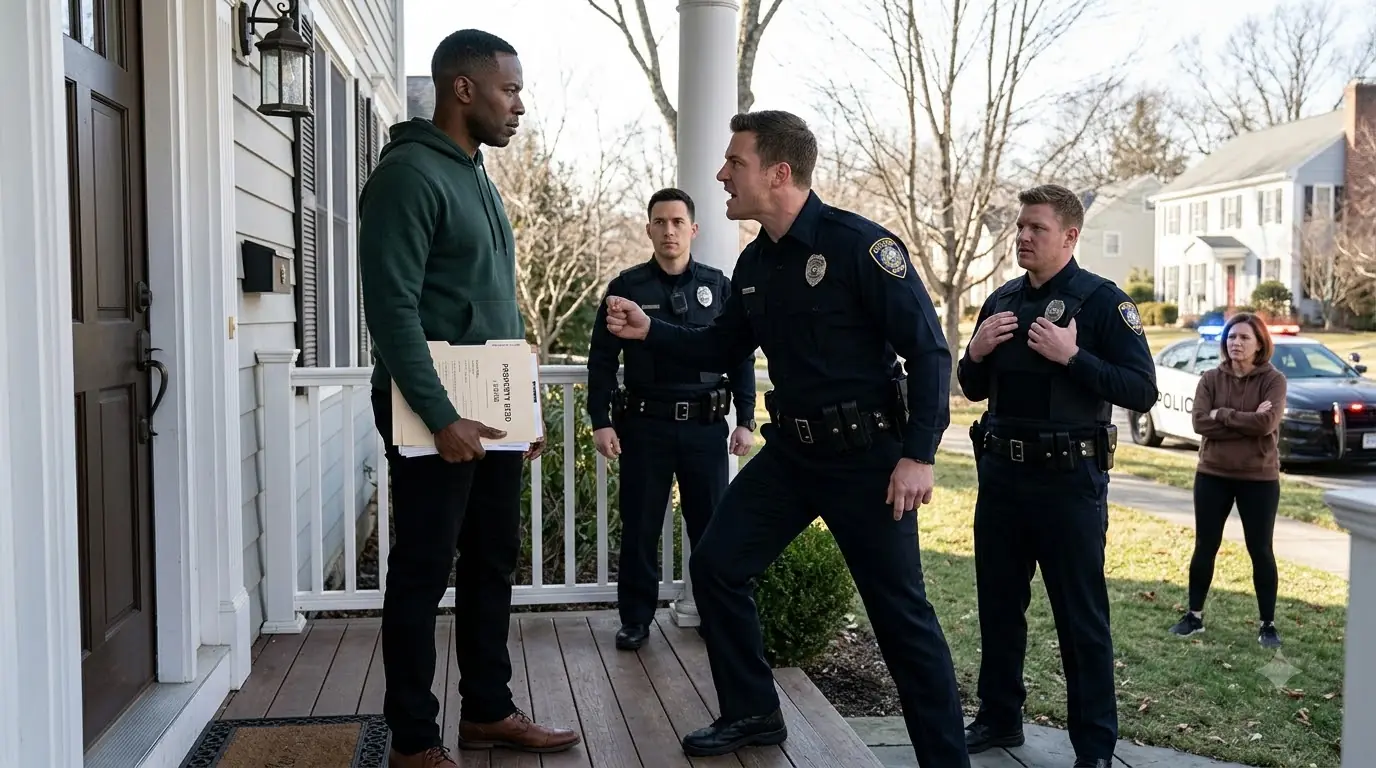
"Ma'am, this is my home," Isaiah said. "I can show you the closing documents." He was forty-two, tall and broad-shouldered, with close-cropped black hair, a neatly trimmed beard, and the tired eyes of a man who had spent the previous night unpacking alone. He wore a navy sweatshirt, faded jeans, and work boots dusty from moving furniture. The woman looked from his face to the door and shook her head as though his explanation were an insult.
"The Whitmores live there," she snapped. "I've known them for fifteen years." Isaiah nodded toward the SOLD sign still leaning against the garage. "They moved to Sarasota. I bought it through an agent named Helen Price. You're welcome to call her." The woman, who would later introduce herself as neighborhood association president Vanessa Harrow, was already speaking to a dispatcher. "There's a suspicious man forcing his way into a house on Briarwood Court," she said. "He's getting aggressive, and I think he has something in his hand. Please hurry."
Isaiah set the cake on the porch railing. "I haven't threatened you," he said, keeping his voice level. "And what I'm holding is a key." Vanessa moved backward dramatically and told the dispatcher he was approaching her, although he had not moved from the doorstep. Across the street, an elderly woman watering her flowerpots turned off the hose. At the neighboring house, a teenage boy lifted his phone to record. Isaiah glanced at his watch, thinking of his daughter Amara and the small surprise he had promised her after months of difficult changes.
The house had been his attempt to give eleven-year-old Amara something steady. Her mother, Naomi, had died two years earlier after a sudden illness, leaving Isaiah to learn the quiet mathematics of single parenthood: lunch money, dentist appointments, permission slips, and the terrible way a child's grief could appear during an ordinary grocery trip. He had accepted the position of city manager in neighboring Fairmont because it offered a better schedule than his previous consulting work. When the Fairmont council asked him to serve temporarily as acting mayor during a vacancy, he agreed reluctantly, insisting that his daughter remain the most important person in his life.
He had not advertised that appointment. He had not wanted a motorcade or a newspaper photograph outside his new home. He wanted Amara to ride her bicycle down a street lined with maple trees, to choose the color of her bedroom, and to stop asking whether they would have to move again. The birthday cake in the box was not for her actual birthday, which was months away. It marked one year since she had finally returned to school after a long period of grief, a milestone Naomi would have celebrated with chocolate frosting and an embarrassing song.