“Stop right there, suspicious Black trash,” Officer Daniel Prescott called from behind Adrian Cole as the older man crossed the last stretch of pavement separating the overflow parking lot from St. Matthew’s Memorial Chapel. Adrian stopped with one polished black shoe still touching the painted edge of the walkway, turned slowly, and saw two uniformed officers approaching from a patrol cruiser that had stopped crookedly across three parking spaces. He was fifty-nine years old, dressed in a charcoal suit his late brother had once told him made him look too serious, and carrying nothing more dangerous than a folded funeral program and his brother’s old silver pocket watch. “Sir,” Adrian said, controlling the first wave of disbelief rising inside him, “I’m heading to the chapel, and my brother’s funeral starts in ten minutes.”
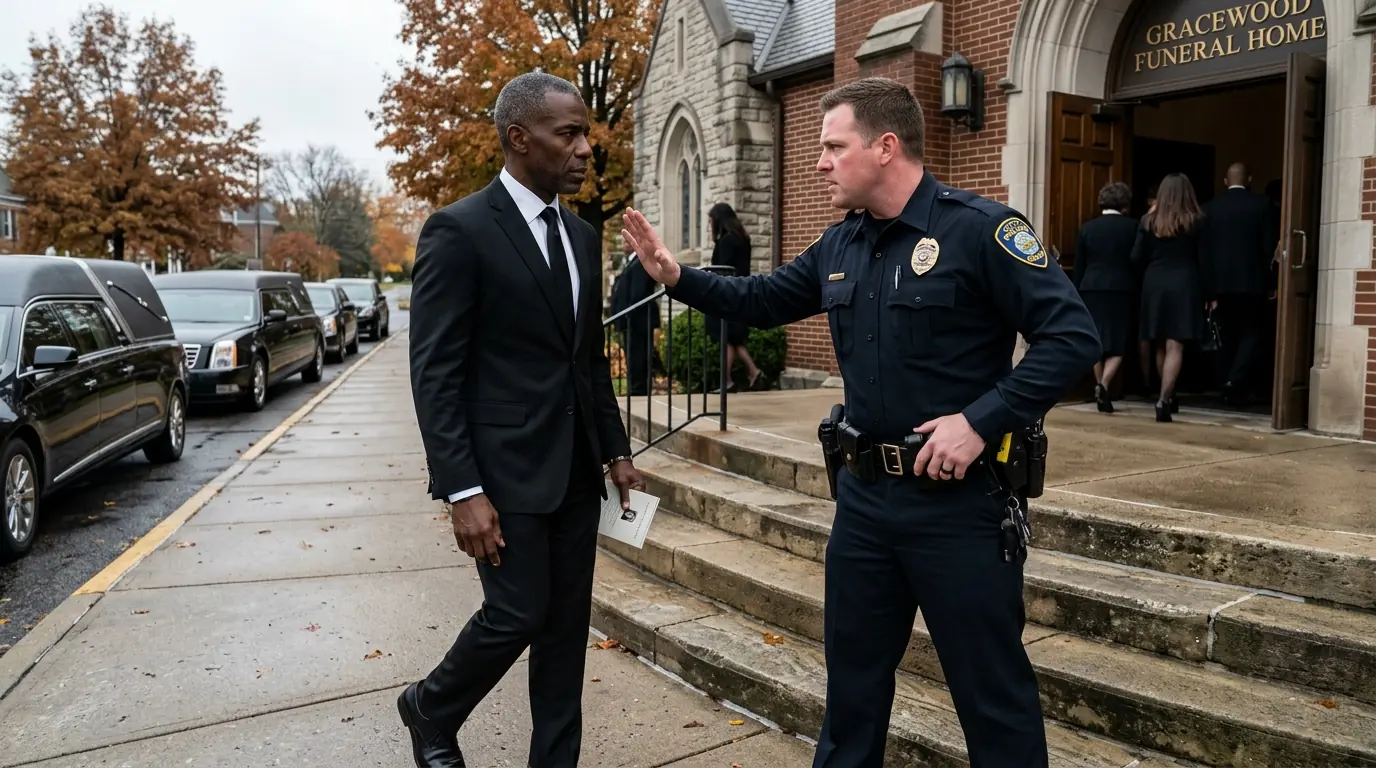
Prescott looked toward the limestone chapel and then back at Adrian as though the explanation amused him. “Funeral,” he repeated, smiling toward his younger partner, Officer Nathan Ross, “that’s a new one, because you people get more creative every week.” Adrian’s jaw tightened, not because the insult was unfamiliar, but because the morning had already required every ounce of composure he possessed before he ever stepped into the parking lot. “My family is waiting inside,” he said, “so if there is a reason you stopped me, please tell me what it is and let’s resolve it quickly.”
Prescott walked close enough that Adrian could smell coffee and peppermint on his breath. “I said stop talking,” he replied, then placed one hand flat against Adrian’s chest as though the sixty-year-old man in a funeral suit had been advancing rather than standing still. Adrian looked down at the hand, then up into Prescott’s face, and said, “Remove your hand, Officer, because I am not threatening you, I am not leaving, and I have not resisted anything.” Prescott’s expression changed the instant Adrian spoke with the calm precision of somebody accustomed to giving clear instructions under pressure.
The slap came so unexpectedly that Ross reacted almost as visibly as Adrian did. Prescott’s open hand struck Adrian across the left side of his jaw, knocking his glasses crooked and sending the folded funeral program onto the pavement between them. Adrian took one involuntary step backward before Prescott grabbed his jacket collar, twisted him sideways, and forced him down onto the asphalt while Ross stood frozen for one disastrous second. A knee pressed between Adrian’s shoulder blades, steel closed around his wrists, and the first thing Adrian thought was not about his rank, his career, or the legal consequences, but that Malcolm’s casket was less than a hundred yards away.
“You think a cheap suit fools anybody?” Prescott said as he tightened the cuffs. Adrian kept his palms open and his body still despite the pain spreading through his jaw and shoulder, because thirty-seven years in uniform had taught him that panic could make a bad situation fatal faster than pride could make it fair. “For the record,” he said, his voice slightly muffled against the cold pavement, “I have not struck you, threatened you, attempted to leave, or refused a lawful safety instruction.” Prescott leaned lower and said, “Keep talking like that and you’ll miss more than the funeral.”
Officer Nathan Ross finally moved. He was thirty-one, six years into law enforcement, and had spent most of the previous thirty seconds trying to understand how a call about a suspicious man near parked vehicles had transformed into an older gentleman in handcuffs on the ground. “Prescott,” he said carefully, “maybe we should figure out who he is before this goes any further.” Prescott looked toward him with the contempt of a senior officer hearing doubt from someone he expected to follow, then replied, “He’s somebody who was casing cars and gave me a story when he got caught.”
Adrian heard the words and understood for the first time what call had brought them. He had parked his rental sedan in the overflow lot because the chapel lot was full, then walked between several rows looking for the blue minivan belonging to his niece Danielle because she had texted that her youngest boy had left an inhaler inside. Adrian never found the van because Danielle texted again saying she had already retrieved it, so he put his phone away and started walking toward the chapel. Somebody had apparently seen a Black man in a suit moving between vehicles and decided the funeral complex required police.
“Officer Ross,” Adrian said from the pavement, “my name is Adrian Cole, and St. Matthew’s has a funeral scheduled for Malcolm Cole at nine this morning.” Ross looked automatically toward the chapel directory mounted beside the entrance, where several names appeared in removable black lettering beneath the date. The second line clearly read MALCOLM EDWARD COLE — FAMILY SERVICE — 9:00 A.M. Prescott saw Ross looking and barked, “That doesn’t prove he belongs to it.”
Adrian closed his eyes. The logic was familiar because he had seen versions of it in intelligence briefings, command investigations, security failures, and war rooms where people became emotionally attached to their first hypothesis. Evidence that should reduce uncertainty could instead become another inconvenience requiring explanation when pride had already invested in the original conclusion. “Then call the chapel,” Adrian said, “because the funeral director, my sister-in-law, my nieces, my nephew, and roughly ninety other people inside can verify me without you keeping your knee in my back.”
Prescott stood and pulled Adrian upward by one cuffed arm. Pain flashed through Adrian’s right shoulder, but he stayed balanced and refused to give the officer the sudden movement that might later become a sentence in a report. “You don’t give orders here,” Prescott said, steering him toward the cruiser. Adrian answered, “I’m not giving orders, I’m giving you easy ways to verify the explanation you say you don’t believe.”
Several guests standing outside the chapel had begun noticing. A teenage boy in a dark suit held the door open while staring toward the parking lot, and an elderly woman near the flower arrangement pointed in Adrian’s direction before saying something to the funeral director. Inside, an organist was already playing quietly, oblivious to the fact that the brother scheduled to deliver the eulogy was being marched toward a police cruiser outside. Adrian saw the chapel doors and thought about Malcolm telling him two months earlier, while laughing over the phone, that no matter how many stars Adrian wore at work, he would always be “the little brother who stole my bicycle in 1974.”
That memory nearly broke his composure. Malcolm had died of a sudden cerebral aneurysm at sixty-four, collapsing in the kitchen while his wife Patrice stood three feet away, and Adrian had received the call halfway through a classified readiness briefing at Fort Belden. He had left the room before anybody finished telling him, because the tone of his niece Danielle’s voice already contained the ending. For the next six days, four-star General Adrian Cole had signed documents, returned calls, reassigned meetings, approved travel, and handled every professional obligation required of one of the Army’s highest-ranking officers while privately becoming a thirteen-year-old boy again.
Malcolm had never joined the military. He became a public-school music teacher, then a high-school principal, and spent forty years building the kind of quiet local life Adrian’s career rarely allowed him to keep. Where Adrian moved every few years, Malcolm bought one house and spent three decades fixing the same back fence. Where Adrian had briefed presidents, secretaries, foreign generals, and congressional committees, Malcolm could walk through a grocery store in Westfield, Virginia, and meet six former students before reaching the milk.
The brothers loved each other without being especially sentimental. Malcolm mailed Adrian newspaper clippings from home even after everything moved online, called every promotion “another opportunity to get blamed for other people’s stupidity,” and once introduced him at a family barbecue as “my brother Adrian, professional mover of PowerPoint arrows.” Adrian retaliated by sending Malcolm photographs of every crooked shelf, broken gutter, or badly painted wall he noticed during visits. Neither man ever ended a phone call with enough seriousness to prepare the surviving brother for the silence after the last one.
Malcolm’s only explicit funeral request had been something he said jokingly after a friend died the previous year. “When I go,” he told Adrian, “do not show up with flags, generals, or a brass band like you’re invading my church, because I was a principal, not MacArthur.” Adrian promised, and after Malcolm died he instructed his staff that the funeral would be private family time, no official announcement, no military honors beyond what relatives personally requested, and no uniform for him. He arrived in a dark civilian suit because for one morning he wanted to be Malcolm’s brother, not General Cole.
His executive officer, Lieutenant Colonel Maya Reeves, was inside the chapel because Adrian’s position made truly unaccompanied travel difficult even when he tried to minimize the official footprint. She had changed into civilian clothes, sat several rows behind the family, and carried only one government phone because Adrian had ordered her not to turn the funeral into an extension of his office. Maya respected the boundary until she noticed the time and realized Adrian had not entered. When Danielle whispered that her uncle had texted from the parking lot eight minutes earlier, Maya quietly stepped into the vestibule.
Outside, Prescott opened the rear door of the cruiser. Adrian stopped before getting in and asked, “Am I under arrest?” Prescott said, “You’re detained while we figure out what you were doing around those cars.” Adrian replied, “Then I want your supervisor here before you transport me anywhere, and I want the basis for physical force documented now.”
Prescott laughed. “You sound like you watched too many courtroom shows.” Adrian looked at him steadily and said, “Call your supervisor.” Ross stood a few feet away, watching the exchange with increasing discomfort.
Prescott leaned closer. “You think because you can talk clean and wear a suit, you’re special?” Adrian answered, “No.” Prescott seemed almost disappointed.
“I think I’m a man going to my brother’s funeral.” Adrian paused. “That should be enough.”
The words stayed with Ross. He looked again toward the chapel sign, then toward the funeral program lying where it had fallen near the first parking row. “I’m going to call St. Matthew’s,” he said. Prescott turned sharply and told him, “No, you’re going to help me search him.”
Ross stared. “For what?”
“We need ID.” Adrian said, “My wallet is in the inside pocket of my jacket, and if you want identification you can retrieve it while the cuffs are on.”
Prescott smiled. “Now you want to cooperate.” Adrian answered, “I have been cooperating since you arrived.”
Prescott reached into Adrian’s jacket. His fingers passed over a small leather wallet, a folded condolence card, and the silver pocket watch Malcolm had given him the night Adrian graduated from West Point. He pulled out the wallet and opened it. The first visible card was an ordinary Virginia driver’s license.
Adrian Cole. Age fifty-nine. Address in Arlington.
Prescott looked toward the chapel. “You don’t live around here.”
“My brother did.” Adrian’s voice remained controlled.
Prescott flipped past a health-insurance card. Behind it sat a military identification credential. He glanced at the photograph, saw the name, and looked only briefly at the rank line before tossing the wallet onto the front seat.
Ross said, “What does it say?” Prescott replied, “Military.”
Adrian watched him. “Read the rank.”
Prescott shut the cruiser door in his face.
For the first time, Adrian’s anger overcame grief strongly enough that he had to consciously slow his breathing. The credential would not have made Prescott’s earlier conduct lawful or unlawful, but the deliberate refusal to read what had been placed in his hand revealed something deeper than simple confusion. Prescott was no longer gathering information. He was protecting a conclusion.
Ross walked toward the front passenger door and opened it. “Let me see.” Prescott stepped between him and the vehicle.
“I’ve got it.” Ross replied, “Then what’s the rank?”
Prescott looked irritated. “It says general.”
Ross paused.
“What kind?”
“Who cares?” Prescott said.
Ross reached past him and picked up the wallet. He opened the credential and stared long enough that Adrian could see the exact second he processed the words.
GENERAL ADRIAN M. COLE — UNITED STATES ARMY.
Four silver stars appeared in the small official photograph.
Ross’s face changed completely. “Jesus Christ.”
Prescott grabbed the wallet. “It could be fake.” Ross looked at him as though something had finally become undeniable.
“A four-star general’s fake ID?”
“People fake everything.” Prescott shoved the wallet into his own pocket rather than returning it.
Adrian leaned forward in the back seat. “Officer Ross, call your supervisor now.”
Ross reached for his radio.
Prescott said, “Don’t.”
Ross looked at him.
“I’m requesting Sergeant Ellis.”
Prescott stepped closer. “I said don’t.”
Ross answered, “And I’m telling dispatch we have a detainee claiming to be an Army general whose military identification shows four-star rank, so yes, I’m getting a supervisor.”
That was the first moment Adrian thought Ross might eventually understand the difference between discomfort and duty. It came late. Late still mattered.
In the chapel vestibule, Maya Reeves heard a teenage guest say police had somebody in handcuffs near the overflow lot. She stepped outside and saw three cruisers’ worth of empty pavement where only one cruiser had been minutes earlier, then noticed Adrian’s dark suit through the rear window. For several seconds her military instincts and personal disbelief fought each other. Then she started walking.
Patrice Cole came through the doors behind her. At sixty-two, Malcolm’s widow looked almost weightless from grief, dressed in black with a small pearl brooch Adrian’s mother had once owned. “Maya,” she called, “what is happening?”
Maya turned. “Please stay inside.”
Patrice saw Adrian in the cruiser.
Her face collapsed.
“That’s my brother-in-law.”
Maya said, “I know.”
Patrice began walking faster.
“Then why is he in a police car?”
Maya could not answer.
Adrian saw them approaching through the glass. His immediate reaction was shame, irrational but powerful, because Patrice was supposed to spend that morning grieving her husband, not watching police detain the man Malcolm had trusted to speak for him. Adrian straightened despite the pain in his cuffed wrists. He wished more than anything that the cruiser window could become opaque.
Maya reached Ross first. “I’m Lieutenant Colonel Maya Reeves, United States Army, and the man in that vehicle is General Adrian Cole.” Ross nodded rapidly.
“We just figured that out.”
Prescott turned. “Stay back.”
Maya looked at him.
“No.”
Prescott’s hand moved toward his belt.
Ross said, “Daniel.”
Maya continued, “I’m not interfering with your detention, but I am telling you that he is the Commanding General of United States Army Strategic Readiness Command, and his identity can be verified through the Department of Defense duty desk in less than sixty seconds.”
Prescott’s face changed slightly. “Nobody asked you.”
Maya replied, “You were apparently asking who he was.”
Patrice reached them. “Get him out.”
Prescott looked at her.
“Ma’am, stand back.”
“That is my husband’s brother.”
“I said stand back.”
Patrice’s grief sharpened into anger. “My husband is lying in a casket fifty yards from here, and the man who is supposed to give his eulogy is sitting in your car because you couldn’t walk into a chapel and ask a question.”
Prescott said, “He was suspicious around vehicles.”
Patrice stared.
“He was looking for my daughter’s minivan because her son needed his inhaler.”
Ross looked toward Prescott.
There it was.
A completely ordinary explanation, volunteered by somebody who had not heard Adrian give it.
Prescott asked, “Can you prove that?”
Patrice almost laughed.
Maya stepped between the conversation before grief made things worse. “Supervisor.”
Ross held up his radio.
“Already coming.”
A third vehicle turned into the lot less than two minutes later. Sergeant Elena Ellis, a twenty-one-year police veteran with close-cropped gray hair and the exhausted posture of somebody accustomed to being summoned after other people had already complicated easy situations, parked near the chapel and approached. She saw Patrice crying, Maya standing rigidly beside the cruiser, Ross looking sick, and Prescott looking angry.
“What do we have?” Ellis asked. Prescott began immediately.
“Suspicious male moving between vehicles, refused cooperation, became argumentative, resisted detention.”
Ross looked toward him.
Adrian heard every word through the cracked window.
Ellis asked, “What suspicious behavior?”
“Checking cars.”
“Touching handles?”
Prescott paused.
“Looking inside.”
Ross said, “We don’t actually have that.”
Prescott glared at him.
Ellis noticed.
“What do we have?”
Ross answered, “Caller saw a Black male in a suit walking between cars and looking around.”
“Anything stolen?”
“No.”
“Any attempted entry?”
“No.”
“Any vehicle alarm?”
“No.”
“Any matching suspect from another call?”
“No.”
Ellis looked toward the rear seat.
“Who is detained?”
Prescott answered, “Adrian Cole.”
Maya said, “General Adrian Cole.”
Ellis’s eyes moved toward her.
“General?”
“United States Army.”
Prescott muttered, “That shouldn’t matter.”
Adrian spoke from inside the cruiser. “He’s correct.”
Everyone looked toward him.
Adrian continued, “My rank should not matter to whether there is a lawful basis to keep me in that car.”
Sergeant Ellis stared for half a second, then nodded. “Agreed.”
She turned to Prescott. “What is the present basis for continued detention?”
Prescott said, “Obstruction.”
“What did he obstruct?”
“He wouldn’t stop arguing.”
Ellis’s face became very still.
“That is not an answer.”
“He refused commands.”
“What commands?”
“ID.”
Ross said, “He gave us his wallet after he was cuffed.”
Ellis asked, “Did you ask before the physical contact?”
“Yes.”
“Was he required to produce it under the facts you had then?”
Prescott hesitated.
Ellis continued, “Did you already have a name?”
“Yes.”
“Did anyone attempt verification through the funeral home?”
“No.”
“Why not?”
Prescott said nothing.
Ellis walked to the rear door and opened it. Adrian looked up at her, suit wrinkled, left cheek reddened, glasses bent slightly at one temple, hands cuffed behind him.
“Sir, are you injured?”
“My jaw hurts.”
“Shoulder?”
“Yes.”
“Did you strike either officer?”
“No.”
“Attempt to flee?”
“No.”
She looked toward Ross.
He shook his head.
Ellis asked, “Did you physically resist the cuffs?”
Ross answered, “No.”
Prescott said, “He tensed.”
Adrian looked at Ellis.
“My body reacted when he put his knee in my back.”
Ellis turned toward Prescott.
“Take the cuffs off.”
Prescott opened his mouth.
“Sergeant—”
“Now.”
The word carried enough command that he obeyed.
Adrian stepped from the cruiser and held his wrists in front of him while blood returned painfully into his hands. Maya looked at the red marks.
Her face hardened.
Patrice covered her mouth.
Prescott unlocked the cuffs.
“General, I—”