For years, Officer Brock Ramsay and his team ruled the streets with unchecked power, their badges serving as shields against any real consequence. Leon Whitaker knew their type all too well. cops who viewed men from his community as easy targets, who wielded their authority to harass, brutalize, and bury the truth beneath falsified reports, and conveniently lost evidence. He had watched it happen too many times. Neighbors pulled over for no reason, friends humiliated on the sidewalk, families torn apart by a system that seemed designed to protect its own. But Leon Whitaker was no ordinary man to be silenced. He was a former Marine trained to endure, to fight, and to survive. And he refused to wait for the next victim.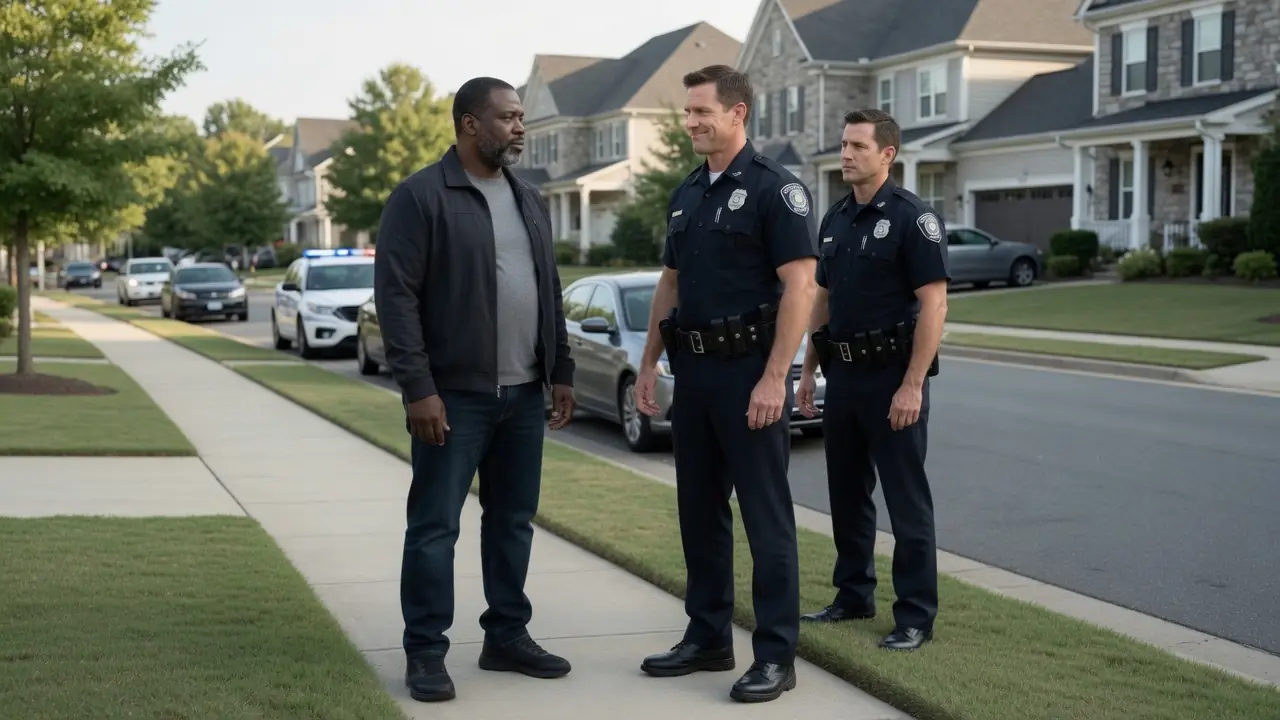
He would expose them. He would make sure the world saw the truth. Setting the trap was dangerous, but necessary. A hidden camera, a staged encounter, undeniable proof. He would give them the opportunity to do what they had always done.
And when they did, there would be no way to spin it, no way to bury it. This time, justice would not simply be demanded. It would be inevitable. Before we go any further, comment where in the world you are watching from, and make sure to subscribe. Leon Whitaker walked slowly along the cracked sidewalk, his hands tucked into his jacket pockets as a chill breeze swept through the neighborhood.
He had called this place home for many years. It wasn't perfect. His street had its share of boarded up windows, and the little corner store he once frequented had closed some time ago, but it was still home to him, at least. To others, it seemed like nothing more than a problem to be solved. The signs were subtle at first.
Police cruisers began lingering a little too long on certain blocks, slowing down as children played outside or as an elderly couple sat on their stoop. Then the question started. What are you doing here? Where are you headed? Questions asked in sharp clipped tones as if simply existing in that space was a crime. Leon had brushed off the first few incidents.
He was a former Marine. He had been through far worse. But it didn't stop. It only grew worse. Some time ago, they had pulled over his neighbor, an older man who ran a small cleaning business. They called it a routine stop, but everyone knew what it really was.
A man in a van full of cleaning supplies must have looked suspicious. The man's granddaughter had filmed the whole thing on her phone. It circulated online for a while. People were outraged, but then the attention faded. Nothing changed.
That was what finally got under Leon's skin. the helpless feeling of watching his neighbors, his friends, his community endure the same harassment day after day with no real recourse. He had been trained to defend people, to protect the vulnerable, and here he was just letting it happen. He first heard about Tara Ellison from a friend who had once tipped her off about a predatory landlord in another part of the city. She's one of the good ones, his friend had said. doesn't twist your words, doesn't stop until she finds the truth. Leon had been skeptical.
Reporters were not exactly on his list of trusted people, especially those who swooped into neighborhoods like his hunting for stories. But when Tara contacted him, she didn't sound like someone chasing a scoop. She sounded genuinely curious and serious. She showed up at the community center where Leon was fixing a leaky pipe. a petite woman with sharp features and even sharper eyes. She introduced herself and got straight to the point.
I've been hearing about what's happening around here. I think there's a bigger story. Leon eyed her suspiciously. A bigger story, huh? And what are you going to do with it? Write an article that gets buried in the back pages.
I'll do more than write an article, Tara said firmly. I'll make sure people can't look away. I don't just want to talk about what's going on here. I want to show it. He didn't say yes right away.
In the following days, Tara kept showing up. She talked to other residents, asked questions, and listened more than she spoke. Each time she returned to Leon, "You're the one who can help me make this happen," she would tell him. "People respect you. They'll see what's really happening if you're the one showing them." Leon had shaken his head the first few times.
"I don't need that kind of attention," he'd say. "What if it makes things worse?" Tara's response was always the same. What if it makes them better? It wasn't like Leon to trust reporters, but Tara's persistence made an impression. She wasn't just passing through.
She seemed determined to stay until something changed. By the end of their last conversation, Leon found himself agreeing, if only because someone had to do it. It was her idea to go undercover. "People need to see it," she had said. "Not just hear it, not just read about it, they need to see it happen." Leon adjusted his jacket and set off down the block.
This was it. No turning back. He didn't know exactly what was going to happen, but he knew he couldn't stay silent any longer. Leon strode toward this upscale neighborhood. Each step measured and deliberate.
It was a short walk, but the change in scenery came quickly. The boarded up windows and cracked sidewalks gave way to neatly trimmed hedges and driveways with luxury cars parked in them. He passed a family unloading groceries, their SUV gleaming in the afternoon sunlight. The mother glanced his way, her smile faltering slightly as her eyes lingered on him. He knew the look well.
It wasn't open hostility, but it wasn't warm either. It was that cautious, assessing gaze that hinted at suspicion. He kept moving, forcing himself not to react. This wasn't new. He was here to show the world what happened next.
A few blocks in, the neighborhood grew quieter. The only sounds were the faint hum of a lawn mower and the rhythmic swish of sprinklers. Leon adjusted his jacket slightly, feeling the hidden camera pressing against his chest. He could hear Tara's voice in his head, reminding him to stay calm and natural. "Afternoon," a middle-aged man said, stepping out onto his porch with a newspaper tucked under his arm.
The man's smile was friendly enough, but his gaze lingered a moment too long. Leon nodded. "Afternoon?" the man tilted his head, his smile wavering. "You live around here?" he asked, trying to keep his tone casual, but not quite succeeding. "No," Leon said simply.
"Just walking through." The man's smile disappeared completely, replaced by a tight, polite nod. Enjoy your walk," he said, his tone cooler now. Leon kept moving, his footsteps deliberate but relaxed. Inside, though, his thoughts churned. He didn't have to look back to know the man on the porch was still watching him.
Further down the block, a police cruiser idled at a stop sign. Leon's stomach tightened as he passed, but he made himself look straight ahead. The officers inside didn't move at first, but the longer he stayed on the same street, the more obvious it became. They were watching him, too. At the next corner, the cruiser slowly rolled forward.
It wasn't fast enough to catch up, but it wasn't idle anymore. Leon's mind churned. Was this it? Was it starting already? When he reached the next block, he noticed a second cruiser parked on the side of the road.
Two officers leaned against it, talking casually, but their eyes followed him as he approached. One of them said something to the other, and both began to move toward him. Leon's pulse quickened. He glanced around, nothing but quiet homes and manicured lawns. He focused on his breathing just as he'd learned in the Marines.
Stay calm. Stay steady. Excuse me, sir. One of the officers called out. Can we have a word?
Leon stopped, standing tall. "Sure," he said. "What can I do for you?" The officer, a broad man with a square jaw, stepped closer. "We got a call about someone matching your description. Said you were acting suspicious." Leon raised an eyebrow.
"Suspicious? How?" The officer crossed his arms. "Just wandering around." "Not from around here, are you?" "I'm just taking a walk," Leon replied evenly. The second officer, taller and thinner, joined the conversation. "Well, we're going to need some ID." "Just routine," Leon hesitated.
"Am I being detained?" "Not yet," the first officer said, a smirk tugging at his lips. Leon kept his voice steady. "If I'm not being detained, I'd like to be on my way." The officers exchanged a glance. The first one's smile vanished. "Not so fast.
We have some questions." Leon clenched his jaw. This was the moment he'd prepared for. The moment Tara had warned him about, the moment that would be caught on camera. "You don't see many guys like you around here," the taller officer said, his eyes narrowing. "Big guy like you walking through a neighborhood like this stands out, don't you think?" Leon's voice was calm but firm.
I'm just walking. The shorter officer stepped closer, his smirk returning. Walking? You mean waddling? Maybe you're just out for a stroll, but most people don't call that exercise.
The officers chuckled, the taller one shaking his head. You sure you're not just out here casing the place? Big guy like you must be looking for an easy target, right? Leon's jaw tightened, but he didn't move. I'm just walking, he repeated.
Well, the shorter officer said, his smirk now a sneer. Maybe you should walk a little faster before things get complicated. Leon didn't flinch. He didn't let his anger show. He knew the camera was rolling.
Knew Tara would be watching this later. "I'm not doing anything wrong," he said. The taller officer took another step closer, now towering over him. "No, you're not," he said slowly. "But you sure don't look like you belong here." "Looks can be deceiving," Leon said.
Chest puffed out, arms crossed, the barely restrained urge to assert dominance. He stayed still, his feet planted firmly on the sidewalk, his hands at his sides, calm, controlled. He knew the camera was catching all of it. "So, you're refusing to cooperate?" the shorter officer said, his smirk curling into something more menacing. "I never said that," Leon replied.
His voice was steady, even measured. "I told you I'm just out for a walk." The taller officer raised an eyebrow, his tone dripping with sarcasm. Just out for a walk, huh? Dressed like that. Dressed like what? Leon asked.
What's wrong with what I'm wearing? Nothing, the shorter officer said, his grin reappearing. Just looks a little out of place, like you're not from around here. I already told you, Leon said, holding his ground. I'm just walking through.
Well, maybe you should walk yourself back where you came from. The taller officer snapped. You think these people want to see you standing around here? Leon didn't flinch. I have every right to be here, he said calmly.
I'm not breaking any laws. Your attitude is what's suspicious, the shorter officer shot back. Guy like you, big and heavy, just wandering through, looking at these houses like they're free for the taking. Leon's jaw tightened. He'd had enough.
I haven't done anything wrong, he said firmly. You stopped me. I'm just walking. The taller officer sneered. Listen, buddy.
I don't know what you think you're doing here, but I don't trust it. You don't look like you belong in this neighborhood, and you sure as hell don't act like you do. What's that supposed to mean? Leon asked, his voice still calm, though his patience was wearing thin. It means, the shorter officer said, stepping closer.
That maybe we need to have a little chat down at the station. You know, just to be sure. That sounds an awful lot like you're detaining me," Leon said, meeting the officer's eyes. "And if that's the case, I'd like to know what law I've broken. You got a smart mouth," the taller officer muttered.
He leaned in closer, his eyes narrowing. "Maybe you're not breaking any laws, but you're pissing me off, and that's enough to make you a problem." Leon kept his expression neutral. Last I checked, that's not a crime. The shorter officer laughed, though it sounded forced. You think you're clever, don't you?
Big tough guy with all the answers. Let's see how clever you are when we bring you in. Bring me in for what? Leon asked. His voice remained calm, but the edge was sharper now.
I told you what I'm doing. I'm walking through this neighborhood. That's not a crime. It is when you're casing houses, the taller officer shot back. His tone wasn't sarcastic anymore.
It was firm, deliberate, and dangerous. "Casing houses?" Leon asked, a slight rise in his voice. "That's ridiculous. I'm just walking." "We've got reports," the shorter officer said, his grin gone now. "A big guy,, matching your description, going door to door, trying to look for easy targets." Leon narrowed his eyes.
"You're lying. You never got a call." The taller officer stepped forward, his hand resting on his belt. Are you calling us liars, sir? I'm calling it what it is, Leon replied. An excuse.
Excuses don't land people in cuffs, the shorter officer said. But keep this up and we'll see if we need to get you down to the station for some questioning. Leon's pulse quickened, but he held his ground. I've done nothing wrong. I'm not casing houses.
I'm not robbing anyone, and you know that. Is that so? the taller officer said, a sneer curling at the edge of his mouth. Because from where I'm standing, it sure looks like you've been hanging around a little too long, and it sure looks like you're looking for something more than just a walk. Leon took a slow breath, steadying himself. The camera was still rolling, capturing every word, every sneer, every accusation.
But he could feel the temperature rising, the air thick with tension. I'm not robbing anyone," Leon said again, his voice clear and firm. "And if you're going to accuse me of that, you'd better be ready to back it up with more than just your assumptions." The officers exchanged a glance. Their confidence didn't falter, but the lines in their faces hardened, their postures stiffened. They weren't letting him go.
The officers' expressions darkened, the sneers turning into something colder. Leon could feel the weight of their stairs, the way they stood too close, their hands inching toward their belts. He didn't move. He couldn't afford to. He knew how quickly situations like this could spiral out of control.
"You don't seem to understand," the shorter officer said, his voice low and menacing. "You're not just going to walk away from this." Leon's jaw tightened. "I'm not going anywhere until you tell me exactly what I've done wrong." The taller officer stepped even closer, towering over him. "You've got a smart mouth, don't you? Maybe you're used to talking back to people, but out here, that's not going to fly." "I'm not talking back," Leon said, his voice steady.
"I'm just asking for some clarity." "Clarity?" The shorter officer barked a laugh. "You're in the wrong neighborhood, big man. Clarity is not going to help you here." Leon stood his ground. I'm not going to let you intimidate me. That was when it happened.
The taller officer's hand shot out, shoving Leon hard in the chest. It wasn't subtle. It wasn't a light push. It was a full force attempt to knock him off balance. Leon staggered back, but didn't fall.
His training kicked in, instinctively steadying his stance. "Hey," Leon barked, his voice sharper now. "What's your problem?" "My problem is you." The taller officer snapped, stepping forward again. "You think you can just stand here and run your mouth like you're untouchable?" Leon raised his hands, palms open. I'm not looking for trouble.
I'm just standing here. The shorter officer smirked. Maybe you should have thought of that before you mouthed off. Mouthed off? Leon repeated, his voice rising.
I'm just asking you why you're stopping me. I'm not threatening anyone. You put hands on me. You're lucky that's all we did. The taller officer snarled, closing the distance again.
Guys like you think you can do whatever you want. Not in this neighborhood. Leon's heart pounded, but he kept his voice firm. I don't have to explain myself to you. I'm not doing anything illegal. You've got no reason to be in my face.
The words barely left his mouth when the shorter officer reached out, grabbing at his arm. Leon yanked it back, but the movement escalated the tension in an instant. The taller officer seized the opportunity, reaching for Leon's jacket collar. They weren't just questioning him now. They were making it physical.
"Don't touch me," Leon snapped. his voice loud enough to carry. He wasn't shouting, but the command in his tone was impossible to ignore. Or what? The shorter officer sneered, his grip tightening. Or I'll defend myself, Leon warned.
He wasn't bluffing. He knew he couldn't afford to make the first move, but he also knew he wasn't going to let himself be manhandled. The taller officer shoved him again harder this time. Leon stumbled back, his shoulder brushing against a nearby lamppost. It was clear now.
They wanted a reaction. They wanted him to fight back so they could claim he was the aggressor. But Leon wasn't going to give them that satisfaction. "I'm warning you," Leon said, his voice steady despite the adrenaline surging through him. "Let go of me." The shorter officers pulled back for a moment, just long enough to exchange a glance with his partner. Then, without another word, he swung.
The punch caught Leon off guard, glancing off his jaw, but not knocking him down. The pain was sharp, sudden, but it also flipped a switch in his mind. He didn't have a choice anymore. They'd started it, and now he had to defend himself. Leon ducked as the taller officer swung next, the punch missing him by inches.
He planted his feet and shoved back, using his size and strength to create space. The officers didn't stop. The shorter one lunged again, and this time Leon caught his arm and twisted it just enough to make him yelp and let go. "Enough!" Leon shouted. "I don't want to fight you." The taller officer stepped in again, his face twisted in anger.
"Yeah, well, you got one anyway." The fight moved into the street. Leon kept his movements tight, controlled, not throwing wild punches, but using calculated blocks and counters to keep the officers from overwhelming him. It wasn't a brawl. It was tactical, almost surgical. His military training had taught him how to neutralize threats quickly, but he was holding back.
He didn't want to hurt them, even though they clearly had no such hesitation. The taller officer threw another punch, this time connecting with Leon's shoulder. He staggered, but didn't fall. Instead, he used the momentum to step to the side and deliver a quick open-handed strike to the officer's forearm, forcing him to drop back. The shorter officer tried to grab him from behind, but Leon spun, breaking the hold and shoving him away.
They kept coming. Every time Leon deflected one, the other would attack. His breathing was heavy now, each move deliberate, but tiring. He wasn't going to go down easily, though. He wasn't going to give them that satisfaction.
Leon's breath came fast and heavy. His muscles tensed as he moved with precision, blocking one officer while bracing for the other. He wasn't trying to win this fight. He was trying to survive it. He had been trained for combat, but this wasn't war.
He was fighting two men who had the power to make him the villain, no matter how much he tried to hold back. The taller officer lunged at him again, fists swinging wildly. Leon ducked, weaving just in time to avoid a direct hit to the face. Instead, the officer's knuckles scraped across his temple, sending a sharp sting through his skull. He clenched his jaw, his instincts screaming at him to strike back.
"Stop this," Leon bellowed, stepping back, hands raised in a defensive posture. "I don't want to fight." The shorter officer spat at the ground, his chest heaving. "You don't get to decide that, fat boy." Leon's blood ran hot, but he swallowed the insult, forcing himself to stay composed. He backed up another step, trying to put more distance between them. If he could just keep them from closing in, maybe.
The taller officer didn't give him a chance to finish the thought. He rushed forward again, this time slamming his shoulder into Leon's chest, knocking him backward onto the pavement. Pain exploded through Leon's back as he hit the ground hard, the rough asphalt scraping against his skin beneath his clothes. Before he could get up, a boot came down on his arm, pinning him. "Got you now, big guy." The shorter officer sneered, pressing his weight onto Leon's forearm.
Leon gritted his teeth, feeling the strain in his arm as the pressure increased. The taller officer crouched down, his face inches from Leon's. "You think you're tough, huh?" he hissed. "Think you can just walk through here like you belong?" Leon tried to yank his arm free, but the officer twisted his foot, grinding it into his muscle. He bit back a groan, refusing to give them the satisfaction of hearing him in pain.
I didn't do anything, he forced out. The shorter officer crouched, his smirk widening. You did enough, fat boy. You should have known better. He punctuated the words with a hard punch to Leon's gut.
A deep pain shot through his stomach, forcing the breath from his lungs. He coughed, gasping for air, his body involuntarily curling inward. The taller officer laughed. "Not so tough now, are you?" Leon clenched his fists. His vision swam for a moment, but his mind was clear.
If he didn't do something, they weren't going to stop. He exhaled sharply and moved. Using his core strength, he twisted his body, jerking his trapped arm free just as the officer's balance wavered. The sudden motion sent the shorter officer stumbling to the side, just enough for Leon to push himself halfway up. The taller officer grabbed for him, but this time Leon didn't just block.
He struck. A solid elbow to the ribs sent the officer reeling back with a grunt. Leon surged upward, adrenaline pumping through his veins. The shorter officer rushed him, but Leon stepped aside, using his opponent's momentum against him. The officer stumbled forward and Leon shoved him, sending him sprawling onto the ground.
"Stay down!" Leon growled. His voice was low, commanding. He was still trying to end this without going too far. But the officers weren't done. The taller one came at him again, swinging with full force. This time, the punch connected, landing across Leon's jaw.
His head snapped to the side, the taste of blood filling his mouth. The shorter officer recovered, grabbing at Leon's jacket, yanking hard. Leon staggered, trying to keep his footing, but they were both on him now. The blows came fast, fists slamming into his ribs, into his arms as he tried to shield himself. They weren't just subduing him.
They wanted to hurt him. Another punch caught him in the stomach, then another. His legs buckled and he dropped to one knee, gasping for air. The shorter officer grabbed his collar, yanking him up. "Not so big now, huh?" Leon could barely hear him over the ringing in his ears.
His body ached, his vision blurred at the edges. He had tried to hold back, tried to deescalate, but they weren't stopping. They weren't going to stop, and he had nothing left to give. The baton came down on his shoulder first, a brutal strike that sent a jolt of pain down his arm. He barely had time to register it before another hit slammed into his ribs.
He gasped, his body instinctively curling inward. "Still up?" The taller officer snarled. "Let's fix that." A sharp crack sounded as the baton struck the back of his knee, forcing him fully onto the ground. "Leon coughed, trying to push himself up, but the shorter officer kicked him in the ribs, rolling him onto his back." "You should have just gone home," the shorter officer muttered before bringing the baton down again, this time against Leon's side hard and fast. Pain exploded through his ribs.
His breath came in short, shallow gasps. He tried to curl away from the blows, but the taller officer pressed his boot against Leon's chest, holding him down. Stop resisting. The officer barked, his voice mocking, "I'm not." Leon's words were cut off as the baton struck his arm again, his vision blurred at the edges, but he held on barely. Then came the weight, the combined force of both officers as they wrenched his arms behind his back.
His wrists twisted unnaturally, the cold bite of metal snapping around them. The handcuffs dug in hard, too tight, cutting into his skin. Leon lay there, chest heaving, pain pulsing through every inch of his body. The taller officer leaned down, his breath hot against Leon's ear. You should have just walked away.
Leon didn't respond. He didn't trust himself to. He kept his head turned to the side, his cheek pressed into the street. But he wasn't defeated. He wasn't broken. They didn't know it yet.
But the whole world was about to see exactly what they had done. Leon lay still on the pavement, his body aching from the repeated strikes. The cold metal of the cuffs bit into his wrists, his breathing ragged as the weight of both officers finally lifted off him. His cheek pressed against the rough asphalt. the scent of blood and sweat thick in the air. He didn't fight as they hauled him up, his muscles screaming in protest as they yanked his arms higher than necessary.
"On your feet!" one of them muttered, pulling him up without care for his injuries. His ribs throbbed with every breath, his legs unsteady beneath him. The world tilted for a moment, but he kept himself upright. The officers led him toward the waiting squad car. The distant murmur of voices from a few onlookers carried through the air.
A couple of people stood on their porches watching. Some shook their heads. No one intervened. The door opened and they pushed him inside. The seat was hard and uncomfortable.
The partition in front of him smeared with fingerprints from previous arrests. Leon leaned his head back against the seat, exhaling slowly. His body ached, his mind still racing through the events that led to this moment. Outside, the officers spoke with another who had arrived late. He couldn't hear what they were saying, but he didn't need to.
Their body language said enough, casual, relaxed. It was routine to them. The car pulled away, the flashing lights casting a faint glow against the darkened streets. Leon stared out the window, watching the quiet neighborhood fade behind them. The roads were empty, the houses still.
He wondered how many of them had seen what happened. How many of them had looked away? The ride was silent for a while. The occasional crackle of the radio the only sound. Then one of the officers spoke without turning around. Long night ahead.
Leon didn't respond. He had nothing to say to them. The station came into view, its harsh lights glaring against the night sky. As they pulled into the lot, he braced himself for what came next. The doors opened and they pulled him out.
The ground felt unsteady beneath his feet. Or maybe it was just the exhaustion setting in. Inside, the station was cold and sterile, the scent of stale coffee and disinfectant lingering in the air. Charges? The officer at the desk asked without looking up.
Trespassing, resisting, assaulting an officer. Leon's jaw tightened. That's not true. The officer at the desk barely glanced at him. Take it up later.
They led him to a holding cell. the metal bars clanging shut behind him. The space was small, the bench against the wall, the only place to sit. Leon exhaled, lowering himself onto the bench with a slow breath. His ribs ached with every movement, the dull pulse of pain settling into his muscles. He rolled his shoulders, testing the strain.
Across town, Tara Ellison's phone buzzed against her desk. She barely had time to register the number before answering, her pulse quickening at the urgency in the voice on the other end. They arrested him. Tara sat up straight. What?
Leon? They've got him in holding. She gripped the phone tighter, already reaching for her bag. Tell me you got footage. More than enough.
Tara was out the door before they finished speaking. Back in the cell, Leon didn't know how long they planned to keep him here. He didn't know what they would try next, but he did know one thing. Tara had the footage, and once it got out, this wasn't going to end the way they thought it would. The cold from the concrete bench seeped through Leon's clothes as he sat with his back against the cell wall, his hands resting loosely in his lap, his fingers tingled from the tight cuffs they had only just removed.
The skin around his wrists raw. The dull pulse of pain throbbed in his ribs, his body stiff from the beating. Every inhale sent a sharp sting through his side, and he knew at least one of the strikes had bruised something deep. He rolled his shoulders and let his head tilt back against the wall, staring up at the ceiling. The fluorescent lights hummed softly, a sound that blended with the occasional murmur of voices beyond the bars.
The station wasn't loud, but it wasn't quiet either. Officers moved in and out of the main room, some laughing at private jokes, others speaking in low professional tones. The normalcy of it all made Leon's stomach twist. To them, this was nothing. Just another night, another arrest, another man in a cell. He exhaled slowly, shaking his head.
His whole body ached. But the worst of it wasn't physical. It was the anger creeping into his chest, the frustration sitting heavy in his gut. This wasn't how it was supposed to go. He knew getting stopped was a possibility. Hell, that was the whole point.
But the way it escalated so fast, the way they went straight to violence left his hands curling into fists. They were waiting for it, he muttered under his breath, his voice. "They didn't need a reason." His fingers flexed, trying to shake the stiffness. He needed to calm down. He needed to focus.
He knew better than to let his emotions take over, especially now. One of the officers walked past the holding cell, barely glancing at him before dropping a file onto the desk at the front. Leon leaned forward, resting his elbows on his knees. "How long you planning on keeping me in here?" he asked, his voice even, but firm. The officer barely acknowledged him, flipping through the paperwork.
"Until we process everything." Leon huffed out a laugh, shaking his head. Process what? You didn't find anything on me. I didn't break any laws. You just needed an excuse.
The officer finally looked up, his expression unreadable. You can talk all you want. Doesn't change the fact that you're sitting in that cell. Leon clenched his jaw, inhaling slowly through his nose. I want my phone call.
You'll get it when? The officer smirked faintly. Whenever we get to it. Leon leaned back, pressing his lips together. He knew the game.
They wanted him frustrated, wanted him to lash out so they could add more charges, extend the hold, keep him locked up just long enough for things to quiet down. But that wasn't going to happen. Tara had the footage. The thoughts settled in his chest, steadying him. He had done his part. The rest was in motion now.
Tara sat at her desk, her fingers hovering over the keyboard, her pulse hammering in her ears. The room was dim, the only light coming from the glow of her laptop screen. The video was playing. She had seen a lot in her years as a journalist. Protests turned violent, leaked body cam footage, grainy cell phone videos of injustice unfolding in real time. But this was different.
This was clear. This was undeniable. She leaned forward, her hands gripping the edges of her desk as she watched the officers surround Leon. Their postures tense before the first push. The sneers, the shoves, the way they circled him. Then the first baton strike.
She flinched when it hit, her fingers tightening. Even though she had known what happened, watching it unfold in crisp, highquality footage made it feel heavier, more real. Leon hadn't provoked them. He hadn't fought back. They had gone after him because they could.
Tara's stomach turned when the final strike sent him to the pavement. The moment the weight of both officers pressed down on him, the moment he stopped struggling, knowing there was no point, she felt something burn in her chest. Anger, frustration, disbelief that this kept happening over and over again. Her phone sat next to her, but she couldn't bring herself to reach for it. Not yet. She pressed play again, forcing herself to watch it from the beginning.
She needed to be sure the footage wasn't shaky. The sound was crisp. The words the officers used, the things they said, it was all there. No ambiguity, no gray areas. Tara swallowed hard, exhaling through her nose.
She reached for her phone, dialing a number with steady hands. It rang once, twice. Then a voice picked up. This better be important, her editor said, his voice groggy with sleep. Tara didn't hesitate. I have something.
Something big. A pause. Then his voice sharpened. How big? She glanced back at the screen at the frozen image of Leon on the ground. His face turned toward the camera, blood on his cheek.
Big enough to set the city on fire. Leon sat in the holding cell, his head tilted back against the cold concrete wall, his body aching from the beating. The bruises were setting in now, a deep throbbing ache in his ribs and arms that made even breathing a chore. He had tried to adjust his position on the hard bench, but there was no comfort here. The fluorescent lights above buzzed faintly, casting a sterile glow over the room.
Officers walked past the bars without looking at him. Their conversations low and filled with laughter as if he wasn't even there. The weight was deliberate. He knew it. They were making him sit, making him stew in it, letting the weight of what they had done settle in his bones.
They wanted him frustrated. They wanted him angry. But he wasn't going to give them the satisfaction. The only thing keeping him steady was the knowledge that Tara had the footage. The whole thing. He exhaled sharply, rubbing his wrists where the cuffs had been too tight.
He had been in worse situations before. He had survived worse. But this this wasn't just about him. This was bigger. And outside, the city was about to find out just how big. Tara sat in her car, her laptop balanced on the center console, the video queued up on the screen.
The unedited footage played from the moment Leon entered the neighborhood. The entire interaction with the officers captured in crystal clarity. The taunts, the shoves, the first baton strike. There was no room for misinterpretation. She had called her editor, given him the rundown, but she knew this needed to move fast.
The longer they waited, the easier it would be for the police to control the narrative. She didn't hesitate. She hit upload. Within minutes, it was out. She pushed open the door, stepping into the cool night air.
Her phone buzzed almost instantly. Her editor, reporters she hadn't spoken to in months, community activists already demanding statements. She ignored the calls. The footage would speak for itself. And it did. Across the city, phones vibrated, notifications lit up screens, and people paused in their tracks as the video began spreading like wildfire.
Social media exploded with outrage. The footage reposted across every platform dissected frame by frame. The hashtag #JusticeForLeon started trending within the hour. In Leon's neighborhood, the reaction was immediate. Inside the corner store, a small crowd had gathered.
The video playing on a customer's phone, heads clustered around the screen. The shop owner, Mr. Daniels shook his head, his jaw tight as he watched Leon take the first hit. "That man served this country," he muttered. "And look at how they treat him." A younger man beside him, maybe in his early 20s, scoffed. "Man, this is what happens when you go looking for trouble." "He should have never been over there." An older woman standing behind them crossed her arms.
He wasn't looking for trouble. He was trying to prove a point. And what did it prove? the younger man shot back. That they're going to do what they always do, that they can beat us down, lock us up, and nothing changes. It proves, Mr. Daniels said, his voice low and firm, that now the whole damn world can see it. Elsewhere, outside a local diner, two men leaned against the wall, one scrolling through his phone while the other paced.
They didn't even hesitate," the first man said, shaking his head. "They were waiting for an excuse," the second man exhaled, rubbing a hand down his face. "Yeah, and now we got to figure out what we're going to do about it. This is bigger than just one arrest," the first man muttered. "This is about all of us." The church doors down the street had been left open, the video playing on a projector inside.
A group of community members sat in silence, watching Leon's last words before the first baton came down. Reverend Cole, a man in his 60s with graying hair and sharp eyes, turned to the crowd. We cannot let this be just another story, he said, his voice steady. We cannot let this be forgotten. Some nodded, others murmured their agreement.
Outside, a mother sat in her parked car, her hands gripping the steering wheel as the video looped on her phone screen. Her teenage son sat beside her, watching in silence. "This is why I tell you to be careful," she said. Finally, the boy swallowed hard but didn't look away. Inside the police station, the shift in atmosphere was palpable.
Officers who had been laughing minutes ago now, whispered among themselves, checking their phones, glancing toward the holding cells. The station chief stormed out of his office, a phone pressed to his ear, his voice sharp. How the hell did this get out so fast? The officer at the desk shifted uncomfortably. I don't know, sir, but it's everywhere.
The chief swore under his breath. Where's Whitaker? Still in holding. Get him processed now. Leon sat up straighter when he saw the movement outside his cell.
The energy in the station had changed. Something had shifted. The officer who had ignored him earlier now looked uneasy as he approached the bars. Looks like you're getting your phone call. Leon didn't move right away.
He let the moment sit, watching the officer's expression shift. Then slowly, he stood. Tara had done her job. Now it was time for the rest of the world to do theirs. Leon sat at the metal table in the dimly lit processing room, a landline phone pressed against his ear. His ribs ached every time he inhaled, and his knuckles were still stiff from being cuffed too tightly.
The air smelled like coffee and ink. The usual stench of a station where too many people had been processed before him. Tara's voice came through the line, steady but urgent. "They just let you make this call?" she asked. Leon exhaled only because they don't have a choice anymore.
They know what's happening. The video's everywhere and the pressure is mounting, but they're already trying to spin it, Tara said. Leon rubbed his temple, wincing at the lingering pain from the officer's baton. Let me guess. Big guy attacks officers.
They had to defend themselves. Exactly. Tara confirmed. But it's not holding. Too many people saw what really happened. She hesitated. And there's more.
Someone else was recording. Leon sat up straighter. Who? A kid. High schooler.
He was down the street when it happened. Caught the whole thing from another angle. His footage is even worse for them. It shows the first officer checking if his body cam was off before they started hitting you. Leon clenched his jaw.
That's a game-changer. It is, Tara agreed. But there was hesitation in her voice. What's the problem? Leon asked. He's scared.
Tara admitted. Won't give me his name. Says he doesn't want to get involved. Doesn't trust the police to leave him alone if they find out he filmed it. Leon leaned back in his chair, the chain on his cuffs rattling slightly.
He understood the fear. A kid with footage like that, he had every reason to be afraid of the retaliation. We need to protect him, Leon said. He can't do this alone. I told him we can blur his face, keep his identity out of it. But he's still hesitant, Tara said.
I need you to talk to him. Leon exhaled through his nose. Give me his number. I don't have it, Tara admitted. But he agreed to meet with me. Said if I brought you into the conversation, he might reconsider.
Leon nodded. Then let's set it up. Tara hesitated. Leon, they're trying to turn this into a circus. Some media outlets are already calling you a repeat offender, even though you've never been arrested before. Doesn't surprise me, he said.
They'll do anything to make me the bad guy. They've got officers saying you resisted arrest, Tara added. That you were aggressive. Leon let out a bitter chuckle. The footage proves otherwise.
Yeah, Tara said, her voice tight. But they're going to keep throwing everything they can at you. Leon's fingers tapped against the table, his mind already working through the situation. Then we keep pushing. We get that kid's footage out there. The more proof we have, the harder it is for them to rewrite the truth.
Tara was quiet for a moment. Then she said, "All right, I'll set up the meeting. Just hold tight. This isn't over yet." Leon smirked despite the pain in his ribs. It's just getting started. As he hung up the phone, he glanced at the officers lingering near the door. They weren't smiling anymore.
Tara's report was gaining traction. The footage was going viral. And now they had even more evidence coming. The truth was out. And the fight wasn't over. Leon sat in the holding cell, his back against the cold cinder block wall, his wrists resting on his knees. The air in the station felt different now.
Officers moved with less certainty, some avoiding his gaze altogether, others sneaking quick glances at him like he was a loose thread in the fabric of their power, something they didn't quite know how to handle. The video was out and they knew it, but they weren't backing down. His conversation with Tara echoed in his head. A kid had footage that could change everything, but he was scared to come forward. And now the police were scrambling, not just to protect themselves, but to control the narrative.
Footsteps echoed down the hall and Leon looked up as a uniformed officer approached. His expression was unreadable, but his posture was tense. "Whitaker," he said, unlocking the cell door. Leon pushed himself up, his ribs stiff from the beating. "Am I finally getting my phone call?" The officer's lips pressed together.
Your lawyers are demanding your release. Leon studied him. And the officer sighed. The DA isn't budging yet. Leon clenched his jaw. Of course, he had expected this.
The district attorney was feeling the pressure from both sides. Civil rights groups demanding justice and the police union closing ranks. The whole damn country has seen what happened, Leon said. What exactly is the holdup? The officer hesitated before answering.
The DA's office is considering additional charges. Leon let out a slow breath, his fingers curling into fists. Unbelievable. They're not dropping this, the officer admitted, shifting uncomfortably. At least not yet.
A voice from behind made Leon turn. They won't unless they're forced to. Leon's eyes landed on a man leaning against the far wall. His posture relaxed, but his expression serious. He looked to be in his 50s with a salt and pepper beard and sharp, tired eyes.
He wasn't in uniform, but everything about him still read like a cop. Leon narrowed his gaze. Who are you? The man stepped closer. Reggie Harland used to be on the force.
Leon let out a humorless chuckle. Let me guess. Before things got bad. Harlon smirked slightly. Before people had cameras to prove how bad it always was. Leon studied him.
He had the look of someone who had seen too much, who had tried to fight the system from the inside and lost. "You worked with them?" Leon asked. "With Brock," Harlon nodded. "Long enough to see the damage he's done. Long enough to know he doesn't make mistakes.
He makes choices, and you were one of them." Leon exhaled sharply. "So, what happened? Why aren't you still wearing a badge? Harlon's expression darkened. Because I refused to look the other way. Leon crossed his arms, wincing slightly at the pain in his ribs.
Didn't work out, did it? No, Harlon admitted. I filed complaints. I pushed back, but the union always had his back. They made sure I was the one who paid the price.
Leon shook his head. And now you're here. Why? Harlon glanced at the bars, then back at Leon. Because I know exactly how this plays out. Internal affairs will investigate, but they won't take real action unless the pressure stays on. Meanwhile, the union's already circling the wagons, spinning this into a story about how you resisted.
Leon scoffed. I didn't resist. Harlon gave him a knowing look. Doesn't matter. They'll say you did.
They'll dig through your past. try to find anything they can use against you. If they don't find something, they'll make people believe something was there anyway. Leon clenched his jaw. I don't have a record. Harlon smirked bitterly.
Won't stop them from making you the villain. Leon took a slow breath, steadying himself. So, why are you telling me this? What do you want? I want to help, Harlon said simply.
I've been where you are. I know how these investigations go. If you want a chance at real justice, you're going to need people who understand the system. Leon studied him for a long moment before nodding. All right, let's talk.
Harlon nodded back. Good, because if we don't move fast, they're going to bury this before it even starts. Leon glanced at the officers lingering near the desk. They weren't laughing anymore. They were waiting, watching, hoping this would blow over.
Leon sat on the edge of the hard cot in his cell, his elbows resting on his knees, his fingers intertwined. The minute stretched into hours, and the weight of everything settled onto his shoulders. He had known this fight wouldn't be easy, but he hadn't expected it to feel this personal, this suffocating. His phone was gone, but he knew exactly what was happening outside. He was the story now.
Not the officers, not the system, not the brutality caught on camera. him. The smear campaign had started fast. The police union had gone on the offensive, spinning the narrative into something else entirely. Leon Whitaker, aggressive ex-Marine with a history of confrontations, the full story, what the video doesn't show. Did Leon Whitaker provoke the officers?
They were doing what they always did, controlling the narrative, shifting the focus, making people question what their own eyes had seen. The headlines were relentless, twisting facts, digging for anything in his past they could use against him. And worse, they were going after his family. He exhaled sharply, his chest tight as he thought about his mother. She had called Layla in tears, her voice shaking over the phone. His mother had seen the reports.
People had shown up outside her house. Journalists knocking on her door, shoving microphones in her face. Some had even gone through their old social media posts trying to find something, anything, to paint them as troubled, as flawed, as deserving of the treatment Leon had endured. Layla had handled it the way she always did, head on, but she was exhausted, and Leon knew it. The door to the cell block buzzed open.
Leon looked up, expecting an officer, but instead he saw his lawyer, a tall, composed woman in a navy blazer and glasses that gave her the air of someone who had been through too many battles and still had plenty of fight left in her. Talia Brooks, she had been one of the first lawyers to take his case after Tara's report went viral. And from the moment she walked in, Leon knew she was the right person for the job. She sat across from him, pulling out a folder. You doing all right?
Leon let out a dry chuckle. I've been better. Talia nodded. The DA is still stalling. They know they can't hold you forever, but they're waiting to see how the public shifts before they make a move.
Leon's jaw tightened. So, they're trying to see if this blows over. Exactly. Leon sighed. And what's the Union saying? Talia's eyes darkened.
They're in full defense mode, saying the officers acted appropriately, that you were a threat, that they feared for their lives. Leon let out a slow breath. Same script, different name. Pretty much, Talia said, "And they're using every connection they have to pressure the DA into keeping you here." Leon shook his head, the frustration mounting. Am I family?
Talia hesitated for a moment. It's getting bad. Leon clenched his fists. I need to see them. I know, she said.
I'm working on getting you released, but they're playing games. We've got the video. We've got public support, but they're betting they can ride it out until people lose interest. Leon's stomach twisted. Tara won't let that happen.
Talia gave a small smirk. No, she won't. And she's not the only one keeping the pressure up. She slid a folder across the table. Leon hesitated before flipping it open. Inside were printed screenshots, messages, names, stories.
I started collecting them as soon as the video went viral, Talia explained. People started reaching out. People from your neighborhood, people from across the city, all with their own stories about Brock and officers like him. Leon scanned the pages. Testimonies from men from his community who had been harassed for walking in the wrong neighborhood. parents whose teenage sons had been stopped for no reason.
Workers pulled over and searched on their way home. One message stood out. A handwritten letter scanned into the file. I was 15 when it happened to me. Officer Brock stopped me on my way home from school.
Said I matched a description. I was too scared to fight back when he threw me against the car. Too scared to tell my mom what really happened, but I see what they did to Leon and I can't stay silent anymore. Leon exhaled sharply, rubbing his temple. They were just waiting for someone to come forward first, Talia said. And now they are.
Leon closed the folder. His ribs still ached. His head was pounding. But for the first time since this all started, something inside him felt stronger. They're not going to bury this, he said.
No, Talia agreed. They're not. Leon leaned back in his chair, his gaze steady. He was still behind bars, still in the thick of it. But outside, the fight was growing. And this time, he wasn't fighting alone. Leon sat in the holding cell, his arms resting on his knees as he listened to the faint hum of voices beyond the bars.
He knew something had changed. The air in the station felt heavier, charged with something different. The officers moved with an unease that hadn't been there before. They weren't laughing. They weren't making casual remarks as they passed by his cell because they knew internal affairs was digging.
And what they were finding wasn't just about what had happened to him. It was bigger. Leon heard footsteps approaching. He looked up as Talia Brooks appeared outside his cell, her face unreadable. The guard unlocked the door, allowing her inside.
She took a seat across from him, opening a folder. They're still stalling on your release, she said, her voice calm but edged with frustration. Leon exhaled sharply. What's the excuse now? They're pretending they need more time to review the full scope of the incident.
Talia shook her head, which is ridiculous because the entire country has already seen what happened, but the good news is internal affairs has started pulling records on Brock's team. Leon's eyebrows lifted and Talia leaned forward. It's bad. Worse than we thought. Multiple excessive force complaints, discriminatory profiling reports, cases that were quietly settled out of court.
Brock alone has been accused of misconduct at least several times over the years, but none of it stuck. Leon's jaw tightened. Why? The same reason it never does. Reports went missing.
Witnesses changed their statements. The union stepped in every time things got close to real accountability. Leon let the information sink in. He had suspected as much, but hearing it confirmed only made his anger simmer hotter. "And now," he asked.
Talia smirked. "Now they can't bury it. Not with all the attention on this case." She flipped through her notes. Tara's been relentless. Every time the department tries to shift the focus, she counters with more evidence, and it's working.
People are pissed. Leon leaned back against the wall. How bad is it? Talia studied him. Bad enough that they've had to put Brock and his entire unit on paid leave.
The department is trying to act like it's just procedural, but internal affairs is treating it like a real investigation. They're pulling body cam footage, reviewing old cases. This could unravel everything. Leon nodded slowly. Good.
Talia hesitated. There's more. Leon frowned. "What?" She sighed. "There are protests all over the city.
People are marching outside the station, outside city hall, even in front of the DA's office. They're demanding your release. But it's not just about you anymore. Other people are coming forward. People who had run-ins with Brock's unit. The city is waking up and law enforcement doesn't know how to handle it." Leon's hands clenched into fists.
It was working. The truth was coming out. But with that truth came risk. "I need to see my family," he said quietly. "Talia's expression softened." "Layla and your mother have been speaking out. They've done interviews, talked about what this is doing to them, to you." Leon exhaled, a knot tightening in his chest.
His mother was strong, but he knew this was breaking her in ways he couldn't protect her from. "Are they safe?" he asked. Talia nodded. For now, but they've been harassed. Calls, threats, reporters camping outside their house.
Leon's jaw locked. They shouldn't have to deal with this. They know that, Talia said. But they also know you can't fight this alone. Leon ran a hand down his face. He was exhausted, his body still aching, but he wasn't broken. Not yet.
He looked up at Talia. How do we push harder? Talia's eyes gleamed. We keep the heat on. We keep the media focused on the corruption, on the fact that the police still have you in here without charges.
The more attention this gets, the more pressure the DA will feel. Leon nodded. And internal affairs. They're at a crossroads, Talia said. They either expose the truth or they risk being seen as complicit, she smirked. And they're not about to go down with Brock. Leon let out a slow breath. Then let's keep pushing.
As Talia stood, the sound of voices outside the station grew louder. Chants, protesters. Justice for Leon. The fight wasn't over. But for the first time, it felt like they had the momentum, and Leon wasn't going to let it go to waste.
Elena Vargas had never been the kind of investigator to take the easy way out. A seasoned internal affairs officer with many years in the department, she had built a reputation for being thorough, unshakable, and much to the frustration of her superiors, not easily controlled. She didn't play politics. She followed the facts, and the facts in front of her were damning. She sat at her desk, her fingers drumming against the thick file in front of her.
The pages were filled with reports, witness statements, and internal affairs preliminary findings on Officer Brock Ramsay and his team. Every single page pointed to a pattern, a system that had allowed officers like Brock to operate unchecked for years. And yet, the pressure from the top was clear. Shut it down. The office door swung open. Assistant Chief Garrett Holt stepped inside, his presence filling the space with quiet authority.
He was in his early 50s, a man who had worked his way through the ranks, known for handling department scandals with as little collateral damage as possible. He shut the door behind him and folded his arms. Vargas, we need to talk. Elena didn't look up. That's what this is, isn't it?
Holt sighed, stepping closer to the desk. I just got off the phone with the commissioner. The mayor's office is breathing down our necks. The union is already calling this an overreach. Elena finally met his gaze, her expression unreadable.
An overreach? She tapped the file. We have multiple excessive force complaints tied to Brock's unit. Reports that were ignored, covered up, or mysteriously lost. This investigation is barely scratching the surface.
Holt leaned on the desk, his voice lowering. You think I don't know that? Then why are we even having this conversation? Because this is bigger than just one unit, Holt said, his tone sharp. If we push too hard, we expose the entire department to lawsuits, scrutiny, and public distrust we might never recover from. Elena's jaw tightened.
Public trust is already gone, sir. You've seen what's happening outside. The protests aren't just about Leon Whitaker anymore. People are coming forward with stories of harassment, discriminatory profiling, and excessive force. If we try to sweep this under the rug, we only prove them right." Holt exhaled, pinching the bridge of his nose.
"You think I don't see that?" "But this isn't just about justice," Vargas. "It's about politics. If this case goes too deep, it doesn't stop with Brock. It goes all the way up. And then, where does that leave us?" Elena narrowed her eyes.
Maybe it leaves us where we should have been all along. Actually, holding people accountable, Holt's gaze hardened. You don't understand how this works. No, Elena said, standing up, her voice unwavering. I understand exactly how it works.
I understand that for years Brock got away with this because the people in power let him. I understand that if we back down now, we are no better than the officers who looked away while he brutalized people. Holt shook his head. his voice lowering. If we bury this, the department survives. Elena took a slow breath. And if we don't, maybe it finally changes.
A silence stretched between them. Holt's jaw tightened. You're not backing down, are you? No, she said simply. I'm not.
Holt let out a long exhale, then straightened. Fine, but you better be damn sure you can finish this fight because once it's out of the department's hands, there's no coming back. Elena watched him leave, her heart pounding. She already knew there was no coming back. This case was going to shake the entire system, and she was ready.
Tara sat across from Leon Graves and Talia Brooks in the back of a small cafe, her laptop open in front of her. The screen glowed with headlines, social media feeds, and breaking news segments that were covering the case. The protest had grown larger. The pressure on the department was mounting. But with that pressure came resistance. They're pushing back harder, Tara said, scrolling through an article.
More media outlets are running hit pieces on Leon, calling him reckless and combative. They're framing the protests as unrest instead of what they really are, people demanding justice. Harlon leaned back in his chair, rubbing a hand down his face. It's what they do. If they can't make him disappear, they'll make him the villain.
Talia was flipping through documents, her expression unreadable. The DA is still dragging their feet. Even with the protests, even with internal affairs starting to crack open old cases, they're hoping to wait it out. They think if they stall long enough, public outrage will shift to something else. Tara sighed, closing her laptop.
So, what do we do? Graves smirked slightly. We don't give them time to breathe. Tara leaned forward, intrigued. What are you thinking?
Graves folded his arms. We have stories, not just Leon's. Other people are coming forward, right? Let's put them out there, not in some polished press conference, not in some carefully worded news segment. We take their words directly to the people.
Video interviews, live streams, let them tell their own experiences. Tara's eyes widened slightly. You want to bypass traditional media. Graves nodded. The mainstream outlets are playing both sides, afraid to call this what it really is. But the internet, social media, that's where we win.
Tara exchanged a glance with Talia, who gave a slow nod. "It's risky," the lawyer admitted. "But it's the best way to keep the momentum." Tara tapped her fingers against the table, already forming a plan. All right, I can start reaching out to the people who sent us messages. We'll record their stories, make sure they're protected, Talia set her folder down.
Meanwhile, I'll ramp up legal pressure. I have contacts in civil rights groups, advocacy organizations. If the DA won't move, we'll force their hand. Harlon cracked his knuckles. And I'll handle the street side. I know officers who left because of Brock.
They might not want to talk publicly, but they'll talk to me if I can get them on record. Tara nodded. That would be huge. A weight settled between them. This was the moment, the tipping point.
If they didn't act now, if they didn't push harder, the system would bury the case like it had so many before it. Tara took a deep breath, then let's make our move. The night air was thick with tension as Tara set up her camera in the dimly lit office space she had rented for the interviews. The walls were bare, the furniture minimal. Just a few chairs, a desk, and a tripod with her camera set up against the plain backdrop.
It wasn't polished, but that didn't matter. What mattered was the stories they were about to capture. She glanced at the time on her phone. The first speaker would be arriving any minute. Reggie Harlon stood near the window, his arms crossed, scanning the street below.
His face was set in a deep frown. They know what we're doing, huh? He muttered. I got word from some guys still in the department. Officers are warning people to stay quiet.
Tara tightened the camera's focus, adjusting the frame. How bad is it? Harlon let out a low chuckle, shaking his head. Bad enough that they're trying to intimidate people before they even say a word. But you know what that tells me? He turned to look at her.
It tells me they're scared. Tara met his gaze. Good. They should be. The door to the office opened and Tara turned, straightening up as a woman entered.
She was in her mid-forties, dressed conservatively in a gray sweater and slacks, her posture stiff with nerves. Her fingers gripped the strap of her purse so tightly her knuckles were. Tara stepped forward, offering a gentle smile. Tamara Brooks. The woman nodded.
Yes, I I almost didn't come. Harlon stepped forward, his voice steady but reassuring. We understand. You don't have to do this if you're not ready. Tamara took a deep breath, standing in place for a long moment before finally shaking her head.
No, I need to, my son. He was lucky. We got him out before they could ruin his life. But how many others didn't? Tara gestured toward the chair in front of the camera. Take your time. Just tell your story.
Tamara hesitated before slowly lowering herself into the chair. She exhaled shakily, clasping her hands together in her lap. The camera light blinked red, recording, she looked into the lens. My son was 17 when they arrested him. They said he fit the description of a robbery suspect.
She swallowed hard, blinking rapidly before continuing. He was coming home from a friend's house, just walking, but they threw him against the hood of a police car, searched his pockets, called him a thug. Her voice wavered, but she kept going. They put him in the system. It took us months to clear his name.
He still has nightmares about that night. Tara sat behind the camera, nodding silently, not rushing her. Tamara's fingers twisted together in her lap. I tried to file a complaint. They shut me down.
Said if I kept pushing, they'd find something on him. She let out a bitter laugh. He was a kid, a straight A student, and they wanted to ruin him. Harlon exhaled, shaking his head. He had seen this too many times.
Tamara's eyes burned with restrained anger. Brock and his team. They do this because they know no one will stop them. Tara glanced at Graves and they exchanged a silent understanding. This was bigger than Leon.
It always had been. By the time Tamara finished, Tara's phone was buzzing non-stop. Messages from people who had seen the video and wanted to tell their stories, too. Others asking how they could help. The fight was growing.
Meanwhile, across the city, Talia Brooks sat in a conference room with representatives from several civil rights organizations. The energy in the room was tense but determined. "We have momentum," one of the activists said, setting a stack of petitions onto the table. "People are rallying behind Leon's case, but we need to push harder. The DA is stalling because they think this will die down," Talia said, flipping through her notes.
We need to show them that it won't. One of the lawyers, an older man with gray hair, nodded. We've already filed motions demanding an expedited review of Leon Whitaker's case. If they don't act soon, we take it higher. Talia leaned forward, her tone sharp. And what about internal affairs?
A woman sitting at the far end of the table, a former prosecutor turned activist, folded her hands together. They're investigating, but they're not moving fast enough. They're being careful, which means they're being hesitant. They're still hoping the pressure will die down. Talia exhaled through her nose. Then we make sure it doesn't.
A younger activist scrolling through their phone suddenly spoke up. The protests are getting bigger. They're shutting down streets downtown. People are chanting Leon's name, demanding the officers be fired, but they hesitated. I'm also seeing counterprotests forming.
Talia's expression darkened. Figures. The police union supporters are coming out. Tara had warned them this would happen. It was the same pattern every time.
Whenever there was push back against police misconduct, there would be people rushing to defend the system, no matter how damning the evidence. Talia sat back, collecting her thoughts. All right, we keep the legal pressure up. We push for more community testimonies. The DA wants this to go away.
We make sure it's the only thing anyone is talking about. Back in the small office, Tara closed her laptop, looking over at Graves. People are coming forward faster than we expected. Harlon nodded. That's good, but it also means we need to move smart.
The cops still have power. They're not going down without a fight. Tara's jaw tightened. Neither are we. The movement was growing.
The truth was spreading. And soon, the people who thought they could silence it would have to face the consequences. The sound of protest chants echoed through the streets outside the police department headquarters. As Elena Vargas sat at her desk, her eyes scanning the latest batch of documents in front of her. The case against officer Brock Ramsay and his unit had been unraveling for some time, but now she had something that changed everything.
Real, undeniable evidence. She pushed back from her desk and stood, clutching the folder in her hands as she stepped into the main internal affairs briefing room. Several officers and investigators were already gathered, murmuring among themselves, tension thick in the air. The protests outside hadn't stopped growing, and neither had the pressure from the media. At the front of the room stood Captain Ellis, head of internal affairs.
He looked up as Elena walked in, his expression unreadable. Vargas, you have something? Elena nodded. I do. She dropped the folder onto the table, flipping it open.
We just uncovered sealed complaints filed against Officer Brock that date back many years. Some were formally dismissed, but others they were conveniently lost before reaching disciplinary hearings. The murmurs in the room grew louder. Ellis frowned, flipping through the documents. How did we not know about this before?
Elena's jaw clenched. Because it was buried. Someone higher up made sure of it. She reached into her bag and pulled out another file. And it gets worse. Some of the old reports connect Brock to previous cases involving the same pattern. false arrests, excessive force, targeting men from his community in wealthier neighborhoods. This isn't just about Leon Whitaker.
It's about a system that let Brock operate without consequences for years. An older investigator, Detective Jimenez, leaned forward. Are we talking about cases where people serve time because of his actions? Elena nodded. At least five that we can confirm.
She turned the page to reveal a highlighted case. One of them, a young man named Jamal Reeves, arrested on trumped up charges of resisting arrest. The officer on duty, she tapped the name at the top of the document. Brock Jimenez exhaled sharply. I remember that case.
Kid swore up and down he didn't do anything, but the department backed Brock. It ruined that boy's life. Ellis pinched the bridge of his nose. Damn it. Elena pressed on.
That's why we can't let this get buried. If we take real action, we don't just get justice for Leon Whitaker, we start fixing this mess before more people get hurt. Ellis was silent for a long moment before he let out a slow breath. All right, Brock's done. The room went still.
We're moving forward with termination and official charges, Ellis continued. We're also suspending the rest of his unit while we conduct full reviews of their cases. No more administrative leave. No more wait and see. We do this by the book.
Elena nodded, but she wasn't done. That's not enough. Ellis looked at her, brow raised. Excuse me. If we stop at Brock, we're just cutting off a limb while the disease is still spreading, Elena said firmly.
Someone covered for him. Someone protected him for many years. She looked around the room. You want to regain public trust? Start holding the people at the top accountable, too.
A few of the investigators exchanged uneasy glances. They all knew what she meant. Ellis hesitated, but then he nodded. Fine, you keep digging. Find out how deep this goes.
Elena met his gaze. I will. The protest chants outside grew louder. The department's internal email system buzzed with official notices. Officer Brock terminated.
Officer Mills suspended pending review. Officer Doyle suspended. Officer Finch under investigation. The department wasn't just taking action against Brock. His entire unit was under fire.
Inside the precinct, officers whispered among themselves, some shocked, others furious. A few of Brock's supporters grumbled about betrayal. Others, those who had been forced to work alongside him, silently packed up their desks, knowing their time was coming, too. Brock himself sat in a small windowless conference room. His badge and gun already confiscated, a representative from the police union sat next to him, stone-faced, while across the table, Captain Ellis read the official charges aloud.
Brock's face was unreadable, but his hands were clenched into fists under the table. "This is a joke," he muttered. "You're making me a scapegoat." Ellis didn't flinch. "No, we're holding you accountable." The door opened and two officers stepped inside. Officer Brock, you are officially under arrest.
Brock's jaw tightened, but he didn't resist as the cuffs snapped around his wrists. For the first time in his career, he was on the other side of the law. And this time, no one was going to cover for him. Elena watched from her office window as Brock was led out the back entrance of the precinct. His face was set, his shoulders stiff, but this time there were no cameras to spin the story in his favor.
A small satisfaction settled in her chest, but she knew this was just the beginning. She turned back to her desk, flipping open a new file. Brock wasn't the last. There were more, and she was going to take down every last one of them. The city felt different now.
For years, the community had whispered about the things that happened in the shadows, the sudden stops, the unnecessary searches, the way certain officers seemed untouchable. But now, for the first time, those whispers had become shouts. Word spread fast. Officer Brock and his entire unit were gone. Not just suspended, not reassigned. Gone.
Their names stripped from the precinct roster. Their badges taken. Their faces on the news not as law enforcement, but as criminals. And the city celebrated. At first it was small gatherings, neighbors stepping onto porches, exchanging looks that said, "Finally." Then it grew. People poured into the streets, not in anger, not in protest, but in relief.
Outside the precinct, a crowd formed, not with signs of frustration, but with voices lifted in victory. "You hear that?" an older man said, standing with his arms crossed as he looked up at the police station. "That's silence. No more of them out here doing whatever they want. A group of teenagers who had grown up knowing to avoid certain streets when Brock was on duty, stood with their heads high.
One of them, a boy barely 16, wiped at his eyes before shaking his head. I thought they were untouchable. "They wanted us to think that," his mother said, resting a hand on his shoulder. "They wanted all of us to think that. But now, now they had proof that the badge wasn't a shield against consequences.
Across town, in the neighborhoods that had suffered the most under Brock's watch, music played from open windows. Families gathered on sidewalks, not just talking about what had happened, but about what came next. People who had once been too afraid to speak up shared their stories openly. They weren't just angry anymore. They weren't just mourning lost time, lost years, lost lives.
They were hopeful. Inside the police department, it was a different story. The officers who had once moved through the halls with certainty now walked in silence. The ones who had laughed at the complaints, who had looked the other way, who had told themselves they were just doing their jobs. They didn't speak now.
They didn't make eye contact with each other because Brock was gone. And so were the people who had protected him. The weight of it settled in. A young officer, fresh to the force, passed by an older detective and muttered, "I never thought they'd actually." The detective cut him off with a look. Neither did they. It wasn't just Brock's reputation that had crumbled.
It was the entire illusion that officers like him would always get away with it. Captain Ellis watched it all unfold from his office window. He could hear the voices outside, the sound of a community that had won. His gut twisted, not with anger, not even with frustration, with regret. He had known.
Maybe not every detail, maybe not every name, but he had known enough. And he hadn't stopped it. Elena Vargas stepped into the room behind him. He didn't turn to look at her. She didn't speak right away, just let the weight of the silence settle before saying, "It didn't have to take this long." Ellis let out a slow breath. "I know." Elena moved beside him, looking out at the celebration happening just beyond the glass.
"They're not done," she said. "This is just the beginning." Ellis nodded slowly. "Yeah." He looked down at the files still on his desk. The case is being reopened. The names that were still under investigation.
The people who had let this happen weren't done answering for it. Outside, the celebration carried on. But it wasn't just about what had been torn down. It was about what came next. Leon Whitaker had been their first victory, but he wouldn't be their last. The news spread faster than anyone could have expected.
Every major media outlet ran the headline across their screens. And within minutes, it was plastered across social media, lighting up the city with a sense of justice that had long felt impossible. The district attorney had dropped all charges against Leon Whitaker. It was official. After weeks of public outcry, relentless legal pressure, and the overwhelming weight of evidence exposing the corruption within Brock's unit, the state had no choice but to back down.
Inside his holding cell, Leon sat still, absorbing the magnitude of what had just happened. The walls around him had always felt cold and unmovable, a place where time stretched endlessly, where freedom felt distant, no matter how close it truly was. But now something was different. The voices outside, the low hum of movement within the precinct, the shifting energy in the air. It all pointed to one undeniable truth. This was over.
They had finally lost their hold on him. He sat on the same hard bench he had been confined to for what felt like years rather than weeks. his elbows resting against his knees, fingers interlocked as he listened to the activity beyond the heavy metal door. The usual detached murmurs of officers going about their business had changed. There was no more arrogance, no more dismissive remarks, no more quiet amusement at his expense. The air had thickened, their movements slower, their voices lower.
There was a stiffness now, a tension that hadn't been there before. They had spent some time treating him like a cautionary tale, a reminder that standing up against them came with consequences. But now, now he was the one proving them wrong. The sharp sound of the door unlocking pulled him from his thoughts. He looked up just as Talia Brooks stepped inside, her presence filling the small room with an unshakable sense of purpose. She wasn't carrying the usual case files or stacks of legal documents.
Nor did she look like she had just come from arguing for his release in another exhausting courtroom session. Instead, she stood with her arms relaxed, her expression calm. But in her eyes, there was something more, something triumphant. "It's done," she said, her voice steady. "They're dropping everything. The DA doesn't have a case against you anymore.
Leon took a slow breath, letting the words settle over him like a wave breaking against the shore. He blinked once, then exhaled, running a hand down his face. His mind told him to celebrate, to feel relief. But instead, there was just a slow, hollow realization that it had taken all of this, weeks of exposure, endless protests, the complete dismantling of an entire unit for them to acknowledge what he had known all along. They fought it, Talia continued, watching him closely up until the very last minute.
They tried to stall, tried to frame it as a complex legal matter that required further review, but they couldn't outrun this. The footage, the reports, the sheer number of voices demanding they do the right thing. It was too much. They had no choice but to let you go. Leon sat up straighter, nodding slowly as he processed her words.
"Just like that?" he asked, though he already knew the answer. Talia let out a soft scoff, shaking her head. "Not just like that," she corrected. "This only happened because people refused to let them bury you. They fought hard and now you walk out of here a free man.
For a moment he said nothing, just let the weight of everything press down on him. He had prepared himself for every possibility. More delays, more legal maneuvering, more excuses from the system that had never wanted to admit fault. He had steeled himself for a longer fight. But now, as he looked at Talia, hearing her say the words he had been waiting for, he realized that the fight had already been won.
He pushed himself to his feet, feeling the stiffness in his muscles from weeks of confinement. The station felt different now. The officers who had once moved with confidence, who had smirked at him in passing, now avoided his gaze. Their postures were tense, their hands twitching as though they weren't sure what to do with themselves. No one said anything to him.
No one challenged his presence. For the first time, they were the ones who looked unsure. Outside, the world was waiting. The moment the precinct doors opened, the crowd outside erupted into cheers. The sheer force of it hit him all at once, a wave of sound and emotion that nearly took his breath away.
People held signs above their heads, their voices unified in chants of justice for Leon. Some clapped, others embraced, as if his release was proof that change was real, that the fight had meant something, that standing up had been worth it. Layla was the first to reach him, pushing past reporters and cameras, ignoring the flashing lights and microphones being shoved in her face. She didn't speak, didn't wait for him to say anything. She just threw her arms around him, holding him so tight it almost hurt.
Leon held on to her, closing his eyes, breathing in the warmth and familiarity of his sister's presence. "I told you," she whispered against his shoulder, her voice thick with emotion. "I told you you'd walk out of here." He pulled back just enough to look down at her, his voice low. "You never doubted it." She sniffed, shaking her head. "Not for a second." His mother was next, stepping forward hesitantly, her hands trembling slightly as she reached up, cupping his face like she had when he was a child, her fingers brushed against his cheek, and her eyes filled with relief and unshed tears never left his.
"You're home now?" she said, her voice barely above a whisper. Leon swallowed hard, nodding. "I'm home." But he knew, even in that moment, that this wasn't just about him anymore. As the cameras flashed and the reporters fired off questions, his gaze shifted to the television screen inside the precinct where a breaking news report was already running. Investigations into past wrongful convictions had begun.
The first name to be exonerated was Jamal Reeves, the man who had spent years in prison because of a falsified police report written by Brock's team. For years, his appeals had been ignored. His case buried beneath excuses and bureaucracy. But now, with Brock exposed, with the system forced to answer for its failures, Jamal had finally been cleared. And his wasn't the only case. The DA's office, once unwilling to admit fault, was now working alongside internal affairs to review every single conviction that had been tied to Brock's unit.
People who had been wrongfully imprisoned for years were now seeing the first signs of justice. As Leon stood there surrounded by his family, feeling the weight of everything that had happened, he knew one thing for certain. The fight wasn't over. But for the first time in a long time, it felt like justice was finally within reach. The world outside had changed.
But Leon Whitaker wasn't naive enough to believe the fight was over. The officers who had brutalized him were gone. Their names disgraced, their crimes exposed for the world to see. The people who had protected them were now under scrutiny, their careers unraveling as past cases were reopened and reviewed. The weight of everything that had come to light, the corruption, the falsified reports, the unchecked violence was now a storm sweeping through the legal system, forcing it to confront what it had ignored for far too long. And yet Leon knew this wasn't justice. Not yet.
Justice wasn't just watching Brock and his team get locked up. It wasn't just about reopening cases or forcing the department to answer for what it had allowed. Justice was making sure this never happened again. Leon had spent years keeping his head down, trying to move through the world without drawing too much attention. But after everything that had happened, that wasn't an option anymore.
He had been forced into the public eye, first as a victim, then as a symbol. But he refused to let the world define him by what was done to him. Now he was going to define himself by what he did next. It started with a single case, Jamal Reeves. His wrongful conviction had been one of the first to be overturned.
The evidence against him built on nothing but lies and manipulation by Brock's unit. The announcement of his exoneration sent another wave of energy through the city. It wasn't just a statement that the department had been wrong. It was proof that their corruption had caused innocent people their freedom. Then came Isaiah Brooks. The young man had spent a year behind bars for a crime he hadn't committed.
His only mistake being in the wrong place when Brock's team decided to make an arrest. His name was cleared, his record wiped clean. But the time he had lost that could never be given back. One by one, more names surfaced. More convictions were overturned.
The DA's office, now under relentless pressure, had launched a full-scale investigation into every single case connected to Brock's team. Internal Affairs worked alongside civil rights organizations to review old reports, scrutinizing arrest records, interviewing witnesses who had been silenced or ignored for years. And the more they looked, the worse it got. The city had been built on a lie, on the idea that officers like Brock had been cleaning up the streets when in reality they had been creating the very crimes they claimed to be fighting. They had destroyed lives with fabricated charges, beaten confessions out of innocent men, planted evidence when the truth wasn't convenient. And now, for the first time, those lies were being ripped apart.
Leon could have walked away. He could have taken his exoneration, take his settlement, and disappeared into a quiet life away from the cameras, away from the endless cycle of fighting a system designed to protect itself. But everything he had seen after everything that had been revealed, how could he? He didn't ask to be a leader. He didn't ask to be the face of a movement.
But the moment he stepped out of that cell, the moment he looked into the eyes of the people who had fought for him, who had refused to let his story be buried, he knew he had a responsibility. So he stepped forward. With every interview, every press conference, every conversation with lawmakers and activists, Leon refused to let the world forget what had happened. He spoke about accountability, about the names that still hadn't been cleared, about the people who were still sitting in cells for crimes they never committed. He pushed for policy changes, meeting with civil rights groups, attending city hall meetings, using the attention that had been forced onto him to demand something real, something lasting.
He refused to be just another headline, a moment of outrage before the world moved on to something else. He wanted change, real, tangible change. The kind that meant no one else had to go through what he did. With the pressure mounting, the city had no choice but to act. A new civilian oversight board was established, tasked with investigating claims of police misconduct.
For the first time, officers would no longer be allowed to police themselves. Mandatory body cameras were enforced. No more malfunctions, no more lost footage when it mattered most. The police union, desperate to protect what little power it had left, fought back, claiming the reforms were an attack on law enforcement. But the public wasn't listening. Not anymore. Leon met with lawmakers, activists, community leaders, anyone who was willing to listen, anyone who was willing to push for more.
The old system had failed them all. And now the people were taking control of their own future. Tara Ellison continued exposing more cases, working alongside Leon Graves and other former officers who had walked away from the force because they refused to be complicit. More whistleblowers came forward. Officers who had once feared retaliation, now emboldened by the fact that Brock's fall meant that they weren't untouchable anymore.
The change wasn't perfect. The fight wasn't all over. But for the first time, it wasn't impossible. As time passed, Leon found himself standing in front of a crowd, looking out at the faces of people who had been there since the beginning. They weren't just here for him anymore. They were here for each other.
For every name that had been wrongfully taken. For every person who had been silenced, beaten, erased by the system. "This isn't just about one man," Leon said, his voice steady, his presence commanding. "It's about all of us." The crowd erupted in agreement, the energy palpable, the momentum still alive. And as he looked at them, as he saw the fire in their eyes, the determination in their voices, he knew this was where he was meant to be.
Leon Whitaker had been thrown into this fight. But now he chose it. Because as long as injustice remained, as long as power went unchecked, as long as people were still fighting to be heard, he wasn't backing down, and neither was anyone else. The indictment came swiftly, faster than anyone expected. The pressure had been mounting for some time, fueled by relentless public scrutiny and the growing wave of exonerations that had shattered what little credibility the department had left. There was no escaping it now.
Brock and his entire unit were officially facing federal charges. The courtroom was packed, every seat filled with people who had been waiting years for this moment. The air was thick with anticipation as the charges were read aloud. Civil rights violations, obstruction of justice, excessive force, conspiracy. Each count was another nail in the coffin of a man who had once terrorized the very people he had sworn to protect.
Brock sat at the defense table, his posture rigid, his jaw tight. The arrogance was gone. The unwavering confidence that had carried him through years of misconduct had finally cracked under the weight of undeniable truth. His hands, once so quick to reach for a weapon, now trembled slightly as he clasped them together. His attorneys argued that he had simply been doing his job, that the pressure of the streets demanded force, that he was being unfairly targeted in a politically motivated case.
But their words rang hollow in a room filled with victims who had spent years trying to be heard. The prosecution wasted no time dismantling the facade. They presented body camera footage that had been lost until internal affairs recovered it. Reports filled with inconsistencies and blatant fabrications, sworn testimony from officers who had been too afraid to speak out while Brock still had power. There was no stain in seeing this anymore.
It wasn't just Brock. His entire unit was being brought down with him. Mills, Doyle, Finch, every officer who had falsified a report. Every cop who had stood by while Brock brutalized civilians, every name that had been tied to the corruption was now answering for it. The same system that had protected them for years had finally turned its back on them.
Not because it wanted to, but because it had no other choice. For the people who had suffered under them, the ones who had been arrested, beaten, humiliated, and ignored, it was vindication. The fight had been long, exhausting, and full of moments where it felt like change would never come. But now, as the final verdicts were handed down, it was clear the fight had been won. Had the police department had been forced to change.
No longer could it brush complaints under the rug, pretending that abuse of power was nothing more than a few bad apples. The system had finally been forced to acknowledge what the community had known for years. This wasn't a mistake. This was a pattern. The first step had been the creation of an independent civilian oversight board, a panel made up of legal experts, community leaders, and former officers who had walked away when they saw the corruption firsthand.
For the first time, misconduct cases wouldn't be buried inside the department, but investigated by people who weren't afraid of the truth. New policies were rolled out, policies that should have existed long ago. Body cameras were now mandatory, and any officer who turned theirs off or tampered with footage faced automatic termination. No more malfunctions, no more conveniently missing evidence. Training programs were overhauled, stripped of the routine sensitivity courses that had been nothing more than a box to check.
Instead, officers were now required to undergo extensive deescalation training, bias education, and real community engagement. Not photo ops, not press events, but actual involvement in the neighborhoods they patrolled. There was resistance, of course. The police union fought back, claiming the reforms were an attack on law enforcement, that good officers would leave the force, that the department would be weakened. But the public wasn't listening. They had heard those excuses before and they weren't buying them now.
The system wasn't being weakened. It was being rebuilt. Leon saw the shift happening around him. He had been thrown into the public eye against his will. First as a victim, then as a symbol.
He could have taken his exoneration and walked away. Let the world move on while he tried to piece together what was left of his life. But he refused to let the world define him by what had been done to him. He wasn't just a survivor. He was a leader now.
And if this fight had taught him anything, it was that change didn't last unless it was protected. It started with speaking engagements, small at first, community meetings, local town halls, places where people wanted to hear his story, not just as a headline, but as a person. Then it grew. He was invited to sit on panels discussing police reform, asked to speak at universities about discriminatory profiling and systemic abuse. He met with lawmakers pushing for statewide changes, pushing for transparency, pushing for a future where no one else had to go through what he did. And then came the rally. Thousands of people filled the park, their voices unified, their presence a declaration that they weren't going anywhere.
Leon stood on the stage looking out at the sea of faces, some familiar, some strangers who had come because they believed in what he was fighting for. He took a deep breath, the microphone firm in his grip. This isn't just about one case, he began, his voice strong, steady, unwavering. This isn't just about me. It's about every person who ever felt powerless when they saw those flashing lights in their rear view mirror.
It's about every mother who had to teach her son how to survive an encounter with the very people who were supposed to protect him. It's about every name that never made it to the headlines. Every story that was buried, every life that was stolen by a system that refused to see us as human. The crowd erupted in agreement, their energy fueling him, their belief in this moment making it impossible to feel anything but determination. They told us we were imagining it," he continued.
"They told us it wasn't that bad, that we were playing the victim, that if we just followed the rules, we'd be fine." "Well, I did follow the rules, and I still ended up in a cell." A wave of emotion rolled through the crowd. They wanted me to be silent. They wanted me to walk away, but I'm still here, and I'm not going anywhere. The roar that followed wasn't just noise. It was power.
It was the sound of a city that refused to go back to the way things were. The fight was over. For the first time, the people had won, and Leon Whitaker was finally free. Leon Whitaker walked through his neighborhood, the place that had shaped him. The streets where he had once been just another man moving through a world that didn't always make space for him.
The air was crisp. The late afternoon sun casting long shadows across the pavement. The familiar scent of grilled food drifted from a few houses down. The laughter of children echoing from a yard where they played without a care. Everything looked the same.
Yet it felt different. For the first time in a long time, he wasn't looking over his shoulder. There was no police cruiser creeping along the curb, no wary stares from neighbors who had grown accustomed to the presence of officers prowling for an excuse to stop someone who looked like him. The tension that had once settled over these streets like a fog had begun to lift. Little by little, day by day, as he walked past the corner store, a place he had stopped going to after Brock's unit started making a habit of harassing people there, he noticed a small group of young men leaning against the storefront, talking and laughing without worry.
One of them spotted him, nudging his friend before stepping forward. "Yo, Mr. Whitaker," the young man said, nodding respectfully. "It's good to see you out here." Leon stopped, offering a small nod. It's good to be out here. Another one, barely out of his teens, adjusted his cap.
You really did it, man. You took them down. Leon shook his head. We did it. All of us.
The group murmured in agreement, the weight of his words settling over them. They had all seen the footage, heard the stories, felt the shift in the air when Brock and his team were finally removed. It wasn't just about one man. It was about a community that had refused to back down. A city that had chosen to fight instead of surrender.
One of the young men stepped forward a little hesitant before extending his hand. I just want to say thank you. Leon took it, shaking firmly. Don't thank me. Just make sure this never happens again. The young man nodded.
That's the plan. As Leon continued down the block, he passed familiar faces. Ms. Harris, who used to sit on her stoop every evening, but had stopped when the streets felt too dangerous. She was back now, rocking gently in her chair, a small smile appearing as their eyes met. "Leon," she called out, her voice warm.
"You're walking different now," he chuckled. "Guess I am." A little farther down, kids rode their bikes up and down the sidewalk, their laughter ringing through the air, unbothered by fear or the possibility of being stopped for nothing. Their freedom felt real now, not just something that came with conditions. Leon turned onto his own street where his mother's house stood just as it always had, the porch light flickering on as the sun dipped lower. Layla was already outside, leaning against the railing, waiting for him like she had been since the day he came home.
She smirked. "Took your time, huh?" Leon shrugged. "Had to take it all in." Layla studied him for a moment before nodding. "Feels different, doesn't it?" He looked out at the street, at the way the neighborhood felt alive again, at the way people weren't just existing, they were living. He thought about the journey that had brought him here, about the nights in that holding cell. about the fear, the rage, the uncertainty. But now, now there was something else.
Peace. "Yeah," he said, exhaling slowly. "It does." His mother stepped onto the porch, wiping her hands on a dish towel, her eyes soft as they landed on him. "Come inside, baby. Dinner's almost ready." Leon smiled, feeling the warmth of home wrap around him.
He climbed the steps, pausing for just a second to look back at the street, at the place that had once felt like a battlefield. Not anymore. This wasn't just his victory. It belonged to all of them. I hope you enjoyed that story. Please share it with your friends and subscribe so that you do not miss out on the next one.
In the meantime, I have handpicked two stories for you that I think you will enjoy. Have a great day.