“People like you belong in cages, not courthouses.”
Those words would follow Officer Daniel Martinez for the rest of his life.
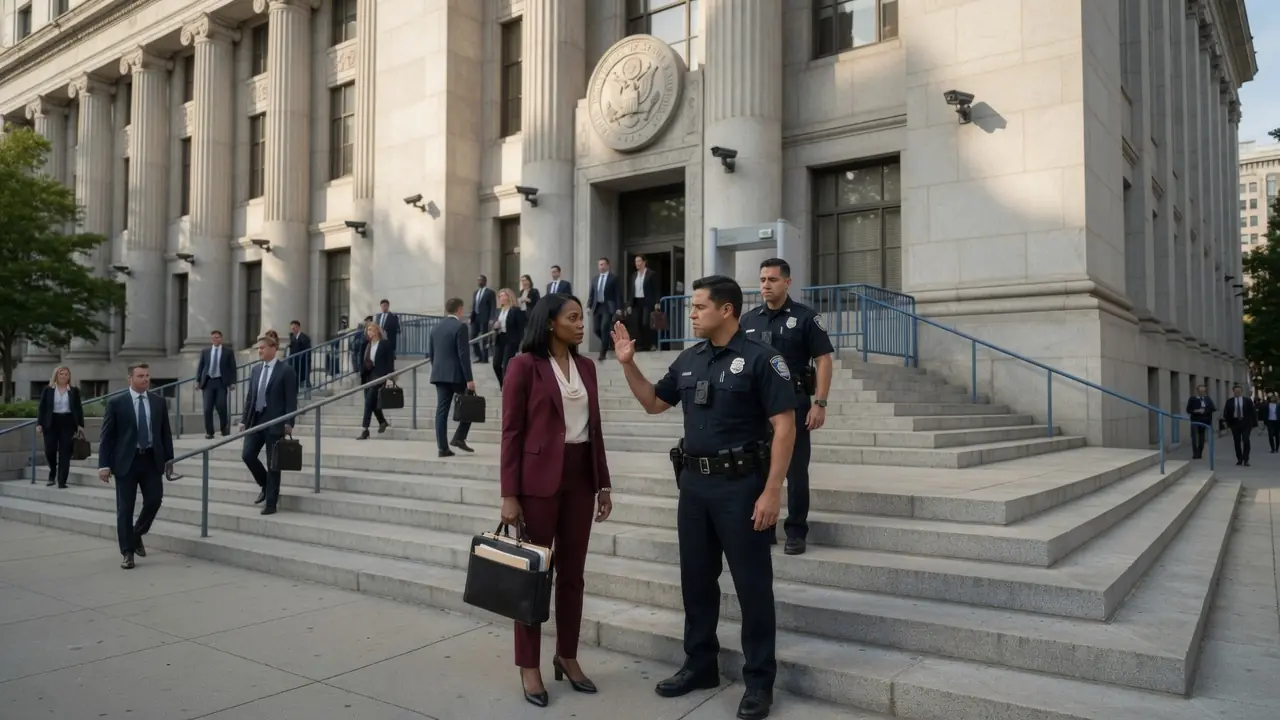
At 8:12 on a gray Monday morning, Judge Kesha Williams approached the Franklin County Courthouse wearing a dark navy coat over a cream blouse and tailored black trousers.
There was no robe over her shoulders.
No security detail walking beside her.
No gold nameplate announcing who she was.
She carried only a leather briefcase filled with case files for the morning docket.
At forty-eight, Kesha had spent more than twenty years inside courtrooms.
She had started as a public defender, moved into civil-rights litigation, served six years as a federal prosecutor, and eventually became the first Black woman appointed to the county’s criminal division.
But on the courthouse steps that morning, Officer Martinez saw none of that.
He saw a Black woman approaching the employee entrance.
And he decided she did not belong there.
“Public entrance is around the other side,” he said.
Kesha slowed.
“This is the judicial entrance.”
“I know what it is.”
“Then please step aside.”
Martinez moved into her path.
He was thirty-six, broad-shouldered, and nearly a foot taller than her. A second officer, Trevor Pike, stood several yards away beside the metal barricades.
Martinez looked at Kesha’s briefcase.
“Where do you think you’re going?”
“To work.”
His mouth curved into a smile.
“Inside a courthouse?”
“Yes.”
“What kind of work?”
Kesha glanced at the clock above the doors.
She had twenty-three minutes before the first hearing.
“Officer, move away from the entrance.”
His expression changed immediately.
People who expected submission often heard calm authority as disrespect.
“Show me identification.”
“My credentials are inside my coat.”
“Then take them out.”
Kesha kept one hand on the briefcase.
“First, tell me why I’m being detained.”
Martinez laughed.
“You’re not detained yet.”
The word yet carried its own threat.
Kesha looked toward Officer Pike.
He had turned slightly toward them but had not approached.
A courthouse employee passing through the doors slowed, then continued inside.
Martinez stepped closer.
“Identification.”
Kesha reached carefully toward the inside pocket of her coat.
His hand shot forward and seized her wrist.
“Slow.”
“I am moving slowly.”
“You don’t tell me what slow is.”
“Release my arm.”
Martinez tightened his grip.
“What are you carrying?”
“Court files.”
“Open the case.”
“No.”
He stared at her.
“What did you say?”
“I said no.”
Kesha’s voice remained controlled.
“The documents are sealed judicial records.”
Martinez glanced toward Pike.
Then back at her.
“Another ghetto rat trying to sneak inside with stolen paperwork.”
Kesha’s face became still.
So did a body camera attached to Pike’s vest.
Martinez’s body camera was not active.
Kesha looked directly at the dark unit on his chest.
“Turn on your camera.”
Martinez smiled.
“You worried about being recorded?”
“I’m worried that you’re not.”
His open palm struck her face.
The sound cracked across the courthouse steps.
Kesha’s head snapped sideways.
The briefcase fell from her hand.
Its brass clasps broke against the stone.
Folders burst open.
Sealed motions, sentencing reports, handwritten judicial notes, and evidence summaries scattered across the steps like confetti.
Several people stopped.
Someone screamed.
Kesha staggered but did not fall.
Martinez grabbed the front of her coat near the throat and slammed her back against the stone wall.
“People like you belong in cages, not courthouses.”
Officer Pike finally moved.
“Daniel, stop.”
Martinez pressed his forearm across Kesha’s upper chest.
“She assaulted me.”
Kesha looked toward Pike.
“You saw what happened.”
Pike stopped three feet away.
His eyes moved toward Martinez.
Then toward the security camera.
“Let her go.”
“She reached for something.”
“My identification,” Kesha said.
“Shut up.”
Martinez forced one of her arms behind her.
Pain shot through her shoulder.
Kesha inhaled sharply.
People near the public entrance had begun filming.
A young court clerk crouched beside the scattered papers.
Kesha raised her voice.
“Do not touch those documents.”
The clerk froze.
Martinez laughed.
“Listen to her giving orders.”
He pulled one handcuff from his belt.
“Hands behind your back.”
Kesha looked over her shoulder.
“You are making a mistake.”
“You all say that.”
“No.”
Her voice dropped.
“You are creating evidence.”
The first courthouse security supervisor emerged through the doors.
His name was Charles Brennan, a retired state trooper who had worked in the building for fifteen years.
“What is happening?”
Martinez pushed Kesha harder against the wall.
“Unauthorized person attempted to force entry through the judicial doors.”
Charles looked at her face.
Then at the broken briefcase.
Then at the documents scattered across the steps.
His expression changed.
“Officer Martinez.”
“What?”
“Take your hands off her.”
Martinez looked confused.
“She assaulted an officer.”
Charles stepped closer.
“That is Judge Williams.”
The courthouse went silent.
Martinez’s grip loosened.
Kesha turned her head slowly.
A red mark had already begun forming across her cheek.
Charles repeated the words.
“Honorable Kesha Williams.”
Officer Pike’s face lost color.
Martinez stared at her.
For the first time, he actually looked.
Not at her coat.
Not at her skin.
Not at the briefcase.
At her.
“You’re a judge?”
Kesha pulled her wrist free.
“That question came too late.”
The judicial doors opened again.
Court Administrator Elaine Crawford rushed outside, followed by two deputy marshals and the chief bailiff.
Elaine stopped when she saw Kesha.
“Oh my God.”
Kesha bent toward the scattered files.
One of the deputy marshals tried to help.
“Do not touch the red folder,” she said.
“That contains sealed juvenile records.”
The marshal stepped back.
Charles looked toward Martinez.
“Badge and weapon.”
Martinez blinked.
“What?”
“Remove them.”
“You don’t have authority over city police.”
Kesha straightened.
Blood touched the corner of her mouth.
“I do.”
Everyone looked at her.
She pointed toward the sealed case files.
“You struck a sitting judge while interfering with active judicial documents at the entrance to her courtroom.”
Her voice remained quiet.
“You may have committed assault, unlawful detention, obstruction of judicial proceedings, evidence interference, and a civil-rights violation.”
Martinez looked toward Pike.
“Tell them she reached inside her coat.”
Pike said nothing.
“Trevor.”
Pike’s eyes dropped.
Kesha turned toward him.
“Your camera is active?”
Pike touched the device.
“Yes, Your Honor.”
“Preserve the recording.”
Martinez’s expression hardened.
“She was acting suspicious.”
Kesha stared at him.
“I was walking into work.”
“You refused identification.”
“You assaulted me before I could produce it.”
“You had a briefcase full of documents.”
“They were my docket.”
“I didn’t know who you were.”
That was the sentence that changed everything.
Kesha looked at him for several seconds.
Then she said, “That is not a defense.”
Chief Bailiff Marcus Green stepped between them.
“Officer Martinez, surrender your firearm.”
Martinez did not move.
Two deputy marshals positioned themselves beside him.
The strength left his posture.
He removed the weapon.
Then his badge.
The handcuffs he had intended for Kesha were used on him less than five minutes later.
As the marshals escorted Martinez inside through the public entrance, cameras followed.
He looked back once.
Kesha was kneeling beside the broken briefcase, organizing the documents by case number.
She did not look at him.
Officer Pike remained on the courthouse steps.
He seemed smaller now.
“Your Honor.”
Kesha continued gathering papers.
“I should have stopped him sooner.”
“Yes.”
“I told him to let you go.”
“After he struck me.”
Pike looked toward the ground.
“I was trying to de-escalate.”
“You were trying not to choose.”
The words hit him harder than anger would have.
Kesha placed the final folder into the damaged briefcase.
Then she stood.
“Officer Pike, report to Internal Affairs.”
“Yes, Your Honor.”
“Do not discuss the footage with anyone before your statement.”
“Yes, ma’am.”
She turned toward Charles.
“Is my courtroom secure?”
He stared at her.
“You’re not going upstairs.”
“I have a docket.”
“You were assaulted.”
“I am aware.”
“Judge Williams—”
“Are the defendants present?”
Charles hesitated.
“Yes.”
“Are the attorneys present?”
“Yes.”
“Then court will begin at nine.”
Elaine Crawford stepped closer.
“Kesha, you need a doctor.”
“I need ice.”
“You may have a concussion.”
Kesha looked toward the courthouse clock.
“Then someone can evaluate me during recess.”
Twenty-two minutes later, the courtroom rose as the side door opened.
“All rise.”
Kesha entered wearing her black judicial robe.
The swelling on her cheek was visible.
A small bandage covered the corner of her mouth.
No one in the courtroom knew the full story yet.
But rumors had already moved through the building.
Attorneys looked at one another.
Bailiffs stood unusually still.
Defendants seated in the jury box watched her walk toward the bench.
Martinez had mocked her outside the courthouse.
Dragged her against a wall.
Tried to place her in handcuffs.
Now she crossed the courtroom without looking toward the gallery.
She stepped behind the bench.
Then she took the judge’s seat.
“Be seated.”
The room obeyed.
Kesha opened the first file.
“Before we begin, I need to address this morning’s delay.”
The courtroom remained silent.
“An incident occurred at the judicial entrance.”
She looked toward the attorneys.
“The individuals involved are being investigated.”
She paused.
“This court will not discuss pending matters outside the proper process.”
Then she lowered her eyes to the docket.
“Call the first case.”
For the next two hours, she worked.
She listened to arguments.
Reviewed evidence.
Granted one continuance.
Denied another.
Released a defendant after discovering the prosecution had failed to disclose exculpatory footage.
Imposed a sentence on a man who had violated probation but ordered treatment instead of incarceration after learning his offense was connected to untreated mental illness.
No one watching her would have guessed that her shoulder throbbed beneath the robe.
At eleven fifteen, she called a recess.
A physician examined her in chambers.
She had bruising across the throat and shoulder, a small fracture near the cheekbone, and signs of a mild concussion.
The doctor told her to go home.
She refused.
At noon, the city police chief arrived.
Chief Harold Vance had held the position for only eight months.
He entered chambers with two deputy chiefs, the city attorney, and a public-information officer.
Kesha sat behind her desk with an ice pack against her face.
Chief Vance removed his cap.
“Judge Williams, on behalf of the department—”
“Do not apologize yet.”
He stopped.
Kesha looked toward the closed door.
“Have you reviewed Officer Pike’s body camera?”
“Yes.”
“The courthouse security footage?”
“Yes.”
“Martinez’s prior complaints?”
The chief hesitated.
“We are compiling them.”
“That means there are several.”
Vance looked toward the city attorney.
Kesha noticed.
“How many?”
The deputy chief answered.
“Seventeen.”
Kesha lowered the ice pack.
“Seventeen complaints?”
“Over nine years.”
“How many involved racial language?”
No one answered immediately.
Kesha waited.
The chief finally said, “Six.”
“How many involved excessive force?”
“Eight.”
“How many were sustained?”
“One.”
Kesha leaned back.
“Then this morning was not unexpected.”
The public-information officer shifted.
“We should be cautious about drawing conclusions.”
Kesha looked at him.
“An officer with repeated complaints struck a woman in front of a courthouse camera while his body camera was disabled.”
She pointed toward the files on her desk.
“The conclusion is already recorded.”
Chief Vance lowered his voice.
“We have suspended him without pay.”
“Good.”
“We will conduct a full investigation.”
“Internal?”
“Yes.”
“Not enough.”
The chief’s expression tightened.
“What are you requesting?”
“An independent review.”
“We have procedures.”
“Your procedures cleared him sixteen times.”
The room became quiet.
Kesha turned toward the city attorney.
“Preservation letters will be delivered this afternoon.”
The attorney looked surprised.
“You’re planning litigation?”
“I am planning accountability.”
The footage leaked before sunset.
No one ever proved who released it.
The video spread first through local news, then nationally.
Millions watched Officer Martinez block Kesha’s path.
They heard him call her a ghetto rat.
They saw the slap.
The scattered legal documents.
His hand at her throat.
Then they watched a security supervisor identify her.
That was the moment most headlines focused on.
COP ATTACKED WOMAN, THEN LEARNED SHE WAS THE JUDGE.
Kesha hated that framing.
During her first public statement, she corrected it.
“The problem is not that Officer Martinez failed to recognize a judge.”
She stood outside the courthouse three days later, the bruise still visible beneath makeup.
“The problem is that he believed the woman in front of him needed a title before she deserved lawful treatment.”
Reporters shouted questions.
Kesha raised one hand.
“I will not discuss the criminal investigation.”
She looked toward the same entrance where the assault occurred.
“But I will say this.”
“Authority does not become lawful because a uniform speaks loudly.”
“Respect is not a reward given after someone proves who she is.”
“And a courthouse cannot claim to represent justice if injustice is practiced on its own steps.”
The investigation moved quickly.
Martinez’s body-camera data showed he manually disabled the device before approaching Kesha.
It was not the first time.
In thirty-two previous encounters, his camera had stopped recording moments before disputed searches, arrests, or uses of force.
The pattern was obvious once someone bothered to look.
Internal Affairs reopened every complaint.
A college student had accused Martinez of slamming him against a patrol car after the student asked why he was being stopped.
A nurse said he searched her vehicle without consent and mocked her hospital identification.
A seventy-year-old man claimed Martinez called him an animal before forcing him onto the pavement.
A Black attorney had reported being detained outside his own office because Martinez did not believe he worked there.
Each complaint had been dismissed as unsubstantiated.
No video.
Conflicting testimony.
Officer safety.
Failure to cooperate.
The words changed.
The outcome did not.
Kesha hired civil-rights attorney Naomi Brooks.
Naomi had argued cases before Kesha years earlier.
She was brilliant, direct, and incapable of pretending institutional language was harmless.
When she reviewed the complaint history, she placed the files across Kesha’s dining-room table.
“This is not one officer.”
“I know.”
“The department promoted him twice.”
“I know.”
“They assigned him to courthouse security after the complaints.”
Kesha looked up.
“That I did not know.”
Martinez had requested the assignment six months earlier.
The position was considered prestigious.
Regular hours.
Fewer emergency calls.
Daily contact with prosecutors, judges, attorneys, and political officials.
His supervisor approved the transfer despite the misconduct history.
An internal email described him as confident, proactive, and effective at controlling difficult populations.
Naomi read the sentence aloud.
“Difficult populations.”
Kesha’s face hardened.
“They turned prejudice into performance language.”
Discovery revealed more.
Martinez belonged to a private message group used by twelve officers.
The group contained racist jokes, photographs of detained civilians, and comments about courthouse defendants.
Several messages referred to Black defendants as animals.
One described public defenders as traitors helping garbage escape cages.
The morning before Kesha’s assault, Martinez sent a photograph of the judicial entrance.
His caption read:
Let’s see what crawls in today.
Officer Pike was also in the group.
He rarely posted.
But he never reported it.
During his deposition, Naomi placed the messages in front of him.
“You read these?”
“Yes.”
“You understood they were racist?”
“Yes.”
“Why didn’t you report them?”
Pike looked toward his attorney.
“I was worried about retaliation.”
“From whom?”
“Other officers.”
Naomi leaned forward.
“So when Martinez struck Judge Williams, you had already seen years of warning signs.”
Pike’s eyes filled.
“Yes.”
“And you still paused.”
“Yes.”
Kesha watched from across the room.
Pike had not assaulted her.
But silence had helped Martinez believe he could.
The criminal case against Martinez went before a judge from another county.
He was charged with aggravated assault, official misconduct, unlawful restraint, evidence interference, and civil-rights violations.
His attorney argued he had reasonably believed Kesha posed a security threat.
Then prosecutors played the footage.
No jury believed him.
The slap was visible.
The insult was clear.
The hand around her throat left no ambiguity.
Martinez rejected a plea deal.
He testified at trial.
That decision ended him.
“I didn’t know she was a judge,” he repeated.
The prosecutor looked at him.
“If she had been a court cleaner, would striking her have been acceptable?”
“No.”
“A defendant’s mother?”
“No.”
“A visitor?”
“No.”
“Then why do you keep mentioning that you did not know?”
Martinez had no answer.
The jury convicted him on every major count.
But Kesha’s civil case continued.
The city offered two million dollars.
She rejected it.
Then four million.
She rejected that too.
Naomi looked at her after the second offer.
“The amount is substantial.”
“The problem is larger.”
“What do you want?”
Kesha slid a handwritten list across the table.
Independent review of all excessive-force complaints.
Automatic investigation when body cameras were disabled.
No courthouse assignment for officers with unresolved misconduct findings.
Mandatory intervention policy.
Public reporting of complaints by officer and outcome.
External oversight for racial-bias allegations.
Protection for officers who report colleagues.
Naomi read the list.
“The city will fight half of this.”
“Then we continue.”
The city did fight.
Officials argued that public complaint data would damage officer morale.
The union warned that intervention requirements could make officers hesitate during dangerous situations.
Kesha answered during mediation.
“Your officers already hesitate.”
Everyone looked at her.
“They hesitate when the danger comes from another officer.”
The final settlement reached $8.4 million.
But the money was only one part.
The department agreed to every major reform.
A federal monitor reviewed complaint procedures for five years.
Officers who disabled cameras without documented cause faced automatic suspension.
Courthouse security assignments required independent background review.
Failure to intervene became a disciplinary offense.
The private message group led to nine suspensions and three terminations.
Two supervisors retired before hearings could begin.
Officer Pike received a six-month suspension.
He later resigned from patrol and joined the academy’s ethics unit.
Many people accused him of trying to rebuild his reputation.
Kesha did not defend him.
She did not attack him either.
She told him only one thing when they met after the settlement.
“You cannot change what you watched.”
Pike nodded.
“But you can decide what the next officer does while you are watching.”
He carried that sentence into every training class.
Kesha donated half of her personal award to create the Williams Courthouse Access Project.
The program provided legal help for people detained, searched, or denied entry at government buildings because officers or security staff decided they looked suspicious.
The first client was a janitor arrested while entering a municipal building where he had worked for eleven years.
The second was a grandmother denied access to her grandson’s hearing because security refused to believe the name on her identification.
The third was the Black attorney Martinez had previously detained outside his own office.
The reopened complaint resulted in a separate settlement.
One year after the assault, Kesha returned to the courthouse steps for a ceremony.
A bronze plaque had been installed near the judicial entrance.
It did not contain her name.
She had refused that.
Instead, it displayed words taken from her public statement:
JUSTICE DOES NOT BEGIN IN THE COURTROOM.
IT BEGINS WITH HOW PEOPLE ARE TREATED ON THE WAY INSIDE.
Court employees gathered.
Judges stood beside clerks.
Public defenders stood beside prosecutors.
Police officers remained at the edge of the crowd.
Kesha approached the microphone.
The scar near her lip had faded.
The fracture had healed.
Her shoulder still ached in cold weather.
“The video of that morning has been replayed millions of times,” she said.
“Most people remember the moment Officer Martinez learned my identity.”
She looked toward the courthouse doors.
“But that was not the important moment.”
“The important moment happened before anyone recognized me.”
“When he believed I was powerless.”
“When he believed no title stood behind me.”
“When he believed the woman in front of him could be insulted, struck, restrained, and explained away later.”
She paused.
“That is where character is revealed.”
Not when power meets power.
When power believes no one important is watching.
After the ceremony, Kesha entered the courthouse through the same doors.
The security officers stepped aside.
She stopped.
A new recruit stood near the metal detector.
He looked nervous.
“Good morning, Your Honor.”
Kesha nodded.
“Good morning, Officer.”
She walked upstairs.
Her courtroom was already full.
Defendants waited with attorneys.
Families filled the benches.
A prosecutor organized files near the front.
Kesha entered through the side door.
The bailiff called the room to order.
She took her seat behind the bench.
For a moment, she looked toward the gallery.
Many people there did not know her story.
Some knew only the headlines.
Others had watched the video.
But everyone rose when she entered.
Not because she demanded personal respect.
Because the court represented an idea larger than any one person.
Kesha opened the first file.
“Be seated.”
The room settled.
She looked toward the defendant standing before her.
A nineteen-year-old man accused of interfering with police after recording his brother’s arrest.
The prosecutor requested detention.
Kesha reviewed the footage.
The young man had not touched an officer.
He had asked questions.
Refused to stop filming.
Backed away when ordered.
An officer described his tone as aggressive.
Kesha looked toward the prosecutor.
“Where is the crime?”
“He failed to comply with commands.”
“Were the commands lawful?”
The prosecutor hesitated.
Kesha waited.
The courtroom remained silent.
Finally, he answered.
“No, Your Honor.”
“Then release him.”
The young man looked stunned.
Kesha turned to him.
“Knowing your rights does not give you permission to provoke.”
“Yes, ma’am.”
“But asking an officer to follow the law is not provocation.”
He nodded.
“Thank you.”
Kesha moved to the next case.
Years later, people continued telling the story with the same dramatic line.
Police officers messed with a woman outside court.
Seconds later, she entered and took the judge’s seat.
It sounded like a story about hidden power.
A satisfying reversal.
An arrogant officer discovering that the woman he humiliated could destroy his career.
But Kesha never viewed it that way.
She did not defeat Martinez because she was a judge.
The cameras defeated his lie.
The complaint records defeated the department’s excuses.
The officers who finally spoke defeated the culture of silence.
The law did what it was supposed to do only after people were forced to apply it honestly.
Her robe did not make the slap unlawful.
Her title did not make his hand around her throat excessive.
The judicial files did not make her worthy of dignity.
She had possessed that dignity while standing outside in civilian clothes.
Before anyone said Honorable.
Before Charles Brennan recognized her.
Before the courtroom stood.
Officer Martinez believed people like Kesha belonged in cages.
In the end, he was the one who heard a cell door close behind him.
But that was never the point.
The point was the courthouse entrance.
A place where ordinary people arrived every morning frightened, accused, grieving, or desperate.
They did not all have cameras.
They did not all carry titles.
They did not all know how to turn official language against those abusing it.
Kesha understood that the measure of justice was not how institutions treated powerful people after recognizing them.
It was how they treated unknown people before they had proven anything at all.
That morning, Martinez saw a woman he believed nobody would defend.
He struck her because he thought her story could be rewritten.
What he failed to notice was the camera above the courthouse door.
It captured the badge number.
The insult.
The slap.
The broken briefcase.
And the moment a man entrusted with enforcing the law revealed exactly what he believed the law allowed him to do.
Minutes later, Kesha Williams took the judge’s seat.
Not because she needed revenge.
Because the docket was waiting.
And unlike the officer outside, she still understood what power was for.