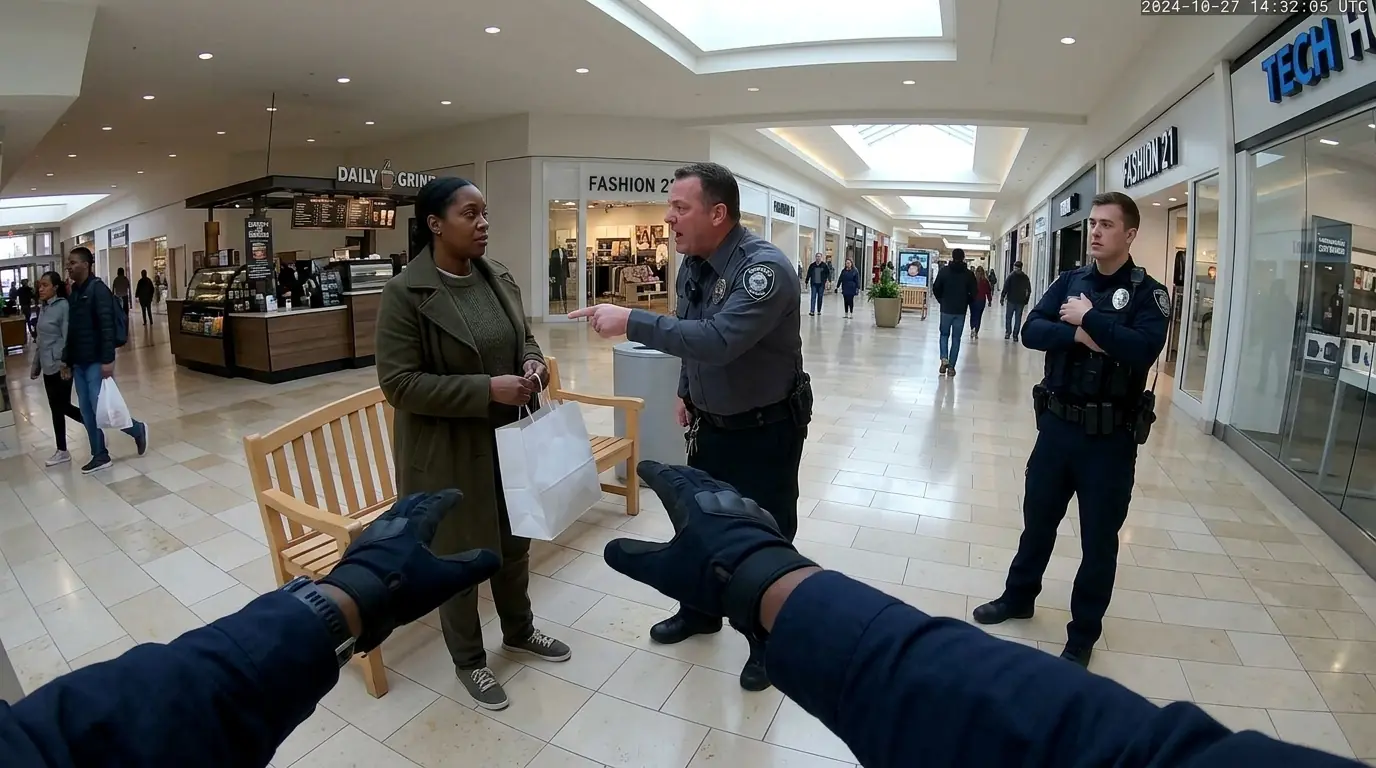
The handcuffs closed around her wrists in the middle of a shopping center crowded with strangers and the woman did not fight, did not raise her voice, did not so much as flinch when the metal bit into her skin. A security officer stood beside a uniformed patrolman pointing at her shopping bag as though it were a weapon. "You're under arrest for shoplifting. " the officer said flat and certain and the woman only looked at him and asked, "Are you sure about that? " Somewhere behind her someone laughed. A store employee held up a grainy clip of black and white footage and the bag in her hand became in an instant evidence of a crime she had not committed. None of them knew that the calm woman standing in the center of that circle of strangers had just been appointed her captain of the very police department now dragging her toward a patrol car and the most frightening part of what was about to happen was not the wrongful arrest itself.
It was the moment still hours away when she would realize that someone had planned every second of it. Captain Amara Whitfield was 38 years old and she had spent the better part of two decades earning a badge that most people in her position never got the chance to wear. She had transferred to the city only four days earlier ahead of a formal swearing in that was scheduled for the following morning and in all that time she had not yet set foot inside the precinct that would soon answer to her. She had wanted one quiet day before the uniform, before the introductions, before the weight of command settled onto her shoulders. So she drove to an upscale shopping center on the edge of downtown dressed in plain clothes with no badge, no insignia and nothing about her that announced who she was or what she had accomplished to get there.
She had earned that promotion the hard way working her way up through three different departments across two states closing cases that had gone cold for years turning down easier assignments because she had never been interested in the version of the job that simply kept the peace without ever questioning who that peace protected. Her new precinct had a reputation, quiet but persistent, for cutting corners in ways that never quite surfaced in an official report, and the people who had recommended her for the position had done so precisely because they believed she would not look away from whatever she found once she started looking. None of that history walked through the shopping center with her that afternoon. She was, for one last day, simply a woman with a bag over her shoulder and nowhere she had to be. The mall itself stretched wide and bright under skylights that scattered the afternoon sun across polished floors, the kind of place built to make people feel comfortable spending money they had not planned to spend, and Amara had chosen it precisely because it asked nothing of her.
She moved through the stores unhurried, the way anyone might on an ordinary afternoon, and after paying for a handful of items at a boutique near the center court, she stepped out into the wide promenade with her bag in hand and her receipt folded into her coat pocket. She had walked perhaps 30 feet when a security guard fell into step beside her and asked her to stop. He told her that an expensive item had left the store without being paid for, and when Amara asked to see her receipt against his claim, he said flatly that the item did not appear anywhere in the system. She did not raise her voice. She simply asked him to check again.
Two patrol officers arrived within minutes, summoned by a call that had gone out faster than the situation seemed to warrant. Officer Darius Vance walked in first, broad-shouldered and already certain of what he was looking at, and Officer Nolan Price followed a step behind him, younger, quieter, his eyes moving between Amara and the guard as though trying to read a room that did not yet make sense to him. Darius did not ask questions before he acted. He told Amara to open her bag, and she did without protest, without a single word of complaint. And when the contents were laid out on a nearby bench, there was no stolen item among them.
Only the guard insisting that the store's camera showed otherwise was enough for Darius to reach for his cuffs anyway. "I paid for everything in that bag. " Amara said, and her voice did not rise even a fraction. "You can explain that at the station. " Darius answered, already turning her by the shoulder. She looked down at the badge pinned to his chest, read the name stitched beneath it, and looked back up at him with an expression that unsettled him more than he wanted to admit. "Fine. " she said.
"I'd also like to know who trained you to handle a situation like this. " Darius let out a short laugh, more reflex than genuine amusement, and asked her who exactly she thought she was. Amara said nothing. She only watched him, and something in her silence made the question feel far more dangerous than it had sounded coming out of his mouth. They walked her through the widest part of the promenade, rather than the service corridor that any experienced officer would have used. Past a coffee stand and a jewelry counter and a line of shoppers who slowed to watch, several of them lifting their phones to record what was happening.
Store employees whispered to one another as she passed. And a mother pulled her small son closer against her hip, as though the sight itself might be contagious. An older woman near the fountain lowered her sunglasses and watched with an expression that hovered somewhere between pity and suspicion, saying nothing, doing nothing, the way most people did when a scene like this unfolded in front of them and asked something uncomfortable of their conscience. One young man, a stranger who would never learn her name or hear how the story ended, kept his phone raised the entire way, narrating quietly to whoever might watch the footage later that a woman had just been caught stealing in broad daylight, certainty dressing itself up as fact before a single piece of evidence had been checked. Amara heard fragments of it as she walked, and she let none of it reach her face.
By the time they reached the loading area near the mall's security office, a store manager named Marceline Crowe had already positioned herself at the center of the small crowd, insisting loudly that the missing item was worth a significant sum, and that the woman in cuffs had been behaving suspiciously from the moment she walked in. Marceline planted herself directly in front of Amara, arms crossed, her voice pitched loud enough to carry to the small crowd still gathered near the loading dock. "We have this on camera," she said, as though repeating it louder made it truer. Amara asked her evenly, "Which camera, and at what time? " And Marceline hesitated just long enough for the hesitation itself to become an answer. "It doesn't matter which camera," she snapped.
"You were seen. " Amara asked calmly to see the full security footage rather than the single clip that had already been passed from hand to hand. Marceline refused, calling it internal property that could not simply be handed over. And when Amara pressed further, asking what exactly the item was, what it was worth, when precisely it had gone missing, and who had performed the last inventory check before the alarm was raised, the answers she received contradicted one another within seconds. Darius grew visibly irritated at the number of questions, muttering that she was making the process harder than it needed to be, while Nolan hung back, his discomfort deepening with every inconsistency he heard. Amara noticed something the others had missed entirely.
The timestamp written on the incident report did not match the timestamp printed on her own receipt. And the gap between the two numbers was not something a mistake could easily explain. She checked her watch once, unhurried, and said, "You have a problem. " Darius asked what kind of problem she meant. She held his gaze a moment longer than was comfortable and answered, "You've arrested the wrong person. " And something in the stillness of her voice made even the onlookers nearby fall quiet, as though they sensed, without knowing why, that the balance of power in that small, crowded room had just begun to shift. The ride to the substation took less than 5 minutes, though it felt considerably longer, the patrol car cutting through the parking structure, while Amara sat in the backseat with her wrists still bound, watching the ordinary world pass by the window as though none of it had anything to do with her anymore.
Nolan drove without speaking. Darius filled out a portion of his report from the passenger seat, glancing back at her twice, as if checking whether her composure had cracked yet. And each time he found it exactly where he had left it, unmoved, unbothered, waiting. They led her into a windowless interrogation room at the substation attached to the mall's security wing, the kind of room built for confessions rather than conversations, with a metal table bolted to the floor and a single overhead light that hummed faintly against the silence. Darius set a clipboard in front of her and told her to sign the incident statement before anything else could happen, and Amara, still composed, told him she would not sign anything until she had seen the evidence he claimed to have.
Darius's patience thinned visibly. He accused her of stalling, of making a routine matter more complicated than it had to be, and still Amara did not raise her voice or shift in her chair. She asked Darius, plainly, whether he had ever once, in his years on the job, arrested someone without first confirming the accusation against them through more than a single uncorroborated claim. He did not answer the question directly, insisting instead that the guard's word, combined with the manager's certainty, was more than enough to justify the stop, that officers could not afford to second-guess every citizen who reported a crime in progress. Amara pointed out, quietly, that no crime had actually been confirmed, only alleged, and that the difference between those two words was the entire foundation of the job he claimed to take seriously.