“Sir, take your hands off the child.”
The knife stopped halfway through a stack of birthday pancakes.
Marcus Reed looked up from the table and found a police officer standing beside the booth with one hand resting on his holster. Across from Marcus, five-year-old Sophie sat frozen beneath a paper crown, her cheeks still puffed from trying to blow out the tiny pink candle balanced in the whipped cream.
A thin curl of smoke rose between them.
The entire diner seemed to pause with it.
Marcus slowly placed the butter knife beside the plate.
“My hands are not on her,” he said.
Officer Grant Keller looked from him to Sophie, then back again. He was in his early forties, tall and solidly built, with a rain-darkened uniform and a silver wedding band around one finger. His patrol car was visible through the diner windows, parked crookedly beside the curb with its lights still flashing.
Sophie’s bright blue eyes moved between the two men.
“Daddy?”
Marcus gave her a calm smile.
“It’s all right, sweetheart.”
Keller’s attention sharpened at the word.
“Did she just call you Daddy?”
Marcus folded his hands on the table.
“Yes.”
The waitress, a young woman named Holly, stood several feet away holding a glass coffee pot. Her smile had disappeared.
Keller looked at Sophie again.
The girl had blonde hair divided into two uneven pigtails with purple ribbons. Her skin was fair and lightly freckled across the bridge of her nose. She wore a yellow cardigan over a dress printed with small blue flowers.
Marcus was a forty-three-year-old Black man with dark brown skin, close-cropped hair, and a neatly trimmed beard. He wore a gray sweater, jeans, and the tired expression of a parent who had been awake before dawn decorating a kitchen that a five-year-old had abandoned in favor of diner pancakes.
Nothing about the scene was unusual except for the officer’s presence.
“Where is her mother?” Keller asked.
Marcus glanced toward Sophie.
“That’s a private family matter.”
Keller stepped closer to the booth.
“It stopped being private when someone reported a suspicious situation involving a child.”
A low murmur moved through the diner.
Marcus’s eyes shifted toward the entrance.
At the counter, an older woman in a green coat quickly looked down at her coffee. Beside her sat a leather purse, a folded newspaper, and a phone placed face down on the counter.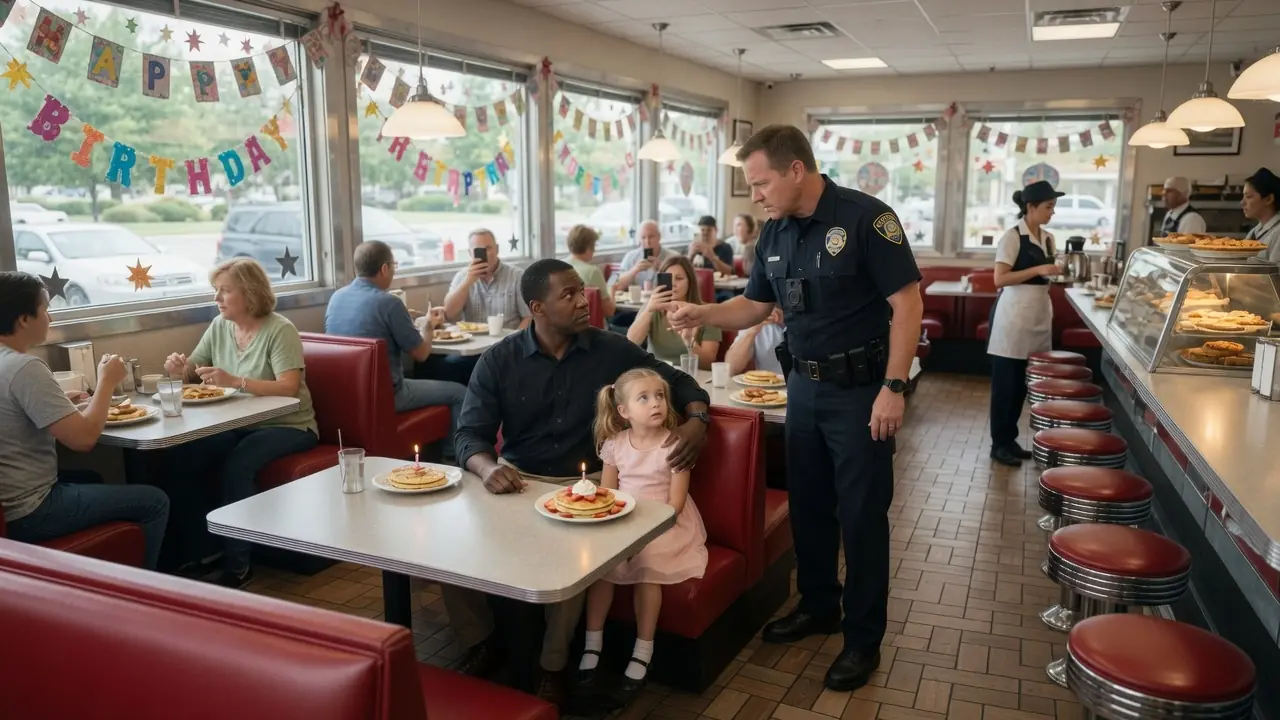
Marcus understood.
Someone had called.
“Who reported it?” he asked.
“I’m not giving you the caller’s identity.”
“Then what exactly did the caller report?”
Keller’s jaw tightened.
“A young white girl appearing uncomfortable with an adult male.”
Sophie frowned.
“I’m not uncomfortable.”
The officer turned toward her too quickly.
“What’s your name?”
Marcus’s voice remained controlled.
“Please speak to me, not her.”
Keller ignored him.
The officer bent slightly so his face was level with the child’s.
“Sweetheart, what’s your name?”
Sophie looked at Marcus.
He nodded once.
“Sophie.”
“Sophie what?”
“Sophie Reed.”
Keller glanced toward Marcus.
“His last name?”
“My last name,” Sophie said.
A few customers shifted in their seats.
Keller’s face did not change.
“How old are you?”
“Five today.”
She pointed proudly at the candle.
“It’s my birthday.”
“Do you know this man?”
Sophie’s eyebrows pulled together.
“He’s my daddy.”
Keller smiled in a way that did not reach his eyes.
“Did he tell you to say that?”
Marcus leaned forward.
“That’s enough.”
The officer straightened.
“I’m investigating a possible child-abduction situation.”
“You walked into a diner, looked at our skin, and decided my daughter had been abducted.”
“I responded to a report.”
“And before speaking to anyone who knows us, you began questioning a five-year-old at her birthday breakfast.”
Holly placed the coffee pot on a nearby table.
“Officer, they come here all the time.”
Keller turned toward her.
“Did I ask you?”
“No, but I’m their waitress.”
“Then continue being their waitress.”
Holly’s face flushed.
Marcus saw Sophie shrinking into the corner of the booth. Her hands had disappeared beneath the table. She did that when she felt scared but did not want anyone to know.
He looked back at Keller.
“Please lower your voice.”
“Don’t tell me how to conduct an investigation.”
“I’m asking you not to frighten my daughter.”
The officer took out a small notebook.
“Identification.”
Marcus did not move.
“For what purpose?”
“To establish who you are.”
“You already know my name.”
“I know what the child said.”
“And I confirmed it.”
“That is not identification.”
Marcus glanced at the birthday pancakes.
The candle had fallen sideways into the whipped cream. Blue sugar sprinkles melted into pale streaks around the flame-blackened wick.
Sophie noticed too.
Her lower lip trembled.
Marcus reached toward the plate.
“Keep your hands where I can see them.”
Marcus stopped.
He looked at the officer’s hand, then at his face.
“I was going to remove the candle.”
“Don’t move without telling me.”
A man in a work jacket at the counter pulled out his phone.
Then another customer did the same.
Keller noticed the movement in the room.
“This is an active police matter,” he said loudly. “No one needs to interfere.”
The older woman in the green coat turned around.
“I was the one who called.”
The diner went still.
She appeared to be in her late sixties, with carefully styled white hair and pearl earrings. Her cheeks were flushed with the uncomfortable certainty of someone who had expected to be praised.
“I saw the girl looking at the door,” she explained. “She looked nervous.”
Sophie stared at her.
“I was waiting for Miss Holly to bring my candle.”
The woman blinked.
Keller turned toward her.
“Did you see the man threaten or restrain the child?”
“No, but they didn’t look related.”
Holly shook her head.
“Oh my God.”
The woman lifted her chin.
“I would rather be wrong than ignore something dangerous.”
Marcus looked at her for several seconds.
“You were wrong before you called.”
She stiffened.
“I was concerned.”
“You watched us for ten minutes. Did you ask the waitress whether she knew us?”
“No.”
“Did you see my daughter call me Dad?”
“I didn’t hear everything.”
“Did you see me hurt her?”
“No, but—”
“Then what did you see?”
The woman’s lips pressed into a thin line.
Keller stepped between them.
“That’s enough. Sir, hand me your identification.”
Marcus looked at Sophie.
Her eyes were wet now.
“Daddy, can we go home?”
The question changed something in the room.
Marcus’s shoulders lowered, not in surrender, but in restraint.
“Yes,” he said. “As soon as we finish this.”
Keller blocked the aisle beside the booth.
“You’re not leaving until I verify your story.”
Marcus’s gaze settled on him.
“My story?”
“That she is your daughter.”
Several phones rose higher.
Keller heard the reaction and doubled down.
“Anyone can teach a child what to say.”
A woman near the window spoke.
“That’s disgusting.”
Keller turned toward her.
“Stay out of it.”
Marcus slowly stood.
He was slightly shorter than the officer, but the movement made Keller take half a step back.
Marcus kept both hands open and visible.
“My daughter’s mother died three years ago,” he said quietly. “I am her only living parent. You have frightened her, interrupted her birthday, and implied that I coached her to hide an abduction.”
Keller’s expression hardened.
“Then proving it should be easy.”
Marcus stared at him.
The officer continued.
“People lie about children every day.”
That was the sentence.
The workman at the counter began recording openly.
Holly pulled out her phone.
A teenage boy in a school jacket held his camera above the back of his seat.
Even the older woman who had called looked unsettled now.
Keller seemed to feel the room shifting against him.
He raised his voice.
“If this man is telling the truth, he has nothing to worry about.”
Marcus looked around the diner.
Then he returned his attention to the officer.
“That sentence has excused a great deal of harm.”
Keller pointed toward his wallet.
“Identification. Now.”
Marcus reached slowly into his back pocket.
The officer moved closer.
“Two fingers.”
Marcus removed a brown leather wallet and opened it.
He passed over his driver’s license.
Keller read the name.
Marcus Elias Reed.
The address matched a large house less than two miles from the diner.
Keller looked toward Sophie.
“This does not prove she is yours.”
Marcus said nothing.
He reached into a second compartment and removed a single white card.
It was not a birth certificate.
It was not a custody order.
It was not a family photograph.
He held it between two fingers and handed it to Keller.
The officer glanced down.
His expression changed so quickly that every person recording understood something had gone wrong.
Keller read the card again.
STATE JUDICIAL OVERSIGHT COMMISSION
HON. MARCUS E. REED
SPECIAL COUNSEL — POLICE CONDUCT REVIEW
Below the title was an authorization seal from the governor’s office.
Keller looked up.
Marcus’s face remained calm.
“Do not mistake that card for proof that I’m her father,” he said.
The officer’s lips parted.
Marcus continued.
“It only proves that you chose the worst possible morning to show me exactly how you treat people when you believe they have no power.”
Keller looked toward the phones.
“Judge Reed—”
“I am not a sitting judge.”
“Mr. Reed, I was responding to a child-safety concern.”
“No. You responded to a caller. What you did after arriving was your choice.”
Keller handed back the card.
“This situation can still be resolved.”
“It could have been resolved before you entered the booth.”
Sophie began crying silently.
Marcus saw the tears rolling down her cheeks and immediately turned away from the officer.
He crouched beside her.
“Hey,” he whispered. “Look at me.”
She did.
“You didn’t do anything wrong.”
“Is he taking you away?”
The diner seemed to hold its breath.
“No.”
Marcus wiped her cheek with his thumb.
“No one is taking me away.”
Keller looked toward the entrance.
His patrol car lights continued painting the windows blue and red.
“I think we should discuss this privately,” he said.
Marcus stood again.
“You made it public.”
“I was trying to protect a child.”
Marcus gestured toward Sophie.
“Then look at her.”
Keller did.
For the first time, he seemed to truly see what he had done.
Sophie had pressed herself into the corner of the booth, paper crown tilted, birthday pancakes untouched, both hands gripping the sleeve of her cardigan.
Marcus picked up his phone.
“I’m calling your supervisor.”
Keller’s face tightened.
“That isn’t necessary.”
“It was necessary the moment you prevented us from leaving.”
“I never said you were detained.”
“You blocked the booth and said I could not leave.”
“That was for safety.”
“Whose?”
Keller did not answer.
Marcus called the Brookdale Police Department’s non-emergency number and asked for the watch commander.
The dispatcher placed him on hold.
A minute later, Captain Elaine Foster answered.
Marcus put the call on speaker.
“This is Captain Foster.”
“My name is Marcus Reed. Officer Grant Keller is currently inside Rosie’s Diner on Maple Street. He has detained me and my five-year-old daughter following a report that we did not appear related.”
Silence followed.
Keller stepped forward.
“Captain, I can explain.”
Foster’s tone changed.
“Officer Keller?”
“Yes, ma’am.”
“Is your body camera recording?”
Keller looked down.
The red light was on.
“Yes.”
“When did you activate it?”
Keller hesitated.
Marcus looked at the device.
The light had not been on when the officer entered.
Holly lifted her phone.
“I have video from the beginning.”
Captain Foster heard her.
“Who said that?”
“A witness,” Marcus replied.
Foster’s voice became precise.
“Officer Keller, do not leave the location. Do not stop or overwrite your camera. Another unit and I are on our way.”
The call ended.
Keller stood beside the booth, no longer speaking.
Marcus sat with Sophie.
He removed the ruined candle and asked Holly for another.
Holly looked at him in disbelief.
“You still want the breakfast?”
Marcus looked at his daughter.
“Yes.”
Sophie wiped her nose.
“I don’t want pancakes anymore.”
“That’s okay.”
“Can I have ice cream?”
“It’s six-thirty in the morning.”
“It’s my birthday.”
Marcus considered this.
“One scoop.”
Sophie held up two fingers.
“You’re negotiating during a crisis.”
She sniffed.
“Two scoops.”
A few people laughed softly.
The tension in the room loosened just enough for her shoulders to relax.
Holly hurried toward the kitchen.
Officer Keller remained near the entrance as if distance might undo the previous twenty minutes.
Captain Foster arrived with Sergeant Luis Ortega.
Foster was a Black woman in her early fifties with a compact build and a streak of gray through the front of her hair. She entered without sirens, surveyed the diner, and approached Marcus first.
“Mr. Reed.”
He stood.
“Captain.”
She looked toward Sophie.
“Is she all right?”
“She will be.”
Foster crouched near the booth but did not move closer without permission.
“Happy birthday, Sophie.”
Sophie studied her.
“Are you a police captain?”
“Yes.”
“Are you his boss?”
Foster glanced toward Keller.
“I am.”
Sophie pointed at him.
“He said Daddy was lying.”
Foster’s mouth tightened.
“I’m sorry he said that.”
Keller stepped forward.
“Captain, the caller reported a possible abduction. The child did not resemble the adult, and he refused to identify himself.”
Marcus looked at Foster.
“He asked my daughter whether I had taught her to call me Dad.”
Foster turned to the officer.
“Did you say that?”
Keller hesitated.
“I used age-appropriate questions to assess whether she was under coercion.”
The workman at the counter spoke.
“That isn’t what happened.”
Holly raised her phone.
“I recorded most of it.”
Others did the same.
Foster looked around the diner.
“How many people have video?”
Seven hands rose.
The older woman in the green coat remained seated at the counter, staring into her untouched coffee.
Foster looked back at Keller.
“Turn over your body camera and duty phone to Sergeant Ortega.”
Keller’s face changed.
“Captain—”
“Now.”
He removed the camera from its mount.
Ortega sealed it inside an evidence pouch, then took Keller’s department phone.
Foster spoke quietly.
“You are relieved of duty pending review.”
Keller looked toward Marcus.
“This is because of who he is.”
Marcus stood again.
“No.”
Everyone turned toward him.
“This is because of what you did.”
Keller laughed bitterly.
“If he were an ordinary citizen, nobody would be relieving me.”
Marcus held his gaze.
“That may be the most honest thing you’ve said this morning.”
Foster ordered Keller to wait outside with Ortega.
When the door closed behind him, Holly returned carrying a glass dish with two scoops of strawberry ice cream, whipped cream, and a new candle.
Sophie’s face brightened despite everything.
The diner applauded when Holly set it down.
Marcus lit the candle.
He expected Sophie to close her eyes and make a wish immediately.
Instead, she looked toward the window where Keller stood beside the patrol car.
“Daddy?”
“Yes?”
“Did he think you stole me because I’m white?”
The applause died.
Marcus sat across from her.
He had spent years preparing for this conversation.
He had imagined it happening in their living room, perhaps after a question at school or an insensitive remark from another child.
He had not imagined discussing it over melting strawberry ice cream with a diner full of strangers listening.
“He saw that we look different,” Marcus said carefully. “And he made a bad decision about what that difference meant.”
“Because you’re Black?”
“Yes.”
Sophie looked down at the candle.
“Mommy was white.”
“She was.”
“And I look like Mommy.”
“You do.”
“Do I look like you?”
Marcus smiled.
“You wrinkle your nose exactly like I do when you don’t believe somebody.”
She wrinkled it.
A few customers laughed again.
“You also sing too loudly in the car,” he added.
“That’s you.”
“That is absolutely not me.”
“It is.”
Marcus leaned closer.
“You have your mother’s eyes. You have my stubbornness. You have your own laugh. Families don’t have to match on the outside.”
Sophie considered this.
Then she looked around the diner.
“Can I blow it out now?”
“Yes.”
She closed her eyes.
The candle flame disappeared with one breath.
The video from Rosie’s Diner spread before noon.
Holly posted only the portion beginning with Keller’s statement that people lied about children every day. The workman uploaded the earlier section showing the officer ordering Marcus away from Sophie’s plate and placing a hand on his weapon when Marcus reached for the candle.
The clips were viewed millions of times.
Headlines focused on the identification card.
POLICE OFFICER QUESTIONS BLACK FATHER—THEN LEARNS HIS JOB.
OFFICER STOPS WRONG DAD AT BIRTHDAY BREAKFAST.
JUDICIAL INVESTIGATOR’S DINER DETENTION GOES VIRAL.
Marcus disliked every version.
The officer had not stopped the wrong father.
He had treated a father wrongly.
There was a difference.
By that evening, reporters were gathered outside Marcus’s house.
He kept Sophie away from the windows.
His sister, Danielle, arrived with balloons, cupcakes, and enough energy to distract a room full of adults.
She found Marcus in the kitchen washing a plate that was already clean.
“You’ve been scrubbing that for five minutes,” she said.
He turned off the water.
“I’m fine.”
“Liar.”
Danielle was thirty-nine, a public-school principal with Marcus’s eyes and none of his patience for emotional avoidance. She set the cupcakes on the counter.
“Where is Sophie?”
“Upstairs showing her new doll to Mom.”
Their mother had driven in from Columbus after seeing the video.
Danielle studied him.
“You should have called me.”
“At six-thirty in the morning?”
“Yes.”
“To say what?”
“My daughter’s birthday breakfast became a civil-rights seminar?”
“To say you were scared.”
Marcus dried the plate.
“I wasn’t scared.”
Danielle gave him a long look.
“What did Sophie ask?”
He looked toward the stairs.
Danielle’s expression softened.
“She asked whether he thought I stole her because she’s white.”
“Oh, Marcus.”
“I told her the truth.”
“Which truth?”
“That he saw difference and made a decision based on it.”
Danielle leaned against the counter.
“And the other truth?”
Marcus knew what she meant.
The truth he had not told Sophie.
That three years earlier, Sophie’s mother, Emily, had died while investigating the same police department.
Not in the line of duty.
Not officially.
Emily Reed had been an investigative reporter for the Brookdale Chronicle. For eight months before her death, she had been working on a series about missing body-camera footage, coerced informants, and unexplained settlements involving Officer Grant Keller.
Then her car went off a bridge during a rainstorm.
Police called it an accident.
Marcus had tried to believe them.
But Emily’s notebook had disappeared from the vehicle.
Two weeks after her funeral, someone broke into Marcus’s office and searched only the locked drawer where he kept copies of her work.
Nothing else was taken.
Marcus later accepted a position with the State Judicial Oversight Commission, partly because the work mattered and partly because it placed him near the systems Emily had tried to expose.
He had never been assigned directly to Brookdale.
That boundary had protected him from accusations of personal retaliation.
Until that morning.
Danielle lowered her voice.
“Keller was one of the names in Emily’s notes.”
“I know.”
“And he walked into Sophie’s birthday breakfast.”
“I know.”
“You think that was random?”
Marcus looked toward the dark window above the sink.
The older woman had made the call.
Keller had responded.
That part could be coincidence.
But Keller’s reaction to the oversight card had carried something beyond professional fear.
Recognition.
He had read Marcus’s name on the driver’s license before seeing the card.
For one brief second, the officer had looked not surprised, but alarmed.
“Did he know you?” Danielle asked.
“He knew the name.”
“How?”
Marcus thought of Emily’s missing notebook.
“I don’t know.”
His phone rang.
Captain Foster.
He answered in the living room.
“Mr. Reed, I wanted to update you before the department issues a public statement.”
Marcus sat on the edge of the sofa.
“What statement?”
“Officer Keller is on paid administrative leave.”
“Paid.”
“I know how that sounds.”
“It sounds accurate.”
Foster exhaled.
“There’s more. We reviewed his body-camera file.”
Marcus waited.
“The recording begins nine minutes after he entered the diner.”
“That matches the witness videos.”
“Yes. But the system log shows the camera was manually activated, then stopped, then activated again.”
“When?”
“Thirty-eight seconds before he entered.”
Marcus looked toward Danielle.
“Then he had footage from the beginning.”
“He deleted the first file.”
“Can it be recovered?”
“Our technical unit is trying.”
Marcus stood.
“Why would he stop the recording before entering the diner?”
Foster did not answer immediately.
“That’s what I wanted to ask you.”
“You think I know?”
“I think Keller recognized your name.”
Marcus walked toward the front window but stayed behind the curtain.
“What aren’t you telling me?”
Foster lowered her voice.
“Three years ago, after your wife died, Keller filed a supplemental traffic report.”
Marcus’s grip tightened around the phone.
“What report?”
“It was not included in the accident file sent to your attorney. I found it in an archived system this afternoon.”
“What does it say?”
“That Keller saw Emily’s vehicle near the Chronicle office forty minutes before the crash.”
Marcus’s heart began beating harder.
“Was he on duty?”
“Yes.”
“Why wasn’t that in the main file?”
“The supplement was marked administrative and sealed by Deputy Chief Harold Vance.”
Marcus knew the name.
Vance had been acting chief when Emily died. He retired six months later and took a security-consulting position with a company that handled police-union cases.
“What else is in the report?”
“Keller said Emily appeared distressed and was arguing with an unidentified man beside her car.”
“Did he identify the man?”
“No.”
“Did he intervene?”
“He wrote that they separated before he approached.”
Marcus closed his eyes.
Emily had called him that evening at 8:14.
Her voice had been hurried.
She said she had found something that changed everything.
She told him to put Sophie to bed and wait for her.
The bridge camera showed her vehicle entering the north ramp at 8:47.
It never exited.
“Captain,” Marcus said, “I need a copy.”
“I can’t release it informally.”
“Then preserve it.”
“I already did.”
“Preserve every log showing who accessed it.”
Foster was silent.
“Someone accessed it this morning,” she said.
Marcus opened his eyes.
“Who?”
“Grant Keller.”
The public story shifted the next day.
The viral diner video remained everywhere, but behind the scenes, the State Attorney General’s Office opened an inquiry into Emily Reed’s death.
Marcus recused himself from any official role.
He hated doing it.
He also understood why it was necessary.
Assistant Attorney General Priya Desai took control of the investigation. She was forty-six, direct, patient, and nearly impossible to intimidate.
She met Marcus in a conference room at the state courthouse.
A digital copy of Keller’s supplemental report lay open on the screen between them.
“You knew your wife was investigating him,” Priya said.
“She was investigating several officers.”
“But Keller appeared repeatedly.”
“Yes.”
“What was the focus?”
Marcus looked at the copied pages from Emily’s old files.
“Traffic stops involving fathers with children.”
Priya frowned.
“What?”
“Emily noticed a pattern in complaints. Black and Latino fathers stopped while driving with children who did not resemble them. Stepchildren. Adopted children. Biracial children with lighter skin. Officers would separate them, question the kids, search the vehicles, and sometimes call child services.”
“Keller was involved?”
“In nine complaints.”
“How many were sustained?”
“None.”
“Body-camera footage?”
“Missing or incomplete in seven.”
Priya leaned back.
“The diner was not an isolated reaction.”
“No.”
“It was a habit.”
Marcus nodded.
Emily believed the stops had another purpose. Officers used the confusion and fear to search cars without clear consent. Parents became so focused on proving their relationship that they stopped challenging the search.
Two vehicles contained cash.
One contained prescription pain medication belonging to a child’s grandmother.
Another contained a legally owned handgun.
Keller made arrests in all four cases.
Three charges were later dismissed.
The evidence in one disappeared.
“Emily thought Keller was stealing?” Priya asked.
“Not alone.”
“Who else?”
“She never told me.”
“That isn’t like an investigative reporter.”
“She said the source was afraid.”
“Did she leave notes?”
“Some.”
“And the rest disappeared from the car.”
Priya studied Marcus.
“You believe Keller took them.”
“I believe somebody did.”
The technical recovery from Keller’s body camera arrived that afternoon.
The deleted file did not show the diner.
It showed Keller sitting inside his patrol car thirty-eight seconds before entering.
He was speaking on his department phone.
The other voice was not recorded, but Keller’s half of the conversation was clear.
“Reed?”
A pause.
“The little girl?”
Another pause.
Then Keller said, “I understand.”
He ended the call, stopped his body camera, and entered Rosie’s Diner.
Priya replayed the clip.
“He was sent there.”
Marcus watched Keller’s face on the screen.
“By whom?”
The department phone log showed no outgoing or incoming call at that time.
The communication had come through an encrypted police application that left only a connection record.
The account contacting Keller belonged to a retired officer.
Harold Vance.
Deputy Chief Vance was found that evening at his home outside Brookdale.
He was seventy, broad-shouldered despite his age, with white hair and a voice that remained authoritative long after his badge was gone.
Priya and two investigators interviewed him.
Marcus watched remotely.
Vance denied contacting Keller.
When shown the connection record, he claimed someone had used his old account.
When shown that the account had logged in from his home internet address, he asked for an attorney.
Before ending the interview, Priya placed a photograph of Emily on the table.
“Did you meet her the night she died?”
Vance’s eyes moved to the picture.
He recovered quickly.
“No.”
“Did Keller?”
“I don’t know.”
“Why did you seal his supplemental report?”
“Administrative error.”
“Why did you contact Keller after someone called police about Marcus Reed and his daughter?”
Vance leaned back.
“I did not.”
Priya closed the file.
“Then you won’t mind if we seize your devices.”
Vance’s face went still.
The warrant was executed an hour later.
His phone had been wiped.
His laptop was gone.
But investigators found a locked steel cabinet in the garage.
Inside were old complaint files, photographs, settlement records, and a plastic evidence bag containing a blue notebook.
Marcus recognized it immediately.
Emily had carried that notebook everywhere during the final six months of her life.
The cover was scratched near the corner where Sophie, then two, had drawn a circle with a silver marker.
Marcus had searched for it for three years.
Now it sat on an evidence table beneath fluorescent lights.
Priya called him before opening it.
“You should be present.”
Marcus entered the secure room alone.
He wore gloves.
The notebook smelled faintly of dust and old coffee.
Emily’s handwriting filled the first pages in tight black lines.
Dates.
Names.
Traffic-stop numbers.
Vehicle plates.
A pattern emerged.
Keller and three other officers repeatedly stopped mixed-race families and adoptive parents. They escalated ordinary questions into child-welfare concerns, then used the confusion to search vehicles.
But Emily’s theory went further.
The searches were selective.
The officers knew which vehicles contained valuable evidence before they made the stops.
Someone inside the department had access to information from confidential informants and pending investigations.
The family-related questioning was camouflage.
Near the middle of the notebook, Emily had written one sentence in capital letters.
THE CHILD IS THE DISTRACTION.
Marcus read it twice.
Below it was a name.
Harold Vance.
Emily believed Vance was leaking targets to officers. The officers would stop the vehicle, create a child-safety concern, and search while the parent tried to prove the family relationship.
If they found drugs or cash, part of the evidence disappeared before booking.
If they found nothing, the encounter was classified as a welfare check rather than a failed investigatory stop.
The system hid racial profiling inside concern for children.
Priya turned the page.
The final entry was dated the night Emily died.
H.V. AGREED TO MEET. SAYS HE WANTS OUT. BRINGING LEDGER. KELLER DOESN’T KNOW.
Marcus felt the room tilt.
“Vance was her source,” he said.
Priya read the line again.
“Or he pretended to be.”
The next page had been torn out.
The investigation moved quickly after that.
Vance was arrested for evidence theft and obstruction.
Keller remained on leave but had not yet been charged in Emily’s death.
He agreed to a second interview after prosecutors showed him the body-camera recovery.
His attorney sat beside him.
Keller looked exhausted.
The confidence from the diner was gone.
Priya placed the blue notebook on the table but kept it closed.
“Why did Vance contact you before you entered Rosie’s Diner?”
Keller stared at the cover.
“He said Marcus Reed was inside.”
“Why did that matter?”
“He said Reed had something belonging to the department.”
“What?”
“I don’t know.”
“Then why confront him about his daughter?”
Keller looked toward the mirror.
“It gave me a reason to identify him.”
“You already knew his name.”
“I needed to confirm it.”
“And search him?”
Keller said nothing.
Priya leaned closer.
“Were you looking for Emily Reed’s notebook?”
“No.”
“Did you know Vance had it?”
“No.”
“Did you meet Emily the night she died?”
Keller’s breathing changed.
Marcus watched from the observation room.
There it was.
The same flicker of alarm from the diner.
Priya saw it too.
“You wrote that you saw her arguing with a man.”
“I did.”
“Who was he?”
“I couldn’t tell.”
“You were twenty feet away.”
“It was raining.”
“Was it Harold Vance?”
Keller looked at his attorney.
The attorney whispered something.
Keller requested a break.
During the recess, an investigator searched the archived dispatch records from the night of Emily’s death.
One detail had never been examined properly.
Keller’s patrol vehicle crossed the bridge twelve minutes after Emily’s car.
It returned twenty-three minutes later.
He did not report leaving his district.
The bridge camera showed another vehicle behind him.
A black department SUV assigned to Vance.
The vehicles returned separately.
Emily’s car did not.
Priya entered the room after the break and placed the images in front of Keller.
His attorney went silent.
Keller looked at the photographs for a long time.
Then he said, “I didn’t push her car.”
Marcus’s hands clenched in the observation room.
Priya’s voice remained steady.
“No one said it was pushed.”
Keller closed his eyes.
The confession did not come as a dramatic speech.
It came in pieces.
Vance had contacted Emily pretending he wanted to expose the theft operation. He arranged to meet behind the Chronicle office and brought a false ledger.
When Emily realized the records were fabricated, she threatened to call federal investigators.
Vance tried to take the notebook.
She escaped in her car.
Vance followed.
He called Keller and ordered him to intercept her near the bridge.
Keller blocked the exit ramp with his patrol vehicle.
Emily stopped.
Vance pulled behind her.
The three argued in the rain.
Emily held up her phone and said she had already sent copies of everything.
Vance did not believe her.
He grabbed the phone.
Emily struck him.
Keller caught her arm.
She broke free and ran toward her car.
Vance drove the department SUV into the rear bumper.
Not hard enough to force it over the edge.
Hard enough to make it roll forward.
Emily’s driver door was open.
The car moved toward the damaged guardrail.
She tried to climb inside and press the brake.
Her foot slipped.
The vehicle broke through.
Keller ran to the edge.
He saw the headlights beneath the water.
He wanted to call rescue immediately.
Vance stopped him.
“He said she was already dead,” Keller whispered.
Priya’s face remained unreadable.
“And the notebook?”
“Vance took it from the road.”
“Emily’s phone?”
“He threw it into the river.”
“Why did you write the supplemental report?”
“To create a reason my patrol vehicle was in the area.”
“Why seal it?”
“Vance handled that.”
“Why did you enter the diner this morning?”
Keller looked toward the mirror again.
“He said Marcus might have recovered the notebook.”
“How would Marcus recover something Vance possessed?”
“Vance thought someone had entered his garage.”
“Had they?”
“I don’t know.”
Priya closed the file.
“You terrorized a five-year-old because you thought her father might be carrying evidence of her mother’s death.”
Keller’s mouth tightened.
“I never intended to hurt the child.”
Marcus turned away from the glass.
He could not listen to another man explain harm as if intention were the only measure.
Vance continued denying everything until investigators recovered damaged files from an old backup drive hidden inside his garage cabinet.
The files included scanned ledgers documenting cash removed from evidence seizures.
They also contained photographs of targeted vehicles, confidential addresses, and lists of family members.
One entry showed a picture of Marcus carrying Sophie out of preschool two weeks before Emily’s death.
Below it, Vance had written:
PRESSURE POINT.
Sophie had not merely become part of the diner confrontation by chance.
Vance had known for years that she was Marcus’s greatest vulnerability.
When the woman called police from Rosie’s Diner, the dispatch information was visible to retired command accounts still connected to the department’s outdated notification system.
Vance saw Marcus’s name.
He contacted Keller.
He did not expect the officer to create a viral spectacle.
He only wanted Keller to determine whether Marcus carried Emily’s notebook or any copied records.
The birthday breakfast became the mistake that exposed everything.
Keller, Vance, and two former officers were indicted on charges including conspiracy, evidence tampering, civil-rights violations, theft, obstruction, and manslaughter.
The district attorney reopened seventy-three criminal cases connected to the targeted stops.
Fourteen convictions were vacated.
Families came forward with stories nearly identical to Marcus’s.
A Black stepfather pulled over while driving his white stepson to soccer practice.
A Latino adoptive father accused of trafficking his red-haired daughter.
A Black grandfather detained with his biracial granddaughter outside a pharmacy.
In each case, officers focused on family appearance while searching vehicles for something else.
Some parents had remained silent for years because they feared people would ask why they had not simply proved the relationship.
Marcus heard the same sentence repeatedly.
If you were telling the truth, you had nothing to worry about.
The trials began fourteen months later.
Vance went first.
His defense described Emily’s death as a tragic accident following a heated argument. They argued the evidence theft scheme had been exaggerated by disgruntled defendants and opportunistic prosecutors.
Then the jury heard Keller’s testimony.
He described the bridge.
The rain.
Emily standing between the two vehicles.
Vance accelerating.
The broken guardrail.
Keller admitted he had helped conceal the truth.
Under cross-examination, Vance’s attorney asked why anyone should believe an officer caught lying in the diner.
Keller looked toward Marcus in the gallery.
“You shouldn’t believe me because I’m sorry,” he said. “You should believe the records, the vehicle data, the photographs, and every person we treated like they were guilty before we asked a single honest question.”
It was not redemption.
Marcus knew that.
Truth spoken under pressure did not erase truth hidden for years.
But it mattered.
The jury convicted Vance of manslaughter, conspiracy, obstruction, evidence theft, and multiple civil-rights offenses.
He received thirty-eight years.
Keller pleaded guilty and received twelve.
Before sentencing, he asked to address Marcus.
Sophie was not in the courtroom.
Marcus had promised she would never be made into an audience for adult apologies.
Keller stood at the defense table.
“That morning, I saw your daughter and understood immediately how I could use the difference between you,” he said.
The courtroom remained silent.
“I told myself I was following Vance’s order. But nobody ordered me to frighten her. Nobody ordered me to say you might have coached her. Those were choices I had practiced so many times they felt like procedure.”
Marcus watched him.
Keller swallowed.
“When I saw your card, I was afraid because of your position.”
He lowered his eyes.
“I should have been afraid of what I had become.”
Marcus did not respond.
The judge asked whether he wished to give a victim statement.
Marcus stood.
“The worst thing Officer Keller did in the diner was not mistake me for a kidnapper,” he said. “It was decide that the appearance of my family mattered more than the reality of it.”
He looked toward Keller.
“My title forced him to reconsider. Most fathers he treated that way had no card capable of changing his expression.”
Several former victims sat behind Marcus.
He turned slightly toward them.
“This case is not important because a powerful man was treated like someone without power. It is important because nobody should need power to be treated like a parent, a citizen, or a human being.”
The judge sentenced Keller that afternoon.
The Brookdale Police Department entered federal oversight.
Its child-welfare stop policy was rewritten.
Officers were required to document specific signs of danger rather than relying on appearance or family resemblance. Body-camera systems were replaced. Retired command accounts were removed. Evidence searches required independent review.
Captain Elaine Foster became chief six months later.
She invited Marcus to serve on a community accountability board.
He declined at first.
Then Sophie asked what the board did.
“It helps make rules for the police,” he explained.
“Better rules?”
“That’s the idea.”
She thought about it.
“Mommy liked better rules.”
Marcus accepted the position.
On Sophie’s seventh birthday, they returned to Rosie’s Diner.
Marcus had avoided the place for two years.
The booth near the window remained the same, though Holly had become assistant manager and the cracked red seats had been replaced.
She hugged Sophie when they entered.
“You want birthday pancakes?”
Sophie shook her head.
“Ice cream.”
“At seven in the morning?”
“It’s tradition.”
Marcus raised one finger.
“One scoop.”
Sophie raised two.
“You know how this ends,” Holly said.
Marcus surrendered.
“Two.”
They sat in the same booth.
For a moment, Marcus saw the past layered over the present.
The tilted paper crown.
The ruined candle.
Keller’s hand near his weapon.
Sophie’s frightened question.
Is he taking you away?
Then Sophie reached across the table and touched his hand.
“Daddy?”
“Yes?”
“Were you scared that day?”
Marcus considered lying.
She was old enough now to recognize when adults softened the truth too much.
“Yes.”
“Because of the police officer?”
“Partly.”
“What was the other part?”
He looked at her.
“I was afraid the day would become the only thing you remembered about turning five.”
Sophie frowned in concentration.
“I remember the ice cream.”
Marcus smiled.
“Two scoops.”
“And Aunt Danielle brought the giant unicorn.”
“She did.”
“And Grandma slept in my room because I was sad.”
“She did.”
“And you burned the cupcakes.”
“That was your aunt.”
“It was you.”
Marcus leaned back.
“You have no evidence.”
“I have Grandma.”
Holly arrived with two scoops of strawberry ice cream and a candle.
Sophie closed her eyes.
Before she blew it out, she opened them again.
“Do you know what I wished for when I was five?”
“No.”
“I wished you wouldn’t go away.”
Marcus’s smile faded.
Sophie continued.
“You didn’t.”
He reached across the table.
“No.”
Her fingers curled around his.
“I didn’t.”
She blew out the candle.
Outside, a police cruiser passed the diner without slowing.
The officer behind the wheel was a young woman Marcus recognized from a community meeting. Her body-camera light was active. She lifted one hand in greeting through the window.
Marcus nodded back.
Sophie began eating the whipped cream first.
“You’re supposed to eat the ice cream with it,” he said.
“I know.”
“You’re separating it.”
“I have a system.”
“Your system is wrong.”
She wrinkled her nose.
Exactly like him.
Marcus laughed.
For years, strangers had looked at Sophie and seen Emily first.
The blonde hair.
The blue eyes.
The fair skin.
Marcus saw Emily too.
But he also saw himself in the way Sophie studied people before trusting them, in the way she negotiated every rule, in the quiet determination she carried when frightened.
Family was not a visual argument.
It did not become real only after documents, explanations, or official cards.
It lived in shared mornings, burned cupcakes, bedtime stories, grief, stubbornness, and the promise to remain.
The officer in the diner had demanded proof.
The truth had been sitting in front of him the entire time.
A father cutting pancakes.
A daughter waiting to make a wish.
And a love that did not need to look alike to belong.