Brian had been thinking about the video game all day.
It was supposed to arrive that afternoon, and from the moment he woke up, he had imagined the small cardboard package waiting on the porch when he got home from school. He had saved allowance money for weeks, skipped snacks at the corner store, and traded two old games to a classmate so he could afford it. To most people, it was just another game. To twelve-year-old Brian Miller, it felt like something bright at the end of a long week.
His little brother, Sean, was just as excited as he was. Sean had not paid for it, had not waited for the delivery notification, and had not spent the last three days watching gameplay clips online, but he acted like the game belonged to both of them. Brian did not mind. Sean was ten, loud, energetic, and convinced that anything fun in the house automatically became a shared family event.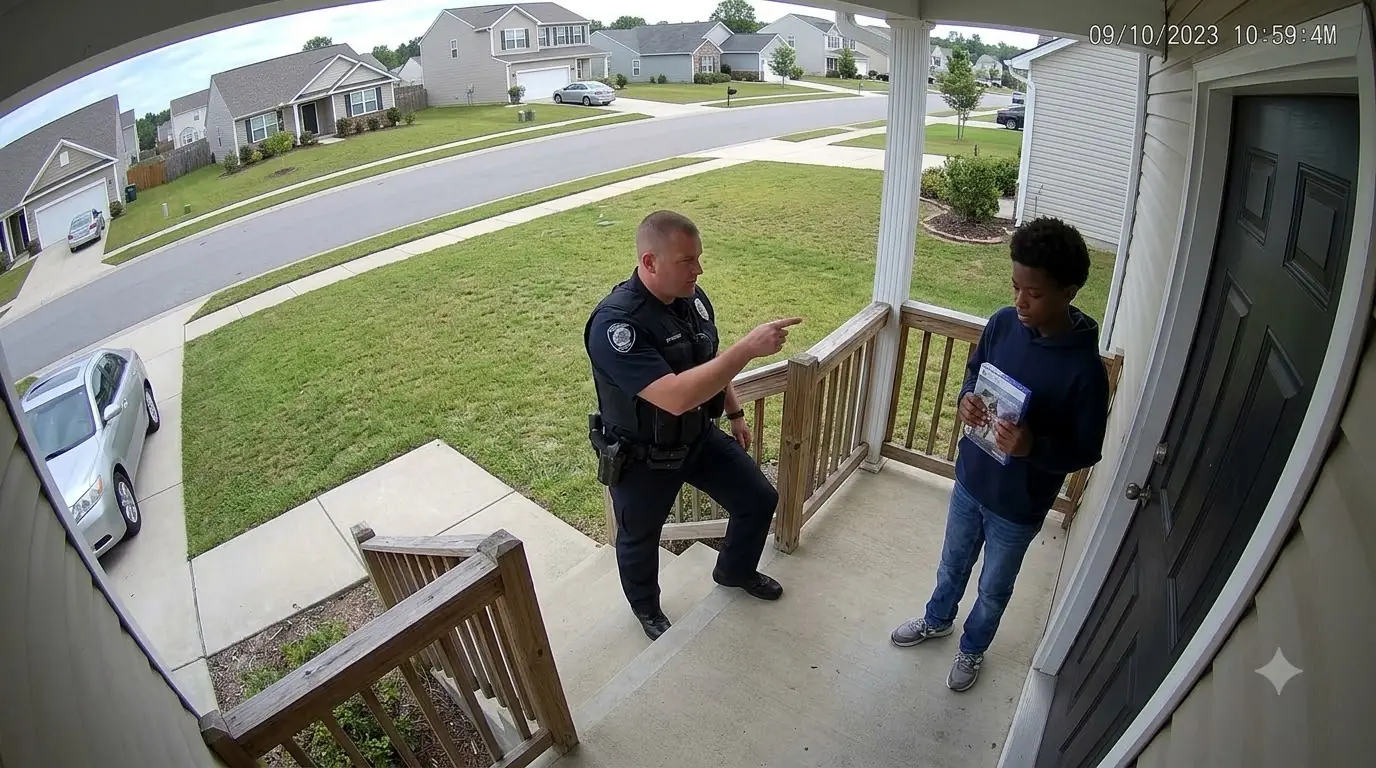
They walked home together through the quiet suburban streets of Maple Grove, North Carolina, tossing a football back and forth as they went. Their backpacks bounced against their shoulders. The afternoon sun fell in golden strips across the lawns, and every driveway seemed to shine with freshly washed cars, trimmed hedges, and the kind of peace that made Brian want to believe nothing bad could happen there.
“Go long,” Sean shouted.
Brian laughed and took three quick steps backward, raising both hands. Sean threw the ball too hard and too wide. It sailed past Brian’s fingers, bounced once off the curb, and struck the side door of a silver sedan parked in the driveway across the street.
The sound was not loud, but it was sharp enough to make both boys freeze.
“Oh no,” Sean whispered.
Brian stared at the car, then at the front window of the house behind it. “That’s Mrs. Smith’s car.”
Sean’s face drained. “She’s going to kill me.”
The front door opened before either boy could move. Mrs. Evelyn Smith stepped onto her porch in a pale sweater and white slacks, her mouth already tight with anger. She was a retired real estate agent who had lived on the street for decades and spoke as if every blade of grass in the neighborhood personally belonged to her. She had never liked children playing near her lawn, never liked noise, and never liked Brian.
“Hey!” she snapped. “I saw what you just did.”
Sean took a nervous step forward. “I’m really sorry, Mrs. Smith. We were just messing around. I didn’t mean to hit your car.”
Mrs. Smith came down the walkway and bent to inspect the door. There was a faint mark near the handle, hardly more than a smudge, but she touched it as if the entire car had been destroyed.
“There is a dent,” she said coldly. “You had better hope you can fix it, or I am calling the police.”
“Please don’t call the police,” Sean said quickly. “I’ll fix it. I swear.”
Mrs. Smith looked at him, and her expression softened in a way that made Brian’s stomach tighten. Sean was small, pale, blond, and wide-eyed. Adults usually smiled at him even when he did something wrong.
“Not you, honey,” Mrs. Smith said.
Sean blinked. “Me?”
Brian’s throat tightened. “Mrs. Smith, I didn’t throw the ball.”
Sean stepped in front of him. “He didn’t do it. I did.”
“Don’t cover for him,” Mrs. Smith said, her voice turning sugary and poisonous at the same time. “I know an angel like you didn’t do that.”
Brian looked down at his sneakers. He had been in this family since he was four years old. He and Sean had grown up in the same house, eaten at the same kitchen table, built blanket forts in the same living room, and fought over the same cereal. But moments like this reminded Brian that some people only saw one thing first.
“It was him,” Mrs. Smith continued. “He’s been skulking around this neighborhood anyway.”
“I haven’t been skulking around,” Brian said. “I live here.”
Mrs. Smith laughed without humor. “You live here?”
“He’s my brother,” Sean said loudly.
“Your brother?” Mrs. Smith looked between them. “Do you expect me to believe that?”
“It’s true,” Sean said. “He’s my brother.”
Mrs. Smith’s eyes narrowed. “Look at your skin color. Do you think I was born yesterday?”
Brian felt the familiar heat rise behind his eyes, but he swallowed it down. He had learned early that anger made people believe whatever they already wanted to believe. His mother had told him he had every right to speak up. His father had told him silence should never be forced on him. But Brian also knew Mrs. Smith lived two houses away and could make life harder for all of them if she wanted to.
“Ma’am,” Brian said quietly, “I can try to clean the mark.”
Sean spun toward him. “Brian, no. I did it.”
“It’s okay,” Brian said, trying to sound older than twelve. “Just go home. Tell Mom I’ll be late for dinner.”
Mrs. Smith folded her arms. “That is the first smart thing you have said. Now get over here and start working on that dent. You better hope you can fix it, boy. If you don’t, I am calling the police and having you arrested. You are going to end up in jail sooner or later anyway.”
“Yes, ma’am,” Brian whispered.
Sean stood there for a moment, fists clenched, face red with guilt. Brian nodded toward home, silently begging him to leave before things got worse. Sean finally turned and ran down the sidewalk.
When Sean reached the house, their mother, Karen Miller, was in the kitchen setting plates on the table. She was a nurse at the county hospital, a woman with tired eyes, strong hands, and the kind of calm voice that could steady a room full of panic. She looked up when Sean came in alone.
“Where’s your brother?”
Sean dropped his backpack near the door. “He’s at Mrs. Smith’s house fixing her car.”
Karen paused. “Why would he be doing that?”
Sean swallowed. “Don’t get mad.”
“That sentence has never once helped me not get mad,” Karen said.
“We were playing football, and I hit her car.”
“Sean Miller,” she said, rubbing her forehead. “How many times have I told you not to play ball near the neighbors’ yards?”
“I know. I’m sorry.”
“Then why is Brian fixing it?”
Sean’s eyes filled with frustration. “That’s the weird part. I told Mrs. Smith I did it. Brian told her too. But she wouldn’t believe us. She kept saying she knew Brian did it.”
Karen’s expression changed. The tiredness vanished. Something harder settled behind her eyes.
“Mrs. Smith said that?”
“Yeah. She said Brian was skulking around the neighborhood. She said we couldn’t be brothers because of our skin color.” Sean’s voice cracked. “Mom, why would she say that?”
Karen pulled out a chair and sat down slowly. She had known this conversation would come one day, but knowing did not make it easier.
“Come here, sweetheart.”
Sean stepped closer.
Karen took his hands. “Some people are prejudiced against Brian because he is Black.”
Sean stared at her. “But he’s Brian.”
“I know.”
“He’s my brother.”
“Yes.”
“That’s so stupid.”
Karen gave a sad smile. “Yes, sweetheart. It is.”
Sean looked toward the window, guilt washing over his face. “Why did Brian tell me to leave? Why did he say it was okay?”
“Because Brian has had to deal with things like this before,” Karen said softly. “Sometimes he thinks keeping his head down will make things safer.”
“That’s not fair.”
“No,” Karen said. “It isn’t.”
Sean wiped his eyes angrily. “I didn’t know. I never noticed.”
Karen squeezed his hands. “Now you do. And now you know what kind of brother you need to be.”
Sean nodded. “After dinner, can we go over there and tell Mrs. Smith she was wrong?”
Karen stood. “After dinner, I’m going over there myself.”
But before she could make that promise fully, a sharp cry echoed from outside.
“Mom!”
Sean turned toward the front door. “Was that Brian?”
Karen was already moving.
Brian had finished wiping the mark from Mrs. Smith’s car and had hurried home as fast as he could. By the time he reached his porch, the package was waiting by the front door. His name was printed across the label in bold black letters.
Brian smiled for the first time that afternoon. For one second, everything else disappeared. Mrs. Smith, the football, the humiliation, the ache behind his ribs. The game had arrived. He bent down, picked up the box, and turned it over in his hands.
That was when the police cruiser rolled to a stop at the curb.
A tall white officer stepped out, one hand already resting near his taser. His name tag read Officer Dale Mercer. He looked at Brian, then at the package, then at the house behind him.
“Hey there, you little thug,” Officer Mercer said. “What are you doing at this house?”
Brian froze. “What?”
“I asked what you’re doing at this house.” The officer walked closer. “You don’t belong here.”
Brian clutched the package to his chest. “I live here, officer.”
Officer Mercer looked up at the house with its white shutters, flower boxes, and welcome mat. “I know for a fact a white family lives here.”
“Sir, I really do live here,” Brian said. “This is my house. See?”
He turned the package so the officer could see the name.
The officer leaned closer. “Brian Miller.” He laughed once. “You expect me to believe your name is Brian?”
“It is,” Brian said, voice trembling now. “I’m telling you the truth. It’s a video game I ordered.”
“Opening another person’s mail is illegal,” Officer Mercer said. “I’m going to have to take you down to the station.”
“No, sir. Please. Leave me alone.”
“Step away from the door.”
Brian backed toward the porch. “This is my house.”
“I’m not going to tell you again.” Officer Mercer’s hand moved to his taser. “Back away from the door.”
“Mom!” Brian shouted. “Mom, help!”
Officer Mercer’s face hardened. “Do not yell.”
“Please don’t shoot me,” Brian cried.
“You’re not supposed to be in this neighborhood,” Mercer said. “Mrs. Smith called and told me you were causing problems earlier. I was willing to give you a chance, but now you’re resisting.”
“I’m not resisting. I live here.”
“That’s it,” Mercer said, pulling the taser free. “I’m going to have to taser you.”
The front door flew open.
Karen rushed onto the porch, Sean right behind her. “What is happening?”
Officer Mercer turned, suddenly changing his tone. “I’m sorry to disturb your evening, ma’am. I just caught this delinquent trying to steal a package off your front porch.”
Karen stared at him. “What are you talking about? He wasn’t stealing anything. He lives here.”
The officer blinked. “Ma’am, you’re telling me this kid lives here?”
“Yes,” Karen said. “He told you that, didn’t he?”
“He did, but I thought he was lying.”
“Why?” Karen asked.
Officer Mercer shifted. “Well, I mean, look at him.”
Sean stepped forward, face blazing. “It’s because he’s Black, isn’t it?”
“Sean,” Karen said quietly, though she did not tell him he was wrong.
Officer Mercer cleared his throat. “He just didn’t look like he would live here.”
Karen came down the steps slowly, placing herself between the officer and Brian. “Say what you mean.”
“Ma’am, I made a mistake.”
“No,” Karen said. “You threatened my twelve-year-old son with a weapon because you decided he didn’t belong on his own porch. You accused him of stealing his own package because you decided a Black child could not be part of this family.”
Officer Mercer’s jaw tightened. “I was responding to a call.”
“From Mrs. Smith?” Karen asked.
“She reported a suspicious person.”
“His name is Brian,” Sean said. “He’s not suspicious. He’s my brother.”
Officer Mercer looked from Sean to Brian. “Your brother?”
Karen’s voice grew colder. “My son.”
Brian stood behind her, shaking. The package had fallen at his feet. His hands were still raised halfway, as if his body had not yet realized the danger had passed.
Karen turned and pulled him into her arms. Brian held on tightly, burying his face in her shoulder. Sean wrapped his arms around them both.
Officer Mercer holstered the taser awkwardly. “I apologize for the misunderstanding.”
Karen looked at him over Brian’s head. “This was not a misunderstanding. This was prejudice with a badge.”
The next morning, Karen filed a formal complaint with the Maple Grove Police Department. She did not file it quietly. She brought Sean. She brought Brian. She brought the package with Brian’s name on it. She brought security camera footage from her front porch, which had captured every word Officer Mercer had spoken.
The police captain, Robert Hale, watched the footage in silence. He was a heavyset man in his late fifties with gray hair and a face carved by years of bad news. When the video ended, he did not immediately speak. He replayed the moment when Officer Mercer said, “I know for a fact a white family lives here.” Then he replayed the moment when Brian pleaded not to be shot.
Karen sat across from him with both sons beside her.
Captain Hale looked at Brian. “I am sorry.”
Brian stared at the floor.
Hale turned to Karen. “Your complaint will be investigated immediately.”
“No,” Karen said. “My complaint will be handled honestly. There is a difference.”
Captain Hale nodded once. “You’re right.”
Two days later, Officer Mercer was called into the captain’s office.
He entered with his uniform pressed and his posture stiff, trying to look like a man who had done nothing more than make an unfortunate error. Captain Hale sat behind his desk with the complaint file open in front of him.
“You wanted to see me, sir?” Mercer asked.
“Yes,” Hale said. “I received a call from a very upset mother saying you threatened and tasered—” He stopped himself, jaw tightening. “Threatened to taser her twelve-year-old son on his own porch.”
Mercer swallowed. “It was just a misunderstanding. I thought he was breaking into her house.”
“She says you thought that because he was Black.”
“Sir, I’m really sorry. It won’t happen again.”
Captain Hale stood. “No. You’re right. It won’t happen again.”
Mercer’s eyes widened. “Sir?”
“Because you’re fired.”
“Please, sir. Don’t fire me. This job is all I have.”
“You should have thought of that before you aimed a taser at an innocent child.” Hale pushed the badge return form across the desk. “There is no place for prejudice on this police force. Not in my department. Not under my name.”
Mercer stood motionless.
“Badge and service weapon,” Hale said. “Now.”
Mercer’s hands shook as he removed them. Whatever apology he might have made stayed trapped behind his teeth. The captain did not ask for one.
That evening, Karen gathered both boys at the kitchen table. The video game box sat unopened in front of Brian. Sean had not asked to play it once.
“I’m sorry,” Sean said again.
Brian looked at him. “You already said that.”
“I know. I just keep thinking about Mrs. Smith’s car. If I had stayed, maybe—”
Brian shook his head. “You were trying to help. She wasn’t going to listen.”
Sean looked down. “Next time, I’m not leaving you.”
Brian was quiet for a moment. Then he slid the game box across the table. “Then next time, player two is yours.”
Sean smiled a little. Karen watched them and felt her heart ache with love and anger at the same time. She wished the world had never taught Brian to lower his voice. She wished Sean had never needed to learn what prejudice looked like in a neighbor’s driveway. But she also knew something had shifted in their family. Sean had seen the truth, and Brian had seen that he did not have to carry it alone.
A week later, Mrs. Smith received a visit from Karen.
Karen did not shout. She did not threaten. She stood on the porch with the kind of calm that made Mrs. Smith look away first.
“You called the police on my son,” Karen said.
“I was concerned about the neighborhood.”
“No,” Karen said. “You were wrong about a child, and instead of admitting it, you put him in danger.”
Mrs. Smith folded her arms. “People are too sensitive these days.”
Karen’s voice did not rise. “My son was twelve years old. He was standing on his own porch. He begged an officer not to shoot him because of a story you started.”
For the first time, Mrs. Smith’s face shifted. Not enough to become remorse, but enough to become discomfort.
“I didn’t tell the officer to do that,” she muttered.
“You told him Brian didn’t belong,” Karen said. “That was enough.”
Karen turned to leave, then stopped. “Sean hit your car. Brian tried to protect him because he knows how people like you see him. If there is any decency left in you, sit with that.”
Mrs. Smith said nothing.
The neighborhood did not change overnight. Nothing important ever did. But people talked. Some defended Mrs. Smith. Some defended Brian. Some said the officer had simply made a mistake. Others had seen the porch footage and knew better. The story moved from house to house, from driveway to driveway, until silence was no longer comfortable.
At school, Sean told his class what had happened during a discussion about fairness. He did not use big words. He did not make a speech. He simply said, “My brother shouldn’t have to prove he belongs in his own family.”
Brian heard about it later from a friend and pretended not to care. But that night, when Sean asked if he wanted to play, Brian tossed him the second controller before he even sat down.
Months passed. The dent in Mrs. Smith’s car was gone. The football stayed in the garage for a while, then came back out carefully, cautiously, never toward the street. Brian still checked the porch whenever a cruiser passed by. Karen still watched his face when he did. Sean noticed too, though he no longer asked why.
But Brian also started standing taller.
Not all at once. Not like a movie. Just little by little. He answered questions in class without lowering his hand halfway. He stopped apologizing when adults stared too long. He let Sean introduce him proudly as “my brother” without trying to soften the moment for anyone else.
And on one quiet Saturday afternoon, nearly a year after the incident, Brian and Sean sat on the porch steps waiting for another delivery. This time it was a new controller they had ordered together.
Sean nudged him. “You think it’ll come today?”
Brian smiled. “It better. You still owe me a rematch.”
A delivery truck turned onto the street.
Brian glanced at it, then at the porch camera, then at the street where the police cruiser had once stopped. The memory passed through him like a shadow, but it did not stay.
Sean looked at him. “You okay?”
Brian nodded. “Yeah.”
The truck pulled up. The driver walked over, checked the label, and handed Brian the box without hesitation.
“Here you go, Brian Miller.”
Brian took it. “Thanks.”
The driver left. Sean grinned.
Brian looked down at his name printed clearly on the package. Same porch. Same house. Same family. But this time, nobody told him he didn’t belong.
He tucked the box under one arm, opened the front door, and stepped inside with his brother beside him.