The first thing Isaiah heard was the officer's voice.
"You think I'm stupid?"
He froze with one hand inside the paper smoothie bag and the other gripping the strap of his backpack. The August sun beat down on the strip mall parking lot, baking the asphalt until the air shimmered above it. Cars crawled past the smoothie shop, the phone store, the discount shoe place, and the small electronics store at the end of the row. A woman pushed a cart toward her minivan. A delivery driver leaned against his open door checking an address. Everything around Isaiah felt normal until that voice cut through the noise like a door slamming shut.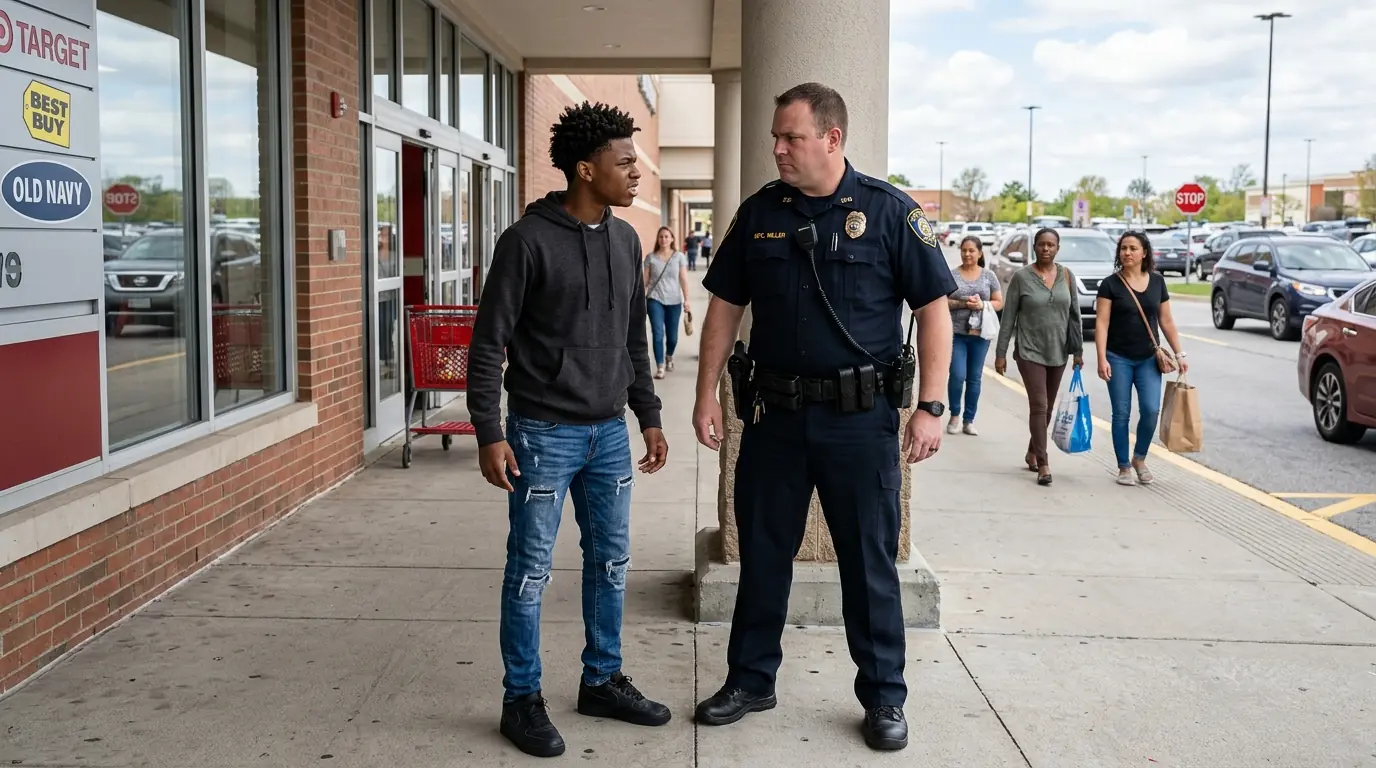
He turned and saw the patrol car angled behind him, blocking the narrow lane between two rows of parked cars. The officer had already stepped out. He was broad, square-jawed, and red-faced from the heat, with one hand resting near his belt as if he had already decided the situation was dangerous. His name tag read Whitaker. His eyes moved over Isaiah's hoodie, his backpack, the paper bag in his hand, and then back to Isaiah's face.
Isaiah was fifteen, tall for his age but still built like a kid who had grown too fast, all long arms and sharp shoulders. He wore a gray hoodie despite the heat because the smoothie shop was always freezing inside and because his mother had told him to grab something before they left the house. His curls were still damp from basketball practice that morning. He had bought a mango smoothie for himself, a strawberry one for his brother, and an extra paper cup of ice water because his mom said the car's air conditioning was acting up again.
"Store says male hoodie grabbed speakers from electronics," Officer Whitaker said, walking closer. "That's you."
Isaiah blinked. "What?"
"You heard me."
"I was at the smoothie place with my brother."
"Your brother?" The officer gave a short, humorless laugh. "Right. Where is he?"
"Right there," Isaiah said, looking past the officer.
Ethan stood about twenty feet away near the smoothie shop door, holding his own drink with both hands. He was thirteen, pale and freckled, with the same gray hoodie tied around his waist because he had gotten too hot. His hair was light brown, his cheeks still round in a way that made strangers call him sweetheart even when he did not want them to. He looked terrified and confused, his eyes darting between Isaiah and the officer.
"Officer," Ethan said, voice cracking, "that's my brother. We were just getting smoothies over there."
"Zip it," Whitaker snapped without looking at him. "I didn't ask you. Stay there or I'll make this your problem too."
Ethan stopped moving.
"Empty your pockets," Whitaker ordered. "Slow."
Isaiah swallowed. "I didn't steal anything."
"Empty. Your. Pockets."
People nearby began to slow down. The woman with the cart stopped beside her minivan. A man in a baseball cap lifted his phone halfway, then hesitated. The smoothie shop door opened, and two girls stepped out, both staring.
Isaiah set the paper bag on the hood of a parked sedan because his hands had started to shake. He pulled out his phone, a crumpled receipt from the smoothie shop, a house key, and three coins. He placed everything on the hood.
"Backpack," Whitaker said.
"You can check it," Isaiah said. "There's nothing in there."
The officer took the backpack, yanked it open, and rummaged through it. A notebook fell onto the ground. So did a pair of basketball socks and a paperback book from school. Whitaker flipped through the compartments quickly, aggressively, as if stolen speakers might appear if he looked angry enough.
Nothing.
"Where'd you hide it?" Whitaker asked.
"I don't have anything."
"Back car? Dumpster? Under a seat inside?"
"I didn't take anything."
Whitaker stared at the empty backpack, then at Isaiah. "You ditched it before I rolled up, huh? Smart."
"So every kid with a hoodie is stealing now?" Isaiah asked before he could stop himself.
The officer's eyes hardened. "A kid with an attitude like yours, yeah."
"Officer," Ethan said, stepping forward, "this is really unnecessary. He didn't do anything. We were with our mom."
Whitaker pointed at him. "I said stay there."
Isaiah's mouth went dry. He saw his mother through the smoothie shop window, standing at the counter arguing about the receipt. The cashier had charged her twice by mistake, and she had gone back inside to fix it while the boys waited outside. She had only been gone a few minutes. Somehow, in those few minutes, the world had rearranged itself into something ugly.
Whitaker tossed the backpack back at Isaiah. The notebook and socks were still on the ground. "Turn around."
"What?"
"Turn around. Hands on the car."
"I know my rights," Isaiah said, his voice trembling despite his effort to keep it steady. "You need probable cause."
"You want to play lawyer now?" Whitaker stepped closer, lowering his voice. "I got all day. I'll call for backup. We'll sit here until your rights sweat off."
"Hey," Ethan said, louder now. "He didn't do anything."
"I said shut your mouth, kid," Whitaker barked. "Last warning. You want cuffs too?"
Ethan flinched.
Isaiah felt everyone watching him. The woman with the cart. The man with the phone. The girls from the smoothie shop. A couple walking past with takeout containers. Their eyes did not feel like help. They felt like heat lamps, bright and useless.
Whitaker grabbed Isaiah's wrist.
"Whoa," Ethan shouted. "Don't grab him like that."
"Stay there," the officer snapped. "Think you're tough? Think your silence makes you innocent? Makes you guilty to me."
Isaiah looked down at the officer's hand clamped around his wrist. His smoothie sat forgotten in the bag, melting. His phone lay on the hood beside his receipt. His breath shortened. He could hear his pulse in his ears.
"Mom," he said, barely above a whisper.
Whitaker leaned closer. "What was that now? You got something you want to say?"
Then a voice came from behind him.
"My son," the woman said. "I said get your hands off my son."
Officer Whitaker turned. Denise Carter walked across the parking lot fast, her receipt still clutched in one hand, her face tight with a kind of calm Isaiah knew meant she was seconds away from exploding. She was forty-one, small but strong from years of carrying groceries, laundry baskets, backpacks, and family worries all at once. Her dark hair was pulled into a bun, and she wore a navy blouse from work with the sleeves rolled up. Her eyes moved from Isaiah's face to the officer's hand on his wrist.
"Ma'am, step back," Whitaker said. "This is police business. I don't know who you are."
"I'm his mother," Denise said. "What's the charge, officer?"
"He fits the call we got. Male, hoodie, theft at Store Four. We don't need a charge to detain a suspect."
Denise looked at Isaiah, then at Ethan. "That's my son. This is also my son. Same hoodie. Neither of them were at that store. They were with me at the smoothie place."
Whitaker's eyes flicked to Ethan, then back to Isaiah. "Both your sons? That's convenient."
"Convenient?" Denise repeated quietly.
"Look, lady, I go off the description I got. His behavior says he was hiding something."
"Behavior?" Denise stepped closer, but not close enough for him to accuse her of interfering. "All right. Let's talk behavior. You have two kids in hoodies. You only stopped one. You only searched one. And you only put hands on one. Explain that."
The officer's jaw flexed. "I see where this is going. I don't think this is racial profiling. I don't care what color they are. I care about the call and the attitude I'm getting."
"No," Denise said. "His attitude says he's done. This happens to us every time we go out. Gas station. Mall. Store. Parking lot. My white son walks, and my Black son gets the wall. Every time."
Ethan stared at the ground, shame coloring his face, though none of it was his fault. Isaiah could see the pain in his brother's expression, the awful realization that their mother was naming something he had noticed but never fully understood. Ethan had been questioned by adults before, but never like this. Never with a hand on his wrist. Never with a crowd watching.
Whitaker released Isaiah's wrist, but only to point at him. "Kid, stay still while we ID him and clear it."
A crackle came over the officer's radio.
"Unit Three-Twelve, update from Store Four. Suspect located near rear loading dock. Male in red hoodie, stolen speakers recovered. Stand down on unrelated stops."
The parking lot fell very quiet.
Whitaker shifted his weight. "Yeah," he said into the radio. "Copy."
Denise stared at him.
The officer cleared his throat and forced a thin smile that did not reach his eyes. "All right. Misunderstanding. See, we got our guy. We're good? You folks have a nice day, okay? No hard feelings?"
"No," Denise said. "We're not done."
Whitaker looked annoyed. "Ma'am—"
"You had the chance to protect, not profile. You chose wrong."
Isaiah bent down and picked up his notebook and socks. His hands were still shaking. He wanted to leave. He wanted to disappear. But something inside him, something heavy and tired and older than fifteen, would not let him move.
He looked at the officer.
"You want to know what my behavior says?" Isaiah asked.
Whitaker looked surprised that he was speaking.
Isaiah's voice was low at first, but it grew steadier with each word. "It says tired. Tuesday, I got followed out of 7-Eleven. The clerk watched my hand. I bought gum. Thursday, mall security stopped me coming out of the sports store. He said I looked nervous. I was tying my shoe. Today, you. So the next time you see a Black boy like me and he's not smiling, not scared, just empty, it's not because he's guilty. It's because he doesn't know how to win."
The crowd stood still. Even the traffic seemed to quiet.
Isaiah swallowed. His throat hurt, but he kept going. "So tell me, officer, how do I get up every morning, put a smile on, and get through the day when I'm already guilty before I leave the house? You get accused of being something you're not enough times, and you start thinking maybe you should be that. Save everybody the time."
Denise's eyes filled with tears, but she did not interrupt him.
"But I'm not going to do it," Isaiah said. "I'm not going to let you be right. And maybe that's how I win. Not today, but someday. I am."
Whitaker looked at the ground.
For the first time, he did not have a quick answer.
"I'm sorry," he said finally, barely audible. "So sorry."
Denise went to Isaiah and put both hands on his face, making him look at her. "Hey. Look at me. That voice? That's what wins. Every time you tell the truth and walk away still standing, you win. Do you hear me? You win."
Isaiah nodded.
Ethan stepped beside him and put an arm around his shoulders. "Yeah, bro," he whispered. "You did good. Love you."
"Love you too," Isaiah said.
They gathered the smoothies, though none of them wanted them anymore, and walked to the car. Denise did not let the matter end in the parking lot. Before they even left, she wrote down Officer Whitaker's name, badge number, and patrol car number. The man in the baseball cap, who had finally recorded the last half of the stop, gave her his phone number. The woman with the shopping cart offered to be a witness. The smoothie shop cashier printed the receipt showing the exact time the boys had bought their drinks. The manager even pulled security footage showing Isaiah, Ethan, and Denise inside the smoothie shop during the time the electronics store theft happened.
At home, Isaiah went straight to his room. He did not slam the door. Somehow, that made Denise worry more. Ethan stood in the hallway holding his melted strawberry smoothie, looking smaller than he had that morning.
"Mom," he said, "why did he only think Isaiah did it?"
Denise leaned against the kitchen counter. She had answered versions of that question before, but never to Ethan with tears in his eyes.
"Because some people see the world through fear and bias," she said. "And sometimes that means they don't see people as people."
"But I was wearing a hoodie too."
"I know."
"And I talked back too."
"I know."
Ethan looked toward Isaiah's door. "I should've done more."
Denise crossed the kitchen and pulled him into her arms. "You spoke up. That mattered. But this isn't your guilt to carry. It belongs to the officer who chose not to listen."
That night, Denise filed a formal complaint with the police department's internal affairs division. She attached the receipt, the witness names, and the smoothie shop footage. She wrote every detail she could remember: the accusation, the search, the threat of backup, the hand on Isaiah's wrist, the officer's refusal to explain why only Isaiah had been targeted. She did not write it like an angry mother, though she was one. She wrote it like a woman building a wall brick by brick, because she knew people in power loved to dismiss pain if it arrived without paperwork.
Three days later, Sergeant Marisol Vega called her.
"Mrs. Carter," she said, "I've reviewed your complaint and the evidence you sent. I want you to know we are opening a formal investigation."
Denise closed her eyes. "Good."
"I also want to apologize for what happened to your son. The footage from the smoothie shop confirms he was not at the electronics store during the theft. The store's own footage also shows the actual suspect was wearing a red hoodie, not gray."
"Then why did Officer Whitaker stop my son?"
There was a pause.
"That's what we're investigating."
The investigation lasted six weeks. Officer Whitaker was placed on administrative duty while internal affairs reviewed his body camera, radio transmissions, and previous stops. Denise did not expect much. She had seen enough stories end with words like misunderstanding and retraining. But Sergeant Vega was thorough in a way Denise had not expected.
She found twelve prior complaints involving Officer Whitaker and young Black men stopped near stores, gas stations, bus stops, and parking lots. In five of those cases, the alleged suspects were later cleared within minutes. In three, security footage showed the people stopped had never been near the reported incident. In one case, a seventeen-year-old had missed a scholarship interview because Whitaker detained him for forty minutes after a shoplifting call even though the caller had described someone ten years older.
None of those complaints had led to discipline. Each had been treated as separate. Each had been written off as a reasonable response to a vague description. Sergeant Vega put them together and saw the pattern.
At the review hearing, Denise sat with Isaiah on one side and Ethan on the other. Isaiah wore a button-down shirt because he wanted them to know he had come prepared, but he kept his sleeves pulled down over his wrists. Ethan stayed close enough that their shoulders touched.
Officer Whitaker sat across the room with a union representative. He looked smaller without the parking lot and the patrol car and the crowd behind him. When asked why he searched Isaiah and not Ethan, he said he had followed instinct. When asked what specific behavior suggested guilt, he said Isaiah had seemed defensive. When asked whether a child falsely accused by police might reasonably appear defensive, he had no answer.
Then Isaiah spoke.
He did not shout. He did not cry. He read from a page he had written the night before.
"I don't want your apology if it only means you're sorry you got caught," he said. "I want you to remember that when you stop someone, you're not stopping a description. You're stopping a person. You stopped me like I was already guilty. My brother was standing right there wearing the same hoodie, and you didn't even see him as a suspect. I need you to ask yourself why. Not for me. For the next kid."
The room stayed silent after he finished.
Two weeks later, the department announced disciplinary action. Officer Whitaker was suspended without pay, removed from patrol, and ordered into mandatory bias and de-escalation training. More importantly, the department changed its policy on vague suspect descriptions. Officers responding to retail theft calls would now be required to confirm specific identifiers beyond race, gender, and clothing before detaining someone, especially minors. Body camera review would be mandatory for all stops involving juveniles. Parents or guardians had to be notified immediately when a minor was detained for questioning without arrest.
Denise wanted Whitaker fired. Part of her still did. But Isaiah surprised her.
"At least the policy changed," he said one evening while sitting on the porch.
Denise looked at him. "That doesn't make what happened okay."
"I know," he said. "But maybe some other kid won't have to stand there like I did."
Ethan sat beside him, turning a basketball between his hands. "I keep thinking about what you said. About maybe becoming what they think you are."
Isaiah looked away.
"Don't," Ethan said. "Don't ever let them decide who you are."
Isaiah gave a small smile. "You sound like Mom."
"Good," Ethan said. "She's usually right."
The next month, the electronics store theft case made local news for a different reason. The actual suspect, a nineteen-year-old from another county, had been caught on camera selling the speakers online. He confessed to the theft and admitted he had run through the back of the shopping center wearing a red hoodie. The article barely mentioned Isaiah. Denise was grateful. Her son did not need his name attached to someone else's crime forever.
But the incident stayed with them.
For weeks, Isaiah hesitated before entering stores. He kept his hands visible without realizing it. He stopped wearing the gray hoodie even though it had been his favorite. When Denise noticed it folded at the bottom of his drawer, she sat beside him on his bed.
"You don't have to wear it," she said. "But don't let him take it from you."
Isaiah looked at the hoodie for a long time. The next Saturday, he wore it to the park.
Nothing happened. No one stopped him. No one accused him. He played basketball with Ethan until sunset, and when they walked home, his shoulders were a little less tight.
The following spring, Isaiah was invited to speak at a youth forum hosted by the community center. The topic was trust between police and young people. He almost said no. Then Ethan reminded him, "That voice wins."
So Isaiah went.
He stood in front of fifty teenagers, parents, teachers, and a few officers, including Sergeant Vega. His hands shook at first, but he kept them on the podium until they steadied.
"I used to think winning meant proving I didn't do anything," he said. "But sometimes people who already think you're guilty don't care about proof. So now I think winning means not letting someone else's fear change who you are. It means telling the truth. It means asking for accountability. It means still walking into the world even when the world has made you tired."
In the back row, Denise wiped her eyes. Ethan clapped first, loudly and without shame. Others joined.
After the forum, a younger boy approached Isaiah. He was maybe eleven, wearing a red hoodie and holding his mother's hand.
"That happened to me once," the boy said quietly. "At a gas station."
Isaiah crouched a little so they were eye level. "I'm sorry."
"Were you scared?"
Isaiah thought about lying. Then he shook his head. "Yeah. I was."
"What did you do?"
Isaiah glanced at his mother, then at Ethan. "I told the truth. And I let the people who loved me stand with me."
The boy nodded like that answer mattered.
Years later, Isaiah would still remember the parking lot, the heat, the officer's hand on his wrist, and the feeling of being watched by strangers who did not know whether to help. But he would also remember his mother stepping forward. He would remember Ethan saying, "That's my brother." He would remember the witnesses who gave their names, the manager who printed the receipt, and the sergeant who finally looked at the pattern instead of the excuse.
He would remember that one bad moment did not get to define him.
And every time he saw another kid walking through the world with his hood up, trying to look tough because looking tired felt too vulnerable, Isaiah would think of what his mother told him in that parking lot.
Every time you tell the truth and walk away still standing, you win.
So he kept standing.
Even when the world tried to make him bend.