Marcus Reed had learned long ago that the most dangerous moments were often the quiet ones.
Not the courtroom arguments that made headlines.
Not the board meetings where men twice his size tried to talk over him until he dismantled their positions one sentence at a time.
Not even the tense nights twenty years earlier, when he was a young prosecutor walking into neighborhoods where people looked at his suit and decided he had chosen the wrong side.
No. The most dangerous moments were the ordinary ones. The ones that began with a flashing light in the rearview mirror and a voice already convinced you had done something wrong.
That Friday afternoon, the highway outside Briar County looked harmless enough.
The sky was clear. The traffic was light. Heat shimmered above the shoulder in soft ripples. Marcus’s black sedan moved in a steady line between long stretches of scrub grass and distant utility poles. He was forty-eight now, the gray at his temples showing more clearly whenever the light hit just right, but his hands were steady on the wheel and his mind was where it usually was on a workday—three steps ahead.
He was headed to a leadership summit in Ashcroft, where he had been invited to speak about police accountability, prosecutorial reform, and the growing tension between public trust and public power. The irony of that destination would only become obvious later.
At first he barely noticed the patrol SUV pulling out from the median.
Then the lights came on.
Marcus exhaled once, slow and controlled, and signaled as he eased onto the shoulder.
He knew the routine.
Window down partway.
Hands visible.
No sudden movements.
Voice calm.
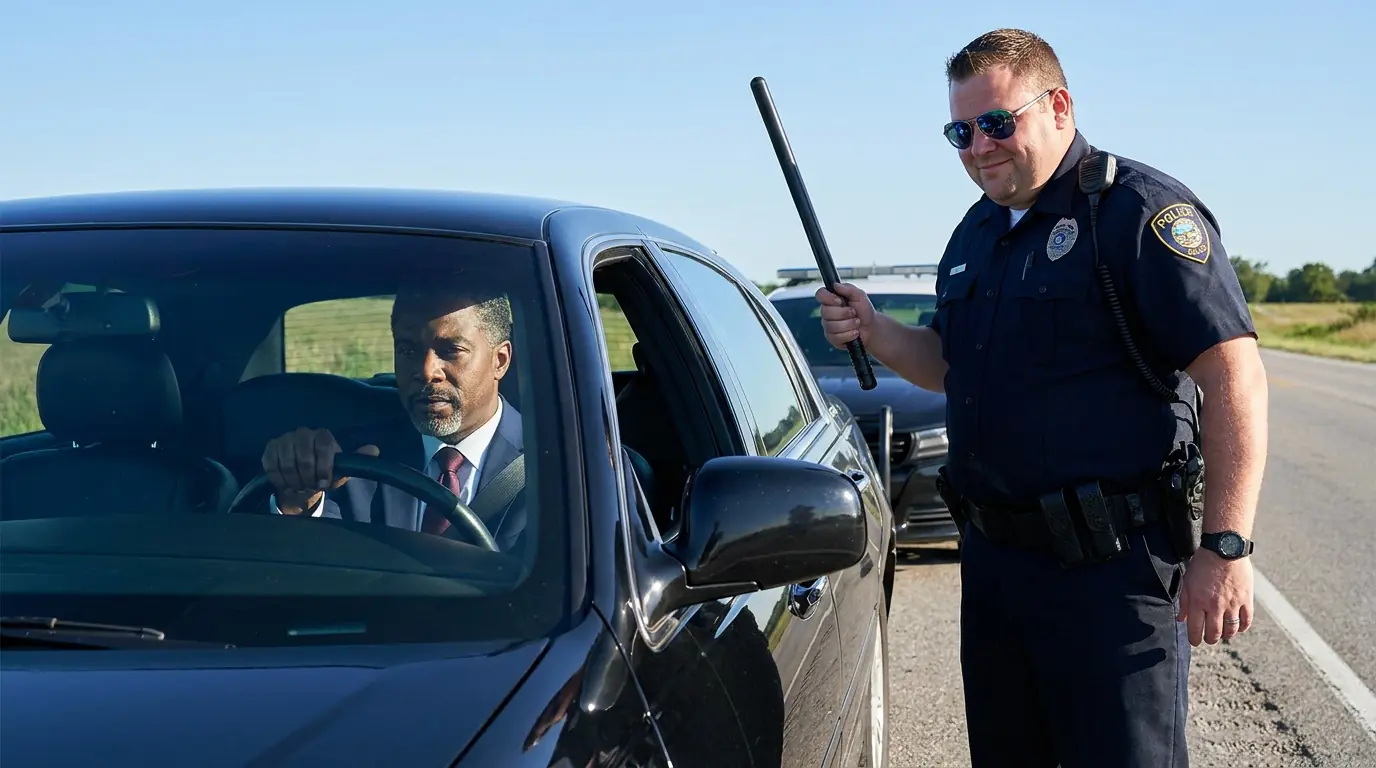
The sedan rolled to a stop on the gravel edge of the highway. A few seconds later, a white patrol cruiser with county markings stopped behind him. Through the side mirror Marcus watched the driver’s door open and a large officer step out.
Heavy build. Square shoulders. Navy uniform. Mirrored sunglasses. Baton already in hand.
That last detail made Marcus frown.
Most officers approached a routine stop with a hand near their belt, maybe a thumb tucked into the vest. This man walked toward the sedan gripping the metal baton openly, swinging it once against his leg as if enjoying the weight of it.
Marcus kept both hands on the steering wheel.
The officer came up fast and stopped beside the driver’s window, not quite looking at Marcus as a person, more like he was looking at a problem he had been waiting to solve all day.
“License and registration,” he snapped.
Marcus turned his head slightly. “Officer, my registration is in the glove compartment. My license is in my jacket pocket. I can get both if you tell me which you want first.”
The officer’s mouth twisted.
“I didn’t ask for a speech.”
Marcus said nothing.
The officer leaned closer to the glass. “Roll the window all the way down.”
Marcus lowered it a little more, but not fully. “I’m happy to cooperate. I’d just like to know the reason for the stop.”
The officer gave a short, humorless laugh.
“You don’t get to question me. Roll it all the way down and step out of the car.”
Marcus kept his hands where they were. “I will comply, officer. I’m just asking why I was pulled over.”
The grin that appeared on the officer’s face was the kind some men wore when they mistook cruelty for authority.
“Because I said so.”
The air inside the car seemed to change.
Marcus had heard that tone before—not from professionals, but from men who enjoyed the part of the badge that let them decide when another person’s dignity ended.
“Officer,” Marcus said evenly, “I am not refusing. I’m asking for a lawful reason.”
The officer stepped back half a pace. His jaw tightened. The baton rose in his hand.
“Step out,” he barked, louder now, “or I’ll drag you through this window.”
Marcus looked directly at him.
The officer must have expected fear, or pleading, or anger. What he got instead was calm.
“You’re making a mistake,” Marcus said.
The officer’s grin widened.
“Who’s going to stop me?”
Then he swung.
The baton smashed into the driver’s side window with a sharp explosive crack. Tempered glass fractured instantly, then collapsed inward in a glittering rush across Marcus’s lap and the passenger seat. He turned his face and raised an arm instinctively as shards scattered across the leather.
The officer laughed.
Actually laughed.
Then he reached through the ruined window toward the inside door handle.
Marcus lowered his arm and looked at him.
No panic. No shouting. Just a long, steady stare that landed harder than most men’s threats.
“You just crossed a line,” he said quietly.
The officer—his nameplate read MERCER—started to pull at the lock.
That was when the second patrol vehicle arrived.
It came in too fast, tires spitting gravel as it braked behind Mercer’s cruiser. The driver’s door flew open and another officer stepped out, older, taller, rank bars glinting on his collar.
Lieutenant Alan Whitaker had been on the force twenty-three years. He had seen enough bad stops to know one the second he stepped into it. But what made him move faster wasn’t the broken glass.
It was the car.
Black sedan. State judicial parking decal low on the windshield. Custom plate he recognized from a briefing downtown two weeks earlier.
Whitaker’s eyes widened.
“Oh, hell.”
He strode forward just as Mercer got the driver’s door open and reached for Marcus’s arm.
Whitaker grabbed Mercer’s wrist so hard the baton nearly slipped from his hand.
“Me,” Whitaker said, voice like iron. “Get your hands off him—now.”
Mercer jerked back, startled. “Lieutenant, this guy—”
“I said let him go.”
Mercer stared at him. “He was refusing commands.”
Whitaker shoved his arm away from the car. “And you smashed his window?”
“He was noncompliant.”
Whitaker looked through the broken glass into the sedan.
Marcus Reed was sitting exactly as before, back straight, suit dusted with safety glass, burgundy tie still centered beneath his collar. There was a shallow cut on his cheek where a shard had caught him, but his expression was controlled.