The morning came in gray and quiet. The kind of cold that settles into stone benches and empty coffee cups left overnight. Frost clung to the edges of the fountain in the middle of the park, and the last of the autumn leaves drifted down in slow spirals, gold and rustcoled, scattering across the gravel paths. Joggers passed with their breath fogging in front of them, barely glancing at the woman who sat on the third bench from the fountain, wrapped in a coat two sizes too large. She held a worn leather notebook against her knees.
Its cover cracked from years of handling, and a thin silver necklace hung from her neck, tucked beneath the collar of her coat. Nobody in that park knew her name. Nobody could have guessed that within the hour, armored vehicles would tear through the quiet streets surrounding that very fountain. Sirens silent but lights flashing, converging on a scene that would end one man's career and reveal a secret 3 years in the making. For now she was simply the woman on the bench, and the city moved past her the way it moved past all things it had already decided not to see.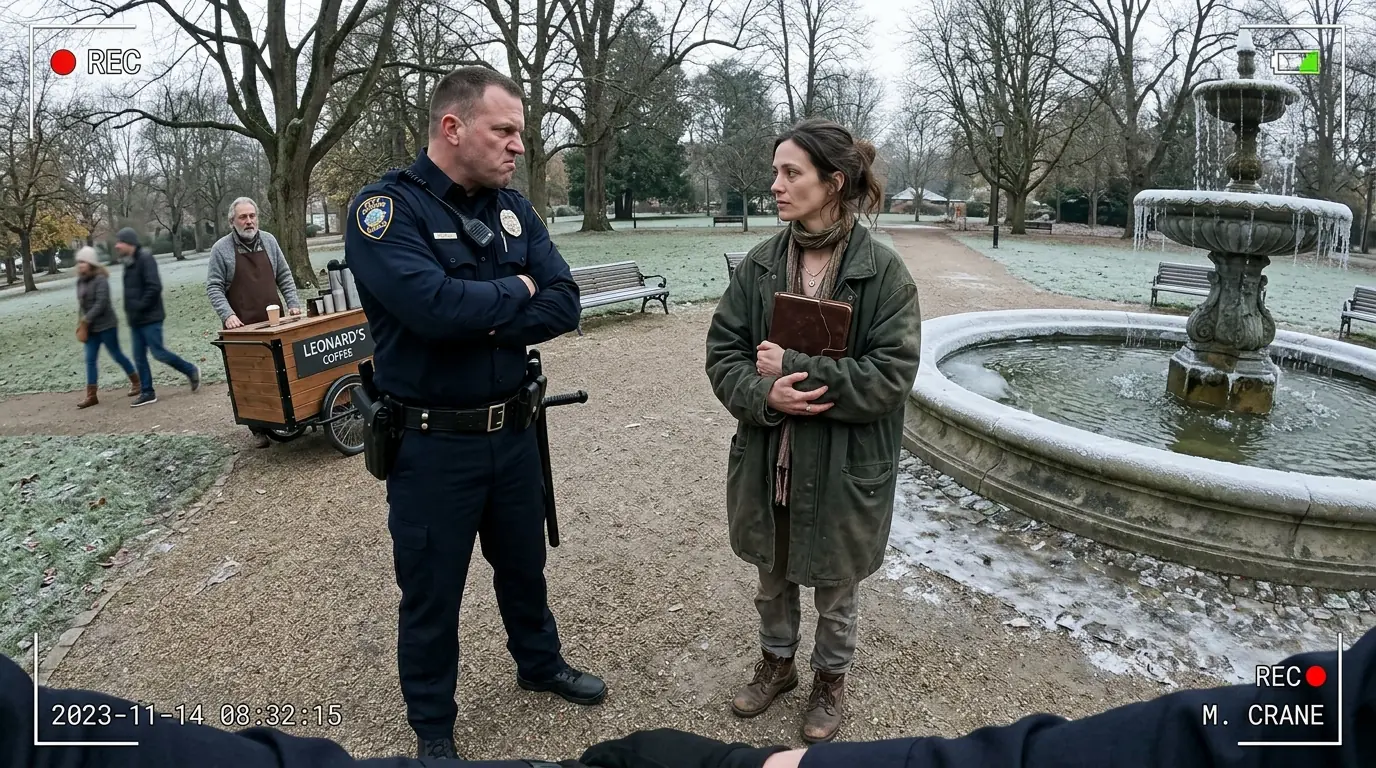
Her name was Zariah Monroe, 34 years old, though the lines under her eyes, and the way she moved with careful deliberation made her seem both younger and far older at once. She wrote in that notebook every single day, filling its pages with small, tight handwriting that curled across the lines like something rehearsed a thousand times before. Some of the regulars who passed through the park assumed she was troubled that the constant writing was a symptom of something broken in her mind and they gave her the same wide birth people give to anything they do not understand. What none of them knew was that she was not rambling at all. She was recording methodically the way a scientist records data, the small transactions of kindness and cruelty that passed through that park every single day.
She wrote about the man who fed the pigeons before dawn. She wrote about the teenager who mocked an elderly man for shuffling too slowly across the crosswalk. Each entry was dated, precise, and utterly without judgment, as though she were building an archive that only she understood the purpose of. Leonard Price ran the coffee cart near the north entrance, a business he had built with his own hands over 22 years, and he was the closest thing Zariah had to a friend in that park. Every morning around 7, he would bring her a paper cup of black coffee, no charge, and sat it gently on the bench beside her without a word, because he had learned early on that she did not like to be approached directly.
He noticed things about her that others missed, the way she spoke when she did speak, careful and precise, using words that did not belong to someone who had supposedly spent her life on the street. He noticed how she never begged, never asked for money, and how she always stood and gave a small bow of the head when someone showed her kindness as though gratitude were a discipline she practiced rather than a feeling she merely had. Once when a tourist's map blew away in the wind, it was Zariah who explained the fastest route to the memorial three blocks over. speaking with the confidence of someone who had memorized the entire city grid. Leonard filed these details away without asking questions, because in his experience, people who had been broken by the world rarely wanted to explain how. Even the squirrels along that stretch of path seemed to recognize her rhythm, scattering only when strangers approached, and staying near her bench without hesitation, as though her stillness had become part of the landscape itself.
An older man named Curtis, who had lived on those benches for nearly a decade, once told Leonard that Zariah reminded him of someone important, though he could never say who, and he laughed it off as an old man's foolish memory. Nobody pressed him further, and the thought passed like so many others in that park, unexamined and forgotten. The truth sat quietly inside Zariah's notebook. Inside the silver necklace she never removed, inside the calm she carried like armor. And that morning, as the frost began to melt off the fountain's edge, a police cruiser turned slowly onto the access road that ran along the park's northern boundary, its engine humming low against the cold, carrying with it a man who was about to make the worst mistake of his career.
Officer Travis Boon had been patrolling that district for 11 years, and in that time he had developed a worldview so rigid it had calcified into something resembling certainty. He believed with the kind of conviction that never bothered to question itself that anyone living without a permanent address was one bad moment away from causing real trouble. He had built his entire career on that belief, stopping people for the crime of existing somewhere visible, and more often than not, his superiors had looked the other way because his numbers looked good on paper. That morning, dispatch had relayed a vague complaint phoned in by someone who claimed a woman near the fountain was harassing customers at a nearby kiosk. Though the details were thin, and the caller had already hung up by the time officers were assigned, Travis took the call anyway, eager as always to be the one who restored order, and he pulled his cruiser up along the curb with the practiced swagger of a man who had never once doubted his own righteousness.
Beside him sat Officer Melissa Crane, 38 years old, quieter by nature, who had ridden with Travis for the better part of a year, and had learned to read the tension in his jaw before he ever opened his mouth. She did not share his certainty, not entirely, but she had also not yet found the courage to say so out loud. They stepped out of the cruiser and walked toward the fountain. Travis leading with the kind of exaggerated stride meant to announce his authority before he ever spoke a word. Zariah looked up from her notebook, calm and unhurried, closing it slowly and folding her hands over the cover.
Travis stopped a few feet away and pointed toward the path leading out of the park. "Leave this area," he said, his voice pitched loud enough for the nearby joggers to hear. Loud enough to be a performance rather than a request. Zariah tilted her head slightly, studying him the way someone studies a puzzle rather than a threat, and she asked quite simply what law she had broken. The question landed wrong in Travis's ears, because in his mind, questions from people like her were not questions at all.
They were defiance, dressed up as curiosity. His jaw tightened, and something in his shoulders squared itself for confrontation, the way it always did when he sensed his authority being tested. A cyclist slowed his bicycle to a stop near the fountain path, one foot still on the pedal, watching the exchange with the particular curiosity of someone who sensed a story unfolding before it had fully arrived. Two women walking a small terrier paused as well, exchanging glances, their conversation trailing off mid-sentence as Travis's voice climbed another register above what the moment seemed to actually require. Melissa shifted her weight, glancing between her partner and the woman on the bench, sensing the temperature of the moment rising faster than the situation seemed to warrant.
A few pedestrians slowed their pace, phones still in pockets, but attention sharpening, the way a crowd gathers around tension even before it understands what it is witnessing. Leonard from behind his coffee cart 30 ft away straightened up and watched with a growing knot in his stomach because he had never once seen Zariah cause a single moment of trouble in all the months he had known her. Travis raised his voice again, demanding she stand and move along immediately, his hand drifting toward his belt in a gesture that was less about safety and more about theater. Sariah rose slowly from the bench, not out of obedience, but out of the same careful deliberation that governed everything she did, her notebook tucked under one arm. The wind picked up just then, sudden and sharp, tugging a thin scarf from around her neck and sending it tumbling across the gravel path toward the fountain's edge.
And in that single unremarkable moment, everything was about to go terribly wrong. Zariah bent down without a word to retrieve the scarf, a motion so plain and human that under any other circumstance it would have gone entirely unnoticed. But Travis, already primed for confrontation, already convinced in his own mind that this woman intended to resist him, saw the movement as something else entirely. He saw defiance. He saw a threat dressed in the shape of a simple gesture.
And before Melissa could even open her mouth to intervene, his hand shot out and struck Zariah hard across the face. The sound of it cracked through the cold morning air like something breaking, sharp and final. And for one suspended second, the entire park seemed to stop breathing. Her silver necklace snapped loose from its clasp and fell to the gravel with a small metallic clink that somehow seemed louder than the slap itself. She did not cry out.
She did not stumble. She simply stood there for a moment, one hand raised slowly to her cheek, and the stillness of her reaction was somehow more devastating than if she had screamed. Leonard was the first to break the silence, shouting from behind his cart, telling Travis in no uncertain terms that he had gone too far, that the woman had done nothing wrong. Melissa stepped forward quickly, placing a hand on her partner's arm, her voice low but urgent, telling him to stand down, that this had crossed a line neither of them could walk back from. But Travis, flushed now with the strange mixture of adrenaline and humiliation that comes from being watched in a moment of overreach, refused to back away.
He reached for his handcuffs instead, insisting loudly that the woman had resisted a lawful order and needed to be restrained immediately, his voice cracking slightly under the weight of his own justification. Around them, a small crowd had gathered, phones now raised, faces caught somewhere between horror and disbelief at what they had just witnessed in broad daylight. Zariah knelt slowly and picked up her fallen necklace from the gravel, cradling it in her palm as though it were something far more precious than silver. She looked up at Travis, then, her expression unreadable, her cheek already reening from the blow, and she spoke only a single sentence, quiet, but unmistakably clear. "You have just made a very serious mistake," she said.
And there was nothing in her tone that resembled a threat, only a kind of quiet, terrible certainty. Travis scoffed, waving off her words as the desperate bluff of someone trying to talk her way out of consequences, and he reached for the cuffs at his belt regardless. Melissa's stomach twisted because something about the woman's calm did not match the panic she would have expected from someone genuinely afraid, and she found herself hesitating, unsure for the first time that morning whose side the truth actually belonged to. The crowd murmured louder now, someone shouting for the officers to stop. Another voice insisting that this had all been caught on a phone camera from across the path.
Travis, sweating despite the cold, seemed not to hear any of it, fixed entirely on restoring the authority he felt slipping away from him by the second. And nobody in that park, not Leonard, not Melissa, not even Travis himself, understood yet just how quickly that authority was about to collapse entirely. Melissa finally stepped fully between her partner and the woman, her hand raised, telling him firmly that she was taking over the situation from this point forward. She turned to Zariah, softening her voice, asking if she needed medical attention for her cheek, and searching her face for any sign of the aggression Travis had claimed to see. There was none.
No slurred words, no smell of alcohol, no erratic movement, nothing in her posture or her eyes that matched the description. Phoned in by the anonymous caller who had started this entire chain of events. Melissa had seen enough intoxicated and volatile individuals in her career to know the difference immediately. And what she saw instead was a woman standing with more composure than most people manage during a routine traffic stop. A woman standing near the fountain, a stranger to Leonard and to the park itself, spoke up unprompted, saying she had watched the same woman calm an anxious child on a bench weeks earlier when the boy's mother had briefly lost sight of him near the carousel.
Another onlooker, an older gentleman with a folded newspaper under his arm, admitted quietly that he had exchanged polite morning greetings with Zariah for the better part of a year, and had never once seen her raise her voice at anyone. Leonard came out from behind his cart, despite the risk of leaving it unattended. Walking straight up to the officers and insisting loudly enough for the gathering crowd to hear that Zariah had spent months helping people in that exact park. He told them how she had guided lost tourists to their hotels, how she had once talked down an argument between two elderly men over a parking dispute near the entrance, how she had helped an anxious mother locate her missing toddler stroller during a busy afternoon the previous summer. Passers be, who had paused to watch, began nodding along, a few even adding their own small memories of the quiet woman on the bench, who never asked for anything, but somehow always seemed to give something.
Travis, cornered now by the mounting testimony, insisted stubbornly that appearances meant nothing, that people like her were unpredictable, no matter how calm they seemed in any given moment. He reached again for his cuffs, determined to salvage some version of the authority he had walked in with, and Melissa opened her mouth to stop him outright. But before either officer could take another step, the radio clipped to Travis's shoulder crackled sharply to life. An urgent transmission cutting through the tension. Dispatch relaying words that made every officer with an earshot go suddenly and completely silent.
The transmission came through in clipped, controlled tones, the kind used only when something far above the paygrade of a district patrol officer was unfolding. All units in the vicinity of the park were to hold position immediately and await further instruction, the voice said, because a federal security detail was inbound and would be arriving within minutes. Travis frowned, confused, glancing toward Melissa as though she might explain what federal business could possibly involve a homeless woman and a routine disturbance call. Neither of them had time to speculate further because the sound reached them before the vehicles even came into view. a low mechanical rumble growing steadily louder along the access road. A jogger who had stopped near the treeine described it later as the sound of something arriving with purpose, an engine note too disciplined and too heavy to belong to any ordinary emergency response.
Then the SUVs appeared, three of them, black and armored, moving with a precision that suggested rehearsal rather than chaos, sweeping around the fountain in a formation that closed off every exit from that section of the park. Pedestrians who had gathered to watch the earlier confrontation now backed away instinctively, some pulling out phones again, others simply staring in stunned silence as doors opened before the vehicles had even fully stopped. Men in dark suits stepped out first, moving with the disciplined efficiency of trained security personnel, forming a loose perimeter around the fountain without a single wasted motion. Local officers who had begun arriving as backup froze at the site, uncertain whether to assist, retreat, or simply stand at attention because nothing in their training had prepared them for this particular collision of worlds. Then from the middle vehicle, an older man stepped out, tall and silver-haired, dressed simply, despite the obvious weight his presence carried over everyone around him.
He did not pause to speak with the security detail, did not wait for any briefing or explanation, and instead walked directly and swiftly toward the small crowd gathered near the fountain, his eyes locked on one figure alone. It was Dr. Isaiah Monroe, 62 years old. the national security adviser of the United States, a man so rarely seen outside of secured briefings, that most of the officers present did not even recognize his face at first. He crossed the last few steps at nearly a run, and when he reached Zariah, he did not ask a single question. He simply pulled her into his arms. The crowd fell into a silence so complete it felt almost physical. every officer, every pedestrian, every phone camera frozen on the sight of the nation's most guarded adviser, embracing a woman they had all assumed was nothing more than another face lost to the streets.
Isaiah pulled back after a long moment, his hands still on her shoulders, and his eyes caught the redness blooming across her cheek, where Travis's hand had landed only minutes earlier. His expression shifted instantly, grief and fury moving across his face in the same breath, and for a moment, he seemed unable to speak at all. Melissa felt her stomach drop entirely, the pieces reassembling themselves in her mind far too quickly to process, and beside her, Travis had gone the color of old paper, his earlier bravado evaporating into something closer to panic. Leonard simply stood frozen behind his cart, coffee cup still in hand, watching a man he had only ever seen on television, now standing inches from the woman he brought coffee to every single morning. Nobody moved.
Nobody spoke. The only sound in that stretch of the park was the low idle of the SUVs and the distant indifferent traffic beyond the trees, utterly unaware that history had just quietly rearranged itself beside a fountain. Nobody would ever look at the same way again. Isaiah turned slowly from his daughter to the assembled officers. And though his voice remained level, there was an unmistakable weight behind every word.
The kind of authority that did not need volume to be felt, he asked plainly and without theater, who among them had struck her. Nobody answered immediately, the silence stretching long enough to become its own kind of confession, until Melissa finally stepped forward and explained as clearly and honestly as she could exactly what she had witnessed. She did not soften it, did not offer excuses for her partner, because something in her had already decided that the truth mattered more in that moment than the fragile loyalty of a badge. Travis opened his mouth to interject, some half-formed explanation about a lawful order and non-compliance, but the words died somewhere in his throat under the weight of Isaiah's gaze. One of the security agents quietly requested access to the park surveillance cameras, and within minutes, footage was being pulled directly onto a tablet, the entire encounter replaying in silence for everyone gathered to see.
There, in unforgiving clarity, was the scarf caught by the wind, the simple bend to retrieve it, and the strike that followed, with no provocation whatsoever. Isaiah watched the footage without a word, his jaw tightening with each replayed second, and when it ended, he looked up not at Travis, but at the small crowd that had gathered around them. He introduced Zariah to them, then plainly and without embellishment, confirming what half of them had already begun to suspect. This was his daughter," he said, and the words landed across that stretch of park like a stone dropped into still water, rippling outward into stunned disbelief. Several onlookers actually laughed at first, a nervous, disbelieving sound.
Certain this had to be some elaborate misunderstanding rather than fact. But the agents standing at attention around Isaiah, the identification quietly produced from Zariah's coat pocket, and the unmistakable resemblance now visible in the shape of her eyes and the set of her jaw left no real room for doubt. Melissa felt something cold settle in her chest as the full scope of the morning's events came into focus, understanding now that this was not simply a mistake that could be quietly buried in a report. Travis, for his part, said nothing at all, his eyes fixed on the ground, as though staring hard enough might make the last 20 minutes rewind themselves into something survivable. Isaiah asked for a moment alone with his daughter, and the agents obligingly widened their perimeter, giving the two of them space near the fountain while the rest of the park watched from a respectful distance.
He asked her quietly now how long she had been out here, how long she had let him believe she was simply away on some extended personal retreat rather than sleeping on benches in the cold. Zariah's answer came slowly, each word chosen with the same careful precision she brought to everything else. and what she told him unraveled a story that none of the officers or bystanders could have imagined. Three years earlier, she said she had walked away from her old life entirely, not out of any conflict with her father, not out of any breakdown or crisis, but out of a deliberate and calculated choice. She wanted to understand firsthand and without the shield of her father's position, exactly how the country treated the people it had chosen to stop seeing. She had spent her final weeks before disappearing quietly, closing out old accounts, donating clothing that no longer suited the life she intended to build, and memorizing the layout of shelters and soup kitchens across three different neighborhoods, so she would never need to ask for directions once she began.
She had left no trace, told no one, and built a life among the very people society had trained itself to look past. all so she could document with total honesty what that life actually was. Isaiah listened without interrupting. His expression somewhere between heartbreak and something that looked almost like pride, though grief clearly outweighed in that moment. She explained that she had never once used his name or his position to make her circumstances easier. Not when she was turned away from shelters that had reached capacity.
Not when she went hungry on nights the coffee cart was closed. Not even now, standing in a park with a reening cheek and a father who commanded federal security details. She had kept a notebook the entire time, filling page after page with observations, dates, and names, an unbroken record of small cruelties and small kindnesses that most people never bothered to notice at all. It was, she said quietly, the most honest research she had ever conducted, more honest than anything produced in the sterile briefings and policy meetings that defined her father's world. Melissa, standing close enough to overhear fragments of the conversation, felt her eyes fill without quite understanding why, some mixture of shame and awe tightening in her chest.
Leonard too had gone quiet, realizing only now the full weight of the woman he had been serving black coffee to for months without asking a single question. And somewhere behind them, Travis stood utterly alone, already sensing that his career, his reputation, and every certainty he had carried into that park that morning were about to collapse entirely. One of the security agents carefully retrieved the leather notebook from where it had fallen near the bench, offering it back to Zariah with a gentleness that suggested he understood, even without being told, how much it mattered. She opened it slowly, flipping through pages dense with handwriting, and for the benefit of those still gathered nearby, she began reading a few entries aloud, her voice steady despite everything that had just happened. There were accounts of an elderly veteran who shared his last sandwich with a stranger during a snowstorm the previous winter.
There were accounts of teenagers who mocked and filmed unhoused men for entertainment, laughing as they walked away. There were entries about small acts that most people would never think twice about. A woman leaving an umbrella behind on purpose during a sudden downpour. A shop owner who quietly slipped extra bread into a bag without ever mentioning it. Each entry was dated and precise, written with the same discipline Leonard had noticed from the very beginning, never once softened by judgment or exaggeration.
Then came the entries that made the gathered crowd fall utterly silent, because among the thousands of pages recorded over 3 years, certain names appeared again and again. Leonard's name surfaced repeatedly, always in connection with small, unglamorous kindnesses, free coffee on freezing mornings, a blanket quietly left on a bench during a particularly hard week in January. Melissa's name appeared as well, noted for the times she had deescalated tense situations with other officers, for the moments she had chosen patience over force, even when her partner had not. And Travis appeared, too, though his entries carried a very different weight. each one a quiet, careful documentation of moments where his badge had become less a symbol of protection and more an instrument of unnecessary force. Zariah had never confronted him directly about any of it before that morning, had simply recorded what she witnessed, the way a historian records events without needing to insert herself into them.
She had written, too, about the small mercies extended by strangers who never learned each other's names. A stranger paying for another's groceries during a busy afternoon rush. A delivery driver leaving extra food outside the pavilion without ever announcing it. Standing there now, hearing her own words read back in the cold morning air, she seemed almost surprised by how plainly the truth had assembled itself over time, waiting only for the right moment to be spoken aloud. The pattern in those pages did more than simply confirm what everyone standing in that park had already witnessed firsthand only minutes earlier.
It painted a fuller picture of who Travis Boon truly was when he believed no one of consequence was watching. A portrait built not from a single mistake, but from a long accumulation of small abuses that had simply never been challenged before. Melissa realized with a growing weight in her stomach that she had seen fragments of this pattern for months and had chosen again and again to stay quiet rather than risk the discomfort of confrontation, Leonard felt something close to vindication mixed with sorrow, grateful that someone had finally written down what he had always sensed, but never had the standing to prove, Isaiah closed his eyes briefly as his daughter finished reading, absorbing not just the record of cruelty towards strangers, but the specific entry describing the very moment his daughter had been struck without cause only minutes before his arrival. When he opened his eyes again, his voice was calm, but there was an unmistakable finality in it. The tone of a man who had heard more than enough, he instructed one of his agents to formally contact the department's internal affairs division, ensuring that what happened that morning would not simply disappear into a quietly buried incident report.
Word moved quickly once the internal affairs investigators arrived on scene. Their presence, a formality by that point, given the overwhelming evidence already assembled between the surveillance footage, the notebook, and dozens of witnesses still lingering near the fountain. Travis was placed on immediate administrative leave right there in the park. his badge and service weapon collected in full view of the very crowd that had watched him strike an unarmed woman without provocation. He said very little throughout the process. The earlier bravado, completely drained from his posture, replaced instead by the hollow stillness of a man watching the consequences of his own choices arrive all at once.
Melissa, for her part, gave a full and unflinching statement to investigators, refusing the easier path of vague or careful language that might have shielded her partner from the worst of it. When she finished, she turned to Zariah and offered a quiet, genuine apology, not for anything she herself had done, but for every moment she had stayed silent when speaking up might have mattered. Zariah accepted it with the same calm she had carried throughout the entire ordeal, telling her gently that recognizing the moment now still counted for something, even if it had come only after the damage was already done. Leonard, still standing near his cart with his coffee gone cold in its cup, finally allowed himself to step forward and embrace Sariah, no longer holding back the disbelief and relief tangled together in his chest. he told her, voice thick with emotion, that he had always known there was something remarkable about her, even if he never could have imagined this particular truth. Isaiah watched the exchange quietly, and rather than pulling his daughter away into the waiting security of his vehicles, he simply stood beside her, allowing the moment between her and the people who had shown her kindness to unfold without interruption.
He made a point before the crowd eventually began to disperse of personally thanking both Leonard and Melissa for the decency they had shown his daughter during the months she had lived entirely outside his knowledge and protection. He made no threats toward the department, sought no retribution beyond what the facts themselves demanded, insisting instead that the process be allowed to run exactly as it would for anyone else in Travis's position. Investigators later noted that the clarity of the evidence, the surveillance footage, the notebook, and the consistent testimony from multiple witnesses made the case one of the most straightforward disciplinary reviews the department had processed in years, leaving almost no room for the usual delays or quiet dismissals. It was, in its own quiet way, the loudest statement he could have made, choosing accountability through proper channels rather than the raw exercise of power that so many in his position might have reached for instead. And as the SUVs eventually pulled away from the fountain that afternoon, the park itself seemed changed.
The frost long melted, the story already spreading from mouth to mouth faster than any official statement could contain it. In the weeks that followed, the investigation into Travis Boon moved with unusual speed. The combination of video evidence, written testimony, and the notebook's corroborating entries, leaving almost no room for the kind of ambiguity that so often allowed similar cases to quietly stall. He was formally terminated from the department, stripped of his badge for good, and referred for further legal proceedings that would unfold independent of any political pressure. exactly as Isaiah had insisted from the very first afternoon. He did not appear in public again during that period, and those who had known him at the precinct spoke of him afterward, mostly in careful, uncomfortable silences, unwilling to defend what the footage had made undeniable.
Melissa, meanwhile, found herself transformed by the entire experience in ways she had not anticipated, volunteering to help design new training protocols, focused specifically on deescalation, and on recognizing the dignity of people too often rendered invisible by uniforms and assumptions. She spoke at several internal sessions about that morning by the fountain, not to center herself in the story, but to make clear exactly how easily silence can become complicity when it goes unexamined for too long. Leonard's small coffee cart became something of a quiet landmark after word spread through the neighborhood. Though he never allowed the attention to change how he ran it, still handing out free coffee to anyone who looked like they needed the warmth more than they could afford to pay for it. Zariah in the months that followed did not retreat immediately back into the private guarded life her father's position might have offered her.
Instead, she spent that time finishing what she had started 3 years earlier, transcribing the thousands of handwritten pages from her notebook into a manuscript that would eventually become a book, unflinching in its portrayal of both cruelty and grace among people who rarely made it into any headline at all. She wrote about Leonard's quiet generosity and about Curtis's strange unspoken recognition of something familiar in her face long before anyone else guessed the truth. She wrote about Travis, too, though she resisted the urge to reduce him to a simple villain, choosing instead to describe plainly and without embellishment the exact pattern of choices that had led him to that single unforgivable moment. When the book was finally published, it moved through the public conversation quickly. Not because of any manufactured controversy, but because of the sheer honesty embedded in every page.
The kind of honesty most people never got the chance to witness firsthand. Curtis, the older man who had lived on those benches for nearly a decade, received a signed copy of the book from Zariah herself, and he kept it folded carefully inside a plastic bag to protect it from the rain. telling anyone who asked that he had known all along. There was something remarkable about the quiet woman who once shared his corner of the park. Isaiah attended her small book launch event months later, choosing deliberately to sit near the back rather than in any seat of honor, content simply to watch his daughter speak as herself rather than as anyone's daughter at all. On a cooler morning many months after that fateful encounter by the fountain, Zariah returned once more to that same park.
Though everything about the moment felt entirely different from the mornings that had come before, she sat on the same bench near the same fountain, but this time she was not hiding behind a borrowed identity, and she was no longer alone in the way she once had been. Around her, a small gathering had assembled, part of a new community initiative she had helped establish alongside several officers, including Melissa, aimed at creating real conversations between local law enforcement and the unhoused population they so often overlooked or misjudged. Leonard was there, too, his coffee cart pulled up close, still handing out cups exactly the way he always had, though now with a quiet pride in knowing precisely who he had been serving all along. Curtis sat beside her on the bench, finally able to say aloud what he had only ever sensed before, that something about her had always carried the weight of someone important, long before the world confirmed it for him. The frost had returned to the fountain's edge again by then, the seasons circling back the way they always do, but the park itself felt entirely different from that cold morning, when a single slap had shattered its quiet indifference forever.
Zariah looked around at the faces gathered near her, some familiar from those long invisible months. Others knew, drawn in by curiosity or hope or simple restlessness. And she understood more clearly than she ever had exactly why she had chosen this path in the first place. status. She often said in the months that followed, whenever asked to explain what those years on the street had truly taught her could make people bow their heads or lower their voices out of obligation. But it was never status that revealed the true measure of a person's character.
It was the way someone treated another human being who had absolutely nothing to offer them in return. No title, no power, no promise of favor or consequence. That," she said quietly, looking out over the fountain where it had all begun, was the only test that ever really mattered. The only truth that could not be faked, bought, or performed for an audience that happened to be watching. Leonard poured another round of coffee that morning, handing cups down the small line that had formed near his cart.
And for the first time in a long while, he found himself smiling without quite knowing why. Melissa lingered near the edge of the gathering, watching the exchange between Zariah and Curtis with a quiet satisfaction, understanding now that redemption rarely arrived as a single dramatic gesture, but instead accumulated slowly, one honest choice after another. She thought back often to that cold morning by the fountain, to the moment she had hesitated instead of acting, and she carried that memory forward, not as guilt, but as a quiet reminder of exactly what silence could cost when it went unchallenged.
Somewhere beyond the trees, the city continued exactly as it always had, indifferent and hurried, entirely unaware that a fountain tucked inside one of its smaller parks had quietly become the sight of something that would outlast the season. Zariah closed her notebook one final time that morning, tucking it beneath her arm the way she always had, and rose from the bench not to hide, but simply to walk among the people who had once looked past her without a second thought. The frost along the fountain's edge caught the pale morning light, and for a long moment nobody spoke at all, content simply to sit together in the quiet that follows, when the truth has finally been allowed to settle.