A hand grabbed the back of a man's collar and slammed him forward against a van. His head hit the metal with a dull crack. The wheelchair rolled out from under him and he dropped hard onto the asphalt. A boot came down and shoved the chair sideways, popping the brake loose. A dog lunged.
Another boot caught the dog in the ribs and sent it yelping across the concrete. The man on the ground didn't shout. He didn't beg. He turned his head slowly with blood on his lip and said six quiet words. Read the name on my vest.
Stitched across the leather in faded white thread was a single word, deacon. And under it three letters most people in that town had only heard about in warnings. What happened in the next four minutes made a grown man in uniform beg. Let me back this up because to understand what happened in that gas station lot, you need to know who was sitting in that wheelchair. And you need to know why the man standing over him made the single worst mistake of his life.
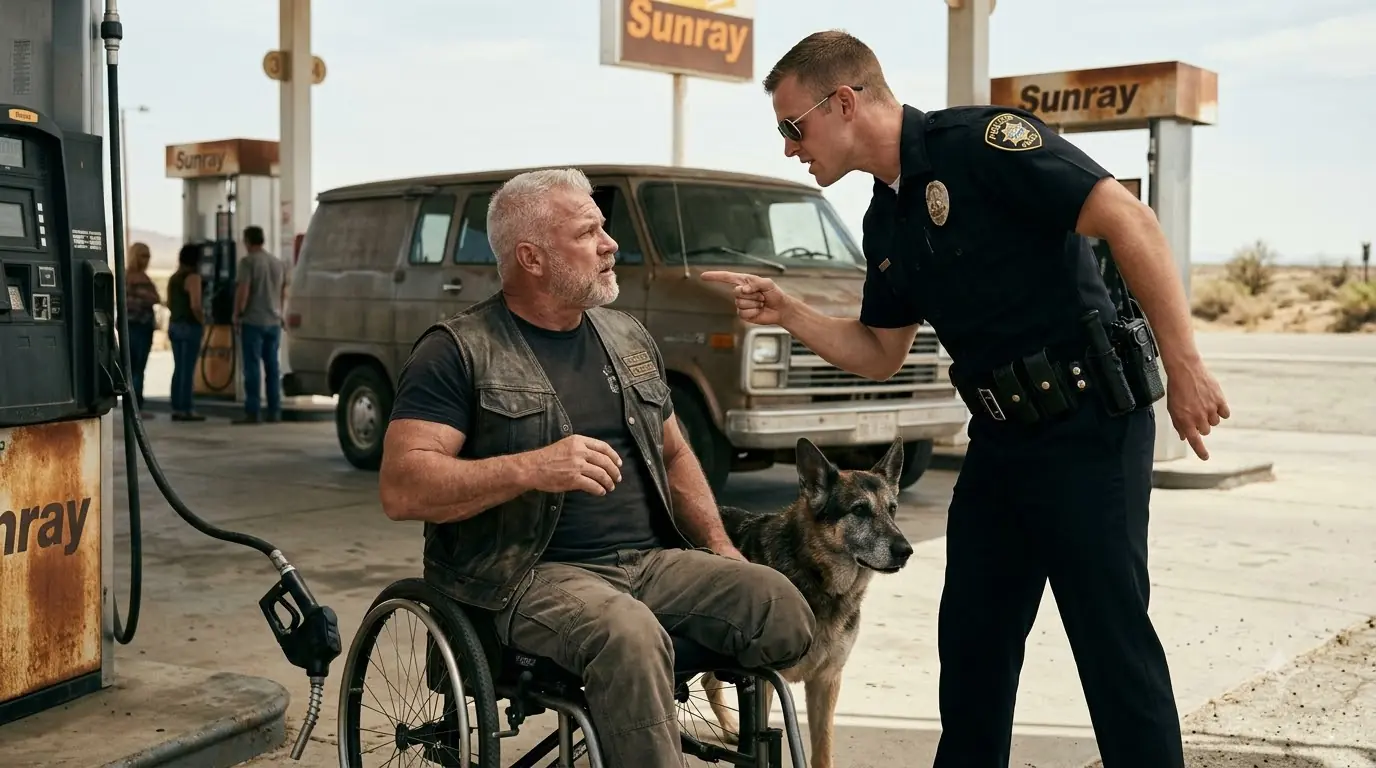
The van pulled into the Sunray station off Route 58 at a little afternoon, 20 m outside Barstow. The heat came off the pavement in waves. The kind of desert heat that makes the air look like water and makes people mean. A ramp folded down from the side door and a man rolled out into the sun.
He was big. Even sitting down, you could tell. Shoulders like a door frame. Forearms thick as fence posts.
A gray beard cut close and a crew cut going white at the edges. 58 years old, both legs gone below the knee. But nobody who looked at him thought weak. There was a stillness to him, the kind you only see in men who have been all the way to the bottom of something and climbed back out.
His name was Marcus Reeves. Everybody who mattered called him deacon. 22 years a United States Marine. Two tours he'd talk about and one he wouldn't.
He lost those legs to a roadside bomb outside Falluja pulling two younger men out of a burning truck before the second blast took him down. He got a medal for it. He never wore it. He kept it in a drawer next to his mother's Bible, and the only time he took it out was on the anniversary every year when he'd sit alone at the kitchen table and hold it a while and put it back.
On the back of his leather cut above those three letters, there was a small patch, a folded American flag. He'd sewn it there himself. The winter he got out of the hospital and was still learning how to live in a body that stopped where it used to keep going. Riding beside the chair, tail low, ears up, was a German Shepherd named Diesel.
Old dog now, gray in the muzzle. He'd been a military working dog once, retired the same year Marcus was, and the two of them found each other at a shelter outside San Diego. The story went that Marcus rolled down the row of kennels, and every dog barked and jumped except one. Diesel stood up, walked to the front of the cage, and sat down in front of the chair like he'd been waiting there the whole time.
Neither one of them had anybody else. Now they had each other. Diesel didn't leave that man's side for anything. Not food, not weather, not thunder.
Marcus rolled up to the pump, set his brake, and reached for the nozzle. Simple thing. Fill the tank. Get a cold bottle of water.
Get back on the road toward home where a porch and a quiet evening were waiting. That was the whole plan for the day. That's when the cruiser pulled in. It came in slow and parked crooked across two spaces like it owned the lot.