The call came through Officer Harold Dickens's radio just after lunch, at the exact moment he had convinced himself that the powdered doughnut in his hand was the best part of his day.
He sat in his patrol car near the west entrance of Mango Park Mall, leaning back with one elbow against the window frame and a paper bag of doughnuts open on the passenger seat. The August heat shimmered over the parking lot. People moved in and out of the mall carrying shopping bags, iced coffees, and the ordinary concerns of a weekday afternoon. To Dickens, it all felt like a waste of his time. He had joined the police department expecting action, respect, and people stepping aside when he walked into a room. Instead, he spent most of his shifts answering minor calls, listening to dispatch, and telling teenagers not to loiter.
"Car seven alpha six," dispatch crackled. "Come back, please."
Dickens sighed and looked at the doughnut as if the radio had personally insulted it. "This is Officer Dickens. Go ahead."
"We have another report of trespassing at Mango Park Mall. Possible solicitation near the southeast corner. Are you still in that area?"
Dickens rolled his eyes. "Yes, I'm still at the mall. I'll check it out."
He dropped the doughnut back into the bag, started the car, and drove slowly around the building. Another report of trespassing. Another person without money being accused of existing too close to people who had some. He had already handled two calls like it that week, and each one irritated him more than the last. In his mind, the problem was never complicated. People were allowed to shop. People were allowed to work. People were not allowed to sit near the doors asking for change and making customers uncomfortable.
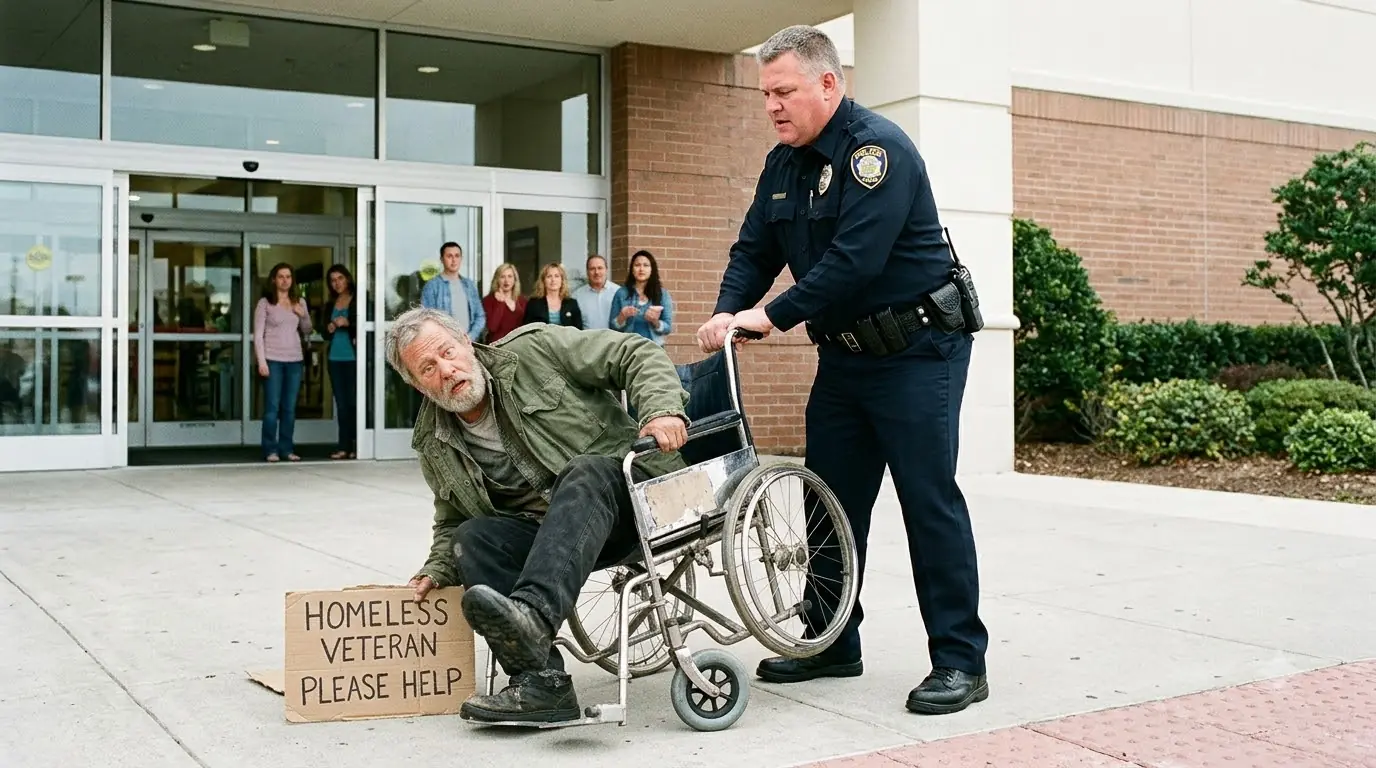
At the southeast corner, near a row of planters and a glass entrance that led toward the food court, he spotted the man almost immediately.
The man sat in a worn wheelchair with one mismatched wheel and a torn cushion flattened by years of use. A faded army-green jacket hung over his shoulders despite the heat. His beard was gray and uneven, and his hands rested loosely in his lap. A small cardboard sign sat against the side of his chair, written in thick black marker: HUNGRY. ANY HELP IS A BLESSING.
Dickens parked badly across two spaces, got out, and slammed his door.
"Hey," he barked. "You right there. Don't move."
The man lifted his head. His eyes were tired but alert. "Hello, officer."
"There's no soliciting in this mall. Can you see the signs?"
The man touched one hand to his ear. "I'm sorry. I can't hear you too well."
Dickens stepped closer and raised his voice. "There is no soliciting. I got complaints that you're harassing customers."
"I'm not harassing anyone," the man said. "I was just asking for a little money for food. I didn't mean any harm."
"Wheeling up to people and begging them for money is harassment in my book."
"I didn't wheel up to anybody. I've been sitting right here."
"You're bothering customers. Go home."
The man looked down, then back up. "I'm homeless."
Dickens gave a short, ugly laugh. "Of course you are."
The man's face tightened. "Excuse me?"
"You heard me." Dickens pointed toward the street. "You've got ten seconds to get out of here before I take you downtown."
"Arrest me for what?"
"Let's see. Trespassing for starters. Panhandling. Obstruction. Resisting if you keep running your mouth. Whatever else I decide fits after you make this harder than it needs to be."
The man looked around as if hoping someone nearby might say this was wrong. A few shoppers slowed their pace, saw the uniform, and kept moving. One woman clutched her purse tighter and hurried through the doors. The man swallowed. "I wasn't disturbing anyone."
"You're disturbing me right now." Dickens leaned down, his voice sharp. "Three seconds. Beat it."
The man gripped the sides of his wheelchair and began turning it slowly toward the sidewalk. "Fine. I'll leave."
Dickens smirked, satisfied.
Then the man added, softly but clearly, "Thanks for your service, officer. You're really a credit to that uniform. Have a nice day."
A passing teenager snorted. Someone else laughed under their breath.
Dickens felt heat climb his neck. It was not the words alone. It was the tone. It was the idea that this man, this homeless man in a battered wheelchair, thought he could embarrass him in public and roll away untouched.
"Hey, buddy," Dickens snapped.
The man stopped.
"That little comment just bought you a one-way ticket to jail. You're under arrest."
The man's eyes widened. "Are you serious? I haven't done anything wrong."
"That's what they all say."
Dickens grabbed the man's wrist and jerked it backward. The wheelchair shifted unevenly. The man cried out as Dickens twisted his arm behind him.
"You're hurting me," the man gasped. "My arm. Officer, please."
"Stop resisting."
"I'm not resisting. You're hurting my arm."
Dickens forced the man's upper body forward. The wheelchair bumped against the curb. The man's shoulder strained at a painful angle, and his voice broke into a sharp yell.
"You're going to break it!"
"I'll break both if you don't shut up."
By then, a few people had stopped. One man held his phone at chest level, unsure whether to record. Dickens saw him and glared hard enough that the man lowered it. The homeless man winced, breathing through clenched teeth while Dickens reached for his cuffs.
Neither of them noticed the black SUV turning into the lot.
Captain James Porter had not planned to stop at the mall that afternoon. He was off route, heading back from a meeting with city officials when he heard the dispatch call about another trespassing complaint. Something about the location bothered him. Mango Park Mall had become a repeated source of petty calls, and more than once he had reminded his officers that poverty was not a crime.
He radioed in as he drove. "Dispatch, this is Captain Porter. Just verifying the disturbance is on the south side of the mall? I don't see anything yet."
"Ten-four, Captain. Southeast corner of Mango Park Mall."
Then Porter heard the shouting.
He parked quickly and stepped out. From across the lane, he saw Dickens standing over a man in a wheelchair, one arm bent behind the man's back, his knee pressed against the chair to keep it from moving. The man was crying out in pain.
Porter's expression went cold.
"Disregard," he said into the radio. "I found it."
He walked fast, each step harder than the last. "Enough."
Dickens turned. Annoyance flashed across his face before he recognized the rank. "Captain."
"Let him go."
"Sir, he was resisting."
"I said let him go."
Dickens released the man's wrist with exaggerated reluctance. The man pulled his arm close to his chest, breathing hard. His face was damp with sweat, and his eyes were fixed on the ground.
Porter crouched slightly, keeping his voice steady. "Sir, are you hurt?"
"My arm," the man said. "He twisted it bad."
Dickens scoffed. "Captain, I received a complaint that this homeless man was harassing customers. When I attempted to detain him, he tried to flee."
Porter slowly turned toward him. "Flee?"
"Roll away, sir. Then he resisted arrest."
Porter looked at the wheelchair. Then at Dickens. "You are telling me this man tried to flee from you in that chair?"
"Yes, sir."
"And you felt this required force?"
"He was trespassing. Panhandling. Obstructing. The man's a criminal. Look at him."
The homeless man lifted his head. "I'm not a criminal."
"I told you to shut up," Dickens snapped.
Porter's voice hardened. "Officer Dickens, you will not speak to him again unless I tell you to."
Dickens stepped back, jaw tight.
Porter turned to the man. "I'm Captain James Porter of the Mango Park Police Department. Tell me what happened."
The man studied his face. Something flickered in his eyes, but he seemed unsure. "I was just asking for some money so I could get food. I know maybe I shouldn't have been sitting right by the entrance, but I wasn't chasing nobody. I wasn't blocking nobody. He told me to leave, so I started to leave. I made a comment I shouldn't have made, and then he grabbed me."
Porter listened carefully. The man's voice had a roughness to it, a rasp shaped by cold nights, bad sleep, and old pain. But beneath it was something familiar. A rhythm. A tone he had not heard in years.
Porter leaned closer. "What's your name?"
The man hesitated. "Clyde Palmer."
Porter's face changed.
For a moment, the parking lot disappeared. He was twenty-four again, sweating inside a dusty vehicle in Iraq, his ears ringing after an explosion, smoke filling his lungs. He remembered a sergeant pulling him by the collar, dragging him behind cover while bullets cracked against concrete. He remembered a voice yelling his name over and over until he answered.
Palmer.
"Clyde?" Porter whispered.
The man blinked. "Do I know you?"
"Porter," he said, almost laughing from disbelief. "James Porter. We served together outside Fallujah. Second platoon."
The man's eyes widened. He looked past the uniform, past the captain bars, past the years. "Porter?"
"Yeah," Porter said. "It's me."