By the time Officer Paul Kesler grabbed her wrist, the camera inside the battered backpack had already recorded twenty-three minutes of evidence.
The woman on the bench looked like someone most people in Riverside Park had trained themselves not to see. She wore an oversized faded jacket despite the warmth of the afternoon, an old gray shirt, worn jeans, and shoes with cracked soles. Her long blonde hair fell past her shoulders in loose, uncombed waves, and the deliberate exhaustion in her face made her seem older than thirty-two. Beside her sat a military-style backpack with frayed straps, a dented water bottle clipped to one side, and a small tear near the bottom seam that concealed a lens no bigger than a shirt button.
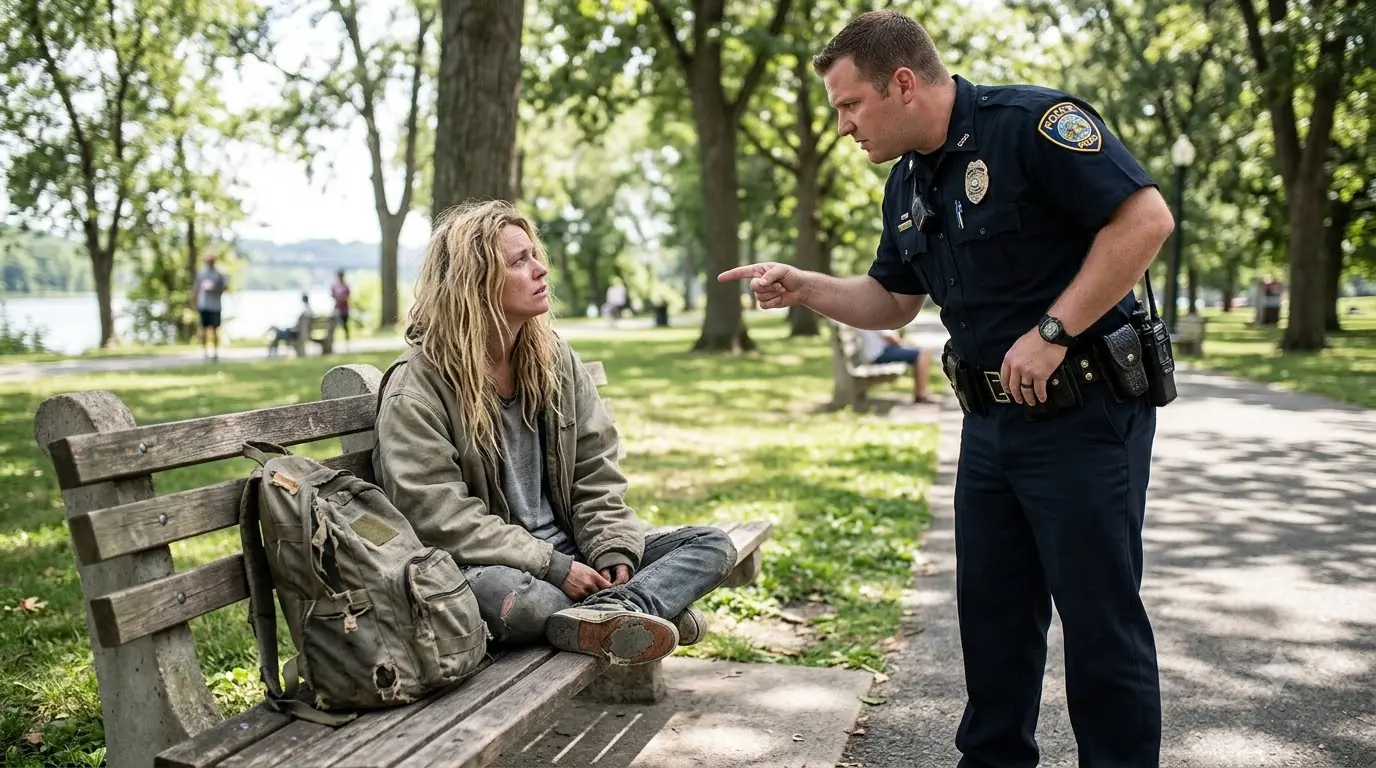
Her name was not Leonard Hayes, though that was the false identity printed on the temporary shelter card tucked inside her pocket. Her real name was Claire Hayes, and she had spent eight years working federal civil-rights investigations. She had learned to disappear without hiding, which was harder than people imagined. Looking invisible did not mean vanishing. It meant standing exactly where others expected a powerless person to stand, then listening while they revealed who they thought they were allowed to be.
Riverside Park had been chosen because of complaints no one inside the city wanted to call a pattern. Six people had filed formal statements in three months alleging they had been removed, threatened, or detained while sitting quietly on public benches. Four were unhoused. One was a day laborer waiting for a ride. One was a veteran sleeping in his car after losing an apartment. Different dates, different times, same officer appearing in four reports: Paul Kesler.
The city called them isolated encounters. Internal affairs had closed two for lack of evidence. The department’s spokesperson said park officers had broad discretion to address public safety concerns. The mayor’s office wanted the complaints to disappear before budget hearings. Claire’s unit had been brought in after a legal aid attorney found something harder to explain away: the language in the reports was nearly identical, right down to the same phrases about “family use,” “quality of life,” and “moving along before there’s a problem.”
So Claire sat on a bench beneath bright afternoon light while children played near the picnic area and joggers moved along the paved path. She kept her hands visible. She said little. The backpack recorded everything.
Kesler arrived twenty minutes later.
He was a broad white patrol officer in his thirties with the kind of posture that made ordinary standing look like a challenge. He approached slowly, scanning her clothes, the backpack, and the bench with open disgust. There had been no complaint that Claire knew of. No one nearby appeared frightened. No posted rule prohibited sitting. Still, Kesler stopped directly in front of her and pointed toward the park exit.
“Look at you,” he said. “You stink up this whole park. Get out.”
Claire looked up without shrinking. “I’m sitting quietly. I haven’t broken any law.”
Kesler took another step until his shadow fell across her shoes. “Families shouldn’t have to look at trash like you.”
The sentence landed harder than Claire expected, not because she believed it, but because she had heard versions of it before. Years earlier, after her mother died, Claire’s younger brother had spent three months sleeping in his truck while trying to keep a construction job. He had never forgotten how quickly people stopped speaking to him like a man once his clothes stopped looking respectable. That memory was one reason Claire had volunteered for this assignment.
“It’s a public park,” she said, keeping her voice controlled. “I’m staying right here.”
Kesler’s jaw tightened. He looked around once, perhaps expecting the usual response: fear, apology, movement. Instead he found a woman sitting still. That seemed to offend him more than open resistance would have.
He reached down and grabbed her wrist.
Claire let her body move with the pull rather than against it. Her other hand remained open. She did not reach toward her jacket. She did not say anything about who she was. Her pulse rose anyway, because training never made a hand around your wrist feel harmless.
“Stand up,” Kesler ordered.
“You’re hurting me.”
“Then stop making this difficult.”
His free hand moved toward his handcuffs.
Inside the backpack, the tiny camera kept recording.
Claire’s instructions had been clear: do not reveal unless there was immediate danger, an arrest, or a search likely to expose protected equipment. The point was to observe actual conduct, not altered conduct. A badge shown too early would only prove Kesler knew how to behave around power. Claire needed to see how he behaved when he believed none was present.
She rose slowly from the bench. “Am I being detained?”
“You’re being removed.”
“For what offense?”