The first thing Special Agent Malcolm Reed noticed about Hawthorne Park was not the heat. It was the silence.
On most August afternoons in Wilmington, North Carolina, the public park should have been noisy with kids running through sprinklers, mothers unpacking snacks under the pines, old men playing chess near the fountain, and teenagers throwing footballs too close to the flower beds. Instead, the benches sat empty. The swings moved only when the wind touched them. A yellow slide baked under the sun without a single child climbing it.
Malcolm lay on a stone bench beneath the biggest live oak in the park, one arm tucked behind his head, his baseball cap pulled low over his eyes. A half-eaten pack of crackers rested beside his hip. A worn backpack leaned against the bench leg. His faded T-shirt had sweat stains under the arms. His jeans were scuffed at the knees. He looked like a man with nowhere important to be.
That was the point.
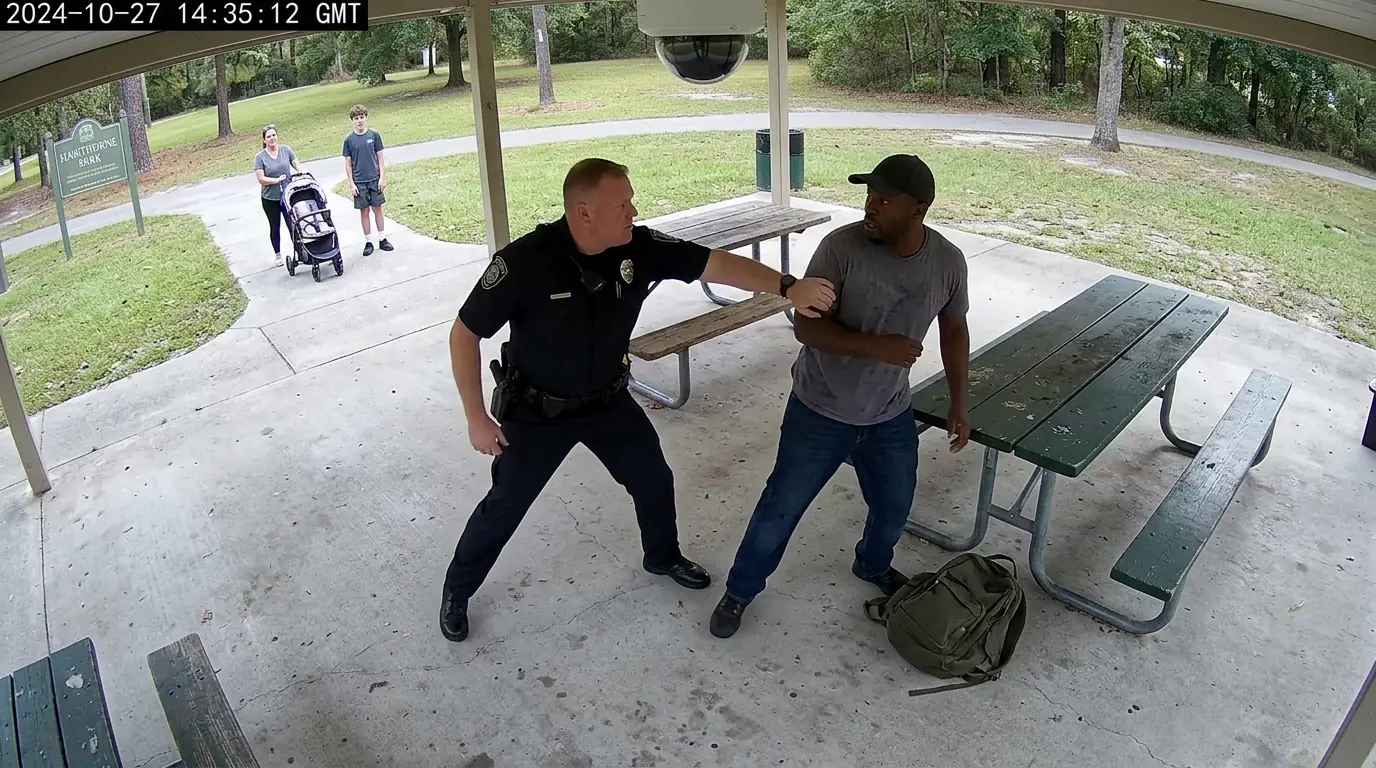
For twelve days, Malcolm had been watching Hawthorne Park. Not as a citizen, not as a drifter, and not as the harmless man Officer Brad Johnson would soon decide he was allowed to push around. Malcolm Reed was an undercover FBI agent assigned to a joint task force investigating a string of illegal searches, false trespassing charges, and missing cash connected to low-income residents near the redevelopment district.
The city called it renewal. Developers called it opportunity. But the people who had lived around Hawthorne Park for decades had another word for it.
Erasure.
The park sat on the edge of two Wilmingtons. On one side were old brick duplexes, corner stores, barber shops, churches with hand-painted signs, and porches where people still knew one another's names. On the other side were new glass condos, coffee shops with four-dollar pastries, boutique gyms, and townhomes selling for more money than most longtime residents would make in twenty years.
The complaints had started quietly. A Black mechanic searched while eating lunch in his work truck. A Latina grandmother cited for loitering while waiting for her bus. A homeless veteran arrested for sleeping under the pavilion, even though the city had no posted ordinance against it. A teenager shoved against a patrol car after refusing to empty his backpack without a reason.
Each complaint went nowhere.
The reports always used the same language. Suspicious person. Public safety concern. Refused cooperation. Officer discretion.
Malcolm had read all of them. Then he read the officer names.
One name appeared more than any other.
Brad Johnson.
Johnson was thirty-nine years old, broad-shouldered, clean-shaven, and proud in the way small men sometimes disguised as confidence. He had nine years on the Wilmington Police Department, a reputation for being aggressive, and a file thick enough that Internal Affairs should have been ashamed to keep calling it inconclusive. His body camera malfunctioned too often. His reports were too polished. His arrests leaned too heavily toward people who looked like easy targets.
The FBI did not step in because one officer had a bad attitude. They stepped in because the pattern began to suggest something larger.
A local activist named Maribel Cruz had sent them the first video. It showed Johnson stopping a man outside a corner store, demanding ID, accusing him of casing cars, then searching his pockets. The man asked if he was under arrest. Johnson laughed. When the man protested, Johnson cuffed him. The official report said the man became aggressive and attempted to flee.
The video showed no such thing.
After that came more videos, more complaints, and finally one old woman who claimed Johnson took $312 from her grandson during a search and never logged it into evidence.
That was when Malcolm came to Hawthorne Park.
He had spent twelve days becoming invisible.
He wore cheap clothes. He stopped shaving. He carried an old backpack filled with harmless items chosen to look like a man surviving between couches. He napped on benches. He ate crackers. He filled a notebook with details when no one was watching. He learned patrol times, blind spots, camera angles, witness habits, and which officers acted uncomfortable when Johnson crossed lines.
Today was supposed to be simple. Sit in the park, wait for a contact from the trafficking side of the investigation, and observe Johnson's patrol if he appeared.
Then Johnson appeared early.
The patrol SUV rolled slowly along the curb, tires crunching over loose gravel. Malcolm did not move. He heard the engine idle, the driver's door open, then the soft thud of boots on pavement. He smelled aftershave and hot leather before the shadow fell across his face.
"What's up, my man?" Officer Johnson said.
Malcolm opened his eyes beneath the brim of his cap. Johnson stood above him with one hand resting near his belt, not on his weapon, not quite, but close enough to send the message. His sunglasses reflected the oak branches overhead.
"Afternoon," Malcolm said.
"What are you doing laid up out here in the park?"
"Just cooling off."
Johnson looked around like Malcolm had personally cleared the entire park by existing in it.
"You got any ID on you?"
Malcolm sat up slowly. Slow was important. Nonthreatening was important. Every movement had to be clean.
"I do," he said. "But what's the issue?"
Johnson laughed once through his nose. "What do you mean, what's the issue? I'm out here patrolling, and I see a guy just laid out in the park."
"It's a public park."
"It is," Johnson said. "But it ain't really meant for this."
Malcolm held his expression still. "Me sitting under a tree?"
"You know what I mean."
"No, sir. I don't think I do."
Johnson took a half step closer. "You're making people uncomfortable."
Malcolm glanced across the empty lawn. A young mother with a stroller was near the walking path, far enough away that she likely could not hear the words, but close enough to see the posture. An older man sat in a parked pickup near the basketball courts. A teenager in a grocery store vest waited at the bus stop outside the fence.
"Did someone call about me?" Malcolm asked.
"I'm asking the questions."
"I'm not trying to be difficult. I just want to know why you're asking for my ID."
Johnson's face tightened. "Because I asked."
"Is there a crime you believe I've committed?"
"Look at you." Johnson gestured with two fingers, from Malcolm's shoes to his backpack. "You're out here sleeping in the middle of the day, making the park look unsafe. People want to bring their kids here. They don't want to see a grown man laid out like this."
"I'm not bothering anybody."
"You're bothering me."
The words sat between them.
Malcolm did not answer immediately. Inside, he felt the familiar split of undercover work. One part of him was the man on the bench, tired, hot, careful. Another part was the agent cataloging every phrase, every escalation, every violation of policy.
Demand for ID without reasonable suspicion. Subject calm. Officer cites discomfort, appearance, unspecified public concern.
Johnson pointed toward the backpack. "What's in the bag?"
"Personal items."
"Drugs?"
"No."
"Weapons?"
"No."
"You mind if I check?"
"I don't consent to a search."
Johnson smiled like Malcolm had given him exactly what he wanted.
"See, that's where people like you always mess up," he said. "A decent person with nothing to hide just cooperates."
Malcolm kept his voice calm. "I'm cooperating by speaking with you. I'm also exercising my rights."
"Your rights." Johnson repeated the words with open contempt. "Everybody wants to talk about rights until something happens and then people ask why we didn't stop it."
"Stop what?"
"Whatever you might be planning."
A city maintenance truck passed slowly on the street. The driver turned his head, watching.
Malcolm shifted his weight on the bench. He had a miniature recorder sewn into the inner seam of his backpack strap. His phone, screen dark, was recording audio from his pocket. The park camera on the recreation center faced the oak tree. Three sources already.
Still, this was not the moment to reveal himself.
Not yet.
"Officer Johnson," Malcolm said, reading the nameplate on his chest, "I'm going to ask plainly. Am I free to go?"
Johnson's jaw moved once. "Not until I know who I'm dealing with."
"So I'm being detained?"
"You're being talked to."
"Am I free to go?"
"I just answered you."
"No, you didn't."
Johnson removed his sunglasses slowly. His eyes were small and hard.
"Stand up."
Malcolm did not move right away. "For what reason?"
"Because I told you to."
"Officer, I am not refusing. I am asking for the legal basis."
"The legal basis is you're making this park unsafe."
"By sitting here."
"By being here like this." Johnson motioned again, disgust in the flick of his wrist. "Laid out, eating snacks, looking like you don't belong."
"A person doesn't need to look a certain way to use a park."
"Don't lecture me. Stand up."
Malcolm stood. He did it slowly, hands visible. He was six feet tall, solidly built, and he watched Johnson's eyes change as his height registered. The officer stepped back half a pace, then covered the retreat by pointing toward the backpack.
"Turn around and put your hands on the bench."
"Am I under arrest?"
"You're being detained."
"For what crime?"
"Suspicious activity."
"Suspicious activity is not a crime."
Johnson's face reddened. "You want to play lawyer with me?"
"No, sir. I want to understand why I'm being detained."
"Because I don't know you. Because I don't know what your mental state is. Because I don't know what you might do if a family walks through here. Because if I let you go and you hurt somebody, that's on me."
Malcolm felt the anger move through him then, clean and hot, but he did not let it reach his face.
"You have no reason to believe I'm going to hurt anybody."
"I got instinct."
"Instinct is not probable cause."
"Put your hands on the bench."
Malcolm looked toward the path. The young mother had stopped now. Her hand rested on the stroller handle, but she was watching. The teenager at the bus stop had lifted his phone. The man in the pickup had opened his door.
Johnson noticed the witnesses, too. His voice grew louder.
"Do not resist."
"I am not resisting."
"Put your hands on the bench."
Malcolm placed his hands on the bench.
Johnson patted him down aggressively, not like a search for weapons, but like a punishment for asking questions. His palm hit Malcolm's ribs hard enough to sting. He kicked Malcolm's ankles wider apart.
"You got anything sharp?"
"No."
"Needles?"
"No."
"Warrants?"
"No."
"Everybody says that."
Malcolm kept breathing evenly.
The contact he had come to meet was due within ten minutes. If Johnson cuffed him, the meeting would collapse. If the contact saw him reveal a badge, the wider investigation might take a hit. But if Johnson continued, Malcolm had a duty to stop the unlawful arrest before the situation turned dangerous.
Johnson grabbed his wrist.
"Hands behind your back."
"Officer Johnson," Malcolm said, still calm, "I have not committed a crime."
"You're obstructing."
"I have answered your questions."
"You refused ID."
"That is not obstruction in this state without reasonable suspicion."
Johnson slapped one cuff around Malcolm's left wrist.
The metal click was small, but it changed the air.
The young mother gasped softly. The teenager's phone lifted higher. The older man from the pickup started walking toward them.
"Don't make this hard," Johnson said. "I'm trying to protect you from yourself."
Malcolm turned his head slightly. "You need to stop."
Johnson laughed. "Or what?"
"Before you do anything else, I need to identify myself."
"Shut up."
"My name is Special Agent Malcolm Reed. Federal Bureau of Investigation."
Johnson froze.
Only for half a second.
Then he laughed.