Afternoon. You can't be sitting here all day, man. This is a public park, not a shelter. Time to move along. You're loitering.
If you don't get up and leave, I'm going to have to arrest you. Understand? I'm not loitering, officer. I'm sitting in a park, not breaking any law. I'm going to stay right here.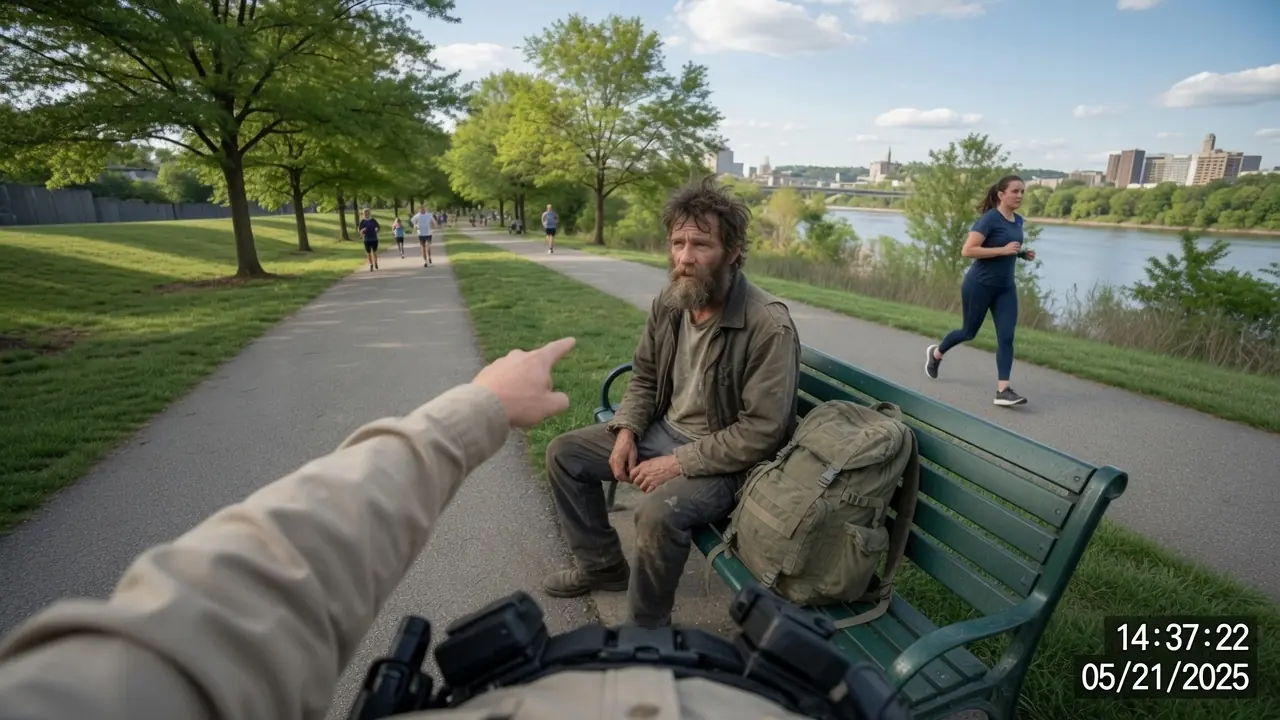
Sir, not breaking any law. On your feet. You're under arrest. Officer Paul Kesler, badge number 4,791, had patrolled Riverside Park for 3 years, and had his own ideas about who belonged there and who didn't. When he saw a man in shabby clothes sitting alone on a bench, he approached with immediate hostility, ordered him to leave and threatened, "Last warning.
Get out of this park or you're going in cuffs." What Kesler didn't know was that Leonard Hayes wasn't homeless. he was an undercover FBI agent 10 minutes away from a breakthrough in a six-month narcotics investigation. That his entire team was listening on surveillance equipment, that every racist threat was being recorded, and that this confrontation would destroy Kesler's career and compromise a major federal operation targeting a violent drug organization. Leonard Hayes had been sitting on the same park bench for the past 4 hours. And to anyone watching, he looked like just another homeless man passing time on a Tuesday afternoon.
At 38 years old, with 12 years of experience as an FBI special agent, Leonard had learned that successful undercover work required complete commitment to the role. His clothes were deliberately worn and stained, purchased from a thrift store and aged further through weeks of wear. His beard was unkempt, his hair needed cutting, and the old military-style backpack beside him looked like it contained everything he owned in the world. But inside that backpack, hidden beneath a layer of actual homeless survival gear, was $50,000 worth of FBI surveillance equipment, including encrypted radios, high-resolution cameras, and recording devices that were currently transmitting everything to a mobile command unit parked two blocks away. Leonard was 18 weeks into Operation Viper Den, a complex investigation targeting the Cordio Drug Trafficking Organization that used Riverside Park as a key distribution point.
The organization was sophisticated, violent, and careful. They rotated their dealers, used coded language, and conducted their business in plain sight among the joggers and families who used the park every day. Leonard had spent months building his cover, sleeping on benches, eating at soup kitchens, becoming a familiar face to both the homeless population and the low-level dealers who operated in the park. He had earned trust slowly, painfully, and now he was close to a breakthrough. Today at 3:00, two mid-level operators in the Cordio organization were scheduled to meet at a picnic table 50 yards from Leonard's bench.
The meeting would give the FBI critical intelligence about supply chains and distribution networks. Information that could lead to indictments all the way up to the organization's leadership. It was 2:47 p.m. when Leonard spotted the first target arriving. Carlos Vega, a 32-year-old distributor with connections to the Cordio family, sat down at the designated picnic table and pulled out his phone. The second target, Ramon Torres, would arrive within the next few minutes.
And for the past 3 years, Riverside Park had been part of his regular patrol route. He considered himself the unofficial guardian of the park. The officer who kept it safe and clean for the families and joggers who used it properly. In his view, that meant keeping out the undesirables, the homeless, the addicts, the people who sat on benches all day and made the park look bad. Kesler had 23 civilian complaints in his personnel file, 18 of them involving allegations of harassment or excessive force against homeless individuals or minorities.
Internal affairs had reviewed his conduct twice and found patterns of concern, but nothing had resulted in serious discipline. Kesler knew his supervisors wanted the park kept clean, and he believed he was just doing his job when he approached people who didn't fit his image of proper park users. When Kesler saw Leonard on the bench, he saw exactly what his biases told him to see. A man in shabby clothes with a backpack, probably homeless, definitely someone who shouldn't be taking up space that families could use. Kesler didn't consider that the man might be resting legitimately.
He didn't think about whether any actual law was being broken. He just knew that people like that made the park look bad, and it was his job to move them along. He walked directly toward the bench with the purposeful stride of someone who had done this dozens of times before and expected a quick compliance. Leonard saw Kesler approaching and felt his stomach tighten. This was the worst possible timing.
Carlos Vega was 50 yards away and Ramon Torres would arrive any minute. The meeting Leonard had waited 6 months to observe was about to happen and now a patrol officer was walking straight toward him. In his earpiece, he heard Agent Park's voice, tense and quiet. We see him. Stay in character.
Do not break cover unless absolutely necessary. Kesler stopped directly in front of the bench, his shadow falling across Leonard. "You need to leave now." Leonard looked up slowly, staying completely in character as someone who had been living rough for months. I'm just sitting here, not bothering anyone.
Kesler's face hardened. I don't want your kind in this park. Get up and leave before I make you. Leonard felt the words hit him like physical blows, but he kept his voice calm and measured. My kind?
What law am I breaking? It's a public park. Don't get smart with me, boy. Kesler said, the slur coming easily and naturally. I said, leave.
We don't need people like you around here scaring the families. In Leonard's earpiece, Agent Park's voice was sharp with anger. But she maintained operational control. Leonard, do not engage. Maintain cover.
We're assessing options. Leonard kept his eyes on Kesler, knowing that every word was being recorded on the wire, taped to his chest beneath his worn shirt. "I have a right to be here." Kesler stepped closer, his hand moving to rest on the taser on his duty belt. The threat was clear and deliberate.
Rights? You're trespassing. Last warning. Get out of this park or you're going in cuffs. 50 yards away, Ramon Torres was walking toward the picnic table where Carlos Vega waited.
The meeting was about to start. 6 months of work, hundreds of hours of surveillance, the careful building of cover and trust. All of it was coming together at exactly the moment when Officer Paul Kesler had decided that a man sitting on a park bench needed to be removed by force. Leonard's mind raced through his options. If he left, the operation failed.
If he revealed his identity, his cover was blown and the operation still failed. If he refused to move, Kesler would arrest him and the dealers would see police activity and disappear. There was no good choice, only damage control. In his ear, Agent Park made the decision for him. All units move in.
We're pulling him out. Operation is compromised. Before Leonard could respond, Kesler reached for his arm. I said, "Get up. You're coming with me."
Leonard pulled his arm back, not aggressively, but defensively, keeping his hands visible. I'm not going anywhere. You have no legal reason to detain me. That's resisting, Kesler said, and his hand moved from his taser to his handcuffs. You just made this a lot worse for yourself.
In the distance, Leonard heard car doors opening. The FBI team was coming, but they were two blocks away. And Ramon Torres was sitting down at the picnic table, and Carlos Vega was pulling out a small package. And 6 months of careful work was falling apart in real time because a police officer had seen a man on a bench and made an assumption that was about to destroy both their careers in completely different ways. Kesler grabbed Leonard's wrist, and Leonard knew that in the next 60 seconds, everything was going to change.
Kesler's grip on Leonard's wrist was tight and aggressive, the kind of hold designed to establish dominance rather than ensure safety. Leonard kept his other hand raised and visible, knowing that any movement could be interpreted as resistance. 50 yards away, Carlos Vega and Ramon Torres were leaning across the picnic table, beginning their conversation. The meeting Leonard had waited 6 months to observe was happening right now, and he was being physically detained by an officer who had decided his presence was a crime. "I'm not resisting," Leonard said clearly. keeping his voice calm despite the anger building inside him.
You're grabbing me without cause. I haven't broken any law. Kesler twisted Leonard's arm behind his back, forcing him to turn around. I told you to leave and you refused. That's trespassing.
Now you're resisting arrest. Keep talking and I'll add disorderly conduct. In Leonard's earpiece, Agent Park's voice was sharp with urgency. 30 seconds out. Try to delay without breaking cover.
Leonard tried one more time to de-escalate, knowing it was probably useless, but needing to document every attempt on the recording. Officer, I'm asking you to check with your supervisor before you do this. I'm telling you that you're making a mistake. The only mistake here is you thinking you can sit in this park all day, Kesler said, pulling out his handcuffs. Turn around and put your hands behind your back or I'll put you on the ground.
A woman jogging past slowed down, watching the confrontation with concern. She pulled out her phone and started recording. Kesler noticed and pointed at her. "Ma'am, keep moving. This is police business."
The jogger didn't lower her phone. "He's just sitting on a bench." "What did he do?" "I said keep moving," Kesler barked, his voice rising with her irritation. At the picnic table, Ramone Torres looked up at the commotion.
He saw a police officer with his hands on someone, saw the jogger recording, and his expression changed immediately. He said something quick to Carlos Vega, and both men stood up. The package that had been on the table disappeared into Carlos's jacket. They started walking in opposite directions, moving with the practiced casualness of people who knew how to leave a scene without looking like they were fleeing. A black SUV pulled into the parking lot at the edge of the park, moving fast, but not using lights or sirens.
Three people in FBI windbreakers jumped out and started moving toward Leonard's location. Kesler didn't see them yet because he was focused on getting the handcuffs on Leonard, but other park users noticed the federal agents and started pointing. Leonard saw his team approaching and knew the moment had come. There was no saving the operation now, no way to maintain cover with FBI agents running into your across the park. The only thing left was to stop this from getting worse and to make sure everything Kesler had said and done was properly documented for what would come next.
"Officer Kesler," Leonard said using his name for the first time. I'm going to tell you one more time. You need to stop what you're doing right now. Kesler snapped one cuff onto Leonard's wrist, squeezing it tighter than necessary. I don't take orders from you.
You're under arrest. Agent Park reached them first, her FBI credentials already out and held high. Federal agent, release that man immediately. Kesler froze, his hand still gripping Leonard's arm, the handcuff dangling from one wrist. He looked at Agent Park with confusion and growing alarm.
What? I'm conducting a lawful arrest. Two more FBI agents arrived flanking Agent Park. One of them, a tall man named Agent Marcus Webb, pointed at Leonard. That man is a federal agent conducting an authorized undercover operation.
You just compromised a six-month investigation. Kesler's face went through several expressions in rapid succession. Confusion, disbelief, then the beginning of fear as he realized what he had done. How was I supposed to know that? He looks homeless.
He's supposed to look homeless, Agent Park said, her voice cold with controlled anger. That's what undercover means. She pointed across the park where Ramon Torres and Carlos Vega had disappeared in different directions. Those two men you just scared off were targets of a major narcotics investigation. We were 10 minutes from recording evidence that would have connected them to a drug trafficking organization responsible for moving millions of dollars in product.
And you just ended that because you decided a man sitting on a park bench needed to be removed. Kesler released Leonard's arm like it had burned him. Leonard pulled his hand back and removed the single handcuff that had been attached, rubbing his wrist where the metal had already left a red mark. Agent Park stepped closer to Kesler, close enough that other Park users couldn't hear, but the recording equipment Leonard wore would capture every word. Take out your notepad and write down your name, badge number, and supervisor's contact information.
You're going to need all of that because the FBI will be filing a formal complaint with your department. And depending on what we find when we review your history, there may be federal civil rights charges." Kesler's hand trembled slightly as he pulled out his notepad and wrote down the information. The confidence he had shown 5 minutes ago was gone, replaced by the growing understanding that his career had just taken a catastrophic turn. Leonard stood watching him, still wearing his undercover clothes, still playing a role even though the operation was over.
The wire under his shirt had recorded everything. Every slur, every threat, every moment of Kesler's assumption that a man in shabby clothes had no right to exist in a public park. And that recording was about to follow Officer Paul Kesler for the rest of his very short law enforcement career. 2 hours later, Officer Paul Kesler sat in a conference room at Central Police Headquarters with his union representative beside him. Across the table sat his captain, the department's internal affairs lieutenant and two people from the FBI, special agent Jennifer Park, and the man Kesler had tried to arrest, now wearing a crisp suit with his FBI credentials clipped to his belt.
The transformation was jarring. The homeless man from the park was gone, replaced by a federal agent who looked like he belonged in a courtroom. Captain Richard Morrison opened a folder on the table and looked at Kesler with barely concealed anger. Officer Kesler, the FBI has made some serious allegations about your conduct this afternoon. Before we begin, I want to make something clear.
Whatever you say in this room will be part of the official record. Do you understand?" Kesler nodded, his throat tight. "Yes, sir." Agent Park placed a small digital recorder on the table.
"This is the audio from Special Agent Hayes's wire. He was wearing recording equipment during your entire interaction. We're going to play it now." She pressed play and Kesler's voice filled the room. You need to leave now," then Leonard's calm response then Kesler's escalation.
"I don't want your kind in this park." The words sounded worse in the quiet conference room than they had in the open air of the park. When the recording reached the point where Kesler said, "Get out of this park or you're going in cuffs," his union representative closed his eyes and shook his head slightly. The recording played for 6 minutes total, documenting every threat, every slur, every moment of aggression. When it finished, the silence in the room was heavy and uncomfortable.
Captain Morrison spoke first. Officer Kesler, you want to explain to me what I just heard? Kesler's face was flushed with a mix of embarrassment and defensive anger. I didn't know he was FBI. I thought he was homeless. We've had complaints about homeless people in that park.
Complaints about what specifically? Agent Park asked, her voice sharp. About people sitting on benches. About people existing in public spaces. about loitering, about making families uncomfortable. Leonard spoke for the first time since entering the room, and his voice was calm, but carried an edge that made everyone pay attention.
I wasn't loitering. I was sitting quietly on a public bench during park hours. I wasn't drinking. I wasn't using drugs. I wasn't harassing anyone.
I was doing absolutely nothing illegal. You approached me with immediate hostility because of how I looked. I was doing my job, Kesler insisted. "Your job?" Leonard repeated.
He leaned forward slightly. Let me tell you about my job, Officer Kesler. I'm a 12-year veteran of the FBI. I served four years in Army intelligence before that. I specialize in organized crime and narcotics trafficking. I've worked undercover in eight different operations across four states.
I've testified in federal court 23 times. I speak three languages. I have a master's degree in criminal justice. and for the past 6 months I've been living in Riverside Park building a case against the Cordio Drug Organization. He paused, letting that sink in. I slept on benches.
I ate at shelters. I befriended other homeless people to build my cover. I did all of that because the Cordio organization is responsible for trafficking millions of dollars in narcotics, for violence that's killed 17 people in this city, for addiction that's destroyed countless families. Today I was 10 minutes away from recording a meeting that would have given us evidence to indict mid-level operators and work our way up to the leadership. 6 months of work, hundreds of hours of surveillance, and you destroyed it in 5 minutes because you saw a man on a bench and decided I didn't belong there.
The internal affairs lieutenant pulled up something on his laptop. Officer Kesler, according to your file, you have 23 civilian complaints. 18 involve homeless individuals or minorities. You've been flagged twice for patterns of discriminatory enforcement. Did you learn nothing from those reviews?
Kesler started to answer, but his union rep put a hand on his arm to stop him. Agent Park opened her own folder. The FBI has reviewed Officer Kesler's complaint history. We've also reviewed his arrest records, his stop reports, and his use of force incidents. We found a clear pattern of targeting individuals based on appearance and race.
We're recommending a federal civil rights investigation into his conduct. Kesler's face went white. "Federal investigation?" "You interfered with a federal operation," Agent Park said coldly. "You used racial slurs against a federal agent.
You threatened unlawful arrest. You grabbed him without legal justification." "Yes, Officer Kesler." Federal investigation. Captain Morrison closed his folder.
Officer Kesler, you're suspended without pay effective immediately. Pending the outcome of both the internal investigation and the federal review. You will surrender your badge and service weapon. Kesler sat frozen, unable to process how quickly his world was collapsing. Leonard stood up, looked down at him one final time, and delivered the coldest truth of all.
If you'd done this to an actual homeless person, would anyone be here right now? Would the FBI have shown up? Would you be suspended? The only reason you're facing consequences is because you happen to harass someone with a badge. Think about that, Officer Kesler.
Think about how many people you've done this to who didn't have the power to fight back. He walked out of the conference room, leaving Kesler sitting at the table with his career in ruins and the full weight of his assumptions finally coming due. Officer Paul Kesler was fired from the Central Police Department 6 weeks after the incident in Riverside Park. The termination letter cited multiple violations, including racial discrimination, harassment, interference with a federal investigation, and conduct unbecoming an officer. Because he was fired for cause, Kesler lost his pension after 7 years of service.
He lost his health benefits. He lost everything he had built in law enforcement. And the viral spread of the audio recording ensured he would never work as a police officer again. The FBI's investigation into Kesler's conduct expanded beyond the single incident with Leonard Hayes. Federal investigators reviewed 7 years of arrest records, stop reports, and complaint files.
They found a pattern that was both clear and disturbing. 87% of Kesler's stops in Riverside Park involved minority individuals. 92% of his harassment complaints came from homeless people or minorities. The evidence showed systematic targeting based on race and socioeconomic status, a pattern that had been documented in internal reviews, but never seriously addressed until a federal agent became the victim. The Department of Justice filed civil rights charges against Kesler 4 months after his termination.
The charges included deprivation of rights under color of law and obstruction of justice. Kesler's attorney reviewed the audio recording in the FBI's evidence file and delivered the same advice his counterparts had given to other officers in similar situations. Take the plea deal. Fighting federal charges with recorded evidence of racial slurs and threats was a battle no jury would side with. Kesler pleaded guilty to obstruction and civil rights violations.
He was sentenced to 10 months in federal prison and 2 years supervised probation. He would never be allowed to work in law enforcement again anywhere in the United States. At 34 years old, with a felony conviction and a recording of his racism available to anyone with an internet connection, Kesler found himself working warehouse jobs for minimum wage and living in a small apartment 40 miles from the city where he had once patrolled with authority. The Cordio drug investigation that Kesler had compromised took 14 more months to rebuild. The FBI assigned a new undercover agent and developed a different approach.
But the delay had real consequences. During those 14 months, the Cordio organization continued operating, distributing drugs that fueled addiction and violence across the city. When the operation finally concluded with 26 arrests and the seizure of over $6 million in narcotics, the FBI's final report included a section detailing how Officer Kesler's interference had extended the timeline and allowed the organization to cause additional harm before being dismantled. Leonard Hayes received the commendation from the FBI director for his work on Operation Viper Den and his professionalism during the confrontation with Kesler. He continued working on undercover operations and became an instructor at the FBI academy, teaching new agents about maintaining cover under pressure and dealing with unexpected complications in the field.
He also became an advocate within federal law enforcement for protecting vulnerable populations during operations, pushing for policies that ensured homeless individuals and others used as cover identities were treated with dignity and respect. The Central Police Department implemented sweeping changes in response to the federal investigation. Officers received mandatory training on implicit bias and constitutional policing. The department created new policies requiring supervisors to review all stops involving homeless individuals. A civilian oversight board was established with real authority to investigate complaints.
Five other officers with similar patterns in their complaint files were quietly pushed to resign rather than face formal discipline. The audio recording of Kesler's harassment became training material in police academies across the country used to demonstrate how bias can destroy investigations and careers. Leonard appeared in some of those training sessions, standing in front of rooms full of recruits and telling them exactly what it felt like to be called slurs and threatened with arrest while doing his job. He always ended with the same message.
Assumptions are dangerous. Every person deserves dignity and the badge is a responsibility, not permission to treat people as less than human. 5 years after that afternoon in Riverside Park, Leonard was promoted to supervisory special agent and assigned to train undercover operatives across multiple field offices. Paul Kesler was still working manual labor jobs, still living with the consequences of 5 minutes.
When he saw a man on a bench and made assumptions that cost him everything, the lesson remains simple and permanent. Profiling destroys lives on both sides, evidence never lies, and treating people as criminals based on appearance can end the career of the person making that judgment. The difference was that Leonard moved forward with purpose and respect, while Kesler moved forward with nothing but regret and a recording that would follow him forever. Playing on a loop in training rooms where new officers learned exactly what not to become.