Officer Dana Whitlock was already shouting before Mayor Camille Brooks realized the command was meant for her.
"Hey! Stop right there!"
Camille kept walking for half a step, because nothing in her mind connected those words to her own body. It was a bright Saturday morning in Hawthorne Grove, one of Bellhaven, Virginia's oldest and most expensive neighborhoods, where restored Craftsman homes sat behind trimmed hedges and the sidewalks looked freshly washed from the city's recent improvement project. Camille wore tan slacks, a navy polo shirt, comfortable walking shoes, and no jewelry except a small silver watch. She had left her city vehicle three blocks away, left her security detail near the community center, and left her mayoral lapel pin in the glove compartment because she wanted to see the neighborhood without people performing for the office she held.
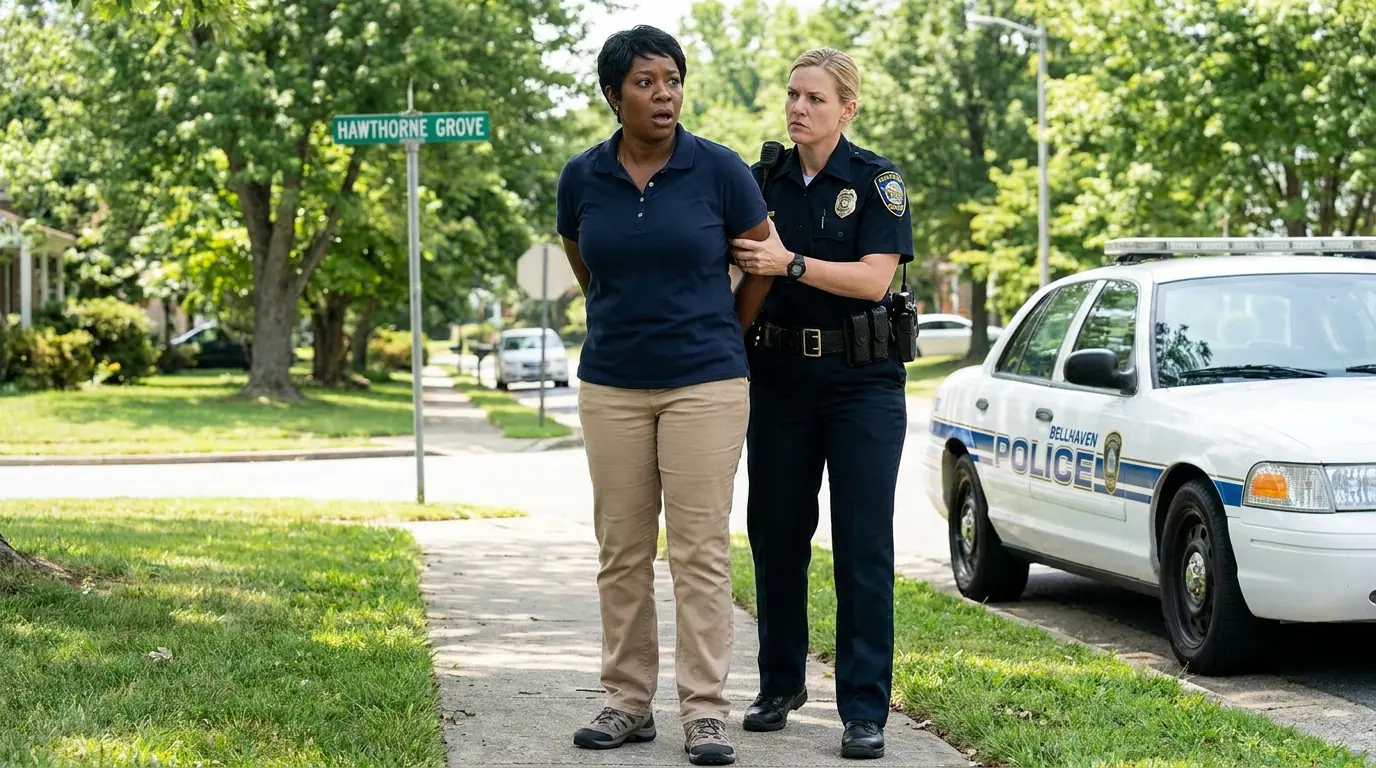
A white patrol cruiser sat crooked at the curb behind her, emergency lights flashing even though there was no accident, no fight, no traffic hazard, and no visible emergency. Officer Dana Whitlock strode toward her with one hand resting near her duty belt, blond hair pulled so tightly behind her head that it sharpened the angles of her face. Her shoulders were squared with the confidence of a person who expected obedience to arrive instantly after command. Camille turned slowly, looked behind herself as if another pedestrian must be nearby, and then met the officer's eyes.
"Are you talking to me?" Camille asked.
Dana stopped several feet away. "Who else would I be talking to?"
The tone was the first warning. It was not the tone officers used when asking if someone was lost, not the tone of service, not even the tone of mild suspicion. It was the tone of a conclusion already reached, a verdict looking for paperwork. Camille studied the nameplate on the officer's chest. WHITLOCK.
"What seems to be the problem, Officer Whitlock?" Camille asked.
Dana's eyes traveled from Camille's walking shoes to her slacks, then to her face. "What are you doing in this neighborhood?"
Camille almost smiled, not because it was funny, but because the question was so broad it revealed more than the officer seemed to understand. She could have said she was the mayor of Bellhaven. She could have said she had personally signed off on the sidewalk improvements Dana was standing beside. She could have said the city had invested in drainage work, new lighting, and public safety grants for this very stretch of Hawthorne Avenue, and that she had every right to inspect it. Instead, she answered like any other person should have been allowed to answer.
"Walking," Camille said.
"I can see that."
"Then I am not sure what you are asking."
Dana stepped closer, and Camille noticed the elderly man across the street lowering a garden hose over a line of blue hydrangeas. A woman carrying grocery bags slowed beside a parked Volvo. Farther down the block, a lawn mower coughed once and went silent. The neighborhood had begun watching, which meant the stop was no longer just about suspicion; it was also about performance.
"Where are you going?" Dana asked.
"Down Hawthorne Avenue."
"To what address?"
Camille held her gaze. "Why?"
That single word changed Dana's expression. Her mouth tightened, and the authority she had been wearing like armor seemed to harden. Camille had seen that look in council chambers, in contract negotiations, and in campaign debates when powerful people realized they had been questioned by someone they had already decided should defer.
"Because I asked," Dana said.
Camille remained calm. "Am I being detained?"
Dana gave a short laugh. "Here we go."
"That is a simple question."
"No, that is something people say when they have been watching too many videos."
"Am I free to continue walking?"
Dana moved directly into her path. "Not until I figure out what you are doing here."
Camille felt a quiet tightening in her stomach. For three months, residents had been sending her office stories that sounded almost exactly like this one. A Black homeowner questioned while collecting mail. A Latino landscaper ordered to prove he worked for the house whose shrubs he was trimming. A teenager stopped after cutting through a development on his way home. Each complaint had been treated as an individual misunderstanding, a vague moment of concern, an officer making contact in a high-theft area. Camille had wondered if the stories were connected, and that was one reason she had come to Hawthorne Grove without cameras and without an announcement.
She had wanted to see whether the neighborhood looked different when no one knew the mayor was watching. Now she understood she had become the test.
"I live in Bellhaven," Camille said.
Dana looked her up and down. "That is not what I asked."
"I am walking on a public sidewalk."
"And I am investigating suspicious activity."
Camille's voice became slightly sharper. "What suspicious activity?"
Dana hesitated. It lasted less than a second, but Camille noticed. The officer had facts only after she needed them, not before.
"We received concerns about someone walking around looking at houses," Dana said.
"From whom?"
"That is not information you need."
"What did the caller say the person did?"
Dana's jaw tightened. "You ask a lot of questions."
"I am trying to understand why you stopped me."
"People around here have had problems."
"What problems?"
"Break-ins. Package theft. Cars being checked."
Camille glanced toward the quiet row of houses. "Was a crime reported today?"
Dana did not answer directly. "Identification."
Camille considered ending the encounter. Her driver's license, if she had carried it, would have shown her full name, and there was a good chance Dana would recognize it. Even if Dana did not, dispatch would. It would be easy to make this go away, but that was the problem. Every resident who had complained to City Hall had been asked to make it easy: hand over ID, explain where you lived, prove why you belonged, turn an unlawful demand into a voluntary conversation just to avoid trouble.
"I am not carrying identification," Camille said.
Dana's eyes hardened. "You are walking through an expensive neighborhood without ID?"
There it was, naked enough that even the woman with the grocery bags looked up. Camille tilted her head, keeping her voice even. "Is identification required to walk through expensive neighborhoods?"
"Don't twist my words."
"I repeated them."
Dana stepped closer. "Where do you live?"
"Bellhaven."
"Where?"
"Does that determine whether I am allowed on this sidewalk?"
Dana inhaled sharply through her nose. "You need to lose the attitude."
Camille had been called worse. Opponents had called her arrogant, cold, combative, too ambitious, not warm enough, too polished, not polished enough, and at least once, in a whisper caught on a hot microphone, dangerous. The word attitude should not have bothered her. Yet it did, because Dana did not know she was speaking to a mayor. The officer believed she was speaking to an ordinary Black woman, and that made the contempt cleaner, more useful, and far uglier.
"I have not raised my voice," Camille said. "I have not insulted you, and I have not interfered with any investigation because you have not articulated one."
"You are refusing to cooperate."
"With what investigation?"
Dana pointed toward a house behind Camille. "How do I know you are not casing that property?"
Camille looked at the porch, the flower pots, the closed front door. "You don't."
Dana seemed pleased. "Exactly."
"You also don't know that I am."
The satisfaction vanished. Dana's hand shifted lower on her belt. "That is why I am asking questions."
"And I am answering."
"No, you are being evasive."
Camille shook her head. "I told you what I am doing. I am walking."
Dana moved closer until only a few feet separated them. "People who belong in this neighborhood do not usually act nervous when police talk to them."
The words settled over Hawthorne Avenue like dust. The elderly man across the street shut off his hose completely. The woman with the groceries stopped pretending to adjust her bags. Camille stared at Dana, and for the first time that morning, she felt something colder than irritation.