At ten eighteen on a Saturday morning, an elderly woman in a blue gardening shirt was forced to her knees among the stones she had arranged by hand. The young police officer gripping her arm had asked no meaningful question about the property and had ignored the three answers she had given him. Across the street, a neighbor was shouting that she lived there. Behind the officer, a body camera recorded the pale gravel, the rosemary bushes, the bright Arizona sky, and the moment seventy-three-year-old Eleanor Price cried out because her knees could not bend the way he demanded.
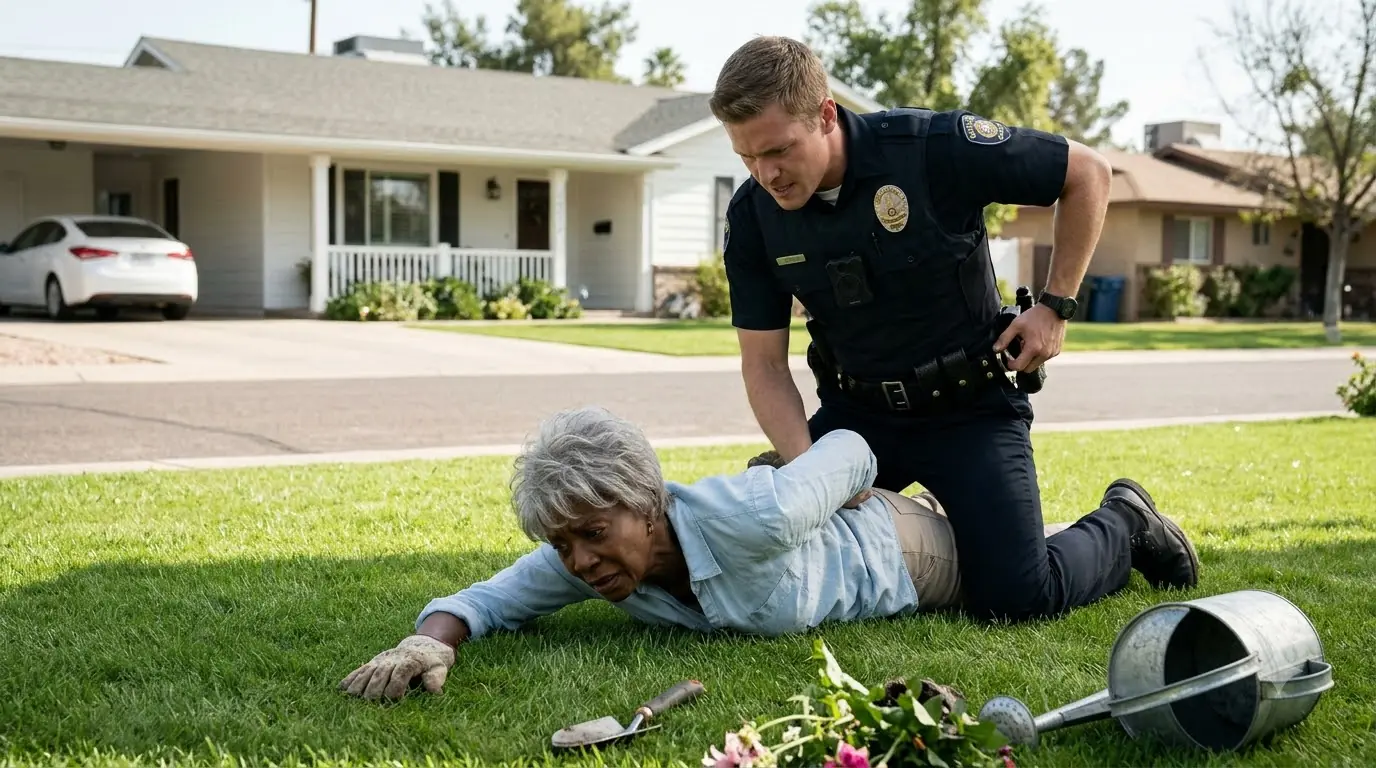
The worst part, she would tell her daughter later, was not that she had fallen. She had fallen before, once while learning to bicycle as a girl in Tucson and once when a courtroom stairwell flooded during a summer storm. The worst part was hearing a stranger tell her she had made him do it. He said she should not have resisted, although she had been standing in her own garden with empty hands. She remembered that sentence with a clarity that would outlast the bruises.
But the morning had begun as an ordinary one, the kind Eleanor spent much of her life learning to appreciate. A small white ceiling fan turned above the kitchen table. A letter from her granddaughter lay beside a glass of water, and the newspaper was open to an article about drought-resistant landscaping. Through the window, she could see the rosemary growing along the western edge of the yard, its silver-green leaves moving lightly in the breeze. She had promised herself she would finish planting the marigolds before the worst heat arrived.
Her husband, Arthur, used to say that the desert did not reward impatience. In the first years after they bought the little ranch-style house in Phoenix, Eleanor had wanted roses everywhere, as her mother had grown them in Georgia. Arthur had taken her to a nursery and shown her what could survive on less water without surrendering color. Over four decades they learned the shape of their ground together. They planted rosemary for the bees, marigolds for their cheerful persistence, and a stubborn bougainvillea that still bloomed beside the front wall.
Arthur had died four years earlier, after an illness that turned the smallest tasks into careful negotiations. Eleanor remembered the sound of his breathing at night and the determination with which he insisted on making breakfast whenever he could stand long enough. After his funeral, visitors had offered to take over the garden. She thanked them and declined. The work gave a shape to mornings when the rooms seemed too large, and she knew exactly where Arthur had laid the first row of stones.
She had served thirty-one years on the Arizona Superior Court, retiring two years before the encounter. Before that, she had been a public defender and then a prosecutor, careers that had taught her how a single encounter could become an official version of events bearing little resemblance to what people had lived through. Her colleagues had called her demanding because she required attorneys to support their assertions and witnesses to answer the question asked. She did not think of that as a special virtue. To Eleanor, it was a basic courtesy owed to truth.