The gun was already drawn when I turned around. I remember the strangeness of it hitting me. Not the weapon itself, but the profound stillness that came with it. The way Officer Bryce Holloway held it with both hands, arms locked tight, as if he had trained his entire career for precisely this moment. As if he had been waiting for it all along.
The afternoon sun caught the barrel, and for one suspended second, I saw my own reflection in the metal. Keira Webb, 41 years old, dressed in a gray Henley and dark jeans, hands empty beside my grocery bags, standing in the driveway of my own house. "Get down," he said. "Get down right now." He did not ask questions. He did not hesitate. He simply pointed that gun at my chest and decided.
What Holloway did not know, what he could not have known, or maybe what he simply did not care to find out, was that the credentials in my front left pocket, earned through 12 years of service and two presidential campaigns, identified me as a United States Secret Service Agent. And what happened in my driveway that ordinary afternoon would cost Officer Bryce Holloway everything he thought he owned. But I am getting ahead of myself. I had moved to Cedarwood Hills before that afternoon.
Lena had picked the neighborhood. She had driven through it twice before telling me, because she knew I would say we did not need the extra space. "It has good light," she had said, standing in the kitchen of the house we eventually bought, arms wide. "The kitchen has good light, Keira." Lena was an architect. Good light was non-negotiable.
I stood there watching her fall in love with the place and thought, "This is what I work for. This exact moment." The house was a colonial. It had three bedrooms and a garage I never parked in because it was full of Lena's drafting tables and architectural models. Our daughter Jasper was seven that spring.
She had claimed the smallest bedroom before we had even unloaded the truck and taped a hand-drawn sign to the door. Jasper's room. No apostrophe. Absolute conviction. I still have that sign. I kept it when everything else fell apart. Cedarwood Hills was the kind of suburb where people mowed lawns on Saturdays and left casseroles when you were sick.
It was also, in a way I understood without anyone saying it, the kind of suburb where my presence required constant low-level justification. The woman at the grocery store who asked if I was the driver waiting for someone. The two HOA complaints about my car in my own driveway. I noted it, filed it away, moved on. I had been doing that my whole life.
I told neighbors I worked in federal law enforcement, which was true and sufficient. For six of my 12 years with the service, I had been on presidential protection detail. The hours were brutal. The travel relentless. And there were months when Lena put Jasper to bed alone more nights than not. She never complained. "You're keeping somebody's mother safe," she had said once when I missed three of Jasper's soccer games in a row.
Somebody's mother, who happens to be the most powerful person on Earth, come home safe. That was Lena. Sometime before the incident, I shifted to a supervisory role, still operational, but with predictable hours. I coached Jasper's soccer team on Saturdays. I grilled on Sundays and argued with old Mr. Hargrove across the street about charcoal versus gas with the kind of genuine, unhurried conviction that only people with uncomplicated friendships can sustain.
He watched me the entire block. I could feel his eyes the way you feel static before a storm. Not something you see, something your body registers first. I slowed to check my watch and he rolled his window down. "You live around here?" he asked. "Two blocks up," I said.
"Morning?" He did not say morning back. He watched me for three more seconds, unhurried, deliberate, then rolled the window up and pulled slowly past. I stood there a moment, watching the cruiser disappear. And I thought, noted, not today. I went home, made coffee, kissed Lena, woke Jasper for school. I did not mention it to anyone.
The second time was at the Block Association meeting. Holloway was there as the community liaison, sitting at the folding table in full uniform with the particular stillness that communicates not calm, but control. The meeting was about car break-ins on the south end. Routine. I sat in the third row and said nothing.
Afterward in the parking lot, he materialized at my elbow. "You're the federal guy," he said. Not a question. "That's right," I said. "Which agency?" I looked at him.
In the orange parking lot light, his face was blocky, etched with the permanent squint of a man who had made skepticism into a professional identity. "Does it matter?" I said. Something moved behind his eyes. Patient. Deliberate. "Just making conversation," he said. "Have a good night, officer," I said, and got in my car.
I told Wesley about it the next morning. Wesley Whitfield, my partner for 9 years, the person I trusted most in the service, sat across from me in the break room, stirring coffee he was not going to drink, listening with his threat assessment expression. When I finished, he set down the spoon. "You know what he was doing?" he said. "Yeah," I said. "Want to get ahead of it?"
"I live there," I said. "I'm not filing a complaint because a cop looked at me twice." I paused. "Not yet." Wesley nodded. Neither of us spoke. Then he changed the subject. Because that is what you do when you have been in this job long enough to know that the threat you see coming is sometimes the one you cannot stop.
It was an ordinary afternoon. Lena left early. She kissed me, hair still damp, a travel mug in each hand. The Ramirez family is getting Jasper from school. Don't forget we're at Mom's Friday. I said I would not forget. I already had.
I ran errands that afternoon. Grocery store, hardware store, gas. A day with no weather, no drama. I pulled into my driveway and popped the trunk to unload. I was on my second trip, both hands full, when I heard tires on the asphalt behind me. I set the bags down and turned.
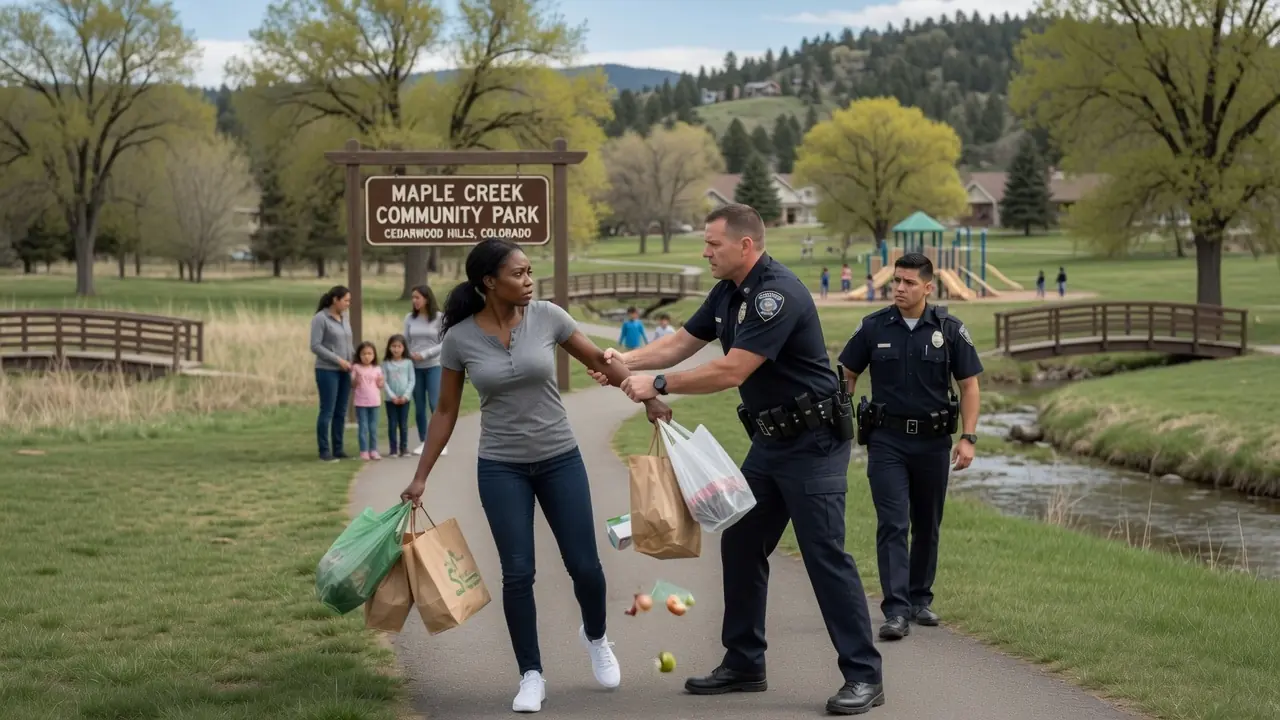
The patrol car was pulled half onto my driveway at a deliberate angle that blocked my car in completely. Holloway was already out, weapon drawn, both hands, shoulders back, stance wide, pointing at the center of my chest with the posture of a man who had already decided how this ended. "Don't move," he said. "Hands where I can see them."
My hands were already visible, empty. I had just set the bags down in some very quiet, very cold part of my brain, the part that does not panic, only assesses. I stood completely still. My pulse was level, not bravado. 12 years of training. "Down on the ground," Holloway said. "Right now."
"I live here," I said. My voice was the same voice I used standing 10 feet from a president in a crowd of 10,000. Level, carrying. "This is my house," I said. "Officer." I kept my hands raised, my body absolutely still. "I'm a federal law enforcement officer. I have credentials in my left front pocket. I need you to let me show them to you."
"You reach into that pocket and I will fire," he said. Flat. Absolute. He meant it. There was a pause. 4 seconds, maybe 5, in which I cataloged everything. The angle of the weapon, the tension in his forearms, the distance, 12 feet. Mrs. Patel, two doors down, standing motionless on her porch, one hand over her mouth. A car slowing on the street. Jasper's soccer gear in a bag by my feet. My service weapon locked in the safe 60 feet behind me, completely irrelevant.
"My name is Keira Webb," I said. "I'm a senior supervisory special agent with the United States Secret Service, badge number whiskey echo 774. This is my home. I have been unloading groceries." I held his gaze. Every word measured. "You can verify my identity right now by calling dispatch for a federal credentials check. I will stand exactly here while you do it."
Holloway stared at me. Something shifted in his face. Not doubt exactly, but something that lived next to it. A recalculation. He did not lower the weapon. I watched the thing happen in him that I had seen before in men who have committed publicly to a position they cannot defend privately. The moment they understand they may be wrong and decide it does not matter. "Get on the ground," he said again. Quieter. The voice of a man digging in.
"I'm not getting on the ground in my own driveway," I said. That was when the second patrol car arrived. It pulled in fast. No lights. The officer who climbed out was young, mid-20s, with the expression of someone dispatched to a call already past what the radio described. He looked at Holloway's weapon, my raised hands, the grocery bags, the soccer sticker on my Tahoe's rear window.
I watched him try to make the math work. "Holloway," he said carefully. "What have we got?" "Suspicious individual loading items from a vehicle refuses to comply." The young officer looked at the grocery bags. He looked at me. "Ma'am," he said, his voice uncertain, almost apologetic. "Can you tell me what's going on?"
"Keira Webb. I live here. Federal law enforcement credentials in my left pocket. I'd like permission to show them." He looked at Holloway. Holloway said nothing. The gun was still up. The only sounds were the low hum of the cruiser's engine, a lawn mower two streets over, and my own heartbeat, which I was keeping deliberately, consciously, slow.
"Let her show the credentials." Holloway said finally, like surrendering something rather than granting it. "Slow." I extracted the credential case with two fingers, opened it. The young officer stepped forward and looked at the badge, the photo ID, the agency seal, and I watched the color drain from his face. Holloway still had not lowered the gun.
"Holloway," the young officer said, with the tightness of someone who has just realized they are going to be in a report. "She's..." "I see it," Holloway said. He stared at my credentials for a long moment. Then slowly, with the deliberate care of a man already constructing a different version of events, he holstered his weapon.
He did not apologize. He did not speak. He stood in my driveway with his hand on his hip and looked at a point past my left shoulder. And the silence between us had a texture, rough, like the concrete under my feet, like the edge of something that was never going to smooth over. "We're done here," he said.
He got in his cruiser and left. The young officer stood holding my credential case. He had not handed it back. "Ma'am," he said. "I'm..." He stopped. "Is there anything..." He stopped again. "Your name?" I said. "Officer Mateo Rivera." "Officer Rivera," I said. "I'm going to need a copy of the incident report."
He handed back my credentials. His hand was shaking slightly. "Yes, ma'am," he said. I watched him drive away. I stood alone in my driveway in the ordinary afternoon between the grocery bags and the open trunk. And I breathed. Just breathed. Mrs. Patel had gone inside. The lawnmower had stopped.
The street was ordinary and empty the way a street looks after something has happened in it that it has no language for. I picked up the bags, carried them inside, closed the trunk, set everything on the kitchen counter, and stood there for a full minute with my hands flat on the cold granite before I picked up my phone and called Wesley.
He answered on the second ring. "What's wrong?" he said. Not a question. I told him everything in order in the same flat voice I had used in the driveway. When I finished, Wesley was quiet. "You know what this is?" he said. "Yeah," I said. "And you know what you're going to do?"
"I'm going to put away the groceries," I said, "and then I'm calling an attorney. And then I'm going to find out everything there is to know about Officer Bryce Holloway." A pause. "Then I'll start tonight." I hung up. I stood in Lena's good light. The light she had fallen in love with.
And I put the groceries away one by one. And I did not let myself feel anything yet. There would be time for that. Right now, I needed to think. Not react. Not rage. Think. I made coffee. I sat at the kitchen table. I opened my laptop and I began. I did not know yet what I was about to find.
I did not know that Holloway had three prior complaints on file. All closed without action. All involving women in cars or driveways or parking lots. I did not know that the most recent had been filed months earlier by a retired postal worker named Harold Jenkins, 72 years old. Ordered out of her vehicle at a grocery store while her wife sat in the passenger seat and watched.
I did not know that the supervisor who had closed Jenkins' complaint without investigation was Holloway's direct superior. I did not know any of that yet. But I was about to find out. And this time the ending would be very different. Wesley called back late that night. I was still at the kitchen table.
The coffee had gone cold an hour ago. But I had not moved. Jasper was asleep. The Ramirez family had dropped her off earlier. She had eaten pasta and fallen asleep in her soccer socks on the couch. And I had carried her to bed without waking her.
Lena was home. I told her what happened in four sentences, flat and factual, the way I would have briefed a supervisor. She had listened without interrupting. And when I finished, she sat down across from me at the table and said nothing for a moment. Then she reached across and put her hand over mine. Her fingers were cold from the glass of water she had been holding.
"How many complaints?" she said finally. "I don't know yet," I said. "Wesley is looking." She nodded. She did not say anything like it will be okay, or they will sort this out, or he will be punished. She had been married to me long enough to know that the system does not sort things out on its own. She made fresh coffee, sat back down, and waited with me.
Wesley called. I put him on speaker. "Three complaints," he said without preamble. "All within the last couple of years. All closed. All without disciplinary action. All involving women between the ages of 30 and 72. The most recent one is Harold Jenkins, retired postal worker, filed months ago. The complaint was reviewed and closed by Sergeant Harlan Coates."
A pause. "Coates is Holloway's direct supervisor. Has been for years." Lena's hand tightened on her coffee mug. "Is there a pattern in the closures?" I asked. "Same language in all three rejection letters," Wesley said. "Nearly verbatim. Officer acted within departmental guidelines. No evidence of misconduct. All three signed by Coates."
I looked at Lena. She was looking at the table. "Okay," I said. "Send me what you have." "Already did." Wesley paused. "One more thing. There's a fourth." The kitchen was very quiet.
"A fourth complaint?" I said. "Filed sometime earlier. Closed within weeks. The woman who filed it, Tyrell Morris, 28, electrician, withdrew it after a patrol car started sitting outside her apartment three nights a week." Another pause. "Holloway's patrol car."
The metallic taste of adrenaline came up in the back of my throat. I swallowed it. "Send me Morris's contact information," I said. "Already there," Wesley said. "Get some sleep." He hung up. I did not sleep. Not much.
Lena went to bed, and I sat at the table until the small hours, reading through Wesley's files. And what I read remade the picture of Bryce Holloway in my mind completely. This was not a cop who had made a bad call in a driveway one ordinary afternoon. This was a pattern. A practiced, consistent, deliberately shielded pattern of targeting, of intimidation, of a man who had found a system willing to protect him, and had used it methodically for years.
The rage came then. Not the hot, immediate kind, but the cold and focused kind that settles in your chest like ballast and does not move. I knew what that kind of rage was good for. I had learned a long time ago. In the morning, I called Victoria Cain. She was the attorney my father had used for 30 years, a civil rights litigator out of DC. Small firm, enormous reputation. The kind of woman who walked into a room and immediately became the most dangerous person in it.
I had met her twice at my parents' house, both times at Christmas, and I had always been slightly in awe of her, in the way you are in awe of people who have built their whole professional life out of refusing to accept things that other people accept. She answered on the third ring. "Keira Webb." She said. "What happened?" I told her.
She listened without a single interruption, which in itself told me she was taking this seriously. When I finished, she was quiet for exactly 4 seconds. "I need the incident report, the body cam footage from both units, the prior complaint files, and the contact information for every witness present on that street," she said. "Can you get me the body cam footage?"
"I can try channels," I said. "James, can..." "Don't try channels," she said. "File a formal records request today. Certified mail and email simultaneously. The moment that footage disappears, and it may, you want a documented record that you requested it before it disappeared." Her voice was measured, quick, precise.
"How many complaints?" "Three closed, one withdrawn under what looks like intimidation." A pause. "Four," she said. "We say four." "Yeah," I said. "I'll be in your city soon. We'll meet then."
She paused. "Keira, do not speak publicly about this yet. Not to neighbors, not to colleagues, not to anyone outside this circle. Let Holloway think this is over." She hung up. I stood in the kitchen holding the phone and for the first time since the driveway, I felt something shift slightly. Not relief, not even hope, but the particular sensation of a situation that is moving from chaos into structure, from something being done to you into something you are doing.
I called Tyrell Morris that afternoon. She did not answer the first time. She called back later. And when I told her who I was, there was a silence that I recognized. The silence of someone who has been burned before and is calculating the risk of opening a door that was previously closed. "I withdrew the complaint," she said carefully. "I know," I said. "I'm not asking you to refile it. I'm asking you to tell me what happened."
Another silence. Then she talked without stopping. And by the end of it, I was sitting very still in my car in the driveway because I had not trusted myself to drive while I was listening. Holloway had pulled Morris over one night, no stated reason, and ordered her out of the vehicle. She had searched the car without consent, found nothing, and told Morris she matched the description of someone connected to a local robbery.
Morris had filed the complaint the next day. Days later, a patrol car appeared outside her apartment building. It sat there for hours. It came back the following night and the night after that. No interaction, no knock on the door, just the car, just the presence, just the message. Morris had withdrawn the complaint after days.
"I have a daughter," she said when she had finished. "She's four." "I understand," I said. "Are you going to do something about this?" she asked. Her voice was tired. Not hopeless, just tired in the way of someone who has asked some version of this question before. "Yes," I said. "I am going to do something about this." I meant it in a way I had not meant anything in a long time.
The meeting came. I met Victoria Cain in a conference room at her associate's office downtown. Glass walls, a long table, afternoon light coming in at a low angle. She had the files I had sent her printed and tabbed. She had already made two phone calls I did not know about. She put her hands flat on the table and looked at me.
"The body cam footage from Holloway's unit," she said, "was deleted shortly after the incident." I felt the cold spread through my chest. "When?" "Soon after your records request was received and logged. The footage was deleted hours after the log entry." She paused. "Rivera's footage is intact. The department claims Holloway's camera malfunctioned." "Of course they do," I said.
"Officer Rivera," Victoria said, "has retained his own counsel. She filed a statement this morning with the department's internal affairs office. She is not being cooperative with the department's preferred account of events." She let that land. "She is 26 years old. She has been on the force for a couple of years. She is apparently a person of conscience."
She paused again, measuring. "And she knows what she saw." I thought about Rivera's shaking hands. "Good," I said. "Here is what we are going to do," Victoria said. She pulled a single sheet from the folder and slid it across to me. It was a list, numbered, clean.
"First, civil suit against Holloway personally, Sergeant Coates personally, and the department. Second, federal civil rights complaint filed with the Department of Justice. Your agency contacts will be relevant there, and I want to be careful about how we use them, but they are relevant. Third, we go to Harold Jenkins and Tyrell Morris, and we ask them formally, with legal support and without any pressure, if they will participate. Fourth," she tapped the last item on the list.
"We hold a press conference." I looked at her. "You said keep it quiet." "I said keep it quiet until we had structure," she said. "We have structure now. We have Rivera's statement. We have four complaints, two willing participants, one deleted video, and a supervisor who signed off on every single closure."
She folded her hands. "Keira, you are a 12-year Secret Service veteran who was held at gunpoint in her own driveway in front of her neighbor while loading groceries. You are not a private citizen. Your agency will be asked to comment. They will comment. The question is whether you are driving that narrative or writing it."
She was right. I had known she was going to be right. That was why I had called her. The press conference was soon after. Victoria had arranged it at a hotel conference room downtown, a space with no visual drama, no courthouse steps, no theater, just a table, a microphone, and the facts.
Rivera had agreed to attend, though not to speak. She sat against the wall to the left in civilian clothes, her hands in her lap, and I could see the effort it cost her to be there. Harold Jenkins was there, 72 years old, and absolutely composed in a dark suit. The kind of composure that only comes from outliving a great deal. Tyrell Morris had not come in person. She had given a written statement, which Victoria read.
I spoke for 8 minutes. I did not use emotional language. I used dates, badge numbers, case file references, and one photograph, a still from Rivera's body cam footage, showing Holloway's weapon drawn and aimed while my hands were plainly visible at my sides. I said Bryce Holloway had done this before. I said the department had known and chosen to protect her.
I said the deletion of body cam footage would be part of our federal complaint. Then I said the thing I had been saving. "I want to say one more thing about Officer Holloway," I said. And the room became very still. "When she stood in my driveway and pointed her weapon at me, she made the decision. She decided what I was before she looked. She decided what I deserved before she knew anything about me. She has made that same decision in that same way at least four times before."
I paused. "The badge in my pocket did not change what she did. It just meant I had the resources to respond to it. Harold Jenkins did not have those resources. Tyrell Morris did not have those resources. Most people do not."
I looked directly at the camera at the back of the room. "That's what this is about. That's what it has always been about." The room was quiet for a moment after I stopped. Then Victoria closed the folder and said, "We'll take questions."
The story broke nationally within hours. Holloway was placed on administrative leave that evening. Sergeant Coates was placed on administrative leave soon after. It came out that she and Holloway had served together before Coates' promotion. That they had a personal relationship that predated the complaints.
And that the nearly verbatim language in all three rejection letters had been written by Coates from a template she had apparently drafted and kept on file. The department's chief held a press conference and used the phrase "deeply troubling" repeatedly. The federal civil rights complaint was filed. The DOJ opened a preliminary inquiry soon after.
Holloway hired an attorney who released a statement calling the press conference a politically motivated attack on law enforcement. The statement mentioned my agency several times. It mentioned the word "agenda" repeatedly. It mentioned Harold Jenkins once in the context of denying the complaint. It did not mention Tyrell Morris or the patrol car outside her apartment building. It did not mention the deleted footage.
Weeks after the press conference, Holloway resigned from the department. Her attorney issued a second statement which said her client was stepping down to protect her family from harassment and to focus on her legal defense. The department did not contest the resignation or negotiate a severance package, which the union rep, speaking off the record, apparently called unprecedented.
Sgt. Coates resigned days later. The department settled our civil suit months afterward. I am not at liberty to discuss the terms. What I can say is that part of the settlement included a mandatory policy change. All misconduct complaints in the department would going forward be reviewed by an independent civilian oversight body rather than direct supervisors.
Harold Jenkins was included in the settlement. Tyrell Morris was included in the settlement. They both called me when it was finalized. Jenkins called first. Her voice was even, measured. The voice of a woman who has been waiting a long time for something and has learned not to show how much the waiting cost her. "Thank you," she said. "I didn't do this for a thank you," I said. "I know that," she said. "That's why I'm saying it."
Morris called an hour later. She said less. Just that her daughter had asked her that morning why she seemed different lately and she had not known how to explain it to a 4-year-old. So she had said, "Sometimes the right thing takes a long time, but it gets there." She had thought about that for a moment and then asked if she could have waffles.
"Smart kid," I said. "She really is," she said. It was a morning when I drove past the corner of Millbrook and Cedar for the first time since the incident. The morning was cold, clear, the kind of early spring morning where the light is thin, but you can feel the year turning. I was coming back from a run, the same route. The corner was empty.
No patrol car. No engine idling. Just the intersection. The bare trees. The street. I slowed anyway out of habit. I stood there for a moment in the cold morning air, hands on my knees, breathing. Mr. Hargrove was out when I turned onto my block, already at her mailbox despite the hour, because that was Mr. Hargrove.
She raised one hand in her slow, deliberate morning wave. I raised mine back. Inside, the kitchen light was on. Lena was at the counter with her coffee, a set of blueprints unrolled in front of her, pencil in hand. She looked up when I came in, and something in my face must have told her something because she did not ask how the run was.
She just watched me for a moment. "You okay?" she said. I thought about the driveway. I thought about Harold Jenkins at her grocery store, and Tyrell Morris watching a patrol car from her apartment window, and Rivera shaking hands, and Victoria Cain with her tabbed folders and her flat, precise voice.
I thought about Jasper's sign on her door, Jasper's room, and how I had carried her to bed that night and stood in the doorway for a moment, just watching her breathe. "Yeah," I said. "I'm okay." I poured myself a coffee and sat across from Lena at the kitchen table in her good light.
The light she had chosen for exactly this. The light that fell through the windows every morning, whether anything happened or not. Outside, the street was quiet, ordinary. The kind of ordinary that some days you earn. I drank my coffee for the first time in months. It did not taste like anything other than coffee.