Linda Mitchell noticed the patrol car only after she had already placed the last grocery bag in her trunk. Until then, the afternoon had been ordinary enough to feel forgettable. The parking lot outside Lawson's Market shimmered in late summer heat, shopping carts rattled along the asphalt, and a teenage bagger in a green apron collected carts near the entrance while humming to himself.
Linda was seventy-two, small framed but steady, with silver hair pinned neatly behind her ears and a blue cardigan folded over one arm because the store's air-conditioning had been too cold. She had come for peaches, coffee filters, chicken broth, and the brand of oatmeal her granddaughter liked when she slept over. Her husband had died eight years earlier, and she still shopped as if two people were waiting at home, then laughed at herself when she had to rearrange the refrigerator to make everything fit.
She was sliding the cart back toward the return lane when a voice cut across the parking lot. “Ma'am, I need to see your identification.”
Linda turned slowly. A police officer stood near the front of her sedan, one hand resting on his belt, the other pointing toward the windshield as though the car itself had offended him. He was broad shouldered, maybe in his late thirties, with a square jaw, close-cut brown hair, and sunglasses that reflected the bright line of parked cars behind her. His nameplate read COLLINS.
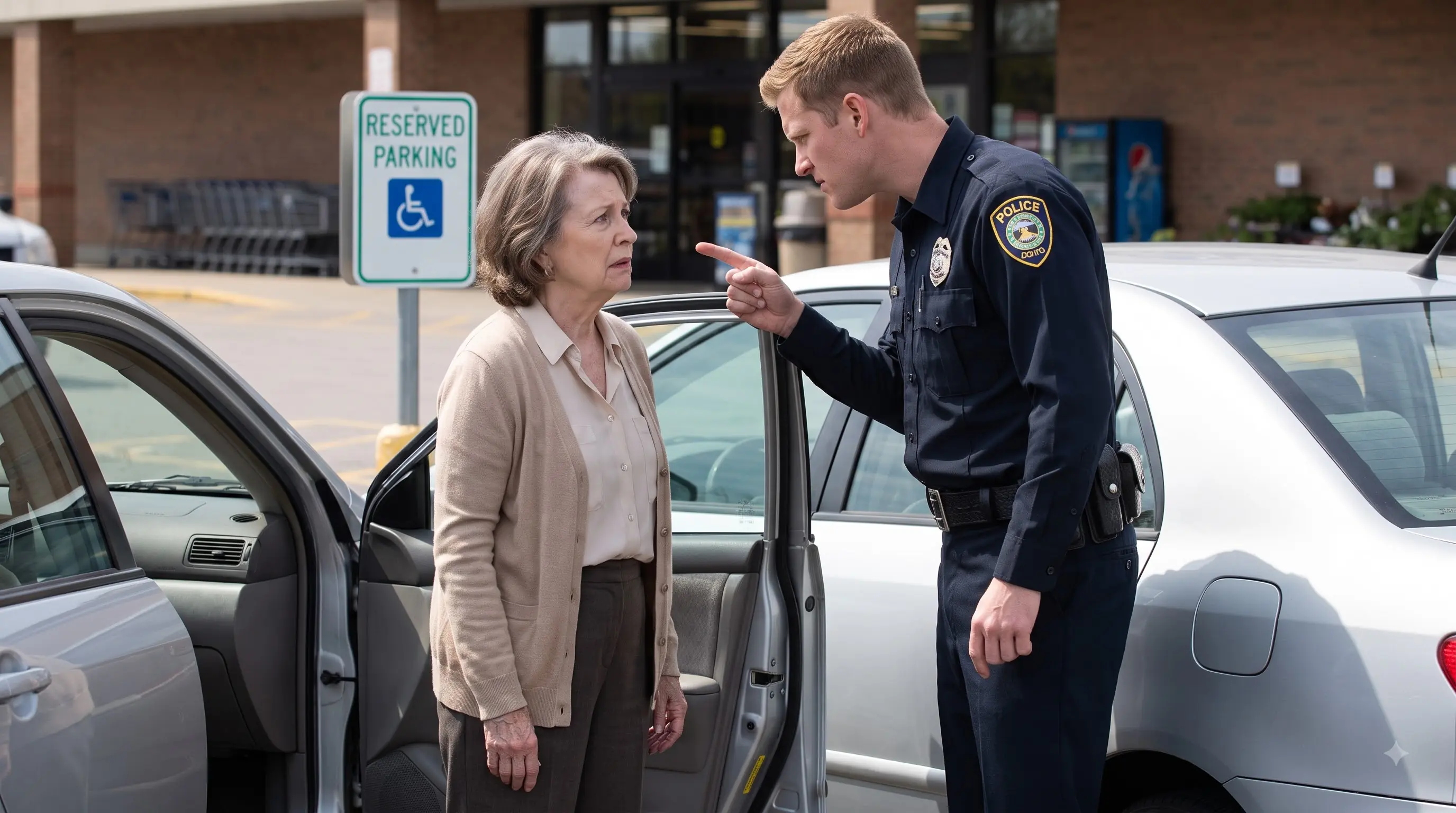
“Of course, officer,” Linda said, still trying to understand the situation. “I'll get it.”
She reached toward her purse in the passenger seat. The officer moved sharply. “Slowly.”
Linda froze.
The word was not loud, but it was heavy. A woman loading paper towels into an SUV two spaces away stopped moving. The teenage bagger looked over from the cart corral. Linda felt several small attentions gather around her like heat.
“I was just getting my wallet,” she said.
“Keep your hands where I can see them until I tell you otherwise.”
Linda turned her palms outward. “Officer, I think this is becoming unnecessary.”
“Just cooperate, ma'am.”
The word sounded polite, but his tone stripped it bare.
Linda looked at the ground in front of her car. The parking space had blue painted lines at the edge and a sign she had not noticed when she pulled in. Reserved for Lawson's Market Customer Pickup. Ten-Minute Limit. Manager Authorization Required. She had been inside for nearly forty minutes. The sign was partly hidden by the low branch of a crepe myrtle tree, but it was there.
“Oh,” she said. “I honestly didn't notice the sign.”
“This spot is reserved,” Officer Collins said. “Didn't you see the sign?”
“I just said I didn't. I'm sorry. I can move the car right now.”
“Not yet.”
Linda looked up. “Not yet?”
“I need to verify who I'm dealing with.”
A strange coldness moved through her chest. She had expected a warning, maybe a small lecture, perhaps even a ticket. But the officer's eyes were not on the sign anymore. They were on her hands, her purse, the groceries in the trunk, the inside of her car. His gaze had turned a parking mistake into something else.
“Verify for what?” she asked.
“Ma'am, you are in violation of posted parking restrictions, and you were reaching into the vehicle after being instructed to stop.”
“You told me you needed my identification.”
“I told you to cooperate.”
Linda inhaled slowly. Her daughter had taught her that. Four counts in, four counts out. Stay calm. Don't argue with someone whose power depends on turning your fear into evidence.
“I'll call my daughter,” Linda said.
Collins' mouth tightened. “That won't be necessary.”
“I would like to let her know I'm being stopped.”
“You're not being stopped. You're being questioned.”
“Am I free to leave?”
The officer gave a short laugh. “Here we go.”
Linda's hand trembled slightly as she held her phone. That small tremor seemed to please him.
“You nervous?” he asked.
“No. I'm confused.”
“People usually get confused when they know they did something wrong.”
Linda looked at him then. Really looked. Not as a frightened elderly woman, not as someone embarrassed by a parking mistake, but as a woman who had lived long enough to recognize the particular pleasure some people took in making another person smaller.
“I parked in the wrong spot,” she said. “That is not a crime that requires you to frighten me.”
His face hardened. “Make the call if you need to, but keep it on speaker.”
Linda pressed her daughter's name.
Sarah Mitchell answered on the second ring. “Mom?”
“Sarah, I'm at the grocery store. An officer stopped me.”
The line changed immediately. Not louder, not panicked, just sharper. “Mom, are you okay? What happened?”
“I'm fine,” Linda said, though she was not sure that was true. “But he's treating me like I did something wrong.”
“What officer?”
Linda looked at the nameplate. “Jake Collins.”
There was a pause.
Officer Collins shifted his weight.
“Mom,” Sarah said carefully, “listen to me. Stay near your car. Don't reach for anything unless he clearly tells you to. Don't argue. Is anyone recording?”
“I don't know.”
The teenage bagger had his phone half raised now. The woman by the SUV was watching with one hand over her mouth.
Sarah's voice turned colder. “Officer Collins, this is Chief Sarah Mitchell. You are speaking to my mother, Linda Mitchell. I want you to explain the legal basis for this detention.”
The parking lot seemed to go silent.
Collins stared at the phone.
Linda saw the precise moment his expression changed. Not guilt. Calculation.
“Chief,” he said, removing his sunglasses. “I had no idea this was your mother.”
“That is not what I asked.”
“She was parked in a reserved customer pickup space and became uncooperative when I requested identification.”
Linda felt heat rise in her face. “I did not become uncooperative.”
Sarah spoke over both of them. “Officer Collins, do not escalate this further. Issue a lawful warning or citation if appropriate, document the encounter, and clear the scene. Captain Harris will meet you at the station.”
Collins' jaw flexed. “Yes, Chief.”
“And Officer Collins?”
“Yes, Chief?”
“Turn on your body camera if it isn't already active.”
His hand moved to his chest.
A small red light appeared only after he touched the camera.
Linda saw it. So did the teenage bagger. So did the woman by the SUV.
Sarah's voice became very quiet. “Mom, I'll call you back in five minutes.”
The call ended.
Officer Collins looked at Linda as if she had tricked him. “You could have told me who your daughter was.”
Linda stared at him. “You could have treated me decently before you knew.”
He did not answer.
He returned to his cruiser, wrote something on a pad, then came back with a warning notice for improper use of a reserved pickup space. His handwriting was hard and angular, the paper almost torn where he had pressed the pen too firmly.
Linda took it without a word.
By the time she drove home, the peaches had bruised in the grocery bag, her oatmeal box had split at the corner, and her hands were still shaking on the steering wheel. She told herself it was nothing. A parking mistake, a rude officer, an embarrassing afternoon. But when she pulled into her driveway and saw the small red mark on her wrist where the officer had grabbed her for reaching too quickly toward her purse, something in her settled into anger.
At police headquarters, Chief Sarah Mitchell stood alone in her office, looking through the glass wall toward the bullpen below. She was forty-four, tall, composed, with dark hair cut just below her jaw and the kind of stillness people often mistook for coldness until they worked with her long enough to realize it was discipline. She had been chief for eight months, long enough to learn where the department kept its clean floors and where it hid its rot.
Captain Aaron Harris entered without knocking because she had told him to.
“You wanted Collins' complaint history,” he said.
“I want all of it.”
Harris set a tablet on her desk. He was sixty, near retirement, and had served under four chiefs with the cautious loyalty of a man who had seen reforms come and go like weather. “Jake Collins has three formal complaints in the last year.”
Sarah looked at him. “Three?”
“That's the official number.”
“What does unofficial mean?”
Harris hesitated.
Sarah turned fully. “Captain.”
He exhaled. “Five more informal contacts, two citizen service concerns, and at least one complaint that was filed but reclassified as customer dispute assistance.”
“Customer dispute?”
“Lawson's Market.”
Sarah's eyes sharpened.
“The grocery store?”
“Yes.”
She looked at the warning notice her mother had texted her. Lawson's Market appeared at the top as the complainant location.
“Pull everything connected to Lawson's,” Sarah said.
Harris nodded, but did not move.
“What?” she asked.
“There may be a reason this feels familiar.”
Sarah waited.
Harris said, “Mark Reynolds owns Lawson's Market.”
Sarah knew the name. Everybody in Brookford knew it. Mark Reynolds owned Lawson's Market, two gas stations, a development company, three rental buildings, and the vacant lot beside the river that every mayor had promised to turn into a park and every mayor had quietly failed to acquire. He sponsored Little League teams, donated turkeys every Thanksgiving, and sat two tables away from the police union president at every Chamber of Commerce breakfast.
“What about him?” Sarah asked.
“Several complaints involving Collins include Reynolds or one of his businesses.”
Sarah sat down slowly.
“Show me.”
Harris opened the first file.
A delivery driver accused Collins of threatening him outside Lawson's loading dock after a dispute over an unpaid invoice. Closed after complainant failed to appear for follow-up.
A cashier reported that Collins escorted a customer out of the store after Reynolds accused the man of stealing a bottle of vitamins, though security footage later showed the man had paid. Reclassified as store misunderstanding.
A homeless veteran filed a complaint after Collins ordered him away from the sidewalk outside Reynolds' gas station and allegedly shoved him against a bus shelter. Closed as unfounded.