Ma'am, stop reaching. Put your hands where I can see them. I'm not reaching for anything. I'm pregnant. I'm just trying to catch my balance.
You're resisting. Turn around now. Mariah froze. The weight of her stomach pulled her slightly forward. The strain visible.
Officer, please. I'm 7 months. I don't care. He cut her off sharply, hands behind your back. You're being detained.
Her grocery bags were still sitting in the shopping cart behind her. The trunk of her Highlander was open. A bottle of baby safe laundry detergent toppled to the ground as the wind nudged the cart. Her baby kicked hard inside her ribs. A warning, a plea, a fear she could feel physically.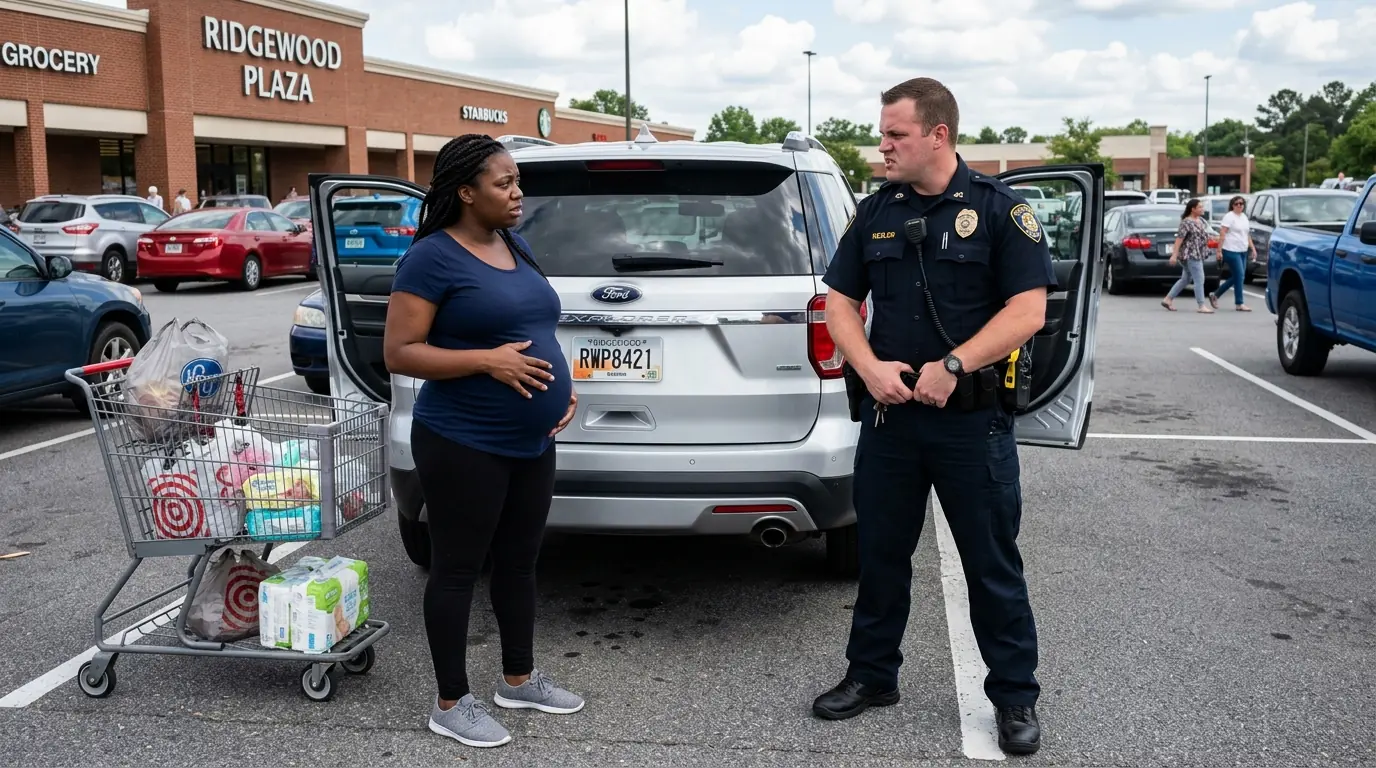
"Sir, you're making a mistake," she whispered. "I haven't done anything wrong. " "Do what I said," he barked, voice cold. "Or this is going to get worse. " The parking lot security camera captured the moment a pregnant woman tried to protect herself and her unborn daughter while an officer escalated a situation that should never have existed. And what officer Raymond Kesler didn't know, what he would only discover when it was far too late was that this arrest would ignite national outrage, end his career, expose systemic misconduct, and cost the city $1.5 million. But before we break down how a routine grocery trip turned into one of the most expensive police misconduct cases in the city's history, before the arrest, the investigation, and the lawsuit, there's something you need to understand first.
You need to know who this woman is. Because nothing about what happened in that parking lot makes sense until you know who Mariah Bennett really was. Her name was Mariah Bennett. And at 31 years old, she was 7 months pregnant with her first child, a little girl she'd already named Amara. Mariah wasn't wealthy.
She wasn't powerful. She wasn't someone who could pull strings or force special treatment. She was an ordinary black woman with an extraordinary amount of responsibility resting on her shoulders. She worked as a neonatal intensive care nurse. She spent her days and often long nights saving babies born too early, too small, too fragile.
Her steps became slower. Her breaths came deeper. Her movements are more careful. Her doctor had labeled her pregnancy high risk because of early hypertension. A diagnosis that forced her to rest more, stress less, and move deliberately.
That Saturday was supposed to be simple. She went to Ridgewood Plaza, a quiet suburban shopping center. She bought baby safe detergent, a car seat mirror, prenatal vitamins, belly butter, and tiny pink socks that had made her eyes well up in the checkout line. She parked close to the entrance. Doctor's orders.
Her SUV displayed a bright baby on board magnet on the rear window. She loaded the trunk slowly, one hand on her belly, the other carefully placing the bags. When little Amara kicked, Mariah paused and smiled. It was peaceful. It was quiet.
It was safe. Or so she thought. A few rows away, mall security guard Evan Bradley watched her. He didn't offer help. He didn't smile.
He didn't check if she needed assistance. He simply watched, his expression shifting into something unspoken, suspicion without reason. Mariah noticed him for a moment, then looked away. Pregnancy made her hyper aware sometimes. She assumed she was imagining things, but she wasn't.
Bradley lifted his radio and made a call that would change her life. Dispatch, I've got a suspicious person near a silver SUV. Black female, medium build, possibly pregnant, might be casing vehicles. That was it. No report of theft, no mention of anything illegal, just a black woman near her own car.
That vague, biased description dispatched Officer Raymond Kesler, a man with a disciplinary file thicker than most officers training binders. He had racked up multiple complaints, unnecessary aggression, disproportionate stops involving black drivers, and three written warnings for inappropriate escalation. None of that was known to Mariah. She closed her trunk, exhaled, and rested her hand on her side. She was exhausted.
All she wanted was to go home, put her feet up, and rest. But in less than 2 minutes, her quiet afternoon would become a nightmare. One that would put her pregnancy in danger, bring national attention to the department, and eventually cost the city $1.5 million. Mariah heard footsteps before she saw him. "Ma'am," Officer Kesler called out sharply, "Step away from the vehicle. " She turned slowly, as any pregnant woman would, and saw a white male officer approaching with a rigid, confrontational posture.
Her heart jumped. "Yes, officer," she said gently. "Is something wrong? Show me your ID," he demanded. "Now? " Mariah blinked, confused.
"My ID? Did I do something? " I said, "Show me your ID. " He repeated louder this time. "We got a report of suspicious behavior. " She instinctively placed a hand on her belly. "I'm loading my groceries into my car. I'm 7 months pregnant.
Is everything okay? " "Don't reach," he barked suddenly. Mariah froze. "My hand is on my stomach," she said softly. "The baby kicked. I wasn't reaching for anything. " "Step away from the car," he ordered.
She stepped away slowly, carefully, deliberately, and that was when she felt it. The moment her peaceful Saturday evaporated, replaced with fear sharper than anything she had felt in her entire pregnancy. Because the look in his eyes wasn't caution. It was assumption, judgment, bias wrapped in a uniform. She knew this was about to go wrong.
She just didn't know how wrong. Mariah stood still, hands visible, breathing carefully. The wind rustled the loose strands of her hair, but the rest of her body stayed perfectly still, every instinct, telling her to avoid sudden movements. Officer," she said softly. "Can you tell me what this is about?
I'm just trying to go home. I'll tell you when you give me your ID. " Kesler snapped. Mariah nodded, her voice steady, even though her heartbeat wasn't. "Okay, I'm reaching into my purse now, slowly for my wallet. Okay, nothing else. " She exaggerated the slowness of her movements, something black parents teach their children long before adulthood.
Kesler's hand tightened on his holster. Anyway, Mariah's fingers found her wallet. She pulled out her driver's license and held it out. Kesler snatched it without a thank you, without acknowledgement, without even looking at her face. "This your car? " he asked flatly.
"Yes," she said. It's registered to me and my husband, Daniel. Prove it. Mariah picked up the key fob. She pressed the lock button.
The lights blinked. She pressed unlock. The lights blinked again. But Kesler wasn't interested in logic or proof. He was interested in control.
He pointed at the shopping bag still in her trunk. What's in those baby items? She said, I'm pregnant. I was just shopping for my daughter. Open them.
Mariah blinked. Why, officer? I bought those inside. I have the receipts. Open the bags.
She kept calm. With what reason am I being accused of a crime? Ma'am, he barked. Your attitude is becoming an issue. She swallowed.
I'm not giving you an attitude. I'm asking for the legal reason behind this stop. Kesler stepped forward close enough for her to feel his breath. Don't test me. Her stomach tightened.
Not just fear, but the baby reacting to her stress. Officer, she whispered. I'm really scared right now. He didn't care. He never cared.
Mariah tried to shift her weight, her balance slightly off due to her stomach as she moved her foot. Kesler exploded. Stop moving. I I'm not, she stammered. I'm just trying to stand comfortably.
My back hurts. Turn around. What? Why? Turn around now.
He grabbed her left wrist before she could even adjust her footing. The sudden force made her gasp as her body jerked forward. "Wait, please, my stomach," she cried. The pressure against her abdomen sent a sharp cramp through her side. Kesler slammed her hands behind her back and snapped cold metal around her wrists.
Her vision blurred. "Officer, please," she cried. "I'm pregnant. You're hurting me. Stop resisting," he said.
"I'm not resisting. You're resisting. A woman in yoga pants yelled, "She's pregnant, sir. Stop. She's pregnant. " Another man pulled out his phone.
"Man, you can't do that. She didn't do anything. " But Kesler was locked in. Adrenaline, bias, ego. There was no turning back. He pushed her toward the patrol car.
Mariah stumbled, legs shaking. "Please, please slow down. I can't move fast. Quit the act," he muttered. "The act? " she whispered.
"I'm seven months pregnant. " But he didn't hear her, or he didn't want to. Mariah cried out as her stomach tightened again, a deep, squeezing pain that made her knees buckle. "Officer! " the yoga woman screamed. "She's in distress. Look at her. " Kesler shoved Mariah into the backseat of the patrol car.
As the door slammed, Mariah felt a terrifying thought rise inside her. What if I lose my baby because of this? The patrol car smelled like antiseptic and old vinyl. The seat was hard. Her hands were cuffed behind her, forcing her stomach forward, making it harder to breathe.
Every bump in the road sent jolts through her abdomen. "Please, baby, just relax," she prayed silently. Kesler didn't speak. He didn't glance at her. He didn't acknowledge her pain.
To him, she wasn't a woman. She wasn't a mother. She wasn't human. She was a suspicious person. But the security report would later show the truth.
Evan Bradley wrote she looked out of place near vehicles and nothing more. That was the entire justification. That lie was about to cost the city millions. When they arrived at the precinct, Officer Carmen Rodriguez, a 12-year veteran, took one look at Mariah and immediately frowned. "Why is she cuffed like that?
She's pregnant. " Kesler shrugged. She resisted. Rodriguez looked at Mariah's face, pale, sweating, chest heaving. "She looks like she's in medical distress," Rodriguez said firmly. "Get those cuffs off. " "No," Kesler said.
"She's being processed. " Rodriguez stepped closer, lowering her voice. "Undo the cuffs before you injure her further. I'm not asking. " Kesler hesitated, and that hesitation told everyone in the room he knew he'd screwed up. He removed the cuffs. Mariah slumped forward, gripping her stomach.
Rodriguez shouted for a medic. Within seconds, a nurse arrived, checking Mariah's pulse, heart rate, and blood pressure. Her BP is dangerously high, the nurse said. Stress induced. She needs to lie down now.
Rodriguez turned to Kesler. What exactly did she do? Suspicious behavior, he muttered. What behavior? He didn't answer.
Rodriguez's expression hardened. Lieutenant Harper stroed in, summoned by the commotion. Report, he ordered. Rodriguez handed him Mariah's ID and her name. This is Mrs.
Bennett, 7 months pregnant, brought in for unclear reasons. Harper turned slowly to Kesler. What's the probable cause? Kesler swallowed matching suspicious description. From who?
Harper said sharply. Mall security. Harper read the brief note, his jaw tightened. This says black woman near SUVs. That's it.
Kesler's silence was answer enough. You arrested a pregnant woman based on that. Kesler tried to recover. She resisted my commands. Rodriguez cut in.
She was moving slow because she's pregnant. Rey, she couldn't even turn properly. Harper's voice dropped. This is bad. This is really bad.
He faced Mariah. Mrs. Bennett, I'm Lieutenant Harper. I'm deeply sorry for what you've been put through. You will be released immediately.
Mariah's eyes filled with tears, a mix of pain, fear, and relief. But she wasn't done. Not by a long shot. I want everything," she whispered. "The call report, the body cam footage, his written statement, all of it.
You'll have it," Harper said softly. "Tonight. " " " Mariah sat on a bench in the station's lobby, still trembling as the nurse checked her blood pressure again. It was stabilizing, but slowly. Her phone had been returned to her. Her purse sat beside her.
Her grocery bags were in a plastic bin near the desk, rumpled, crushed, some items broken from when the officer shoved her into the squad car. She stared at her hands for a long moment before dialing the first number. Her husband, Daniel. When he answered, all she managed to say was, "Honey, I need you. " He arrived within 12 minutes, out of breath, eyes wild with worry, and sprinted through the station doors. "What happened to you? " he cried, dropping to his knees, holding her face in both hands.
"Mariah! Baby, what did they do to you? " She didn't answer. She didn't have the words yet. She just buried her face in his chest, shaking. After a long moment, Daniel looked at the lieutenant.
"This won't end here," he said quietly. "And he was right. " Next, Mariah called her OBGYn. Then, she called her supervisor at the hospital. Then, her older sister, who immediately said, "We're getting you a lawyer. " And finally, she called the local chapter of the NOACP. By midnight, the story was already moving.
The yoga woman who witnessed the arrest uploaded her recording before bed. Within 6 hours, it hit 2.3 million views. By noon the next day, it passed 9 million. Comments flooded in. This could have been my sister.
He didn't see a mother. He saw a stereotype. She literally told him she was pregnant. Fire him now. Mother's groups reposted it.
Civil rights communities amplified it. Even medical professionals weighed in, calling the arrest reckless endangerment of a pregnant patient. News outlets picked up the story. Local first, then statewide, then national. By the next morning, the city was in full crisis mode.
The chief of police issued a public statement, "We take this incident seriously and have initiated a full investigation. " Behind closed doors, the conversation was far less polished. "This is a liability bomb," the city attorney said. "The video is catastrophic," the IIA commander added. "That officer's record will bury us," whispered the assistant chief. Internal affairs investigators began pulling everything.
Kesler's body cam footage, the security guard report, radio logs, witness videos, officer history, prior complaints. Within days, the truth was unavoidable. The investigation uncovered. One, disproportionate stops. Kesler stopped black motorists at 3.1 times the department average.
Two, excessive escalation. He escalated low-level encounters 42% more than his peers. Three prior complaints ignored, five complaints for aggression, three for unnecessary force, one from a pregnant woman in 2021. All previously dismissed, four, no reasonable suspicion. The security guard's report described black woman near SUVs, nothing more.
Five, unlawful detention and arrest. IA concluded no legal basis, no probable cause, no articulable suspicion, excessive force used on a pregnant detainee, neglect of medical distress, violations of departmental policy, violations of constitutional rights. The report was devastating. When the city attorney reviewed the footage and the IIA findings, the conclusion was swift. This case cannot go to trial.
She said, "We will lose badly. " They called Mariah's attorney. They asked for a settlement meeting. Mariah and Daniel attended. Her pregnancy now at 34 weeks, her stress still visible. She listened as the city attorney offered a carefully rehearsed apology.
She didn't smile. She didn't cry. She didn't soften. She only said, "I could have lost my daughter that day. " The room went silent. Her attorney slid a packet across the table.
A federal civil rights lawsuit draft. 23 pages single spaced citing fourth amendment violations, excessive force, unlawful arrest, racial discrimination, negligent endangerment of an unborn child, emotional trauma, medical harm. The city attorney read it, then whispered. What will it take to settle? Two weeks later, the city formally agreed to pay $1,500,000, issue a written apology, implement mandatory deescalation training, revise protocols for pregnant women, re-evaluate officer misconduct tracking.
Mariah accepted the settlement, not for the money, but because the reforms were real. This wasn't about a check, she said. It was about making sure no other mother goes through what I went through. 6 weeks after the arrest, officer Raymond Kesler was fired. The termination letter cited unlawful detention, unlawful arrest, excessive force, racial bias, neglect of detainee, medical condition, conduct unbecoming an officer.
He tried to appeal. His union rep reviewed the footage, then told him simply, "You're done. The video destroyed you. " He withdrew the appeal, and the state opened a formal review of whether he should ever hold law enforcement certification again. Evan Bradley, the mall security guard, was terminated as well. When asked why he made the call, he couldn't provide a single suspicious behavior, only a feeling.
His employer issued a public statement condemning racial profiling. 3 months later, Mariah gave birth to a healthy baby girl, Amara Grace Bennett. When the nurse handed her over, Mariah cried, "This time out of joy, not fear. " Daniel kissed her forehead and whispered, "You protected her, even when they didn't protect you. " Mariah smiled weakly.
No one should ever have to fight for two lives at once, she said. Her story became a case study in training programs nationwide, a reminder, a warning, a lesson carved from trauma. And as for the city, the settlement check cleared. The reforms began, and the community never forgot the pregnant woman who stood up, not just for herself, but for every mother who came after her.