Officer Jake Williams shoves Betty Sanders against the pharmacy wall.
The 68-year-old woman's prescription bottle scatters across the floor. Her reading glasses crack against the tile. I'm just getting my husband's medication. Shut your mouth, Grandma.
Williams twists her arm behind her back. You people always have some sob story. The handcuffs slam shut. Betty gasps as metal cuts into her wrists. Customers record on phones. Some laugh.
An elderly woman brutalized in Georgia's wealthiest zip code, treated like she belongs in chains. Please, officer, you're hurting me. Good. Maybe you'll learn your place. But Betty Sanders has spent 40 years learning her place. 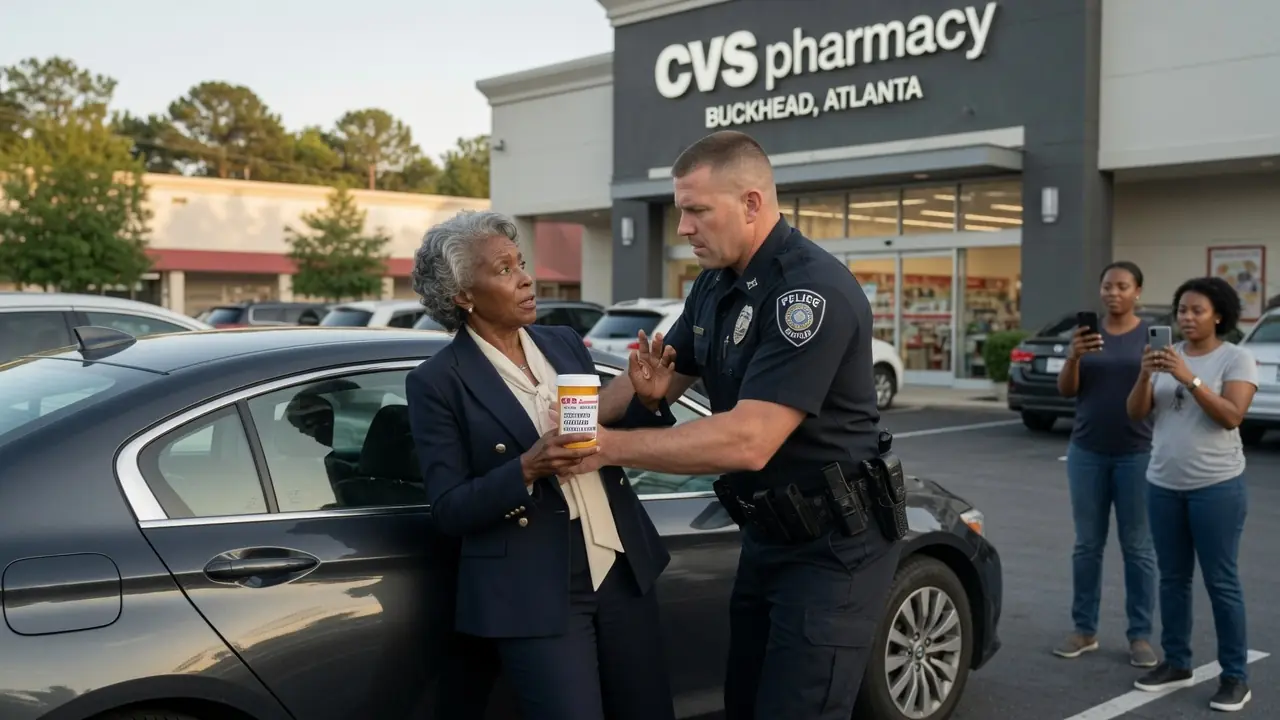
And it's not on her knees in front of a racist cop. When she speaks again, the words that come out will teach Williams exactly who belongs where. What she reveals next destroys his world. Betty Sanders had started this Tuesday like any other in her 47 years of marriage.
Coffee at 6:00 a.m. with Harold, her husband of nearly five decades. Toast cut into triangles the way he liked it since his stroke 6 months ago. The morning news played softly in their Buckhead townhouse where magnolia trees lined the sidewalk and neighbors still waved from their porches.
Harold's heart medication ran low yesterday. Betty noticed the orange bottle sitting nearly empty on their kitchen counter next to the pill organizer she filled every Sunday. His cardiologist had been clear. Miss even one dose and the consequences could be fatal.
I'll get it today, she'd promised, kissing his forehead before he settled into his reading chair. Harold smiled, the left side of his mouth still drooping slightly from the stroke. 47 years together and she'd never broken a promise to him. The CVS on Peach Tree Road sat in the heart of Buckhead, Atlanta's most affluent district.
Betty had been coming here for 3 years, ever since Harold's health declined. The pharmacy staff knew her by name. Marcus Thompson, the manager, always asked about Harold's progress. The young technician, Jennifer, remembered Betty preferred the large print labels.
This wasn't some inner city drugstore where tensions ran high. This was Buckhead, where federal judges shopped alongside Fortune 500 executives, where a woman like Betty Sanders belonged. Betty arrived at 2:15 p.m. 15 minutes early.
The pharmacy was busy, but orderly. She took her place in line behind a businessman checking his watch and a young mother bouncing a fussy toddler. Normal people living normal lives, unaware they were about to witness something that would shake their comfortable assumptions.
She wore her good navy blazer, the one she'd bought for courthouse appearances back when she still worked full-time. Reading glasses hung from a silver chain around her neck, a retirement gift from her law clerks. Her wedding ring caught the fluorescent light as she reached for her purse to check Harold's insurance card.
The prescription number was memorized. RX4471892. Lisinopril 10 mg. Take one daily with food. Harold's lifeline in a small orange bottle. Behind the counter, Marcus Thompson worked efficiently, filling prescriptions and answering phones.
He glanced up when Betty approached, ready with his usual warm greeting. Tuesday afternoons were typically quiet, a good time for conversation for asking about Harold's physical therapy progress. Betty had no way of knowing that officer Jake Williams was parked outside, radio crackling with dispatch calls.
No way of knowing he'd received orders to increase arrest numbers this week. No way of knowing that his supervisor had specifically mentioned the pharmacy as a high activity zone for prescription drug abuse. She certainly couldn't know that Williams had a quota to meet.
Three arrests before his shift ended. Two down, one to go. As Betty opened the pharmacy door, the small bell chimed overhead, the same sound she'd heard dozens of times before. Today, it might as well have been a warning bell.
Because while Betty Sanders saw a routine medical errand, Officer Williams saw an opportunity, and he was about to make the worst decision of his career. Officer Jake Williams enters the CVS at 2:28 p.m. with purpose in his stride.
His body camera blinks red, recording everything. Standard procedure, though Williams has learned which angles work best for his reports. Betty Sanders stands at the prescription counter, reading the medication label carefully through her glasses.
Her lips move slightly as she checks the dosage instructions. 10 mg. Lisinopril once daily with food. Harold's cardiologist had emphasized the importance of consistent timing. Williams notices her immediately.
An elderly woman taking too long at the counter, reading the label too carefully. In his 12 years of policing, he's learned to spot the signs. Drug seekers always study the bottles like that, checking for resale value.
Excuse me, ma'am. His voice carries authority across the quiet pharmacy. I need to speak with you. Betty looks up startled. Her hand instinctively tightens around the prescription bottle.
Yes, officer. What are you doing with that medication? The question hangs in the air. Other customers pause their shopping, sensing tension. Marcus Thompson looks up from behind the counter, his expression shifting from routine professionalism to concern.
I'm picking up my husband's heart medication. Betty explains calmly. Lisinopril, he takes it daily. Williams steps closer. His radio crackles with static.
Your husband's medication or are you planning to sell it? Betty's eyebrows furrow. Sell it? Officer, this is for high blood pressure. Why would anyone. Don't play dumb with me.
Jennifer, the young technician, stops counting pills. The businessman in line pulls out his phone not to record, but to step away from potential trouble. Officer, there's been a misunderstanding, Betty says, her voice steady despite her racing heart.
I have my husband's insurance card, his ID, and a medical power of attorney. Everything is legal. Williams checks his body camera, adjusting the angle slightly. That's exactly what someone running a pill mill would say.
Turn around and put your hands on the counter. Betty's eyes widened. I beg your pardon. You heard me. Hands on the counter. Now.
Marcus Thompson clears his throat. Officer, Mrs. Sanders is a regular customer. She comes in monthly for her husband's medication. We've never had any. Sir, step back from the counter.
This is police business. Williams reaches for his handcuffs, the metal clinking against his duty belt. Betty's hands begin to tremble, not from fear, but from a familiar anger she's kept carefully controlled for decades.
Officer Williams, she reads from his name tag. I'm going to ask you to reconsider your actions. Are you threatening me? Williams smiles, the expression cold, because that's obstruction.
I'm not threatening anyone. I'm simply suggesting turn around, hands behind your back. Betty doesn't move. Around them, customers begin pulling out phones.
Some to record, others to call for help. The young mother with the toddler hurries toward the exit. Ma'am, I won't ask again. Williams grabs Betty's shoulder, spinning her around.
Her prescription bottle falls to the floor, pills scattering across the linoleum like dice. Betty's voice remains calm despite the roughness of his grip. Officer, you're making a serious mistake.
Williams laughs, a sound without humor. The only mistake here is yours. Should have stayed home. The handcuffs click open in his hands.
Behind the counter, Marcus Thompson reaches for the phone to call his district manager. This situation has escalated beyond anything in his training manual. Betty Sanders feels the cold metal approaching her wrists and knows she's reached a crossroads.
She can submit quietly. Let this young officer have his moment of power and deal with the aftermath later. Or she can speak the truth that will change everything. The decision she makes next will destroy more than just Williams afternoon.
The handcuffs snap shut around Betty Sanders wrists with a metallic finality that echoes through the CVS. The sound cuts through normal Tuesday afternoon conversations like a gunshot. Customers freeze midstep.
The gentle hum of air conditioning and soft radio music can't mask the sudden, suffocating tension. Williams yanks Betty's arms tighter, forcing her shoulders back in a position that sends sharp pain down her spine.
At 68, her joints protest every movement, but she refuses to cry out. She's endured worse indignities in her lifetime, though none quite this public. There we go, Williams announces to the growing crowd.
One less drug dealer on the streets. His voice carries satisfaction, the kind that comes from what he believes is a job well done. Betty feels the cold metal cutting into her wrists where her circulation slows.
Her wedding ring catches against the cuffs, pinching skin that's grown thin with age. Marcus Thompson abandons his post behind the counter. His pharmacy training forgotten in the face of this nightmare.
Officer, please. Mrs. Sanders comes here every month. She's picking up legitimate medication for her husband. I can show you the prescription history. Step back, sir.
Williams points a warning finger at Marcus. Unless you want to join her in cuffs for interfering with police business. The threat hangs in the air. Marcus' hands shake as he retreats, knowing that intervention could cost him his job, his livelihood, maybe his freedom, but every instinct screams that this is wrong.
Around the pharmacy, phones emerge from purses and pockets. The businessman who was ahead of Betty in line holds his device steady, recording everything. A teenage girl near the greeting cards whispers into her phone, You need to see this.
Some cop is arresting this old lady for literally nothing. Betty's designer blazer wrinkles as Williams pushes her toward the front of the store. Her reading glasses hang crooked from their chain, one lens cracked from when he spun her around.
The prescription bottle, Harold's lifeline, still lies scattered on the floor, pills mixing with dust and debris. Walk, Williams commands, his hand gripping her elbow with unnecessary force.
Each step sends jolts of pain through Betty's arthritic knees. She stumbles once and Williams jerks her upright without gentleness. The small crowd parts before them like water.
Some people backing away, others following with their cameras raised. This is unbelievable, someone whispers. She's someone's grandmother. But Williams feels vindicated.
In his mind, he's done everything by the book. Suspicious behavior, check. Possible drug trafficking, check. Resisting cooperation, check. His body camera has captured a clean arrest that will look good in his report.
He doesn't notice the way Betty holds herself despite the handcuffs, the straightness of her spine, the careful dignity in each forced step, the way she makes eye contact with witnesses, not in shame, but in something approaching pity.
My husband is expecting me home, Betty says quietly as they near the store's entrance. He'll worry if I'm late. Should have thought about that before you started dealing pills, Grandma.
The automatic doors slide open, revealing the busy Peach Tree Road sidewalk. More phones appear. A woman walking her dog stops and stares. A delivery driver parks his truck and pulls out his device to record.
Williams guides Betty toward his patrol car parked illegally in a handicapped space. The irony isn't lost on anyone watching. Betty notices the violation, but says nothing.
She's learned to pick her battles over seven decades of life. You can't arrest her for picking up prescription medication. The voice belongs to Jennifer, the young pharmacy technician who's followed them outside.
Her voice cracks with emotion and inexperience with confrontation. Watch me, Williams replies, opening the patrol car's rear door. The smell hits Betty immediately, stale sweat, fear, and disinfectant.
The plastic seat is cracked and uncomfortable. Williams places his hand on her head, pushing down as she's forced to bend into the car. Careful with her.
Marcus Thompson has also emerged from the store, his manager's badge still pinned to his shirt. She's 68 years old. Old enough to know better. Williams shoots back.
But as Betty settles into the patrol car's back seat, something in her posture changes. The humiliation is still there, carved into the lines around her eyes. The pain from the handcuffs still shoots through her shoulders.
But underneath it all, something else emerges. Resolve. Betty Sanders has spent 47 years of marriage protecting Harold from stress. She's spent decades navigating systems designed to dismiss women who look like her.
She's learned patience, diplomacy, and the art of strategic silence. But she's also learned when enough is enough. Williams slams the car door, the sound reverberating across Peach Tree Road.
Through the window, Betty can see the crowd that's gathered. Phones still recording. Witnesses to her humiliation. Some shake their heads in disgust.
Others look away, unwilling to confront the uncomfortable truth of what they're seeing. Williams walks around to the driver's seat, already composing his report in his mind.
Drug trafficking, resisting arrest, obstruction. Maybe he can add something about threats or suspicious behavior. Make it stick. He has no idea that the woman sitting handcuffed in his back seat has spent 23 years sentencing people exactly like him, and her patience has just run out.
Williams settles into the driver's seat, adjusting his radio volume. His dashboard computer glows with arrest forms waiting to be filled. Drug trafficking, easy paperwork, another stat for his monthly numbers.
Officer Williams. Betty's voice cuts through his administrative satisfaction. Her tone has changed. Gone is the confused elderly woman. What remains is something else entirely.
Williams glances in the rearview mirror. Save it for the judge, lady. I am the judge. The words hang in the patrol car like a physical presence.
Williams hand freezes on his radio dial. What did you say? I said, I am a federal judge, retired from the Northern District of Georgia. 23 years on the bench.
Williams turns around, studying Betty's face through the metal grating that separates them. She sits straighter now despite the handcuffs. Her cracked reading glasses catch the afternoon light, and behind them, her eyes hold something Williams has never seen before in the back of his patrol car.
Authority. You're lying. But his voice lacks conviction. Something in Betty's posture and the way she speaks makes his stomach tighten with the first whisper of doubt.
Run my name through your system, Betty says calmly. Elizabeth Sanders, Federal Judicial Database. You'll find my commission papers, my security clearance, my retirement ceremony from 3 years ago.
Williams' hands shake slightly as he reaches for his computer terminal. This isn't possible. Federal judges don't get arrested for drug trafficking. Federal judges don't shop at CVS pharmacies in handcuffs.
Federal judges don't sit in the back seats of patrol cars. But as his fingers type Elizabeth Sanders, federal judge northern district into the database, the screen fills with information that makes his blood run cold.
Judge Elizabeth M. Sanders, appointed 2001, confirmed unanimously by the US Senate, presided over 4,847 cases specialized in federal criminal law, civil rights violations, and law enforcement misconduct. Law enforcement misconduct.
Williams stares at the photograph on his screen. Younger, wearing judicial robes, but unmistakably the same woman sitting handcuffed in his back seat. The woman he just arrested for drug trafficking.
The woman he called grandma and shoved against a pharmacy counter. This can't be right, he whispers, but his computer doesn't lie. Cross references confirm everything.
Federal Bureau of Investigation security clearance, Secret Service protection detail during high-profile cases, commendations from three US attorneys general. Betty watches his face in the rearview mirror as reality crashes over him.
I've sentenced 17 police officers during my tenure, Officer Williams. Corruption, civil rights violations, excessive force. I know your type very well. Williams' mouth opens, but no sound comes.
His career, his pension, his future, everything he's worked for over 12 years in law enforcement suddenly balances on the edge of a cliff he didn't see coming. The handcuffs are quite tight, Betty continues conversationally.
I'd estimate you have about 30 seconds before the crowd outside realizes what you've done. 47 people are recording this arrest on their phones. By tonight, this will be national news.
Williams looks through his windshield at the growing crowd. Phones still raised. Witnesses to what they now know is the arrest of a federal judge for picking up heart medication. The story that will end his career before dinner time.
I didn't know. Williams stammers. You didn't identify yourself. I shouldn't have needed to. Betty's voice remains steady.
Judicial. Every person deserves basic dignity during police interactions, regardless of their profession or position. But you chose intimidation, violence, and humiliation instead. Williams' radio crackles with dispatch calls.
Normal police business continues around them while his world collapses. His hands tremble as he reaches for the door handle. Officer Williams, Betty says as he prepares to exit the car.
Before you remove these handcuffs, I want you to understand something very clearly. Williams pauses, his hand frozen on the door. This isn't over. This is just the beginning.
And outside, the cameras keep rolling. Sarah Brown receives the tip at 4:17 p.m. through a text from her nephew, a college student who saw the viral video spreading across social media.
Aunt Sarah, cop arrested federal judge at CVS. This is insane. You need to see this. The Atlanta Journal Constitution's investigative reporter has covered police misconduct for 8 years, but she's never seen footage quite like this.
Her laptop screen fills with shaky cell phone video. An elderly woman in handcuffs forced into a patrol car while witnesses scream protests. The audio quality is poor, but the visuals tell a brutal story.
By 5:30 p.m., Sarah has confirmed Betty Sanders identity through federal judicial records. 23 years on the bench, hundreds of criminal cases, a reputation for fairness that crossed party lines. The last person who should be faced down in a pharmacy parking lot.
Sarah's first call goes to Marcus Thompson, the CVS pharmacy manager who witnessed everything. His voice shakes as he describes the arrest over the phone. Mrs. Sanders comes in monthly.
Same prescription, same insurance card, same polite conversation about her husband's health. Officer Williams treated her like she was running a drug cartel. Did you try to intervene?
I tried to explain that she was a regular customer. Williams threatened to arrest me, too. Sarah takes notes on her laptop, building a timeline. 2:15 p.m. Betty enters CVS.
2:28 p.m. Williams arrives. 2:31 p.m. Confrontation begins. 2:47 p.m. Arrest completed. 16 minutes from normal errand to National News Story.
Her second call goes to the Atlanta Police Department's public information office. The response is predictably defensive. Officer Williams followed department protocol in investigating suspicious behavior related to potential prescription drug abuse.
The department stands behind his actions pending a full investigation, but Sarah has been covering APD long enough to read between the lines. Pending investigation means damage control. Suspicious behavior means they have no real justification.
She requests Williams' personnel file through open records laws. APD has 72 hours to respond, but Sarah knows bureaucratic delays when she sees them. This file will be heavily redacted, if it comes at all.
Her breakthrough comes at 8:45 p.m. from an unexpected source. Dr. Patricia Hayes, Betty's physician, calls Sarah directly after seeing the news coverage. Medical ethics prevent her from discussing specifics, but she can confirm that Betty has legal authority to pick up Harold's medications.
Judge Sanders has been managing her husband's care since his stroke 6 months ago. She has medical power of attorney, insurance authorization, and pharmacy verification on file. There's nothing suspicious about her actions.
Sarah's next move requires more delicate navigation. She reaches out to former colleagues of Betty's from the federal courthouse, retired attorneys, court clerks, and other judges who worked with Betty over two decades.
The picture they paint destroys any narrative about suspicious behavior. Judge Betty Sanders was known for punctuality, preparation, and unwavering ethics. She'd sentenced corrupt cops before, always with careful attention to evidence and fair sentencing guidelines.
Betty doesn't have a vindictive bone in her body, says retired district attorney Charles Morrison. But she also doesn't tolerate abuse of power. If Williams thinks this will blow over quietly, he's never dealt with Betty Sanders.
By Wednesday morning, Sarah has assembled a preliminary profile of Officer Jake Williams that makes her stomach turn. Through public records and anonymous sources within APD, a pattern emerges that department leadership clearly hoped would stay buried.
Williams joined APD 12 years ago after washing out of the Georgia State Patrol Academy for attitude problems. His training officers noted excessive aggression and poor judgment under pressure red flags that someone ignored.
The complaints started within his first year. Mrs. Dorothy Washington, 71, reported that Williams threw her to the ground during a traffic stop for an expired registration. Her daughter filed a formal complaint.
APD's internal affairs division found insufficient evidence after a two-week investigation. Three months later, Marcus Rodriguez alleged Williams used a slur during a shoplifting arrest. The complaint was dismissed because no other officers witnessed the incident.
Williams' body camera had mysteriously malfunctioned. The pattern continues for 12 years. Elderly defendants, petty violations escalated to violent arrests. 12 formal complaints filed with internal affairs.
12 complaints dismissed or buried in bureaucratic procedures designed to protect officers rather than citizens. Sarah's computer screen fills with case numbers, complaint forms, and incident reports that read like a masterclass in systematic abuse disguised as police work.
Williams didn't just profile Betty Sanders. He's been profiling vulnerable people for over a decade. Wednesday afternoon brings Sarah's most significant discovery. Through a source she can't name, she obtains CVS's complete security footage from Tuesday's incident.
Their cameras captured everything Williams' body camera missed. The timestamp shows Williams checking his body camera twice during the confrontation. Once when he first approached Betty and again when he placed her in handcuffs.
Both times he adjusts the angle away from his actions. Deliberate obstruction of evidence. But CVS's overhead cameras captured what Williams tried to hide. Betty's calm demeanor throughout the encounter.
Her repeated attempts to explain her legitimate purpose. Williams's escalating aggression despite her compliance. Most damning is the audio. While Williams claimed Betty was acting suspiciously and resisting cooperation, the security footage shows a polite elderly woman following pharmacy procedures exactly as she had dozens of times before.
Sarah's investigation expands to Williams' arrest statistics. Through data requests, she discovers he leads district 2 in arrests of elderly defendants, a category that should be statistically rare. Williams arrest rates for prescription related offenses are triple the department average.
The numbers tell a story APD doesn't want to tell. Williams doesn't just make arrests. He targets specific demographics for arrests. Elderly people, anyone who seems unlikely to fight back effectively.
A predator in a uniform protected by a system designed to shield bad cops from consequences. Thursday morning brings the smoking gun Sarah needs. An anonymous email arrives with Williams personal text messages from Tuesday afternoon.
Leaked by someone within APD who's apparently tired of watching Williams destroy lives without consequences. 2:14 p.m. Got a live one at CVS Peach Tree. Elderly female. Time for arrest number three.
2:29 p.m. Easy target acquired. She won't even know what hit her. 2:52 p.m. Oops. Might have messed up. Need a cover story ASAP.
The messages are verified through metadata analysis. Williams wasn't investigating suspicious behavior. He was hunting for easy arrests to meet quotas. Betty Sanders wasn't a criminal suspect. She was prey.
Sarah's computer dings with another anonymous message. This one containing internal APD memos from Captain Morris, Williams's direct supervisor. The subject lines alone tell the story. Arrest statistics, need improvement, and performance metrics.
The memos reveal APD's quota system in black and white. Officers are evaluated on arrest numbers, not crime reduction or community safety. Williams has been gaming the system for years, targeting vulnerable populations who won't effectively challenge police reports.
Betty Sanders wasn't just unlucky. She was deliberately selected for humiliation because Williams thought a 68-year-old woman would be powerless to fight back. Captain Morris's response to Williams' mistake reveals the department's true priorities.
Instead of disciplining Williams for false arrest, Morris instructs him to craft incident reports carefully and emphasize the subject's non-compliance. Sarah stares at her laptop screen, surrounded by evidence of systematic corruption that reaches far beyond one bad cop.
APD's leadership knew about Williams pattern. They enabled it, protected it, and planned to cover it up. But they didn't count on Betty Sanders fighting back, and they certainly didn't expect a federal judge to have the knowledge, connections, and determination to expose their entire system.
The war is just beginning and Williams has no idea what he's unleashed. By Thursday evening, Atlanta Police Department's damage control machine kicks into high gear. Captain Morris calls an emergency meeting with department lawyers, public relations staff, and union representatives.
The room smells of stale coffee and desperation. We have a problem, Morris announces, tossing printed screenshots of social media posts across the conference table. The Sanders arrest is going viral.
We need to contain this before it reaches national news. The first salvo comes at 11:47 p.m. through an internal memo marked confidential personnel matter. Officer Williams is placed on administrative leave pending investigation, which everyone understands means paid vacation while the department hopes public attention fades.
Betty Sanders reads the memo on Friday morning from her breakfast table where Harold sips coffee with a trembling hand. His stroke has worsened since Tuesday's stress. The pills scattered across the CVS floor were his last dose before running out.
They think this ends here, Betty tells Harold quietly. Administrative leave, a few weeks of paid time off, then back to normal. Harold's speech slurs slightly. Another effect of missed medication.
What will you do? Betty folds the memo carefully. What I've always done. Follow the evidence wherever it leads. At 2:17 a.m. Saturday, Betty's phone rings.
Heavy breathing on the other end. Then a gravelly voice. Drop this, judge. You don't know who you're messing with. The line goes dead.
Betty writes down the time and caller ID information. Unknown number in her legal notebook. 40 years of judicial experience taught her that anonymous threats usually mean you're over the target.
The harassment escalates through the weekend. Strange cars parked outside their townhouse. Hangup calls at odd hours. Someone leaves a dead rat on their front steps with a note.
Snitches end up like this. Harold's anxiety spikes with each incident. His blood pressure readings worry Betty more than the threats. She considers backing down, letting Williams return to duty, accepting the injustice to protect her husband's health.
But Monday morning brings news that hardens her resolve. Sarah Brown's investigation published in the Atlanta Journal Constitution with devastating detail. Williams 12-year pattern of abuse, the quota system, the cover-ups.
APD's response is swift and vicious. Captain Morris holds a press conference at 3:00 p.m. flanked by police union lawyers and department officials. His prepared statement is a masterclass in victim blaming disguised as professional concern.
After reviewing all available evidence, we find that officer Williams followed appropriate protocols in investigating suspicious behavior at a known location for prescription drug diversion. While we regret any misunderstanding with Mrs. Sanders, our officers must make split-second decisions to protect public safety.
A reporter raises her hand. Captain, how do you explain the text messages showing Williams plan to target elderly suspects? Morris's jaw tightens. We don't comment on alleged evidence that may have been obtained illegally.
However, I will note that Mrs. Sanders has a history of anti-police bias in her judicial rulings. This appears to be a pattern of activism rather than legitimate complaint. The press conference is a declaration of war.
APD isn't just defending Williams. They're attacking Betty's reputation, her judicial record, her credibility. Tuesday brings an escalation Betty didn't expect. Harold collapses in their kitchen while making breakfast.
Betty finds him unconscious on the tile floor, a coffee mug shattered beside him. The paramedics rush him to Emory University Hospital with blood pressure readings that threaten stroke or heart attack.
Stress-induced hypertensive crisis, Dr. Martinez explains in the emergency room waiting area. His body can't handle the current pressure levels. We need to stabilize him immediately.
Betty sits beside Harold's hospital bed, watching monitors that measure his declining health. His hand feels fragile in hers, skin paper thin and cold. The cost of fighting injustice has always been high, but she never imagined it might cost Harold's life.
Wednesday evening, Morris makes a personal visit to the hospital. He arrives in uniform, projecting authority, even in the cardiac care unit. Nurses whisper as he passes, recognizing power when they see it.
Judge Sanders, Morris says, settling into the visitor's chair uninvited. I'm sorry about your husband's condition. Betty studies his face, reading decades of police politics in his expression.
Are you here officially, Captain? I'm here as someone who wants to resolve this situation quietly for everyone's benefit. Morris places a folder on Harold's bedside table.
Williams made a mistake. We acknowledge that. But dragging this through federal court won't help anyone. Your husband needs peace and quiet. We can arrange early retirement for Williams.
Full pension, clean record. Everyone moves on. And my humiliation, the pattern of abuse, the other victims. Morris shrugs. Sometimes justice isn't perfect, judge.
Sometimes it's about what's practical. Betty opens the folder. Williams's resignation letter pre-signed and dated. A department statement calling the arrest an unfortunate miscommunication, no admission of wrongdoing, no systemic change, no acknowledgement of the dozen other victims who suffered in silence.
24 hours, Morris says standing. After that, this gets ugly for everyone involved. Betty watches him leave, his polished shoes squeaking against hospital linoleum.
Through Harold's window, she can see downtown Atlanta's skyline, the federal courthouse where she spent 23 years defending justice against exactly this kind of corruption. Harold stirs in his sleep, monitors beeping steadily.
His medication schedule is finally stabilized, but his stress levels remain dangerously high. Betty knows that accepting Morris's deal would protect Harold's health, end the harassment, and restore their peaceful retirement.
She also knows it would condemn future victims to the same treatment she endured. Williams would walk away unpunished, free to terrorize other vulnerable people under color of authority. For the first time in 47 years of marriage, Betty Sanders faces a choice between protecting her husband and protecting justice.
Betty Sanders sits in the cardiac care unit at 3:47 a.m. watching Harold's chest rise and fall with mechanical precision. The monitors that surround his bed beep softly in the darkness, measuring a life hanging in the balance.
His second heart attack came Tuesday night, 12 hours after Captain Morris's hospital visit. The doctors call it a stress-induced cardiac event. Betty calls it the price of standing up to power.
Dr. Martinez delivered the news with clinical precision. Significant damage to the left ventricle. His recovery depends on eliminating stress factors immediately. Betty holds Harold's hand, feeling how thin and fragile it's become.
47 years of marriage, and she's never seen him look so small. The stroke 6 months ago stole his words. This heart attack might steal everything else. I'm sorry, she whispers to his sleeping form.
I'm so sorry I dragged you into this. Harold's eyes flutter open, focusing slowly on her face. His mouth moves, trying to form words that won't come clearly.
Betty leans closer, straining to understand. Fight, he manages to whisper. Don't stop fighting. But Betty isn't sure she has any fight left.
The anonymous calls continue despite the hospital security. Someone hacked their credit cards. Their insurance company is suddenly reviewing Harold's cardiac care coverage, questioning whether the treatments are medically necessary.
The harassment extends beyond threats. APD's public relations campaign has been devastatingly effective. Online comment sections overflow with character assassination disguised as law and order rhetoric.
Activist judge gets what she deserves. Should have just complied with police orders. Why was she really at that pharmacy? The doubt seeps into Betty's mind despite her decades of experience with public scrutiny.
Maybe Morris was right. Maybe justice isn't worth Harold's life. Maybe some battles are too costly to fight. Sarah Brown calls Wednesday morning with news that feels like another punch to Betty's diminishing resolve.
Williams' union has hired a high-profile defense attorney. Three other officers have come forward to support Williams version of events. APD's internal affairs division announced their investigation concluded Williams acted within department guidelines.
They're closing ranks. Sarah explains over the phone. The blue wall of silence is impenetrable when they want it to be. Betty stares out Harold's hospital window at the Atlanta skyline.
The federal courthouse where she dispensed justice for 23 years looks smaller from here, dwarfed by corporate towers and medical complexes. Maybe I should accept the settlement, Betty tells Sarah quietly. Harold can't take much more stress.
Betty, you can't give up now. Williams will just do this to someone else. But what if there is no justice? What if the system really is too broken to fix?
This is the moment Betty Sanders has avoided for seven decades. The moment when fighting for what's right costs more than surrender. When principle collides with love and both seem impossible to preserve.
Thursday brings word that makes Betty question everything she's believed about justice. The mayor's office announces support for APD's handling of the Sanders case. The police union schedules a rally supporting Williams.
Three city council members issue statements defending officers who risk their lives daily to protect citizens from drug trafficking. Betty realizes she's not just fighting Williams anymore. She's fighting an entire system designed to protect corrupt cops at any cost.
A system that will sacrifice her husband's health, her reputation, and her peace of mind to avoid admitting wrongdoing. Harold sleeps fitfully, monitors showing elevated stress levels, even in unconsciousness.
His body is shutting down under pressure that was supposed to be Betty's burden alone. She holds his hand and faces the hardest decision of her life. Accept Morris's deal and save her husband or continue fighting and risk losing everything that matters most.
For the first time since Tuesday's arrest, Betty Sanders considers the possibility that justice isn't worth dying for. Outside Harold's window, dawn breaks over Atlanta, and Betty must choose between love and justice.
Thursday afternoon brings an unexpected visitor to Harold's hospital room. Judge Patricia Wilson, Betty's former colleague from the federal courthouse, arrives carrying a briefcase and wearing an expression of controlled fury.
I saw the mayor's press conference, Patricia says without preamble. What they're doing to you is unconscionable. Betty looks up from Harold's bedside, exhaustion etched in every line of her face.
Patricia, I appreciate you coming, but no. Patricia's voice carries the same authority that commanded federal courtrooms for 18 years. You're not doing this alone anymore.
Patricia opens her briefcase, revealing a stack of documents. 12 federal judges from our district signed this letter. We're filing an amicus brief supporting your civil rights lawsuit.
Pro bono representation from Morrison Bradley and Associates. Full backing of the Federal Judges Association. Betty stares at the papers, hardly daring to believe what she's reading.
Names of respected jurists she's known for decades lending their reputations to her fight. We've all seen Williams type before, Patricia continues. Bullies with badges who think federal judges are just old people they can intimidate.
Today, they learn differently. Friday morning brings news that transforms Betty's isolation into something resembling hope. Harold's room phone rings constantly with calls of support.
Retired attorneys offering legal assistance. Law school classmates sharing their own encounters with police misconduct. Former defendants whose cases Betty handled fairly regardless of their background.
Dr. Raymond Peters, Atlanta's most prominent civil rights attorney, arrives Friday afternoon with an offer Betty can barely process. My firm will handle your federal lawsuit at no cost. We've been waiting 20 years for a case this clear-cut.
I don't understand, Betty says. Why would you? Because Williams arrested a federal judge. Dr. Peters replies bluntly. If that's not worth fighting, nothing is.
Saturday brings the breakthrough that changes everything. Marcus Thompson, the CVS pharmacy manager, calls with news that makes Betty's hands shake. Judge Sanders, I found something.
Williams came into our store three times last month. Not for arrests, just walking around watching customers, especially elderly customers. I have security footage of him studying people, taking notes.
The footage reveals Williams conducting surveillance, building target lists. Betty wasn't randomly selected. She was researched, profiled, and chosen for maximum humiliation.
Sunday morning brings the most powerful support yet. Dr. Dorothy Washington, the 71-year-old woman Williams assaulted during a traffic stop 3 years earlier, arrives at the hospital with her daughter and granddaughter.
I never had the strength to fight him alone, Mrs. Washington tells Betty. But I ain't alone anymore, and neither are you. Her story opens floodgates.
By Sunday evening, seven other Williams victims have contacted Dr. Peters office. Elderly defendants, vulnerable people who thought they had no voice against police power.
Monday brings national attention. CNN picks up Sarah Brown's investigation. The Washington Post editorial board condemns APD's handling of the case. Congressional representatives from Georgia demand federal oversight of Atlanta police practices.
Harold squeezes Betty's hand during Monday's evening news coverage. His speech has improved slightly with reduced stress medication. Proud of you, he manages to whisper.
Betty looks around Harold's hospital room, now filled with flowers from supporters, legal briefs from colleagues, and contact information from dozens of people offering help. For the first time since Tuesday's arrest, Betty Sanders realizes she's not fighting alone anymore.
And somewhere in Atlanta, Officer Williams is about to learn that attacking a federal judge was the worst mistake of his life. Tuesday morning at 7:23 a.m. Sarah Brown receives an encrypted email that changes everything.
The sender identifies himself only as a friend in blue with an Atlanta PD email signature that checks out through verification software. Williams isn't working alone. Check Officer Rodriguez's body camera from March 12th.
Audio file attached. You'll want to hear this. Sarah downloads the audio file with trembling fingers. Officer Miguel Rodriguez was Williams's partner that Tuesday, assigned to patrol Buckhead's Pharmacy District.
His body camera was supposedly inactive during Betty's arrest. The audio proves otherwise. Sarah's laptop speakers crackle with crystal clear sound.
Williams voice recorded 15 minutes before he entered the CVS, coordinating with Rodriguez through their patrol car radio. Target acquired at CVS Peach Tree. Elderly female alone reading prescription labels too carefully.
Perfect stats padding. Rodriguez responds, Copy that. I'll maintain the perimeter. Keep civilians back when you make the arrest. Remember, accidental camera malfunction if things get messy.
Captain wants clean paperwork on this quota push. Sarah rewinds the audio three times, hardly believing what she's hearing. This wasn't a spontaneous arrest based on suspicious behavior.
This was a planned operation coordinated between two officers designed to manufacture arrests for statistical purposes. The audio continues with devastating clarity. How do you want to play this? Rodriguez asks.
Standard intimidation. Make her feel powerless. Get compliance through fear. These elderly types always fold under pressure. What if she has legitimate prescriptions? Doesn't matter.
By the time she proves innocence, arrest stats are already logged. Captain only cares about numbers, not outcomes. Williams' laugh is audible through the radio static.
Besides, who's going to believe some old lady over a police officer? The system's rigged in our favor. Sarah calls Dr. Peters immediately. I have the smoking gun.
Williams planned this arrest. Rodriguez was complicit. APD command structure knew about quota manipulation. The audio file reaches Betty at 9:45 a.m. through Dr. Peters encrypted phone call.
She listens in Harold's hospital room, watching her husband's face as Williams's words destroy any remaining doubt about his motivations. Elderly types always fold under pressure. Harold's blood pressure monitor shows his fury despite his weakened condition.
Bastards, he whispers with more clarity than he's managed in days. But the audio contains more than Williams' confession. In the background, dispatch radio reveals the scope of APD's corruption.
Three other elderly target arrests were logged that same afternoon. A systematic campaign against vulnerable populations. Sarah's investigation expands the audio evidence through digital forensics.
Williams and Rodriguez have been coordinating these arrests for 18 months. 67 elderly defendants, 43 prescription related charges, statistical manipulation designed to justify budget increases and overtime pay.
Betty recognizes the legal implications immediately. This isn't just civil rights violation. It's criminal conspiracy under federal racketeering statutes. Williams, Rodriguez, and their commanding officers face potential federal prosecution.
Wednesday morning brings confirmation that the audio is authentic through FBI digital analysis. Agent Jennifer Hayes calls Dr. Peters directly. This evidence supports federal charges against multiple APD officers.
We're opening a criminal investigation. Captain Morris learns about the audio Wednesday afternoon through APD's internal security breach investigation. Someone leaked Rodriguez's body camera files to the press.
Morris immediately calls an emergency meeting with union lawyers. We have a problem, Morris tells the assembled officials. Williams operation is blown. Federal charges are coming.
We need complete separation from this disaster. Thursday morning, APD announces Rodriguez's suspension and Williams termination for conduct unbecoming a police officer. No mention of federal investigation or criminal charges, but the message is clear.
The department is cutting ties with both officers. Williams receives termination notice at 2:17 p.m. Thursday through certified mail. After 12 years of protected misconduct, his career ends with a form letter and confiscated badge.
But for Betty Sanders, this isn't about Williams career anymore. The audio evidence proves systematic corruption reaching through APD's command structure. Individual justice has become institutional accountability.
Federal agents are already preparing arrest warrants. And Williams nightmare is just beginning. The Atlanta City Council emergency session convenes Thursday evening at 7:00 p.m. in the packed municipal building.
Every seat is filled. Cameras from CNN, Fox News, and local stations line the back wall. Betty Sanders enters through the main doors at 7:23 p.m. Walking slowly but steadily.
Harold's arm linked through hers. Harold insisted on attending despite his cardiologist protests. His speech remains slurred, his steps unsteady, but his presence beside Betty sends a message that resonates through the chamber.
This family will not be intimidated. City Council Chair Amanda Foster calls for order as the crowd settles into tense silence. This emergency session addresses recent allegations regarding Atlanta Police Department procedures and the arrest of Judge Elizabeth Sanders.
Williams sits at the defendant's table, flanked by his union attorney and a court reporter. His face is pale, hands clasped tightly in front of him. Gone is the swagger from Tuesday's arrest.
What remains is a man watching his life collapse in real time. Council member David Carter speaks first. Officer Williams, you are under oath. Do you swear that your testimony will be truthful and complete?
Williams raises his right hand, his voice cracks on the word yes. Dr. Peters stands to address the council, his voice carrying decades of courtroom authority. Council members, we present audio evidence that fundamentally alters the nature of this case.
The chamber falls silent as Rodriguez's body camera audio plays through the sound system. Williams's voice fills the room with damning clarity. Target acquired elderly female. Perfect stats padding.
Gasps ripple through the audience. Several council members lean forward, studying Williams' reaction. His face drains of remaining color as his own words condemn him.
These elderly types always fold under pressure. Harold Sanders squeezes Betty's hand. Around them, witnesses from Tuesday's arrest nod in recognition.
Marcus Thompson, the CVS manager, shakes his head in disgust. Council Chair Foster addresses Williams directly. Officer, do you deny these are your words?
Williams' attorney whispers urgently in his ear. The silence stretches for nearly 30 seconds before Williams speaks. I I was following departmental procedures for investigating suspicious.
Betty Sanders rises from her seat, her voice cutting through his stammered excuse. You called me a target. You planned my humiliation. You laughed about elderly people folding under pressure.
The chamber erupts in murmurs as Betty continues. For 23 years, I sentenced officers who violated their oaths. I showed mercy when possible, severity when necessary, but I never encountered someone who took such pleasure in cruelty.
Williams tries to respond, but Betty isn't finished. You didn't see a suspicious person Tuesday afternoon. You saw an opportunity to abuse power without consequences. You saw someone you thought was powerless.
Betty's voice grows stronger with each word. But power doesn't come from badges or handcuffs. It comes from the truth. And the truth is that you are a bully who hides behind a uniform to terrorize vulnerable people.
Williams's attorney pulls him aside for whispered consultation. When they return to the table, Williams speaks in a barely audible voice. I resign from the Atlanta Police Department, effective immediately.
The chamber erupts in cheers and applause, but Betty remains standing, her judicial composure intact. Resignation is not justice, she declares. Federal charges are pending. Other victims deserve accountability.
This ends when the system changes, not when one officer quits. Council Chair Foster gavels for order as Williams stands to leave. Camera flashes illuminate his walk toward the exit, documenting his fall from authority to disgrace.
But as Williams disappears through the chamber doors, Betty knows this victory is just the beginning of real change. 6 months later, Betty Sanders picks up Harold's heart medication at the same CVS on Peach Tree Road.
The prescription number remains unchanged. RX4471892. Lisinopril 10 mg. Take one daily with food, but everything else has changed. Marcus Thompson greets her with a warm smile, asking about Harold's recovery.
No suspicious glances, no second-guessing her purpose, just normal courtesy extended to a regular customer. Jake Williams sits in federal prison serving 18 months for civil rights violations and conspiracy.
Rodriguez received 12 months. Captain Morris took early retirement after FBI investigation revealed departmental quota corruption reaching back 5 years. Harold's health improved dramatically once stress subsided.
His speech has returned to near normal clarity. His smile is brighter, his hands steadier as he waits in their car outside. Atlanta PD implemented new policies prohibiting arrest quotas and requiring supervisor approval for prescription related arrests.
Williams 12 victims receive settlement payments ranging from $50,000 to $200,000. But Betty's greatest victory sits in her passenger seat, humming softly to the radio, alive and recovering.
Sometimes justice wears reading glasses and carries heart medication. Sometimes it speaks five words that change everything. Sometimes it requires an elderly woman to teach powerful people about real strength.
Betty Sanders proved that dignity cannot be handcuffed. Truth cannot be silenced. And justice delayed but never denied always finds its way.