"Hey, get off her. Hands where I can see them." " She's having a heart attack. I'm a doctor. I'm giving her CPR." "
Stop talking. Back up now." " You're hurting her. She needs compression." " Away.
Oh, my eyes. I'm helping her." " Get out. Get on the ground." Doctor Adrian Foster was jogging through Riverside Park on a Saturday morning when he saw a white woman collapse on the trail ahead of him.
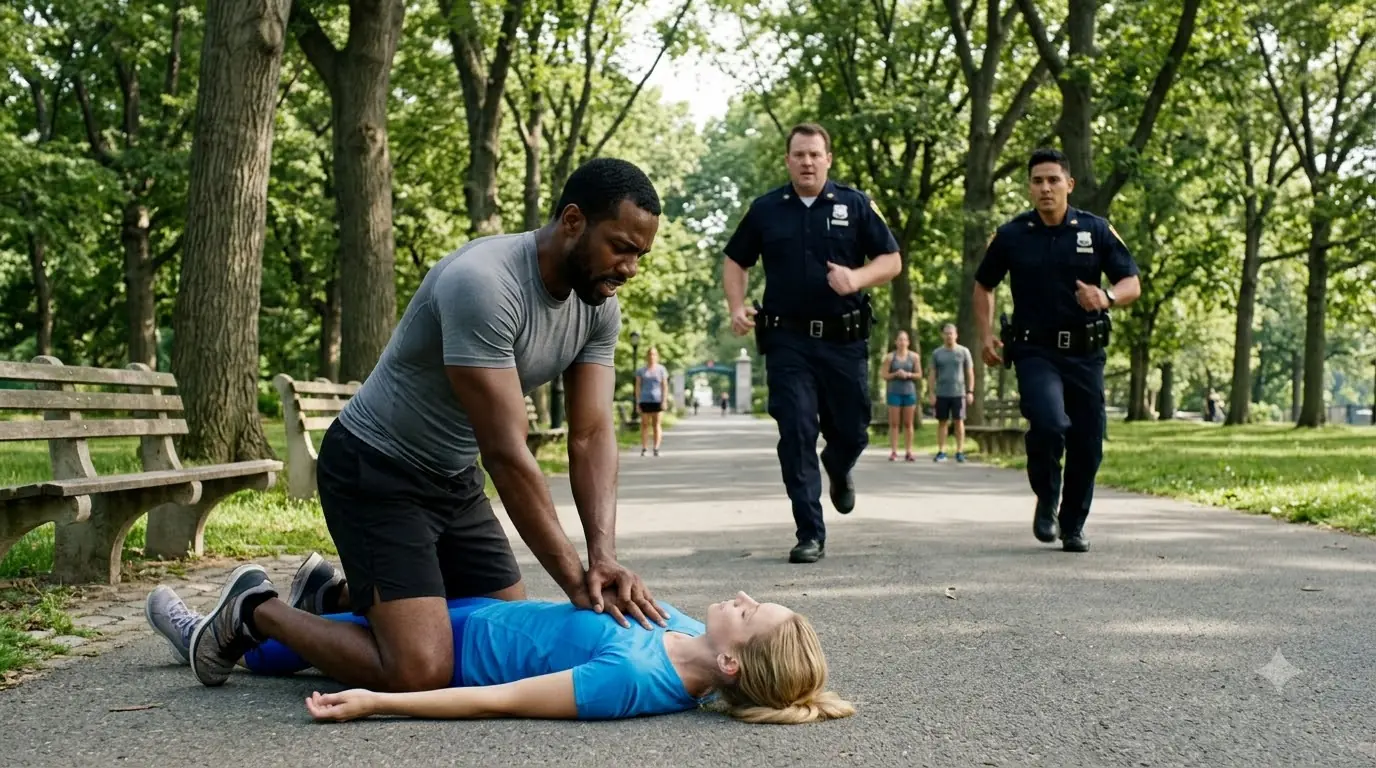
And without hesitation, he dropped to his knees beside her, checked for a pulse, found she wasn't breathing, and immediately began performing CPR to save her life. A white woman watching from a nearby bench saw a black man kneeling over an unconscious white woman. And instead of asking what was happening or offering help, she pulled out her phone and called 911 screaming that a black man was attacking a woman in the park. When officers Greg Lawson and Daniel Cruz arrived and saw Doctor Foster performing chest compressions on the unconscious jogger, they didn't assess the situation or ask questions.
They pepper sprayed him in the face mid-compression, tackled him off the woman, and when Adrian tried to explain that she was having a heart attack and that he was a doctor, Lawson told him to shut up and said, "It's always your kind committing these crimes." And Cruz added sarcastically, "Yeah, right, a doctor." Before telling him he was going to jail for a long time.
What officers Lawson and Cruz didn't know, what they would discover only when paramedics arrived moments later and confirmed that Doctor Foster had just saved the woman's life, was that they had just assaulted and arrested a board-certified emergency room physician, that their racist remarks and failure to assess the situation had nearly killed the woman he was trying to save, and that their actions would cost Officer Lawson his badge and result in a $1.1 million lawsuit that would become one of the most widely condemned examples of racially biased policing ever recorded.
Riverside Park on a Saturday morning in late May was exactly what a city park was supposed to be on a beautiful spring day. The running trail that looped around the park for 3 miles was busy with joggers moving at different paces. Some fast and focused, others slower and more relaxed. Families walked dogs on the grass.
Kids played on the playground near the north entrance. People sat on benches reading or scrolling through their phones. The sun was warm, but not too hot, and the air smelled like fresh-cut grass in the kind of morning that made people glad they lived in a place with parks like this. Dr. Adrian Foster ran the outer loop of the trail at a steady pace.
His breathing controlled and even. His stride smooth from years of running this same route every Saturday morning. He was 38 years old, a board-certified emergency room physician at City General Hospital, and he had been working in emergency medicine for 10 years. He had seen just about everything a person could see in an ER.
Trauma cases, cardiac arrests, overdoses, strokes, every kind of medical crisis that could walk through the doors or arrive by ambulance. He had performed CPR dozens of times, had saved lives that would have been lost without immediate intervention, and he had trained other doctors and nurses on how to respond when seconds mattered and hesitation meant death. Adrian wore black running shorts, a gray compression shirt, and well-worn running shoes that had logged hundreds of miles on this trail.
His headphones were in, playing music that kept his pace steady, and he was thinking about nothing in particular except the rhythm of his breathing and the feeling of his legs moving beneath him.