Pasted text.txt Document
Pasted text.txt Document
Pasted text.txt Document
Pasted text.txt Document
Pasted text.txt Document
Pasted text.txt Document \
Pasted text.txt Document
The doorman almost didn't open the door.
Not because he was rude.
Because he assumed the elderly man standing beneath the pouring rain had mistaken the building for somewhere else.
The Imperial Crown Hotel stood at the heart of downtown Chicago, occupying an entire city block with polished marble, towering glass walls, imported Italian chandeliers, and a reputation that attracted celebrities, diplomats, and business leaders from around the world.
The Presidential Suite cost nearly twelve thousand dollars a night.
Most guests who reserved it arrived in chauffeured limousines.
Not on foot.
Certainly not carrying a faded brown suitcase held together with worn leather straps.
The old man paused beneath the entrance canopy and wiped rainwater from the brim of his weathered hat.
His gray jacket had clearly seen many winters.
The cuffs were slightly frayed.
His shoes were polished but old.
The suitcase beside him looked older than many employees working inside the hotel.
The doorman stepped forward.
"Good evening, sir."
The elderly man smiled warmly.
"Evening."
"Can I help you?"
"I certainly hope so."
He adjusted the suitcase in his hand.
"I'd like to reserve the Presidential Suite."
For one brief second...
The doorman assumed he had misheard.
"I'm sorry?"
"The Presidential Suite."
The old man repeated politely.
"For three nights."
Inside the lobby...
A young receptionist looked up from her computer and caught the final sentence.
She exchanged a quick glance with the concierge.
Neither spoke.
But both smiled.
Not kindly.
The old man entered anyway.
Rainwater dripped quietly onto the polished marble floor.
Everything inside seemed impossibly elegant.
Crystal chandeliers reflected across black marble.
A grand piano filled the lobby with soft music.
Fresh white lilies stood in arrangements taller than most people.
The elderly gentleman admired everything with genuine appreciation.
He wasn't impressed.
He was remembering.
He had approved nearly every design choice in the building himself.
Five years earlier.
Only no one here knew that.
The receptionist straightened her uniform as he approached.
Her name tag read:
Rachel.
She offered the practiced smile every luxury hotel employee learned during training.
"Welcome to the Imperial Crown."
"How may I assist you this evening?"
"I'd like the Presidential Suite."
Rachel blinked.
"The Presidential..."
"Suite."
He nodded pleasantly.
"If it's available."
She hesitated.
Her fingers rested on the keyboard.
Yet she never touched it.
Instead...
Her eyes slowly traveled across his appearance.
The faded jacket.
The worn suitcase.
The old boots.
The inexpensive wristwatch.
Then back to his face.
Her smile changed almost imperceptibly.
It became the smile people wear when they believe they're being polite while quietly dismissing someone.
"I'm terribly sorry, sir."
She said carefully.
"Our premium accommodations are usually reserved well in advance."
"I understand."
He nodded.
"Would you mind checking?"
"There really isn't much point."
She answered.
"I know tonight's occupancy."
The old man remained perfectly calm.
"I'd still appreciate it."
Rachel sighed almost invisibly.
Before she could answer...
The hotel manager noticed the conversation.
Clara Mitchell had managed the Imperial Crown for nearly six years.
She believed luxury meant maintaining certain standards.
Unfortunately...
Some of those standards existed only inside her own imagination.
She approached confidently.
"Good evening."
Rachel smiled with visible relief.
"This gentleman is asking about the Presidential Suite."
Clara looked toward the elderly man.
Then toward the suitcase.
She reached her conclusion before asking a single question.
"I see."
She folded both hands politely.
"Sir..."
"Our Presidential Suite begins at nearly twelve thousand dollars per evening."
The old man smiled.
"Yes."
"I read that online."
Clara waited.
Surely he would now ask for a standard room.
Instead...
He simply asked,
"So..."
"Is it available?"
A businessman standing nearby quietly laughed into his coffee.
Another guest looked up from her laptop.
The atmosphere changed.
People weren't openly mocking him.
But curiosity mixed with quiet amusement.
Clara tried again.
"There are several comfortable hotels only three blocks away."
She pulled a brochure from beneath the desk.
"They offer excellent accommodations at considerably lower prices."
The old man looked at the brochure.
Then gently slid it back across the counter.
"I'm sure they do."
"But I'd like to stay here."
Rachel couldn't help smiling.
She whispered quietly enough that she believed only Clara could hear.
"He doesn't get it."
Unfortunately...
The old man heard every word.
He simply chose not to respond.
After seventy-nine years of life...
He had learned that silence often revealed more about others than arguments ever could.
Clara finally spoke more directly.
"I'm concerned this may not be the best fit."
The old man tilted his head.
"In what way?"
"The Imperial Crown specializes in luxury hospitality."
He waited.
She continued.
"Our guests generally expect..."
She searched for the right words.
"...a certain atmosphere."
He smiled softly.
"I see."
Neither woman noticed the concierge watching uncomfortably from several feet away.
His name was Daniel.
Forty-three.
He had worked in hotels for over twenty years.
Something about the conversation bothered him.
Not because the elderly gentleman seemed important.
Because nobody had asked the simplest question.
His name.
The old man reached slowly into his inside jacket pocket.
"I suppose we can solve this rather easily."
He removed a black credit card.
American Express Centurion.
The card rested quietly on the marble counter.
Rachel stared.
Clara looked down.
Neither spoke immediately.
Finally...
Rachel forced a nervous smile.
"Counterfeit cards have become surprisingly sophisticated these days."
Daniel closed his eyes briefly.
The old man merely nodded.
"I understand."
He picked the card back up.
Then reached into his wallet once more.
"This should complete the check-in process."
He handed over his passport.
"Would you please register the room?"
Rachel accepted it almost absentmindedly.
She opened the passport.
Looked down.
Then looked again.
Her smile disappeared.
Completely.
She blinked twice.
Read the name a third time.
Her hands began trembling.
"Clara..."
Her voice barely existed.
The manager frowned.
"What?"
Rachel silently handed her the passport.
Clara glanced down.
Her expression changed within seconds.
Color drained from her face.
She looked toward the elderly man.
Back at the passport.
Then toward the enormous portrait hanging behind the reception desk.
A portrait unveiled during the hotel's grand opening.
One almost every employee walked past every day.
The younger version wore a tailored navy suit instead of faded denim.
His hair had been darker.
But the eyes...
Were exactly the same.
Harold Bennett.
Founder.
Chairman.
Principal owner of Bennett Hospitality International.
The company that owned the Imperial Crown.
And forty-six luxury hotels across North America.
Clara's mouth opened.
No words came.
The elderly gentleman smiled gently.
"Good evening, Clara."
She almost dropped the passport.
"M..."
"Mr. Bennett..."
Rachel stepped backward so suddenly her chair rolled into the wall.
The businessman who had laughed moments earlier slowly lowered his coffee.
The concierge stared without speaking.
The pianist quietly stopped playing.
Silence spread through the lobby.
Harold Bennett calmly picked up his old suitcase.
"I asked whether the Presidential Suite was available."
Nobody answered.
Clara finally found her voice.
"Mr. Bennett..."
"I..."
"I'm so terribly..."
He raised one hand kindly.
"There will be time for apologies later."
He glanced around the lobby.
"I have one question first."
Both women waited.
"When exactly..."
He spoke softly.
"...did we begin deciding who belongs here before learning their name?"
Neither answered.
Because there was no answer.
Daniel quietly stepped forward.
"Mr. Bennett..."
He nodded respectfully.
"Welcome home."
Harold smiled.
"Thank you."
Then he turned toward Rachel.
"What was your first assumption about me?"
Tears immediately filled her eyes.
"I thought..."
She swallowed hard.
"...I thought you couldn't afford to stay here."
"Why?"
She looked at his jacket.
His suitcase.
Then lowered her head.
"I judged your appearance."
Harold nodded gently.
"Yes."
He looked toward Clara.
"And you?"
She answered honestly.
"I assumed you would make other guests uncomfortable."
Harold smiled sadly.
"Interesting."
He slowly looked around the magnificent lobby.
"Five years ago..."
"When we designed this hotel..."
"I remember arguing for nearly two hours about these marble floors."
Several employees exchanged confused glances.
"I insisted they should feel welcoming."
He rested one hand on the reception counter.
"Apparently..."
"I should have spent less time discussing marble."
"...and more time discussing people."
Nobody moved.
Nobody spoke.
Harold removed a folded photograph from his wallet.
The edges had become soft from decades of being carried everywhere.
He placed it beside the passport.
A tiny roadside diner.
One cook.
Three tables.
His late wife washing dishes.
Harold standing beside the grill wearing an apron covered in flour.
"This..."
He said quietly.
"...was my first hotel."
Several employees looked confused.
"It only had three guest rooms upstairs."
"We cleaned them ourselves."
"My wife cooked breakfast."
"I repaired leaking pipes."
"I carried luggage."
"I checked in every guest."
He smiled while looking at the faded picture.
"The very first traveler who stayed with us arrived wearing overalls covered in engine grease."
Harold looked toward Rachel.
"I almost told him we were full."
She listened without breathing.
"My wife stopped me."
"What happened?"
Rachel whispered.
Harold smiled.
"He turned out to be the regional construction director responsible for building the interstate highway."
Several quiet laughs drifted through the lobby.
"He recommended our little inn to every contractor working within two hundred miles."
He folded the photograph.
"If I had trusted my first impression..."
"There would never have been a Bennett Hospitality."
Silence settled over everyone again.
Harold looked around the enormous lobby.
"This building isn't successful because of its chandeliers."
He pointed toward the crystal ceiling.
"They're beautiful."
"But they don't welcome guests."
He looked toward the piano.
"The music is lovely."
"But it doesn't make people feel respected."
Finally...
He looked directly at every employee gathered nearby.
"The people standing behind this desk..."
"...are the hotel."
Everything else...
Is decoration.
Rachel quietly wiped away tears.
"I'm sorry."
"I know."
Harold answered.
"And I believe you."
He turned toward Daniel.
"You were the only person who looked uncomfortable."
Daniel nodded.
"I kept waiting for someone to ask your name."
Harold smiled warmly.
"So was I."
He reached for his passport.
Closed it.
Then slid it back into his jacket.
"I'm still interested in the Presidential Suite."
Rachel immediately reached for the keyboard.
Hands shaking.
"It's ready."
Harold nodded.
"Wonderful."
Then he added one final sentence before taking the room key.
"Tomorrow morning..."
"I'd like breakfast with every employee working this hotel."
Clara looked surprised.
"All of them?"
"Yes."
"No uniforms."
"No titles."
"No managers."
"Just people."
He picked up his old suitcase.
"And perhaps..."
He smiled gently.
"...we can all introduce ourselves properly."
The following morning, more than eighty employees gathered in one ballroom.
Harold spoke for less than ten minutes.
He never mentioned embarrassment.
Never raised his voice.
Never threatened anyone's job.
Instead...
He reminded everyone of the very first sentence written in Bennett Hospitality's employee handbook.
Every guest deserves the dignity of being welcomed before being judged.
That sentence was later engraved onto a bronze plaque behind the reception desk.
Years afterward...
New employees often stopped to read it during their first day.
Most assumed it had always been there.
Only a handful knew why.
Because one rainy evening...
An elderly man carrying a worn suitcase quietly walked into his own hotel.
And discovered that the greatest luxury a guest could ever receive...
Was never the Presidential Suite.
It was being treated with respect before anyone knew who they were.
Luxury Hotel Staff Mocked an Old Man Asking for the Presidential Suite — Then One Passport Left Them Speechless An elderly man with a worn suitcase quietly asked to book the Presidential Suite, but the staff laughed and suggested he try a cheaper hotel instead. Without saying a word, he calmly paid the full amount and handed over his passport for check-in. Seconds later, the manager's face turned white as he read the name inside. The man they had just humiliated wasn't an ordinary guest... he was the billionaire owner of the hotel.
The rain had just begun when the old man reached the entrance of the Grand Imperial Hotel.
Tiny droplets rolled from the brim of his faded brown hat onto the worn leather suitcase resting beside his feet.
He stood quietly beneath the grand canopy for a moment, looking up at the towering building.
Twenty-eight floors of polished glass.
Italian marble stretching from the revolving doors to the reception desk.
Crystal chandeliers glowing like stars beneath the high ceiling.
Five years earlier...
He had approved every blueprint.
Every chandelier.
Every marble slab.
Every brass handle.
Tonight...
No one recognized him.
Harold Bennett adjusted the collar of his old denim jacket before picking up the suitcase.
At seventy-nine years old, he no longer cared much about expensive clothing.
His fortune could buy almost anything.
Comfort no longer impressed him.
People did.
That was why, several times each year, Harold traveled without assistants, security, or private cars.
He wanted to know what his hotels looked like when nobody expected the owner to arrive.
The revolving doors turned slowly.
Warm air wrapped around him as he entered the magnificent lobby.
Soft piano music floated across the room.
Fresh white orchids decorated every table.
Guests sipped champagne beside a glowing fireplace while bellmen in immaculate uniforms hurried between elevators and polished luggage carts.
Everything looked flawless.
At least from a distance.
The doorman watched Harold walk across the marble floor.
He hesitated.
Not because the old man had done anything wrong.
Because he looked completely out of place.
Most guests arrived in luxury sedans or chauffeured limousines.
Not carrying a suitcase older than many employees working there.
Behind the reception desk, twenty-six-year-old Rachel Collins noticed him approaching.
She had worked at the Grand Imperial for almost two years.
She had been trained to recognize wealthy clients before they even reached the front desk.
Italian shoes.
Designer luggage.
Luxury watches.
Tailored suits.
Those details often determined how much attention someone received before speaking a single word.
The elderly man standing before her carried none of those things.
Still...
She offered her professional smile.
"Good evening, sir."
"Welcome to the Grand Imperial."
"How may I help you tonight?"
Harold smiled warmly.
"I'd like to reserve the Presidential Suite."
Rachel blinked.
"I'm sorry?"
"The Presidential Suite."
He repeated gently.
"For three nights, if it's available."
For just a second...
She assumed he was joking.
When his expression didn't change...
She looked him up and down again.
The faded denim jacket.
The weathered boots.
The old suitcase with cracked leather corners.
A watch that probably cost less than one night's parking at the hotel.
She smiled politely.
"I'm terribly sorry, sir."
"Our Presidential Suite costs eleven thousand eight hundred dollars per night."
"I know."
Harold nodded.
"I read your website before coming."
Rachel waited.
Surely he would now ask for a standard room.
Instead...
He smiled.
"So..."
"Is it available?"
The concierge looked away to hide a grin.
A businessman sitting nearby quietly lowered his newspaper to watch.
The conversation had already become entertainment.
Rachel hesitated.
Then answered carefully.
"I'm not sure this property is what you're looking for."
Harold tilted his head slightly.
"In what way?"
"There are several comfortable hotels nearby."
She reached beneath the desk and produced a brochure.
"They're considerably more affordable."
Harold looked at the brochure for several seconds.
Then gently pushed it back toward her.
"I'm sure they're wonderful."
"But I'd like to stay here."
Before Rachel could answer again...
Hotel manager Victoria Langford approached.
Forty-eight years old.
Perfect posture.
Perfect makeup.
Perfectly pressed navy suit.
She carried herself with absolute confidence.
Rachel spoke quietly.
"This gentleman would like the Presidential Suite."
Victoria's eyes immediately traveled from Harold's boots...
To his jacket...
To the old suitcase.
Her decision formed before she asked a single question.
"I understand."
She folded both hands together.
"Sir..."
"Our Presidential Suite is typically reserved by international executives, diplomats, and distinguished guests."
Harold smiled.
"Tonight..."
"I'd simply like to reserve it."
Victoria nodded sympathetically.
"I believe another hotel may better suit your needs."
"And why would that be?"
The question caught her slightly off guard.
"Our guests expect a certain atmosphere."
Harold remained silent.
She continued.
"We try to maintain a luxury experience."
Nearby...
Someone laughed quietly.
Not loudly enough to seem rude.
Just enough to suggest the old man should understand the situation.
Harold had heard that kind of laughter before.
More than once.
Many decades earlier...
People laughed when he borrowed five thousand dollars to open a tiny roadside motel with six guest rooms.
They laughed because he repaired plumbing himself.
They laughed because he greeted every traveler personally.
They laughed because he believed kindness could become a business strategy.
Eventually...
They stopped laughing.
Harold reached into his jacket pocket.
Without another word...
He placed a black American Express Centurion card onto the marble counter.
Rachel stared.
Victoria barely looked down.
Instead she smiled again.
"Unfortunately..."
"Counterfeit premium cards have become increasingly common."
The businessman folded his newspaper.
Now everyone nearby was watching.
Harold quietly picked the card back up.
Then opened his wallet once more.
"If payment isn't the concern..."
He removed a dark blue passport.
"...perhaps we should begin with identification."
Rachel accepted it.
Almost carelessly.
She opened the passport.
Her eyes scanned the first page.
Then stopped.
She read the name again.
Once.
Twice.
Three times.
Color drained from her face.
Her fingers began trembling.
"Victoria..."
Her voice barely existed.
"What?"
Rachel silently handed over the passport.
Victoria glanced down.
At first...
Nothing happened.
Then...
Her expression changed completely.
The confident smile vanished.
Every trace of color disappeared from her face.
She slowly looked up.
Studied Harold's face.
Looked back at the passport.
Then instinctively turned toward the enormous oil portrait hanging behind the reception desk.
A younger version of the same man looked back at her.
Dark hair instead of silver.
Tailored suit instead of faded denim.
But unmistakably...
The same eyes.
The same gentle smile.
The brass plaque beneath the portrait read:
Harold Bennett
Founder and Chairman
Victoria felt her knees weaken.
"Oh..."
She whispered.
"My..."
"...God."
Rachel stepped backward so suddenly she bumped into the concierge desk.
The businessman quietly folded his newspaper.
Even the pianist stopped playing.
Silence spread across the lobby.
Harold smiled kindly.
"Good evening."
Victoria hurried around the counter.
"Mr. Bennett..."
"I..."
"I'm so terribly sorry."
Harold raised one hand.
"There will be time for apologies."
He looked around the magnificent lobby.
"But first..."
"I have a question."
Neither woman dared speak.
"When exactly..."
He asked quietly.
"...did we begin deciding who belongs here before learning their name?"
No answer came.
Because none existed.
Harold picked up his suitcase.
Slowly walked toward the seating area.
Then turned back.
"I remember opening my very first motel."
"There were only six rooms."
"My wife cleaned every one herself."
"I fixed broken pipes."
"Changed sheets."
"Cooked breakfast."
"And carried luggage."
He smiled at the memory.
"One rainy evening..."
"A farmer walked in wearing muddy boots."
"I almost refused him."
Rachel looked up.
Harold continued.
"My wife stopped me."
"That farmer later introduced us to an entire agricultural cooperative."
"They filled every room for nearly eight years."
He chuckled softly.
"I learned something that night."
He looked directly at Rachel.
"People don't arrive wearing price tags."
The lobby remained perfectly silent.
Harold continued walking.
Stopping beneath the large portrait of himself.
He looked at the painting for several seconds.
"I've changed."
He laughed quietly.
"I used to have more hair."
Several nervous smiles appeared.
Then he became serious again.
"This hotel wasn't built to impress wealthy people."
He slowly looked around the room.
"It was built so every traveler who walked through those doors..."
"...felt respected."
He turned toward every employee watching.
"The marble isn't luxury."
"The chandeliers aren't luxury."
"The Presidential Suite isn't luxury."
He paused.
"Respect is."
"If someone leaves this building feeling smaller than when they arrived..."
"It doesn't matter how expensive the room was."
"We have already failed."
No one moved.
Rachel quietly wiped away tears.
Victoria lowered her eyes.
"I've forgotten that."
She admitted softly.
Harold nodded.
"So have many luxury hotels."
He walked back toward the reception desk.
Picked up his passport.
Then carefully slid it back into his wallet.
"I'll still take the Presidential Suite."
Rachel nodded so quickly she almost dropped the room key.
"Of course, Mr. Bennett."
She handed it over with both hands.
Harold accepted it.
Then smiled.
"Tomorrow morning..."
"I'd like breakfast with everyone."
Rachel looked surprised.
"Everyone?"
"Every employee."
"No uniforms."
"No titles."
"No managers."
"Just people."
The following morning...
Nearly ninety employees gathered in one ballroom before sunrise.
Harold stood before them with nothing but a cup of coffee.
He didn't criticize anyone.
He didn't threaten anyone's job.
Instead...
He told the story of the tiny six-room motel where his dream began.
He spoke about sleeping behind the front desk because they couldn't afford an apartment.
About cleaning toilets.
Changing sheets.
Serving breakfast.
Greeting every guest by name.
Then he ended with the sentence that had been written inside every Bennett Hospitality employee handbook since the very first day.
Luxury begins the moment a stranger feels welcome.
Several months later...
Guests entering the Grand Imperial noticed a new bronze plaque mounted behind the reception desk.
It contained only one sentence.
Treat every guest with the same respect you would offer if they owned the building... because one day, they just might.
Most visitors smiled and walked past without thinking much about it.
The employees never did.
Because every one of them remembered the rainy evening an elderly man carrying an old suitcase quietly asked for the Presidential Suite.
And reminded an entire luxury hotel that true elegance is never measured by marble floors...
But by the kindness offered before anyone knows a person's name.
They Laughed at Her for Filling a Dry Pond With Crawfish — Then Her Farm Took Off When 23-year-old Marie Fontenot inherited 50 acres of cracked, exhausted land, everyone told her to sell it before it ruined her future. Instead, she flooded an abandoned pond and filled it with crawfish, leaving neighbors convinced she'd lost her mind. Season after season, they watched her pour time and money into land that had already defeated every crop before it. Then harvest season arrived... and the farm everyone had laughed at became the one everyone wanted to copy.
Nobody in St. Martin Parish believed Marie Fontenot would still own the farm by the end of her first year.
Some gave her six months.
The kinder ones gave her a year.
The crueler ones laughed before she even unloaded the first trailer.
At twenty-three years old, Marie stood barely five feet four, weighed little more than a hundred pounds, and had never managed more than a vegetable garden behind her grandmother's house.
Now she owned fifty acres.
Unfortunately...
They were fifty acres nobody else wanted.
The soil had been exhausted after decades of overplanting.
The irrigation canals had collapsed years earlier.
The fences leaned so badly that cattle from neighboring ranches occasionally wandered through without noticing.
At the center of the property lay an old pond that hadn't held water in nearly twelve years.
The cracked earth looked like broken pottery stretching across nearly three acres.
People around town didn't even call it a pond anymore.
They called it "the bowl."
Because that's all it resembled.
A giant empty bowl filled with weeds.
The farm had belonged to Marie's grandfather, Louis Fontenot.
For almost fifty years he had grown rice, soybeans, and sugarcane on that land.
Back then the pond supplied water to nearly the entire property.
But weather changed.
The groundwater dropped.
Floods came at the wrong times.
Droughts came at worse ones.
By the time Louis passed away, every neighboring farmer quietly agreed on one thing.
The Fontenot farm was finished.
Marie heard those opinions long before the funeral ended.
"You should sell."
"It's too much for one girl."
"You'll spend more fixing it than it's worth."
"Developers are paying good money."
"You've got your whole life ahead of you."
She smiled politely at every piece of advice.
Then she went home.
For nearly three weeks she walked every acre alone.
Morning until sunset.
Notebook in hand.
Measuring.
Sketching.
Thinking.
She rarely looked at the fields.
She kept returning to the dead pond.
One evening she sat beside its cracked bottom until dark.
Her grandfather's old words drifted back into memory.
"The land always tells you what it wants."
"You just have to stop telling it what you want."
At the time...
She had been twelve years old.
She hadn't understood.
Now...
She wondered if maybe the farm had been trying to say something all along.
Three days later she drove almost two hours south to visit an elderly crawfish farmer named Albert Hebert.
Albert was eighty-one.
His hands looked permanently stained by mud and river water.
He had raised crawfish longer than Marie had been alive.
When she explained her idea...
Albert laughed.
Not because it was foolish.
Because almost nobody her age had ever asked.
"You thinking about flooding that old pond?"
Marie nodded.
"I am."
"You know anything about crawfish?"
"No."
"You know anything about managing water?"
"No."
Albert smiled.
"Honest answer."
Marie shrugged.
"I can learn."
Albert studied her quietly.
Then stood.
"Come back tomorrow."
The next morning...
She returned before sunrise.
Albert handed her a pair of rubber boots.
"If you're serious..."
"...you're starting today."
For six weeks...
Marie followed him everywhere.
She learned that crawfish farming wasn't simply filling a pond with water.
Water quality mattered.
Temperature mattered.
Grass mattered.
Drainage mattered.
Predators mattered.
Timing mattered most of all.
Albert repeated one sentence almost every day.
"The crawfish don't care how hard you work."
"They only care whether you understand them."
Marie filled notebook after notebook.
When she finally drove home...
She didn't begin buying equipment.
She began rebuilding the pond.
Neighbors watched with growing amusement.
Instead of planting soybeans...
She hired an excavator to deepen the basin.
Instead of repairing old crop fields...
She rebuilt levees.
Instead of purchasing tractors...
She installed water-control gates.
Every week another truck arrived.
Clay.
Drainage pipe.
Water pumps.
Then came the biggest surprise.
She flooded the pond.
People literally stopped along the road to watch.
"She's gone crazy."
One farmer laughed.
"That pond's been dead for years."
Another shook his head.
"She inherited fifty acres and turned the best part into a swamp."
Marie ignored every comment.
Water slowly filled the basin.
Week after week.
Until blue sky reflected across the surface once again.
For the first time in over a decade...
The old pond looked alive.
Then one Saturday morning...
A flatbed truck arrived carrying thousands of pounds of juvenile crawfish.
Nearly the entire community gathered along the fence.
Children pointed excitedly.
Adults whispered.
Someone actually applauded sarcastically as workers released the tiny crawfish into the water.
"There goes her inheritance."
"Poor girl."
"She should've listened."
Marie heard every word.
She simply thanked the driver.
Signed the delivery papers.
And watched the last crate disappear beneath the muddy water.
Then came the hardest season.
Waiting.
Every morning before sunrise she checked oxygen levels.
Measured water depth.
Walked the levees searching for leaks.
She planted rice around the pond exactly as Albert instructed.
Not for herself.
For the crawfish.
At night she read agricultural journals until falling asleep at the kitchen table.
Money disappeared frighteningly fast.
Pump repairs.
Feed.
Fuel.
Pipe fittings.
Insurance.
Some evenings she opened the old family ledger and quietly wondered whether everyone else had been right.
Perhaps she should have sold.
Perhaps loving land wasn't enough.
One afternoon...
The county agricultural extension agent stopped by.
His name was Robert Ellis.
He had seen hundreds of struggling farms.
Marie expected another lecture.
Instead...
He walked silently around the pond for nearly an hour.
Finally he smiled.
"You've done your homework."
She looked surprised.
"You don't think I'm wasting my time?"
Robert shook his head.
"I think you're doing something everyone else forgot."
"What?"
"You're working with the land instead of fighting it."
That single sentence carried Marie through the rest of winter.
Spring arrived.
The rice grew thick around the flooded fields.
Water birds returned.
Frogs filled the evenings with sound.
Neighbors still laughed.
Just less confidently.
Because the pond no longer looked abandoned.
It looked healthy.
Summer tested everything.
Heavy storms threatened the levees.
One pump failed during a heat wave.
Marie spent eighteen straight hours knee-deep in muddy water replacing broken parts herself because she couldn't afford emergency labor.
Albert arrived unexpectedly just before sunset.
Without speaking...
He climbed into the water beside her.
Together they finished the repair after dark.
As they packed tools into his truck...
Marie thanked him.
Albert smiled.
"You remind me of your grandfather."
"He listened more than he talked."
Harvest season finally arrived.
Long metal crawfish traps disappeared beneath the water before dawn.
Marie barely slept the night before.
She checked every knot twice.
Every rope three times.
Just after sunrise...
She pulled the first trap.
It felt heavier than expected.
Much heavier.
She lifted it onto the small work boat.
Bright red crawfish spilled across the wire mesh.
Dozens.
Healthy.
Large.
Active.
Marie simply stared.
For nearly ten seconds...
She couldn't move.
Then she laughed.
Not loudly.
Just enough to release months of fear.
By noon...
The boat could barely hold the catch.
Albert arrived shortly afterward.
He looked into the baskets.
Then at Marie.
Without saying anything...
He removed his old cap.
And nodded.
It was the highest compliment she had ever received.
News traveled through St. Martin Parish faster than floodwater.
By the following weekend...
Pickup trucks lined the roadside.
Farmers who had mocked her now asked questions.
How deep was the pond?
What bait worked best?
How many pounds per acre?
What kind of water control system had she installed?
Marie answered every question.
She remembered too clearly what it felt like to need help.
Her first season produced nearly three times the county average for new crawfish operations.
Restaurants competed to buy directly from her farm.
Local seafood markets placed standing orders.
Within eighteen months...
Every loan had been repaid.
The second year proved even better.
Marie expanded carefully.
Never quickly.
She restored another flooded section.
Added natural filtration channels.
Planted native grasses to improve water quality.
The farm became healthier every season.
Then something unexpected happened.
College agriculture students began visiting.
Not because of record harvests.
Because of the way she farmed.
Instead of forcing worn-out soil back into crops that continually failed...
Marie had transformed the weakest part of the property into its greatest strength.
One afternoon a reporter asked why she never became angry with the neighbors who laughed at her.
Marie smiled toward the pond.
"They weren't laughing at me."
"They were laughing at an idea they hadn't seen work yet."
The reporter asked another question.
"Were you ever afraid they were right?"
Marie laughed softly.
"Almost every day."
She picked up a handful of damp soil near the pond's edge.
"My grandfather always said land talks."
"I spent months trying to prove I was smart."
She let the soil slip slowly through her fingers.
"Nothing changed until I started listening instead."
Years later...
The old cracked pond nobody wanted had become one of the most productive crawfish ponds in southern Louisiana.
The farm supported several full-time employees.
High school students worked there every summer.
Agricultural workshops filled every spring.
Albert Hebert attended every one until he passed away peacefully at eighty-nine.
The first bench overlooking the pond now carries a small brass plaque.
It reads:
The land always tells you what it wants.
Thank you for teaching us to listen.
Visitors often stop to photograph the sign.
Most assume it refers only to farming.
Marie always smiles when she hears that.
Because the lesson was never just about the land.
It was about people too.
The world will often tell you to abandon what looks broken.
Walk away from difficult things.
Choose the safe path.
Sell before you fail.
But every so often...
Someone patient enough to listen discovers that what everyone else calls worthless...
Is simply waiting for someone willing to understand it.
That was never just the story of a crawfish pond.
It was the story of a young woman who refused to let other people's certainty become her future.
And in doing so...
She transformed fifty forgotten acres into a place where life returned, season after season, because she listened before she judged.
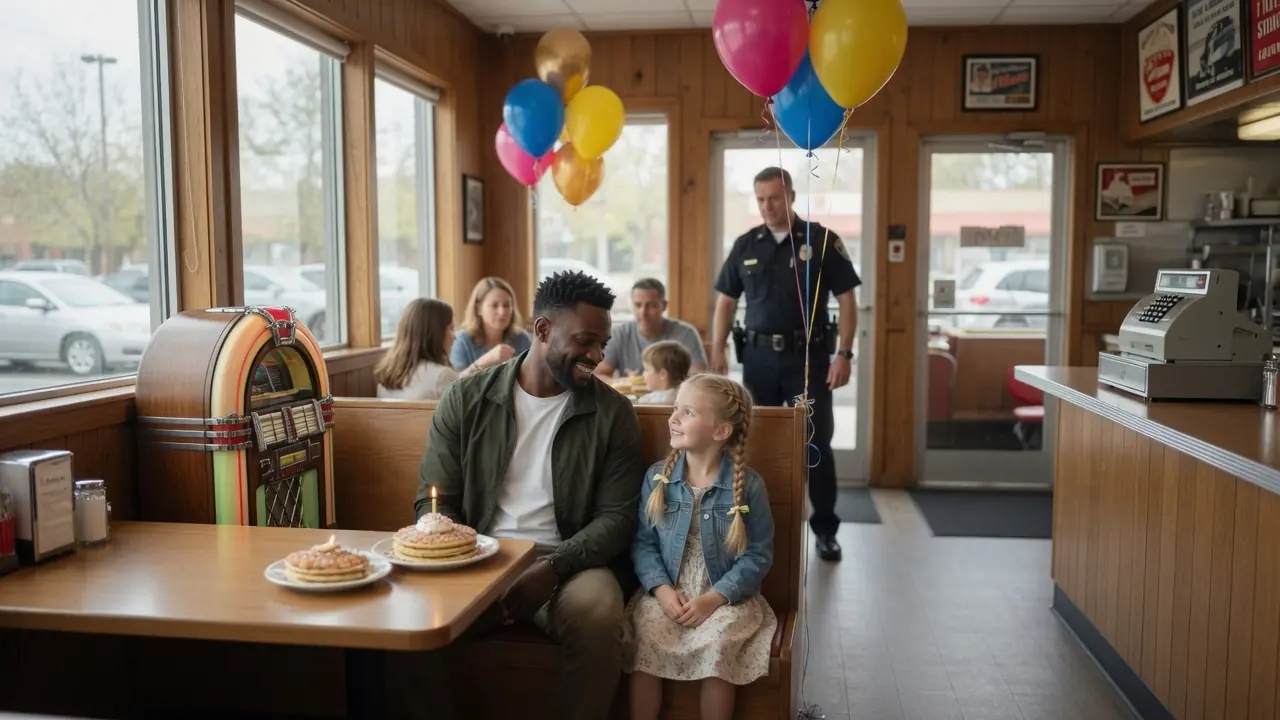
Cop Accused a Father of Lying About His Daughter — Then the Birthday Breakfast Became His Worst Mistake A father was cutting birthday pancakes for his five-year-old daughter when a police officer walked into the diner and decided something was wrong. The little girl had blonde pigtails and blue eyes. Her father was a Black man in a quiet booth, smiling as she waited to blow out her candle. Within minutes, the officer was asking who he was, demanding proof, and questioning the child as if she had been coached. The father stayed calm while the entire diner watched. Then the officer said one sentence too clearly, admitting the only reason he was suspicious. Phones were already recording. And when the father finally slid his business card across the table, the diner went completely silent—because the man being accused wasn't just a parent. He was one of the state's leading civil rights attorneys.
The little pink candle refused to stay lit.
Five-year-old Lily Carter giggled every time the tiny flame disappeared beneath the restaurant's air conditioning before her father could finish singing.
"Daddy..."
She laughed.
"It keeps cheating."
Marcus Carter smiled as he struck another match.
"I think it's nervous."
"Why?"
"Because it knows you're about to make the biggest birthday wish in the whole world."
Lily leaned closer.
"I already know my wish."
"Oh?"
She nodded very seriously.
"But if I tell you..."
"It won't come true."
Marcus laughed.
"I almost forgot the birthday rules."
It was just after eight on a bright Saturday morning at Molly's Country Diner, a family-owned restaurant that had served breakfast in the small Georgia town of Franklin Ridge for nearly forty years.
The smell of maple syrup drifted through the dining room.
Coffee cups clinked softly against saucers.
A retired couple shared a newspaper near the window.
Two construction workers argued good-naturedly over a football game while finishing plates of biscuits and gravy.
Everything felt wonderfully ordinary.
Marcus had planned this breakfast for weeks.
Lily's birthday always began the same way.
Birthday pancakes.
One pink candle.
Chocolate milk instead of regular milk.
Then a trip to the zoo.
It had become their tradition after Marcus's wife, Emily, passed away from leukemia when Lily was only eighteen months old.
Emily had insisted birthdays should always begin with laughter.
Marcus had kept that promise every single year.
He carefully cut the pancakes into tiny pieces while Lily waited impatiently.
"Hurry."
"I'm starving."
"You said that five minutes ago."
"I got even hungrier."
Marcus pretended to think.
"That's impressive."
The waitress smiled as she walked past.
"They make a pretty good team."
"They always have."
Said an elderly woman sitting nearby.
She had watched Marcus and Lily celebrate birthdays there for the last three years.
Everyone at Molly's knew them.
Almost everyone.
The front door opened.
Officer Daniel Brooks stepped inside.
Thirty-one years old.
Recently transferred from another county.
Still unfamiliar with many local faces.
He removed his sunglasses while waiting for coffee.
Then his eyes settled on booth number seven.
A small blonde girl with bright blue eyes sat happily coloring on a paper placemat.
Across from her sat a tall Black man helping her arrange strawberries around a stack of birthday pancakes.
Daniel stopped walking.
Something immediately felt unusual to him.
He looked again.
The little girl looked nothing like the man.
He watched for several seconds.
The child laughed freely.
The man smiled warmly.
Nothing appeared threatening.
Still...
Daniel kept watching.
One assumption quietly became another.
By the time the waitress handed him his coffee...
He had convinced himself something required investigation.
He walked toward their booth.
Marcus noticed him approaching.
"Morning, Officer."
Daniel nodded briefly.
"Morning."
He looked directly at Lily.
Then back at Marcus.
"Is everything alright here?"
Marcus looked surprised.
"Yes."
"We're celebrating her birthday."
Daniel remained standing.
"Your daughter?"
Marcus smiled.
"Very proud father."
Daniel glanced at Lily again.
She looked up happily.
"My daddy made me pancakes."
Marcus reached over and straightened one of her blonde pigtails.
"So I see."
Daniel folded his arms.
"Can I speak with you for a moment?"
"Certainly."
Marcus expected perhaps a parking question.
Or maybe someone had reported damage outside.
Instead...
Daniel asked,
"Can you explain your relationship to the little girl?"
The diner became noticeably quieter.
Marcus blinked.
"I'm sorry?"
"The child."
Daniel nodded toward Lily.
"Who exactly are you to her?"
Marcus stared for a moment.
"I'm her father."
Daniel didn't write anything.
Didn't nod.
Didn't move.
"Do you have identification?"
Marcus slowly reached for his wallet.
"May I ask why?"
"Routine verification."
Marcus handed over his driver's license.
Daniel looked at it briefly.
"Marcus Carter."
"Yes."
"You said she's your daughter."
"She is."
Daniel looked toward Lily again.
"What is your name, sweetheart?"
"Lily."
"How old are you today?"
She held up one hand proudly.
"Five."
"Who's this gentleman?"
She giggled.
"That's a silly question."
Daniel waited.
"He's my daddy."
Marcus smiled gently.
"So far everything she's said is accurate."
Daniel ignored the comment.
"What does your daddy call you?"
Lily frowned.
"He calls me Peanut."
Marcus laughed.
"Sometimes Princess."
"When she's negotiating for extra dessert."
Several customers smiled.
The tension eased for everyone except Daniel.
He wasn't satisfied.
He looked back at Marcus.
"Do you have any documentation proving she's your daughter?"
Marcus's smile faded slightly.
"What kind of documentation?"
"A birth certificate."
"Adoption papers."
"Custody documents."
Anything."
The waitress stopped pouring coffee halfway through another customer's refill.
The construction workers turned completely around in their booth.
Mrs. Holloway, the retired schoolteacher by the window, quietly lowered her newspaper.
Marcus remained remarkably calm.
"Officer..."
"My daughter and I came here for breakfast."
"I wasn't aware parents needed paperwork to order pancakes."
Daniel didn't smile.
"The child doesn't resemble you."
Marcus looked at Lily.
Then back at the officer.
"No."
"She resembles her mother."
Daniel nodded.
"But biologically..."
Marcus interrupted softly.
"Officer."
"I don't owe anyone an explanation about my family."
The room grew still again.
Daniel took one step closer.
"I need to make sure this child is safe."
Lily looked between them, confusion replacing excitement.
"Daddy..."
"Did I do something wrong?"
Marcus immediately turned toward her.
"No, sweetheart."
"You didn't do anything."
"Keep coloring."
She nodded slowly.
Trying very hard to be brave.
Daniel continued.
"Sweetheart..."
"Has this man always taken care of you?"
Marcus looked back up.
"This man?"
Daniel ignored him.
Lily answered proudly.
"He makes pancakes."
"He reads stories."
"He checks under my bed for monsters."
Several people quietly smiled.
Mrs. Holloway wiped at one eye.
Daniel wasn't finished.
"Does he live with you?"
Lily laughed.
"Of course."
"He's my daddy."
Marcus finally sighed.
"Officer."
"I've answered every question."
"My daughter has answered every question."
"Could we please finish her birthday breakfast?"
Instead of stepping away...
Daniel said the one sentence that changed everything.
"I'm only asking because it's unusual to see a little blonde girl with blue eyes calling a Black man her father."
Silence.
Complete silence.
You could hear the coffee machine humming behind the counter.
A fork slipped from someone's hand.
Across the diner...
Three different phones quietly lifted into the air.
Recording.
Marcus didn't speak immediately.
He looked at Lily first.
She wasn't old enough to understand exactly what had just been said.
But she understood something important.
Her father looked hurt.
That frightened her.
She reached across the table and grabbed his hand.
"Daddy?"
Marcus squeezed her tiny fingers.
"I'm alright."
He smiled.
Not because he felt alright.
Because fathers sometimes smile to protect their children.
The waitress approached cautiously.
"Officer..."
"I've served them breakfast here almost every Saturday."
Daniel never looked away from Marcus.
Mrs. Holloway stood next.
"I taught that little girl's mother in third grade."
Another customer spoke.
"I've seen them together dozens of times."
The construction foreman added quietly,
"They're good people."
Daniel remained unconvinced.
Marcus slowly opened his wallet again.
The entire diner assumed he was reaching for family photographs.
Instead...
He removed a simple white business card.
No gold lettering.
No elaborate design.
He slid it across the table.
Daniel picked it up.
Read the first line.
Then the second.
His expression changed almost instantly.
Marcus Carter
Senior Partner
Carter & Reynolds Civil Rights Law Group
Below that...
Former Federal Civil Rights Prosecutor
Special Counsel on Constitutional Rights
Daniel looked back at Marcus.
Then at the card again.
The diner remained silent.
Marcus spoke quietly.
"I've spent the last twenty years representing families who were judged before they were heard."
He glanced toward Lily.
"I just never imagined my own daughter would experience it on her fifth birthday."
Daniel's face lost its confidence.
"I..."
Marcus continued calmly.
"My wife had blonde hair."
"Blue eyes."
"So did her father."
"Lily inherited almost everything from her mother's side."
He smiled gently at his daughter.
"Except..."
He touched her hand.
"She laughs exactly like me."
Lily giggled.
"I do."
Marcus nodded.
"You absolutely do."
Several customers laughed softly through the tension.
Daniel looked around the diner.
Every face watched him.
Not angrily.
Disappointed.
That somehow felt worse.
He slowly handed the business card back.
"I'm sorry."
Marcus accepted it.
"I believe you are."
"But the problem isn't that you questioned me."
Daniel frowned slightly.
"It's why."
Neither man spoke for several seconds.
Finally...
Daniel quietly pulled out a chair.
"May I sit down?"
Marcus looked at Lily.
She nodded.
"Okay."
Daniel sat.
Not as an officer.
As a man.
"I grew up in a town where everyone looked like me."
He admitted quietly.
"I suppose..."
"I carried assumptions I never realized were still there."
Marcus listened.
Without interrupting.
"My daughter deserved better."
Marcus said softly.
"So did you."
Daniel nodded.
"You're right."
Lily looked between them.
"Can we eat now?"
Both men laughed.
The tension finally broke.
Marcus relit the little pink birthday candle.
This time...
The flame stayed burning.
Lily closed her eyes tightly.
Made her wish.
Then blew out the candle in one happy breath.
The entire diner applauded.
Even Daniel.
Before leaving...
He stood beside the booth once more.
"Happy birthday, Lily."
She smiled.
"Thank you."
He looked at Marcus.
"I'm truly sorry."
Marcus extended his hand.
Daniel shook it.
Firmly.
Respectfully.
Not because the business card had impressed him.
Because the conversation had changed him.
Several weeks later...
Officer Brooks returned to Molly's Diner.
Not for an investigation.
For breakfast.
Marcus and Lily were already there.
Lily spotted him first.
"The pancake policeman!"
The entire diner burst into laughter.
Daniel laughed hardest of all.
He walked over carrying a small gift bag.
Inside sat a children's book about families.
Different families.
Adoptive families.
Blended families.
Families that didn't all look alike.
On the first page he had written only one sentence.
Thank you for teaching me to see people before assumptions.
Marcus read it.
Closed the book.
Then looked at Daniel.
"That's a lesson worth keeping."
Years later...
Officer Brooks would speak to every new recruit assigned to train under him.
He never began with laws.
Or tactics.
Or procedures.
He began with the story of a five-year-old girl blowing out a birthday candle.
And the morning he learned that assumptions could wound innocent people far faster than any handcuffs ever could.
Because every badge carries authority.
But only humility allows that authority to become justice.
And sometimes...
The most important lesson an officer will ever learn...
Begins with a little girl.
A stack of birthday pancakes.
And a father who refused to let anger speak louder than dignity.