The steel door to cell four slammed shut at 3:55 on a Friday afternoon.
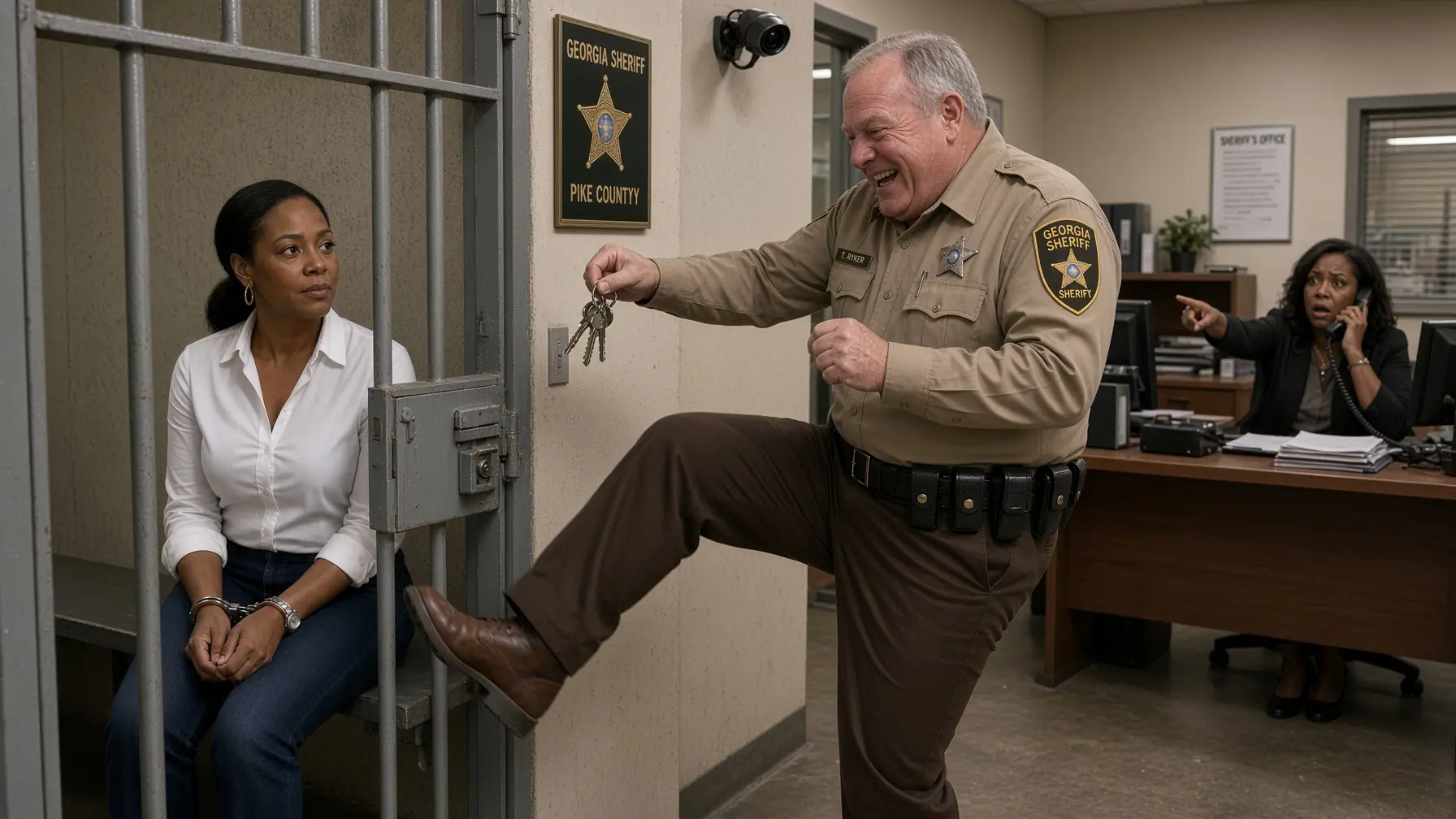
Sheriff Thomas Ryker watched through the narrow observation window as the Black woman inside sat down on the concrete bench without saying a word.
No crying.
No yelling.
No threats.
No demands to know whether he understood who she was.
That irritated him more than anger would have.
For the previous forty minutes, Sarah Reynolds had responded to every accusation with the same maddening calm.
When Deputy Jared Miller said she had crossed the center line, she asked where.
When Ryker demanded permission to search her rental car, she said:
“I do not consent to a search.”
When he ordered her hands behind her back, she complied.
When he accused her of resisting, she asked:
“What action are you identifying as resistance?”
Even after Ryker added disorderly conduct at the roadside and reckless driving during booking, Sarah never raised her voice.
To Ryker, that wasn't composure.
It was attitude.
Now she was sitting in his jail as if she were waiting for a delayed flight.
Ryker gave the cell window a satisfied tap.
“Maybe some time alone will help you remember how to speak to law enforcement.”
Sarah lifted her eyes.
For the first time, she looked directly at him.
“I remember every word you said.”
Something about the answer bothered him.
He smiled anyway.
“So do I.”
Sarah's expression did not change.
“No, Sheriff.”
A beat.
“That’s the difference.”
Ryker walked away laughing.
Five minutes later, the Pentagon called.
And before the afternoon was over, Sheriff Thomas Ryker would wish Sarah Reynolds had forgotten everything.
Seventy-two hours earlier, Major General Sarah Reynolds had been inside the Pentagon working on four hours of sleep.
At forty-eight, Sarah was a two-star Army officer assigned to a joint logistics command coordinating military transportation and supply planning across several regions.
The week had been brutal.
Meetings before dawn.
Secure briefings after dark.
Three days of schedule changes, aircraft availability problems, and logistical contingencies she had no intention of thinking about again until Monday.
By Friday morning, she wanted one thing.
Silence.
Her aunt Lorraine had been recovering from hip surgery outside Savannah, Georgia.
Sarah had promised to visit.
So instead of taking an official aircraft or traveling with staff, she changed into jeans and a white blouse, packed a small overnight bag, rented a dark Ford sedan, and started driving south.
No uniform.
No aide.
No driver.
No stars pinned to her shoulders.
Only a woman in a rental car with a coffee growing cold in the cup holder.
That was exactly how she wanted it.
At 3:31 p.m., approximately ninety miles from Savannah, blue lights appeared in her rearview mirror.
Sarah checked her speed.
Fifty-four in a fifty-five.
She glanced toward the road markings.
She had not passed anyone recently.
Still, she signaled and pulled onto the shoulder of Route 119.
A county patrol cruiser stopped behind her.
Sarah put the car in park.
Engine off.
Window down.
Both hands visible on the steering wheel.
Habit.
Partly military.
Partly experience.
Deputy Jared Miller approached from behind.
He looked young—maybe thirty—and carried himself with the exaggerated stiffness of someone who wanted the uniform to make him appear larger.
“License.”
Sarah looked at him.
“Good afternoon, Deputy.”
“License and registration.”
“My license is in my wallet inside my purse. Rental agreement is in the glove compartment. Which would you like me to reach for first?”
Miller seemed momentarily thrown by the question.
“License.”
Sarah moved slowly.
She gave it to him.
He looked down.
“Virginia.”
“Yes.”
“What are you doing down here?”
“Visiting family.”
“Where?”
“Outside Savannah.”
Miller stared at her for another second.
“You been drinking?”
“No.”
“Any drugs in the vehicle?”
“No.”
“Weapons?”
Sarah paused.
There was a lawfully transported secured handgun in a locked travel case in the trunk, properly declared according to applicable requirements.
She told him.
Miller’s posture immediately changed.
“Step out.”
Sarah looked at him.
“Why?”
“Step out of the vehicle.”
She complied.
Once outside, she stood beside the sedan with her hands visible.
Miller said she had crossed the center line twice.
Sarah frowned.
“I don’t believe I did.”
“Calling me a liar?”
“No. I’m telling you what I observed.”
“Turn around.”
“For what purpose?”
Miller’s jaw tightened.
“You ask a lot of questions.”
“I’m trying to understand the stop.”
He ordered her to wait near the front of his cruiser.
Sarah did.
Miller returned to his vehicle and made a radio call.
Sarah could not hear every word.
She didn't need to.
She noted the time.
3:35.
Unit number.
Deputy name.
Jared Miller.
Camera on his chest.
Dash camera positioned beneath the rearview mirror.
A traffic camera on a utility pole approximately seventy yards behind them.
She had spent a career entering unfamiliar environments and rapidly identifying relevant details.
She did it automatically.
Four minutes later, another vehicle arrived.
Oak Haven County Sheriff.
Thomas Ryker stepped out.
Fifty-four.
Large stomach pressing against his duty belt.
Gray beginning at the sides of his brown hair.
No visible body camera.
He approached Sarah with the confidence of a man entering a conversation he had already decided how to finish.
“What’s the problem?”
Miller said, “Out-of-state driver. Lane violations. Says she didn’t do it. Got a firearm in the trunk.”
Ryker looked at Sarah.
“You carrying?”
“There is a secured firearm in a locked case in the trunk.”
“Open it.”
Sarah remained still.
“The case?”
“The trunk.”
“For what purpose?”
Ryker smiled.
“To make sure you're telling the truth.”
Sarah's voice remained neutral.
“I do not consent to a search of the vehicle.”
The smile vanished.
“I didn't ask whether you consented.”
“You asked me to open the trunk.”
“Correct.”
“I’m declining consent.”
Ryker stepped closer.
“Ma’am, this can be easy or difficult.”
“I prefer easy.”
“Then open the car.”