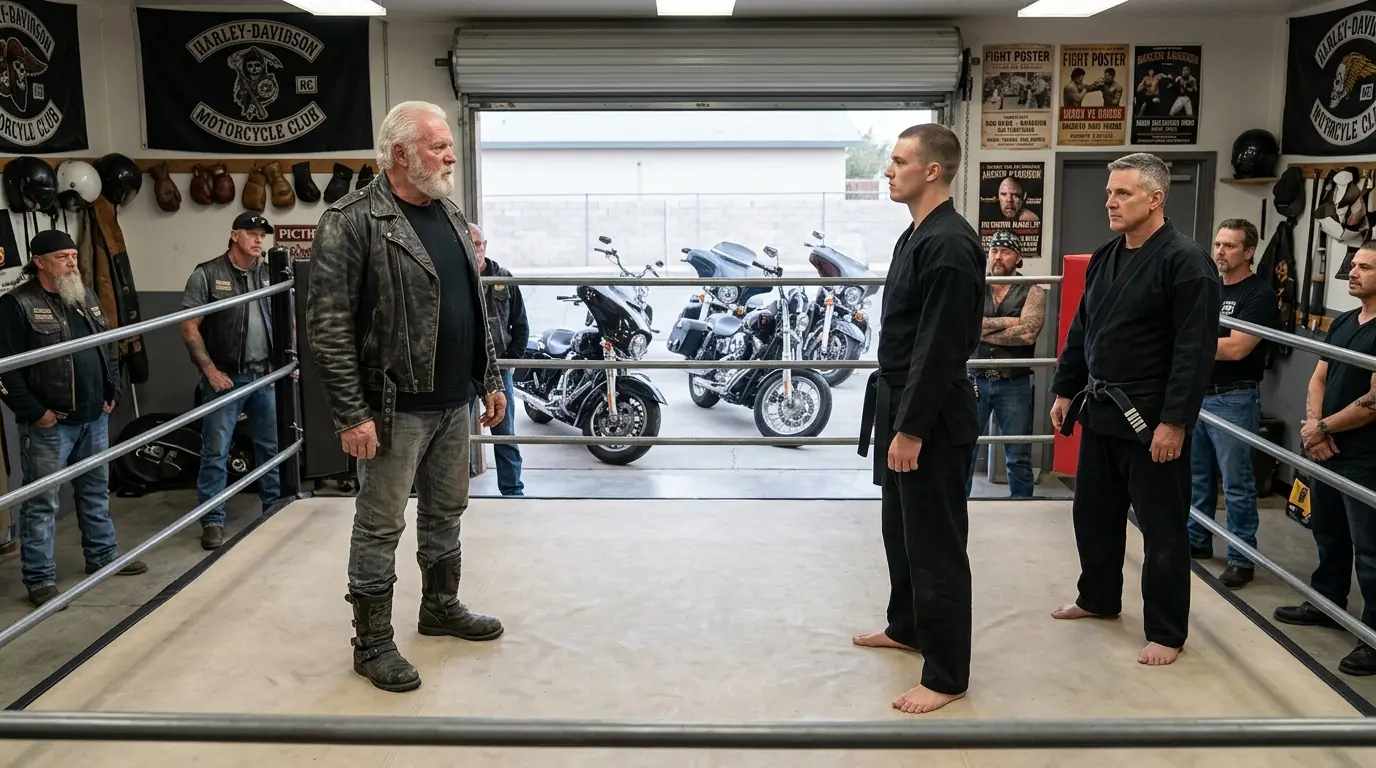
The dojo was completely silent. 40 people stood frozen around the edges of a white tatami mat in the center of Garrison Martial Arts Academy in Ridgecrest, California. The ceiling fans turned slowly overhead. The fluorescent lights hummed.
Nobody moved. Nobody breathed. In the center of that mat stood a young man named Cole Garrison, 24 years old, black belt, chest puffed, jaw tight, the kind of young man who had never once been told no by anyone who mattered. He was bouncing slightly on the balls of his feet, the way young fighters do when they want the room to think they are loose and ready and unafraid.
Across from him stood an old man in a worn leather jacket. The old man was not bouncing. He was not shifting his weight. He was not doing anything at all except standing there with his hands at his sides and his eyes fixed on the young man with the kind of absolute stillness that takes decades to earn.
His hair was white, his beard was white, his face was a map of weather and years and decisions that could not be taken back. His name was "Hank Briggs. " And in the next 90 seconds, everything in that room was going to change. But that is not where this story begins.
This story begins 6 hours earlier on a Tuesday morning in October in a small cabin at the edge of the Mojave Desert with a man standing at a kitchen window and talking to a photograph. The cabin had been built in 1959. It had wood-paneled walls the color of old honey and a stone fireplace that Hank had not lit since the previous winter. The kitchen smelled like coffee and pine and the particular kind of quiet that settles into a house after years of only one person living in it. Hank Briggs stood at the window with a chipped blue mug in both hands and looked out at the desert morning.
The sky was the pale gray of early light, not yet blue, the sun still behind the mountains, the creosote bushes still dark against the pale sand. A jackrabbit moved along the far edge of the property and disappeared behind a boulder. He turned to the photograph on the fireplace mantel. It was a 5x7 in a plain wooden frame. A woman, early 60s, standing in a garden with her hands on her hips and her head thrown back in laughter at something happening behind the camera.
She was wearing a yellow sundress. Her hair was silver blonde. The tomato plants behind her were enormous, the way they only get in a garden that someone really loves. Her name had been June. "Good morning, sweetheart," Hank said.
His voice was low and rough from sleep, and from 9 years of not using it more than necessary. He waited a moment the way he always did, as if somewhere in the fibers of the wood or the light coming through the window, there might be an answer. "Coffee is hot. Sky looks good today. You would have liked it.
" He stood there a moment longer, then set his mug on the mantle beside the frame, just for a second, the same way he might have rested his hand on her shoulder once, and then picked it back up. Same as every morning. Four years of mornings, four years since the spring of his 64th year, when pancreatic cancer had moved through June Briggs, the way a fire moves through dry grass, fast and complete, and leaving nothing behind but the shape of what had been there. They had 92 days from diagnosis to the end. Hank had been with her for every one of them.
He had held her hand in the hospital in Bakersfield on the last morning when the light through the window was the same pale gray. It was right now outside his kitchen. And he had told her things he had never said out loud to anyone because there had never been anyone else he needed to say them to. After the funeral, after the neighbor stopped bringing food, after the cards stopped coming, Hank had done what he had always done when the world became too large and too loud for him to navigate. He had gone to the garage, sat on the workbench, and stared at the motorcycle until the feeling passed.
The motorcycle was a 1997 Harley-Davidson Heritage Softail matte black with a small dent on the left side of the fuel tank from a piece of road debris outside Barstow in 2006. He had never fixed the dent. June had said it gave the bike character, and that had been enough reason to leave it forever. He had taken to calling the motorcycle June after she died. He had never told anyone that either.
He finished his coffee standing at the window. He rinsed the mug in the sink. He put on his leather jacket, the same one he had worn for 31 years, cracked at the elbows and worn smooth at the cuffs with his name stitched in faded red thread on the inside collar and below it the letters USMC. He walked to the garage, checked the oil, checked the tires, checked the chain. He started the engine and let it run for 2 minutes before he pulled out.
He rode the 12 minutes into Ridgerest the way he rode every morning. The same curves, the same loose gravel patch on the bend before the water tower. The same stretch where the road straightened out and you could see 15 mi of desert ahead of you and the Sierra Nevada standing up along the western horizon like old men who had been standing there so long they had forgotten why they started. He parked the Harley in front of Boon's Diner on North China Lake Boulevard between a 2003 Ford pickup and a motorcycle he recognized as belonging to a man named Vince Steel who arrived at the diner every Tuesday before sunrise and always ordered the same thing. The bell above the door rang when he walked in.
The diner was the kind of place that had not changed in 40 years and was not going to start now. Vinyl booths the color of old mustard, a long counter with spinning stools, a coffee machine that made a sound like a sick cat every time it finished a cycle. A jukebox in the corner had not worked since George W. Bush was in office. Nobody had ever seemed bothered by this.
Roy Boon was behind the counter, 70 years old, tall and narrow as a fence post, wearing his permanent uniform of white apron over flannel shirt. He had run this diner for 43 years. He had owned it for 25. His father had opened it and Roy had never once seriously considered doing anything else with his life, which was a kind of clarity that Hank had always respected. Roy pointed at Hank with a coffee pot, the way a man points at something he has been expecting.
"You are late. " "I'm not late, Roy. You are early. " "My diner, my clock. Sit down.
" Hank slid into the corner booth. Three other men were already there. Members of the Iron Veterans Motorcycle Club. Men who had served in different branches in different decades and had ended up in the high desert in the second halves of their lives with motorcycles and not enough to do with their mornings. They nodded at Hank.
He nodded back. Someone slid the biscuit basket toward him. Roy came over with a coffee pot and filled Hank's mug and then stood there instead of leaving, which meant he had something to say. Roy always stood when he had something to say. It was his way of signaling that the next few minutes were going to matter whether you wanted them to or not.
"Hank. " "I am listening. " "There is a young man I need you to know about. " Roy set the coffee pot down. His name is Wyatt Decker.
28 years old. Marine. Did one tour at Camp Lejeune came back in 2018. Bar fight in Ridgerest 2019. Put a man in the hospital.
Served six years at Lampak. Got out eight weeks ago on good behavior. Hank looked at his coffee. His mother died while he was inside Roy continued. His brother is in Nevada and will not return his calls.
He is living at the halfway house on Inyokern Road. He has got no work, no skills outside what the Marines taught him and no one in this town who knows his name except me because his mother used to eat breakfast here on Sunday mornings. And she asked me once to look out for him if anything ever happened to her. Roy paused. He is not okay, Hank.
I can see it in him when he comes in for coffee. I have seen that look before. You know the look. I mean, Hank knew the look. He had seen it in young men for 22 years.
The particular flatness behind the eyes. The way the body moves through the world without quite believing the world is worth the effort of full engagement. He had seen it in Marines coming back from deployments. And he had seen it in Marines who had never deployed, but who had spent enough time inside institutional violence that something had quietly switched off in them. "I want you to talk to him.
Just once, just coffee and conversation. " Hank picked up his mug. He held it with both hands the way he held it every morning like the warmth was something he needed to hang on to. "I am done with all of that, Roy. " "You keep saying that.
" "Because I keep meaning it. " I have been retired for 9 years. "That is not retirement," Roy said quietly. "That is hiding, and you know the difference. " The words went into the air between them and stayed there.
Heavy, accurate, the kind of thing that only a man who has known you for 47 years can say out loud without flinching. Hank set his mug down. He pulled out his wallet. He put a five on the table for the coffee and the biscuit he had not touched. "Send him to the VA, Roy.
" "They are backed up three months. " "Send him to a chaplain. " He will not go to a chaplain. He will not go anywhere a stranger sends him. But he might go somewhere if a man he respects asks him to.
Hank stood up. I'm the wrong man for this. He walked to the door. He did not look back. He could feel Roy's eyes on his back through the window as he mounted the Harley and started the engine.
He sat for a moment with the motor running his hands on the grips, the familiar vibration moving up through his palms and into his forearms. He should have gone home. He had groceries to consider and a back porch that needed a board replaced and no fewer than a dozen legitimate reasons to ride west instead of south. He rode south. Habit.
The Shell station on South China Lake Boulevard, the one he always stopped at after seeing Roy because 40 years of a routine is stronger than any decision you make on a given morning. He pulled up to the pump at 8:47. Fuel gauge sat at a quarter tank not empty, but he had learned a long time ago that a man who lets his motorcycle run to empty in the desert is a man who has stopped paying attention. He was standing at the pump listening to the gas go in when he heard the voices. "Lady, we have been waiting here for 10 minutes.
Move the car. " The voice was young, sharp, the particular sharpness of someone who had never once been on the losing end of an argument and had started to believe that was a permanent condition rather than a streak of luck. Hank turned his head. There were three of them young men in their mid-20s expensive gym clothes, a white BMW 5 Series idling behind an old Subaru Outback that had its hood popped and steam coming off the radiator. The kind of steam that means a cooling hose has let go and the engine has been running hot for too long.
Standing beside the Subaru was a woman, 62, maybe 63. Silver hair cut short and practical. A denim jacket over a flannel shirt, gardening gloves tucked into her jacket pocket. Her name was Dela Flynn, though Hank did not know that yet. What he knew was that her hands were gripping the top of her open car door the way hands grip something when the body underneath them is trying not to show fear.
"My radiator overheated," she said. "I just need 5 minutes to let it cool down and I can move. " The tallest of the three young men stepped forward. He was broad through the shoulders, dark-haired, handsome in the way of someone who had been told so their entire life. He moved the way certain young men move when they have decided that their time is more valuable than anyone else's.
"You have had five minutes. You have had 10 minutes. Push it to the side if you have to. " He reached out and put his hand on the woman's shoulder. Not gently.
She flinched. Hank set down the gas nozzle. He walked across the asphalt slowly, not quickly, not urgently. The way a man walks when he is not in a hurry because he does not need to be. When you have been trained the way Hank Briggs had been trained, and when you have spent 22 years teaching other men how to move through the world with that same training in their bodies, you stop relying on speed a long time ago.
Speed is a young man's weapon. Stillness is something else entirely. "Excuse me. " The three young men turned. The tall one still had his hand on the woman's shoulder.
He looked Hank up and down. The leather jacket, the white beard, the biker boots, the 68 years written plainly across his face. He laughed. The laugh was performed. The kind that young men produce for each other, not because something is genuinely funny, but because laughter is a way of announcing that the thing in front of you is not worth taking seriously.
"Son, take your hand off the lady. " "Or what, old man? " Hank held his gaze. He did not raise his voice. He did not shift his weight or change his expression or do any of the things that signal to another human being that a situation is about to escalate.
He simply looked at the young man with the expression of someone who has already finished the calculation and is now just waiting for the other person to arrive at the same answer. "There is no 'or,'" Hank said. "There is just 'take your hand off the lady.'" Something in the delivery of those words did what it had always done ever since a drill instructor at Parris Island in 1978 had first looked at 19-year-old Hank Briggs and seen something in him worth developing. It was not anger.
It was not threat. It was certainty. The absolute bedrock certainty of a man who has decided that this moment matters and is prepared to see it through to whatever conclusion is required. The hand came off the woman's shoulder. The young man stepped back.
He tried to recalibrate, puffed his chest, set his jaw. He looked at Hank the way men who have never truly lost look at the thing they have just decided they are not afraid of. "Her car is blocking the pump. " "Her radiator overheated," Hank said. That happens to people who drive older vehicles.
You will wait 6 minutes while she lets the engine cool and then you will buy your gas and drive away. And by tomorrow morning, none of us will remember this happened. The young man looked at Hank for a long moment. Something moved behind his eyes, a fast private calculation. Then he looked at his friends, then back at Hank.
He said something under his breath. The kind of thing you say to save face when you have already decided to back down. Then he walked to the other side of the BMW, got in the passenger seat, and the car moved around to a different pump. Hank turned to the woman. She was trembling, not dramatically.
The small fine trembling that comes after a fright has passed and the body is deciding whether it is done being afraid. "Ma'am, are you all right? " She looked at him. She had gray green eyes and a face that had spent a good portion of its life outdoors. "I am fine.
"Thank you. " I am so sorry. I did not mean to cause any trouble. " "You did not cause anything. Some people are just built wrong.
Let me look at your radiator. " He checked the coolant reservoir. Followed the upper and lower hoses. Found a crack in the lower hose near the clamp. Small but sufficient.
He told her to get the water jug from her trunk, which she did, and he filled the reservoir carefully and told her what she needed. "You will make it home on this," he said. "But you need to get that hose replaced this week. You know Frank's Automotive over on Drummond, I have driven past it. Tell whoever is at the counter that Hank sent you.
They will do the hose for $40. Do not let them talk you into anything else. " The woman looked at him with the expression of someone who has just been treated with a degree of ordinary human kindness that has caught them off guard. "My name is Dela Flynn," she said. He shook her hand.
""Hank Briggs. "" She held his hand for a moment before letting go. Her grip was stronger than he had expected. The grip of someone who worked with her hands. ""Mr.
Briggs, may I ask you something strange? "" "Ask away," she hesitated. She looked at her hands, then at him. That young man, the tall one who put his hand on me, his name is Colt Garrison. His father owns the martial arts school on Balsam Street.
My brother Roy's grandson Cole goes there. He has been studying there for 2 years, working extra shifts at the hospital in Big Pine to pay for it. It matters to him enormously, especially since his grandmother passed last winter. She paused. Today is Cole's belt examination.
He is testing for his blue stripe, and after what just happened here, I am worried. I know how young men like that one work. They do not let things go. They find softer targets. Cole is gentle and earnest, and he does not know how to protect himself from someone who wants to humiliate him.
" She looked at him steadily. "I know this is an enormous thing to ask of a stranger, but would you consider coming with me to watch the examination just to sit in the back? Your presence alone, a man like you in the room would be enough. Someone like that garrison boy will not take a run at Cole if there is someone sitting there who looks like you. Hank was quiet for a moment.
He thought about Roy, about Wyatt Decker sitting in the halfway house on Inyokern Road. He thought about the 9 years he had spent methodically building a life that required as little of him as possible and giving himself reasons why that was the right thing to do. Then he thought about June. Specifically, he thought about something she had said to him in the third year of their marriage after he had declined an invitation from a neighbor who had just lost her husband and needed help loading furniture for a donation run. "You can always find a reason to say no," she had told him.
"But some people just need to be seen, Hank. That is all they need. And you are good at seeing people. Do not waste that. " He reached into his jacket pocket.
He touched the silver chain he wore around his neck. The one with June's wedding ring on it. The one he had worn every day for four years. He did not take it out. He just touched it.
"I will come watch," he said. "I am not getting involved in anything. I will sit in the back. " Dela Flynn's eyes filled with relief so plain it was almost difficult to look at directly. "Just being there is enough," she said.
She started at her Subaru confirmed the engine was running steady and pulled out of the station with a small wave. Hank stood at the pump for a long moment after she had gone. He had a feeling, the specific feeling of a door opening that you thought had been permanently shut, that he was about to break a promise he had made to himself. He remounted the Harley, started the engine, sat for a moment, listening to the motor. Then he rode south toward Balsam Street.
Garrison Martial Arts Academy occupied the ground floor of a two-story commercial building near the corner of Balsam and Bowman. New construction tan stucco, a bright red and gold sign above the entrance, floor to ceiling windows along the front wall through which you could see the white tatami mats inside. Hank pulled into the parking lot at 2 in the afternoon. He cut the engine and sat on the bike for a long moment. He had not walked into a martial arts facility in 9 years.