Marcus Thompson had built towers, companies, scholarship programs, and one of the most respected international schools in Georgia, but on Friday night he only wanted to be a father sitting in a gym. He parked three blocks away from Brookhaven International Academy because the main lot was full of polished SUVs and luxury sedans lined beneath the school’s blue-and-white banners. The state championship game had turned the campus into a festival of pride, money, and carefully measured prestige. Parents in tailored coats hurried toward the gym with cameras, flowers, and the nervous excitement of people who believed this night belonged to them.
Marcus stepped out of his old pickup wearing a faded brown jacket, gray T-shirt, dark jeans, and work boots still dusty from the construction site he had visited earlier that afternoon. He could have gone home first, changed into a suit, and arrived like the man whose name appeared on half the legal documents in the school’s archive. But Caleb’s semifinal had gone into overtime, and Marcus had promised his son he would not miss the final tip-off. So he came as he was, carrying nothing but his phone, his wallet, and the gold ring from the first championship team the school had ever produced.
The ring sat heavy in his palm as he crossed the campus walkway. Twenty years earlier, before Brookhaven had become an international school with students from thirty-two countries, Marcus had stood in an empty lot and imagined a place where children from wealthy families and scholarship families would walk through the same doors with the same dignity. People had laughed then. They told him a Black man who made money in logistics had no business building a school for diplomats, executives, athletes, and immigrant families who wanted their children prepared for the world.
Marcus had ignored them all. He had grown Thompson Global from a small freight software company into a billion-dollar logistics empire, but Brookhaven was the project that carried his heart. He had created it after his mother died, naming the first scholarship fund after her because she had cleaned classrooms for thirty years and still believed education could change a child’s entire bloodline. When the school opened, Marcus refused to put his portrait in the lobby. He wanted students to feel ownership of the place, not worship the man who paid for it.
That choice had created a strange gift for his son. Caleb Thompson, now sixteen, had grown up at Brookhaven without most people knowing his father was the founder. Some teachers knew, the headmaster knew, and the board certainly knew, but Marcus had asked them to keep the connection quiet. Caleb wanted to be judged by his jump shot, his grades, and his character, not by the name on the donor wall. Marcus respected that more than anything.
Inside the gym, the noise hit him like a wave. Sneakers squeaked across polished wood, students chanted from the bleachers, and the scoreboard glowed above the far basket with twelve minutes left before the championship began. Blue and white streamers hung from the rafters, and a table near the entrance displayed the silver championship trophy beneath a glass case. Marcus stopped when he saw it, because engraved across its base were the words Thompson Founders Cup.
He had held that trophy twenty years ago when Brookhaven’s first basketball program won its first private school championship. Back then, the gym had been half this size, the bleachers had been borrowed, and the players washed their own jerseys because the athletic department had no budget. Marcus had not been the star, but he had been the captain, the kid who stayed late to sweep the floor after practice because the school still operated like a dream trying not to collapse. Now his son was about to play for the same trophy under brighter lights than Marcus had ever imagined.
He found a seat near the front row, just behind the Brookhaven bench. Caleb spotted him during warmups and lifted two fingers in a small salute. Marcus touched the ring in his palm and nodded back. That was all they needed. No shouting, no waving, no big father-son performance for the cameras.
For a few minutes, Marcus let himself enjoy the simple privilege of watching his child belong. Caleb moved across the court with quiet confidence, lean and quick, his blue jersey tucked neatly, his curls held back by a white headband. He was not the loudest player, but his teammates looked for him when pressure rose. Marcus had always told him leadership was not about being the biggest voice in the room; it was about becoming the person others trusted when the room got loud.
Then Coach Patricia Daniels noticed him. She stood near the scorer’s table in a navy blazer, matching pants, and sharp heels that clicked against the gym floor whenever she moved. Patricia was Brookhaven’s head coach, hired two years earlier from an elite prep program in Virginia, where she had built a reputation for discipline, media presence, and winning records. Marcus had never met her personally, though he had approved the athletic director’s recommendation after seeing her résumé.
Patricia looked at Marcus once, then again, her eyes narrowing at his jacket and boots. She was speaking to a parent near the bench when her expression shifted from confusion to irritation. She excused herself, crossed the sideline, and walked straight toward him. The parents behind Marcus lowered their voices as she approached.
“Excuse me,” Patricia said, standing over him. Marcus looked up calmly. “Can I help you, Coach?” Her eyes flicked toward his boots, then his worn jacket, then the front-row seat beside the players’ family section. “This area is reserved for family members and approved school guests.”
Marcus nodded. “I understand.” Patricia waited for him to move, but he did not. He kept the gold championship ring closed in his hand and glanced back toward Caleb, who was now shooting from the corner.
Patricia’s mouth tightened. “Sir, I said this area is reserved.” Marcus turned back to her. “My son is playing tonight.” A few parents nearby looked up, suddenly interested. Patricia gave a small, dismissive laugh that never reached her eyes. “Which one?”
“Caleb Thompson,” Marcus said. Her face changed just enough to show she recognized the name, but not enough to soften. “Caleb’s father?” she repeated, as if the phrase itself surprised her. “Yes,” Marcus said. “I’m Marcus.”
Patricia folded her arms. “Caleb is one of our scholarship students, correct?” Marcus felt the sentence land exactly where she aimed it. “He earned a scholarship based on academics and athletics,” he said. Patricia leaned closer, lowering her voice but not enough to hide it from the people behind him. “Then you should understand that appearances matter here.”
Marcus looked at her without blinking. Around them, the gym noise seemed to fade by inches. “Appearances?” he asked. Patricia pointed toward the upper bleachers near the far wall. “This is an international school, not a charity program for poor people. If you want to watch, sit in the back and stop making the team area look uncomfortable.”
The words did not shout, but they cut through the air with shocking force. A mother behind Marcus gasped softly. A teenage boy holding a phone forgot to lower it. One of the assistant coaches stared at Patricia as if hoping she would take the words back before they became real.
Marcus did not stand. His hand tightened around the championship ring, and the edge pressed into his palm. He had heard polished versions of that sentence his entire life. Poor people do not belong here. Black ambition should enter through the service door. Dignity must dress well enough to be believed.
“Coach Daniels,” he said quietly, “my son is on that court.” Patricia’s jaw tightened. “Then dress like a parent who respects where he is.” Marcus watched her face, searching for even one flicker of regret. There was none. She seemed annoyed that he had forced her to explain a rule she believed everyone decent should already understand.
Caleb had stopped warming up. He stood near half court, ball tucked against his side, eyes fixed on his father and coach. Marcus saw the hurt rise in his son’s face before the boy quickly buried it. That hurt almost made Marcus stand. But he stayed seated because he knew Caleb needed to see something different from anger.
“Careful,” Marcus said, his voice low. “You are talking about poor people in the school they helped build.” Patricia gave a sharp, humorless smile. “People like you always say things like that when they want special treatment.” Then she pointed toward the back bleachers again. “Move, or I will have security remove you before tip-off.”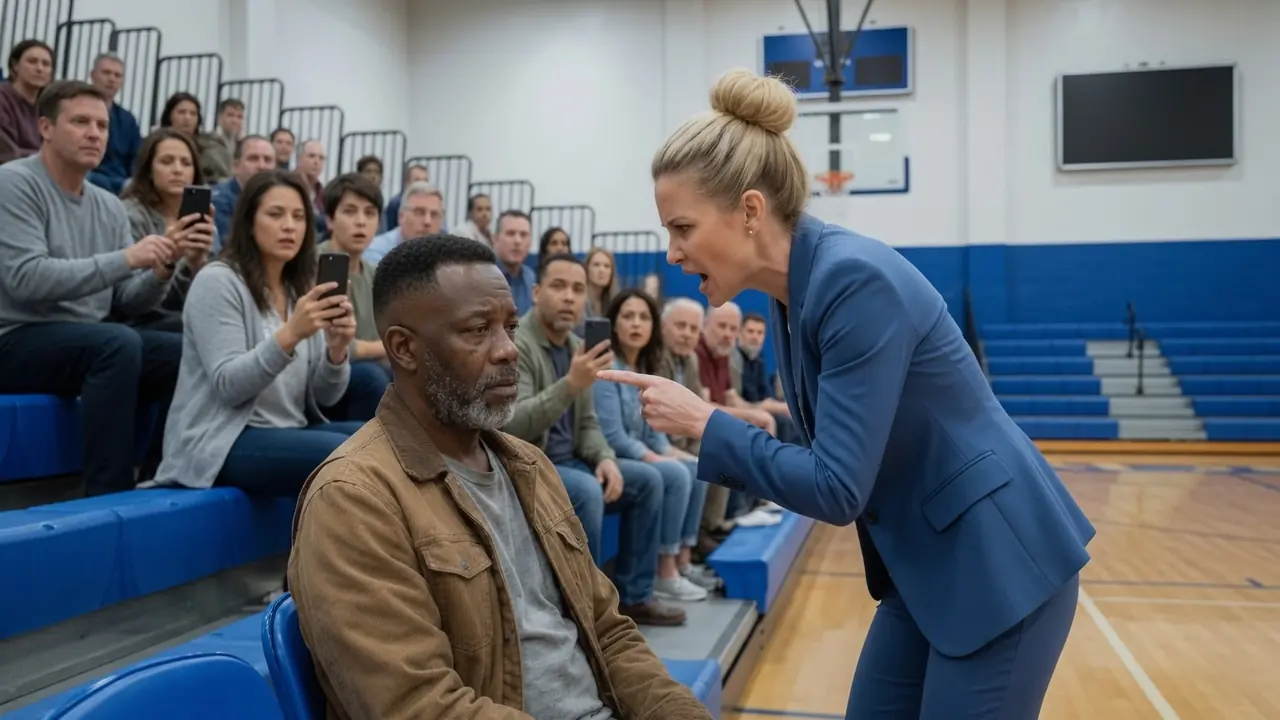
The assistant coach finally stepped forward. “Patricia, maybe we should confirm with administration.” She snapped her head toward him. “I do not need permission to protect my bench.” The assistant stepped back, embarrassed and silent. Marcus looked at him and understood that fear had built a second insult in the room.
Before Marcus could answer, the athletic director, Owen Keats, entered through the side doors with two school board members. He was carrying a clipboard, smiling toward donors near the entrance, until he saw Patricia standing over Marcus. His smile vanished. Marcus noticed the moment recognition struck Owen’s face.
Owen hurried across the court. “Mr. Thompson,” he said, breathless. Patricia turned, confused by the urgency in his voice. “Owen, I’m handling a seating issue.” Owen ignored her and faced Marcus directly. “Sir, I didn’t know you had arrived. Headmaster Reeves is waiting to greet you.”
The gym seemed to inhale. Patricia’s eyes moved from Owen to Marcus, then to the parents behind him, then back to Owen again. “Mr. Thompson?” she said slowly. Owen looked at her with disbelief. “Coach Daniels, this is Marcus Thompson.”
Patricia blinked once. “Caleb’s father?” Owen’s face tightened. “The founder of Brookhaven International Academy.” The words landed louder than any buzzer. A student near the bleachers whispered, “Founder?” and the whisper spread like fire through dry paper.
Marcus finally stood. He was not tall in a theatrical way, but when he rose, the space around him changed. Patricia took half a step back without meaning to. Marcus opened his palm and revealed the gold championship ring. It caught the gym light, flashing blue and silver across the engraved crest of Brookhaven.
“This was from the first championship team,” Marcus said. His voice stayed calm, but every person nearby listened. “Back when this gym had folding chairs, broken lights, and a scoreboard that worked only when it felt generous.” He looked toward the trophy on the stage. “That cup exists because a group of kids with nothing learned to believe they belonged somewhere before the world agreed.”
Patricia’s face drained of color. “Mr. Thompson, I did not know who you were.” Marcus turned to her fully. “That is exactly the problem.” Her lips parted, but he kept going. “You should not need a donor list to know whether a father deserves respect.”
The buzzer sounded for tip-off, but nobody moved at first. Caleb stood at center court, his eyes locked on his father. Marcus tucked the ring into his jacket pocket and nodded toward the floor. “Play your game,” he called. Caleb nodded back, his jaw tight, his shoulders set.
Patricia turned toward the bench, shaken, but still trying to recover her authority. “Team, focus,” she said. Her voice cracked slightly. The players heard it. The parents heard it. Most importantly, Caleb heard it, and something in him changed.
The first quarter was rough. Caleb missed his first two shots, and Brookhaven fell behind by eight. Every time he touched the ball, the opposing crowd shouted, but Caleb’s real battle was happening somewhere deeper than the scoreboard. Marcus watched him fight through the humiliation his father had absorbed in front of the entire gym. He wanted to tell him that pain could sharpen a man if he refused to let it poison him.
At halftime, Brookhaven trailed by six. Patricia avoided looking at Marcus as she gathered the players. Her instructions were sharp but scattered, and the team seemed unsettled. Caleb listened for a minute, then stepped away from the huddle and looked toward his father. Marcus raised one fist against his chest, the signal they had used since Caleb was small.
It meant breathe. It meant remember who you are. It meant no one else gets to write your name for you.
The third quarter began differently. Caleb stole the ball on the opening possession and drove hard to the basket. He took contact, finished the layup, and landed on both feet as the gym erupted. On the next play, he hit a corner three. By the end of the quarter, Brookhaven had tied the game, and the crowd was no longer whispering about Patricia’s insult; they were chanting Caleb’s name.
With thirty seconds left in the final quarter, Brookhaven trailed by two. Patricia called the last timeout, her clipboard trembling slightly in her hand. She tried to draw up a play for another player, but Caleb spoke before she finished. “Coach,” he said, “give me the ball.”
Patricia looked at him, startled by the steadiness in his voice. For a moment, Marcus thought she might refuse out of pride. Then the assistant coach leaned in and said, “He’s the reason we’re still here.” Patricia swallowed, erased the board with her sleeve, and drew the play for Caleb.
The gym rose to its feet as the final possession began. Caleb caught the inbound pass near half court, dribbled left, crossed right, and watched the defense collapse around him. Marcus’s hands stayed folded in front of him, but his heart pounded like he was back on the court twenty years earlier. Caleb drove inside, pulled the defense with him, then stepped back behind the arc as the clock dropped to three.
He shot. The ball spun through the air, clean and high, while the entire gym seemed to forget how to breathe. It struck the rim once, kissed the backboard, and fell through as the buzzer sounded.
Brookhaven won by one. The gym exploded. Students rushed the court, players hugged Caleb, and Marcus stood still for one second before his face finally broke into a smile. He watched his son disappear beneath teammates, not as a founder, not as a CEO, but as a father whose boy had just carried himself through fire.
The trophy ceremony began fifteen minutes later. The players lined up on the court, sweat still shining on their faces, while parents crowded the edges with phones raised. Patricia stood near the microphone with the trophy in both hands, trying to compose herself. Headmaster Reeves arrived beside Marcus and quietly asked, “Would you like to speak?”
Marcus shook his head. “Not first.” Reeves understood. He walked to the microphone and congratulated the team, the assistant coaches, the students, and the families. Then he said, “Tonight’s Thompson Founders Cup has special meaning, because its namesake is with us.”
The gym turned toward Marcus. Patricia closed her eyes for half a second, as if bracing for impact. Reeves continued. “Marcus Thompson founded Brookhaven International Academy so that excellence would never belong only to families who could afford to be recognized. He built this school for students from every background, and many of us are here because of that vision.”
Applause began slowly, then grew. Marcus did not wave. He looked at Caleb, who had taken the microphone from Reeves. His son’s hands trembled slightly, but his voice was clear.
“I want to dedicate this trophy to my father,” Caleb said. The gym quieted immediately. “Not because he founded this school, and not because his name is on the cup.” He turned toward Patricia for one brief second, then looked back at Marcus. “I dedicate it to him because tonight, when someone tried to make him feel like he didn’t belong here, he stayed calm and showed me what real strength looks like.”
Marcus lowered his eyes as the gym erupted again. The sound washed over him, but he heard only Caleb’s voice. For all the buildings, contracts, scholarships, and donations, this was the moment that proved the school had not failed him. His son understood the difference between pride and dignity.
Patricia stood motionless beside the trophy table. Tears had gathered in her eyes, but whether they came from shame, fear, or both, Marcus did not know. After the ceremony, she approached him near the sideline while students took pictures around Caleb. Her hands were clasped tightly in front of her. “Mr. Thompson,” she said, voice low, “I owe you an apology.”
Marcus looked at her for a long moment. “You owe one to my son first,” he said. Patricia nodded quickly. “Yes, of course.” Marcus’s expression did not soften. “And then to every scholarship family you have looked at like they were guests in a place built for someone else.”
Her face tightened. She wanted to defend herself; he could see the instinct rise and die. “I understand,” she whispered. Marcus shook his head. “No, Coach Daniels. You are beginning to understand. Those are different things.”
The board met the following Monday morning. Patricia was placed on administrative leave pending a full review of team culture, parent complaints, and scholarship student treatment. The assistant coach was named interim head coach. Marcus did not demand public humiliation, but he demanded accountability, and at Brookhaven, that meant the truth had to leave the gym and enter the record.
Two weeks later, Brookhaven announced the Thompson Access Initiative, expanding tuition support for working families, athletes, artists, and international students whose parents could not buy their way into belonging. Marcus gave the announcement from the same gym where Patricia had pointed at him. He wore a suit that day, but he also wore the old championship ring. Caleb stood beside him holding the trophy.
“An international school is not international because rich families fly in from different countries,” Marcus told the room. “It is international because it teaches children that dignity does not depend on where you were born, what your parents earn, or how expensive your jacket looks.” Parents listened in silence. Teachers listened harder.
Patricia resigned before the review finished. Her apology letter reached Marcus’s office in a white envelope with careful handwriting. He read it once, then placed it in a file. He did not celebrate her downfall. A person could lose a job and still not understand the damage they caused, but a school had to protect the children before it tried to redeem the adult.
Caleb’s final season became legendary at Brookhaven. Not just because of the winning shot, though that replay lived on every student’s phone for months. It was legendary because of what came after it. Scholarship families sat closer to the court, teachers became more careful with their assumptions, and students began telling the story of the night the founder came dressed like an ordinary father and revealed who truly belonged.
Years later, Marcus still remembered Patricia’s finger pointed inches from his face. He remembered the phrase about poor people in international schools. He remembered the silent parents, the phones, the assistant coach’s fear, and his son’s wounded eyes across the court. But above all, he remembered Caleb standing with the trophy and refusing to let shame have the final word.
That was why Marcus had built Brookhaven. Not for marble floors, tuition brochures, or elite acceptance rates. He built it for the child who needed to know that excellence could come from a crowded apartment, a tired parent, a secondhand jacket, or a name nobody important recognized yet. He built it so no coach, donor, parent, or administrator could decide that money was the measure of belonging.
On the day a new plaque was added beneath the Thompson Founders Cup, Marcus stood with Caleb in the empty gym. The plaque carried no long speech, only one sentence. This school was built for every child brave enough to belong.
Caleb read it and smiled. “Mom would have liked that,” he said softly, thinking of the grandmother whose scholarship fund had opened the first classroom doors. Marcus nodded, his hand resting on his son’s shoulder. “She would have corrected the grammar first,” he said.
They both laughed, and the sound echoed across the polished court. Outside, students from every background crossed the campus beneath flags from dozens of countries. Inside, the trophy caught the light, the ring on Marcus’s hand glinted once, and the gym finally felt like the place he had imagined all those years ago. Not perfect, but awake.