The laughter started before the meeting even began, and within seconds every person in the glass-walled boardroom knew exactly who they were laughing at. A single father named Everett Hale stood quietly near the end of the polished conference table wearing a faded navy suit that was two sizes too loose with worn cuffs and a tie he had carefully ironed that morning. His shoes had been polished until they almost shone, but one small crack remained across the leather. Across from him sat the company's powerful CEO, Celeste Rowan, surrounded by executives wearing designer suits that cost more than Everett had earned in several months. She looked him up and down, smiled with disbelief, and laughed.
What she didn't know was that the man standing in that cheap suit had once walked away from a fortune, sacrificed his career for his son, and was about to become the one person in the room whose approval she desperately needed. Everett had arrived at the headquarters just after 10:00 in the morning holding a thin folder against his chest and trying not to let anyone notice how nervous he was. He had spent the previous night carefully repairing a loose button on his suit jacket, though there had been no need to worry about the button if he had owned another suit. He didn't. The suit had belonged to his father, who had worn it years earlier when Everett was a young man.
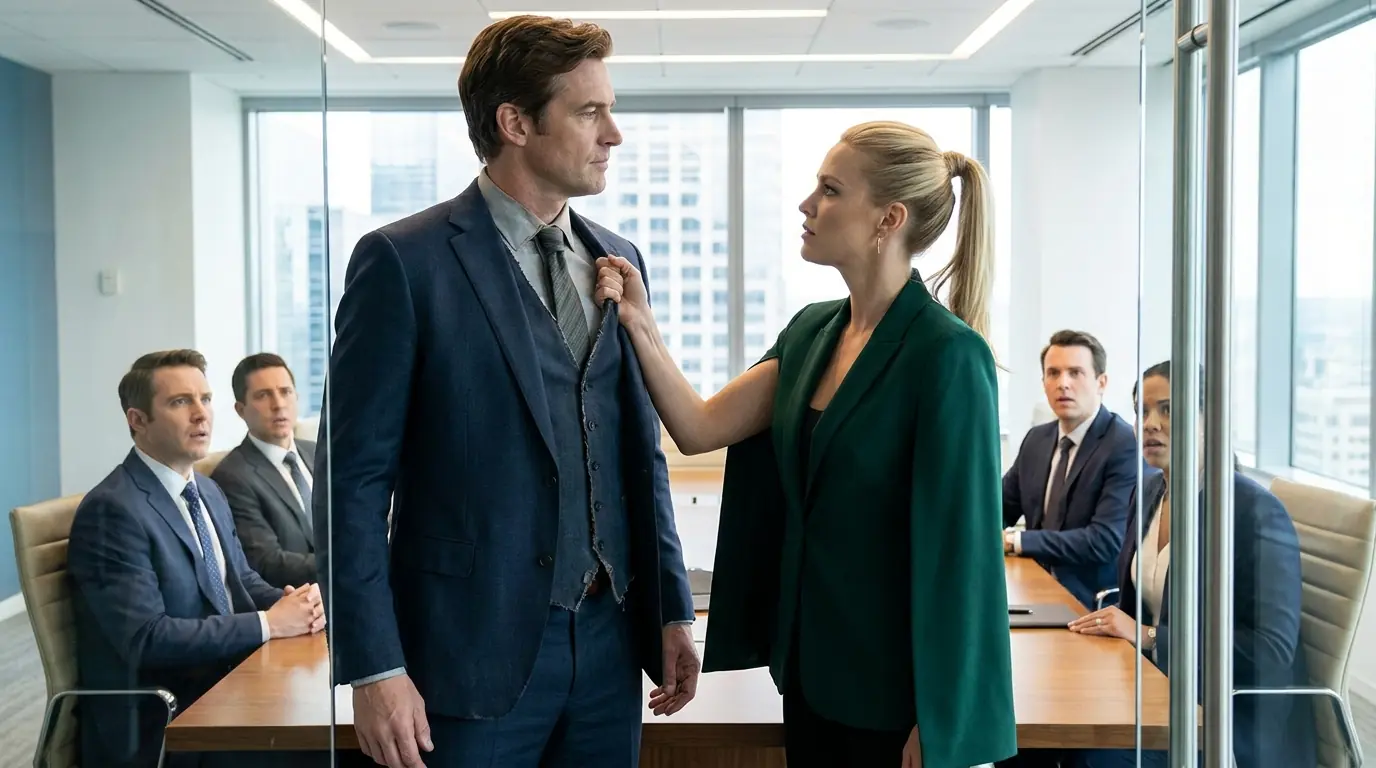
It had been altered twice, patched once, and kept in the back of a closet for nearly a decade. Everett had taken it out that morning because the invitation had said the meeting was important. It hadn't said that appearances would matter more than experience. Everett's 9-year-old son, Micah, had watched him leave their small apartment that morning and had proudly told him that he looked like a superhero. Everett had smiled, kissed his forehead, and promised he would be home before lunch was over.
That promise was more important to him than any boardroom. Years earlier, Everett had been one of the brightest engineers in the technology industry. He had designed systems that were eventually adopted by several major companies, and his career had once seemed destined for extraordinary heights. But everything changed when his wife died unexpectedly, leaving him alone with a 4-year-old boy who barely understood why his mother wasn't coming home. Everett had been offered promotions, international assignments, and a position that would have made him wealthy, but every opportunity required him to spend more time away from his son.
He chose Micah instead. He became a single father, worked smaller jobs, repaired machines, consulted privately, and learned how to stretch every dollar. Some people called it a wasted career. Everett called it being a father. Now, after years of quiet work, he had developed a revolutionary energy storage design that could dramatically reduce operating costs for large industrial systems.
He had submitted the technology anonymously to Rowan Industries because he believed the company had the resources to make it useful to millions of people. The chairman had personally reviewed the technical proposal and requested that the inventor attend the final meeting. Everett had no idea the chairman had arranged the invitation because he wanted to meet him face-to-face. Everett only knew that someone important wanted to discuss his invention. Celeste Rowan, the company's 38-year-old CEO, had built a reputation for being brilliant, decisive, and almost impossible to impress.
She had taken over the company after years of corporate training and transformed it into a global leader. But, success had made her impatient. She had little tolerance for people who looked uncertain, moved slowly, or seemed financially insignificant. When Everett entered the board room, she assumed he was a consultant sent by someone else. When she discovered that he was the inventor behind the proposal that had consumed the engineering department for weeks, her surprise quickly turned into amusement.
She looked at his suit again and remarked that she had expected someone who created billion-dollar technology to at least own a proper jacket. A few executives laughed. Everett simply lowered his eyes, tightened his grip on the folder, and reminded himself that he hadn't come there to impress anyone. The presentation began, and within minutes the room changed. Everett's diagrams were simple, but his explanation was extraordinary.
He showed how his storage system could reduce energy waste, extend equipment life, and make large-scale operations more efficient. Engineers around the table began leaning forward. Questions came rapidly, but Everett answered every one without hesitation. He knew the mathematics, the manufacturing limitations, the failure points, and the cost projections. Celeste stopped smiling.