Adrienne Vale was still smiling when Caleb Reed signed the papers.
It was the sharp smile she wore whenever a negotiation ended exactly as expected. Behind her, two Vale Development executives stood beside a black SUV trying not to laugh as rain tapped against the cracked windows of the old Briar Street garage.
“Three thousand dollars,” Adrienne said, watching Caleb initial the last page. “For eleven thousand square feet of leaks, rust, code violations, dead wiring, and probably enough mice to form a union. I hope you weren’t planning to impress your daughter with your real-estate instincts.”
Caleb capped the borrowed pen and looked at her. “Sophie’s nine. She’s impressed when I fix the toaster.”
One of the executives snorted. Adrienne folded her arms beneath a camel-colored coat that probably cost more than Caleb’s pickup and glanced at the collapsing roofline behind him. “Then maybe start with the toaster. This place is beyond repair.”
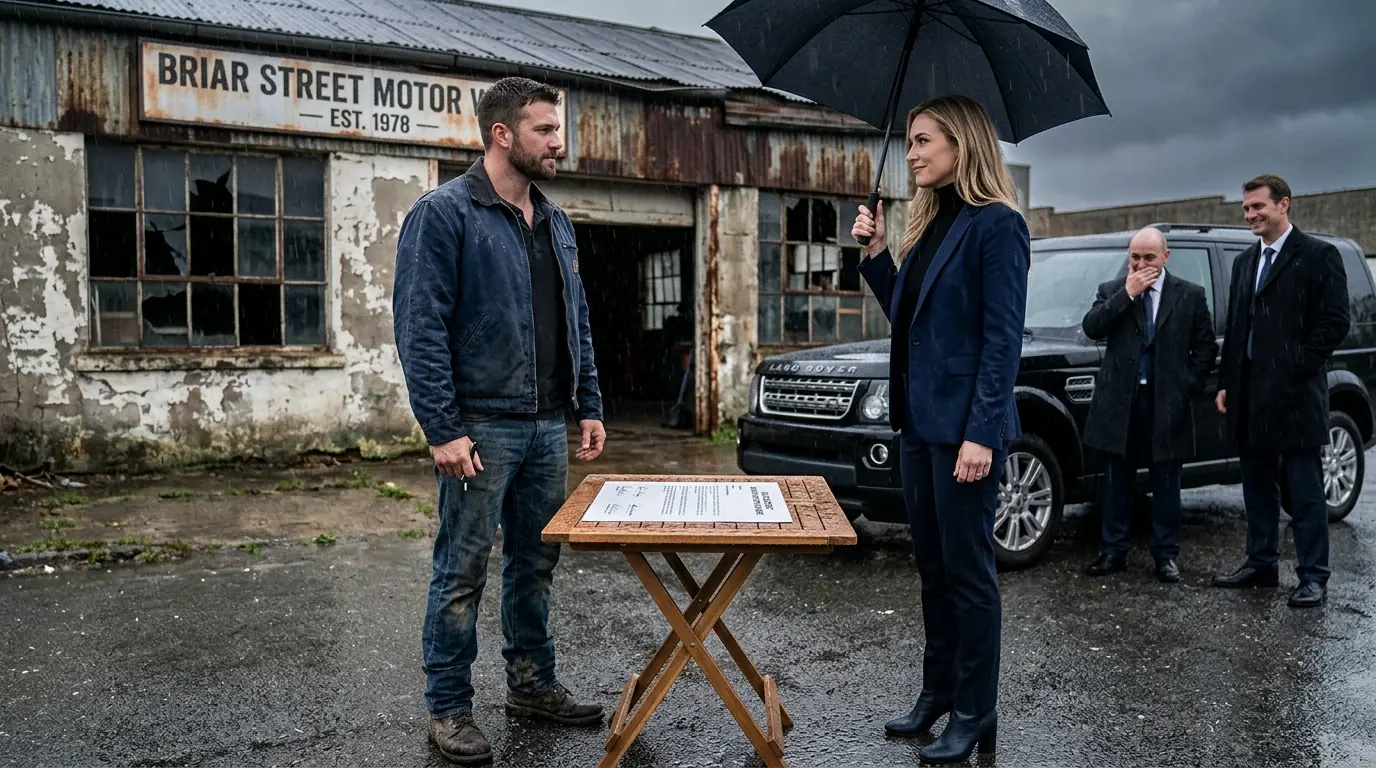
Caleb handed the contract back. “You were the one desperate to sell it.”
“I was desperate to remove a liability from our books.”
“Same building. Different point of view.”
Her smile thinned. “You always do that.”
“Do what?”
“Turn every conversation into a challenge.”
Caleb looked past her at the garage. “Only when somebody starts by assuming I’m stupid.”
That wiped the amusement from her face for half a second, which was enough to make the deal feel worth another hundred dollars. The truth was, he had no business buying the building. He was a thirty-nine-year-old widower with a nine-year-old daughter, a restoration business that barely deserved the word business, and just under six thousand dollars in savings after four years of rebuilding his life one overdue bill at a time.
Three thousand dollars had just disappeared from that cushion. The remaining money had to cover rent, Sophie’s school expenses, insurance, the transmission in his aging Ford, and whatever disaster waited behind the garage doors. Logic said he should have walked away the moment Adrienne’s assistant sent him the listing.
But logic had never seen Briar Street Motor Works before.
Caleb had.
Not in person. In photographs.
His grandfather, Walter Reed, had kept an old black-and-white picture in a tobacco tin that Caleb inherited after he died. It showed a much younger Walter standing beside a low silver roadster outside a brick garage with BRiAR STREET MOTOR WORKS painted over the doors. Caleb had stared at that picture hundreds of times as a boy while Walter told stories about shaping metal by hand, rebuilding carburetors by sound, and working for a brilliant but impossible man named Everett Vale.
Everett was Adrienne’s grandfather.
Caleb had never told her that.
He had not told anyone.
The connection was why Caleb had attended Vale Development’s surplus-property inspection. Adrienne’s company was assembling the industrial block for a riverfront project, and the garage was the last troublesome parcel. Adrienne wanted it gone; Caleb wanted to know why his grandfather had kept that photograph until the day he died.
“You understand the terms?” Adrienne asked.
“As-is. All defects, all environmental responsibility, all fixtures, all abandoned contents.”
“And no claim against Vale Development if the city condemns it next week.”
Caleb tapped the page. “That part is underlined twice.”
“Good.” She turned toward the SUV. “Then congratulations, Mr. Reed. You now own the ugliest building on Briar Street.”
Caleb called after her. “That must hurt.”
Adrienne turned around slowly.
He nodded toward the development banners farther down the block, all glass towers and landscaped walkways. “One ugly building right in the middle of your perfect renderings.”
Her eyes narrowed. “Enjoy the view while it lasts. You’ll probably sell it back to us when the first repair estimate arrives.”
“Maybe.”
“You will.”
“Then you can say I told you so.”
“I won’t need to.”
She climbed into the SUV, and ten seconds later it disappeared through the rain.
Caleb waited until the taillights were gone before pulling the old brass key from his pocket.
Sophie had found it in Walter’s tobacco tin two years earlier. The key was long and narrow, stamped with the number 7 on one side and a tiny winged-wheel emblem on the other. Caleb had assumed it belonged to a toolbox or forgotten cabinet until he saw the same winged wheel above Briar Street’s side entrance during the property inspection.
That was when three thousand dollars stopped looking like a reckless purchase and started looking like a question he could not ignore.
He picked Sophie up from his sister Megan’s house that afternoon. She came running down the steps wearing purple sneakers, a yellow rain jacket, and the serious expression she used whenever she believed adults had been making decisions without her. “Did you buy the haunted garage?” she asked before opening the truck door.
“It’s not haunted.”
“Aunt Megan says if the roof falls down, she’s not helping rebuild it.”
“Your aunt has a gift for encouragement.”
“She also said you spent college money.”
Caleb glanced at her. “You’re nine. We have time.”
“That means yes.”
He laughed despite himself. “I bought the garage.”
Sophie buckled in. “Then I want to see it.”