Vivian Ashcroft laughed before the auctioneer even finished repeating the bid.
“Five hundred dollars,” the auctioneer called, his voice bouncing off the steel beams of the old industrial sale hall. “We have five hundred from the gentleman in the back.” A few heads turned. Not many. Most of the people in the room had already stopped caring about Lot 47, a neglected strip of industrial property on the south edge of Marlow County, wedged between a dead rail spur, a cracked service road, and the back wall of a factory everyone believed belonged to someone else. The photos in the auction packet showed weeds, broken concrete, a rusted chain-link gate, and puddles the color of motor oil. The description had done it no favors either: limited utility, no active improvements, uncertain access, sold as is.
Reed Callahan sat alone near the back in an old canvas work jacket, a folder balanced on his knees and a pencil tucked behind one ear. He looked like the kind of man who had wandered into the wrong room while looking for a loading dock. His hair was dark but graying at the temples, his hands were scarred from decades of wrenches and sheet metal, and his boots had been cleaned with care but not replaced in years. Around him sat developers, corporate buyers, acquisition attorneys, and executives who smelled faintly of expensive cologne and confidence. Reed kept his eyes on the auctioneer, because he knew that if he looked around, he would see exactly what everyone thought of him.
Vivian Ashcroft sat in the front row. She was thirty-nine, polished, precise, and feared in three counties for turning struggling manufacturing assets into profitable holdings before competitors even understood what she had bought. Her company, Ashcroft Industrial, owned warehouses, stamping plants, packaging lines, and enough unused land to make smaller rivals nervous. She wore a cream suit, a gold watch, and the relaxed smile of a woman who believed every room eventually arranged itself around her will. When Reed raised his hand for Lot 47, she turned slightly to the executive beside her and whispered, “Five hundred? For that trash yard?”
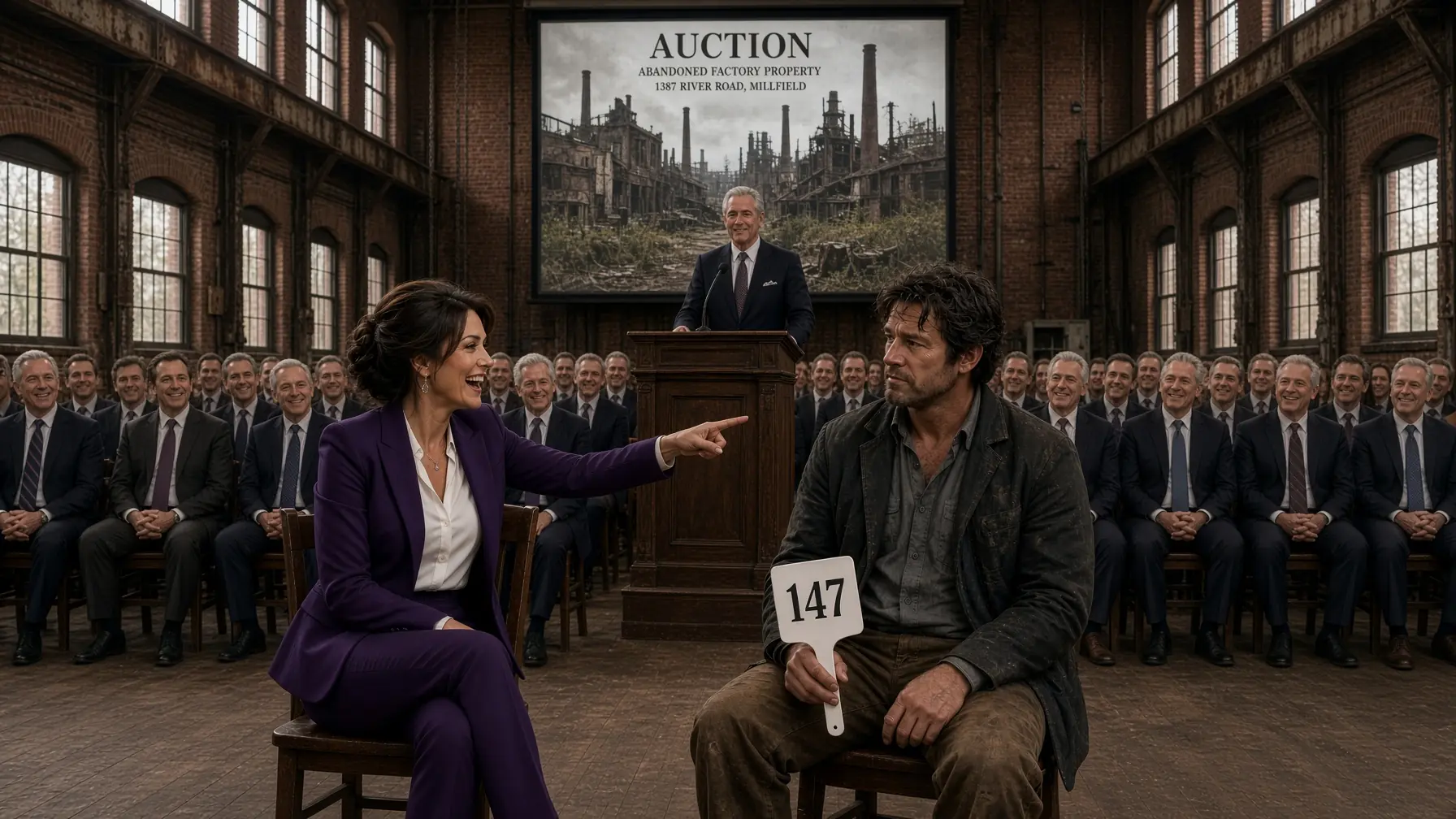
The man beside her, whose name was Elliott and whose job seemed to be agreeing with her professionally, smirked. “Apparently someone wants to become the proud owner of weeds and broken concrete.” Vivian laughed again, low enough to seem private and loud enough to be heard by the people who mattered. A few others smiled. Reed did not turn around. He kept his thumb pressed against the edge of his folder, feeling the rough paper fibers under his skin like a reminder to stay still.
The auctioneer looked over the room. “Do I hear six hundred?” No one moved. Reed could feel them looking at him now. He knew the look. Men like him learned early how wealthy people evaluated silence, clothing, posture, and age. He had received that look in factory offices, bank lobbies, school fundraisers, and once at a father-daughter breakfast where another parent assumed he was there to repair the air conditioner. He had stopped resenting it years ago. Being underestimated was not always an insult. Sometimes it was cover.
“Five hundred once,” the auctioneer called. Vivian glanced down at the lot sheet, amused. She had dismissed the parcel weeks earlier after her acquisitions team marked it as unusable. The land was too oddly shaped, the access too uncertain, and the environmental notes too vague to bother with. Ashcroft Industrial was pursuing a far more important prize: the old Whitaker Works factory beside it, a massive brick-and-steel structure with rail access, loading bays, and enough floor space to anchor a regional manufacturing hub. Lot 47 was background noise.
“Five hundred twice.” Reed’s fingers tightened slightly. No one had asked why he wanted it. No one had looked closely enough to wonder. The auctioneer lifted his hammer. “Sold. Lot 47 to bidder 183 for five hundred dollars.” The sound landed like a joke in the room. Reed closed his folder, stood, and walked toward the cashier’s table without smiling.
He did not pump a fist. He did not glance at Vivian. He did not look like a man who had won anything. That made Vivian laugh one last time. “He doesn’t even know what he bought,” she said. But Reed knew exactly what he had bought, or at least he knew enough to understand that everyone else had stopped reading too early.
Six months earlier, Reed Callahan had been lying under a conveyor motor in a frozen poultry plant at two in the morning when his daughter Nora called because she had a fever. He had been a maintenance supervisor for seventeen years, the kind of man plant managers remembered only when something broke and forgot when everything ran. He knew the sounds buildings made before failure: the tick of an overheated bearing, the hollow cough of a pump drawing air, the low electrical hum that meant a panel had been overloaded beyond what the paperwork admitted. He could read machinery like other people read weather.
He had once loved that life, or at least the useful parts of it. He liked problems with physical causes. He liked the deep satisfaction of putting a line back into production after everyone else had given up. But the job had eaten years from him. It had taken Christmas mornings, school plays, dinners, doctor appointments, and the ordinary quiet hours that make a family feel like a family. After his wife Laura died from an aneurysm no one saw coming, Reed tried to keep the supervisor job and raise Nora alone. For eight months, he survived on coffee, apologies, and neighbors who loved his daughter enough to help.
Then one night he came home late and found Nora asleep at the kitchen table over a science project about simple machines. She had drawn a pulley system in purple marker and written, My dad will help me finish when he gets home. Reed stood there in the fluorescent kitchen light, lunchbox still in his hand, and understood that some broken things could not be repaired after the warranty of childhood expired. He quit the supervisor job two weeks later. People called it foolish. He called it late.
He started a small repair business out of his garage, servicing old presses, compressors, pumps, bakery mixers, restaurant equipment, and anything else with bolts, wires, and owners who could not afford replacement. Money became tighter immediately. Their house needed a new roof. Nora’s sneakers wore thin faster than he expected. He drove a truck with a heater that worked only when it felt respected. But he made breakfast most mornings, attended parent conferences, and learned the difference between regular ponytails and the braided kind Nora wanted on Fridays.
Every night, after Nora went to bed, Reed studied. He studied tax auctions, property records, abandoned industrial sites, rail easements, environmental filings, utility corridors, and county maps. Not because he had money to speculate, but because old factories fascinated him. They were like sleeping animals, misunderstood by people who saw only rust. Reed saw bones, veins, lungs, and nerves: foundations, drainage, wiring, water supply, rail lines, access rights. He knew that a place dismissed as dead sometimes contained the exact thing someone else needed to live.
That was how he found Lot 47. The auction notice had been bland enough to disappear: unimproved industrial parcel, limited practical value, historical access unclear, sold without warranty. Most people saw risk. Reed saw vague language, and vague language was where mistakes liked to hide. He requested the county survey. Then the previous survey. Then the older plat map from the 1960s. Then utility drawings. Then rail easement documents.
He paid small fees one at a time, each one feeling heavier because every dollar had another use at home. He spread the papers across his kitchen table after Nora went to bed, using soup cans to hold the corners down where the old maps tried to curl. At first, it looked like nothing. Then the lines began to disagree. The newer parcel map showed Lot 47 ending before the factory foundation. The older survey showed the boundary running through the east service yard and around several permanent installations.
A rail easement from 1978 referenced “the Callahan spur,” a name that made Reed laugh bitterly because it had nothing to do with his family and everything to do with an engineer named Walter Callahan long dead before Reed was born. A utility corridor agreement listed not vacant land, but “support structures, transformer pads, and loading infrastructure serving the Whitaker Works manufacturing facility.” That was when Reed stopped sleeping well. He visited the property three times before the auction. Once at dawn, once in the rain, and once on a Sunday afternoon with Nora in the passenger seat eating crackers from a paper bag.
From the road, Lot 47 looked worthless. Up close, it spoke. Beneath weeds and broken concrete were old rail ties, drainage cuts, and anchor bolts. A rusted gate had a property tag that matched the historical survey, not the newer map. The factory wall rose beyond it, red brick and broken windows, but the loading bays on the east side sat inside the boundary Reed believed belonged to Lot 47.