For an entire year, Eleanor Hayes secretly paid for a stranger's breakfast. Every Tuesday, before Gabriel Mercer even walked through the door, she slipped the diner owner enough to cover his tab. She never told him, never expected anything back. She had watched him walk in that first morning with the hollow stillness of a man whose life had just lost its center. His wife had died weeks before, and she couldn't do nothing.
She thought she was just softening one man's grief one morning a week. What she didn't know was that 6 years later, when four men in expensive suits would arrive to take everything she had ever sacrificed for, that same man would still be sitting in his corner booth. And when she leaned across the counter and whispered the most desperate thing she had ever asked another human being, he would look at those suits, then look at her, and not move an inch. It was a Tuesday morning so quiet you can hear the coffee dripping into the pot. A roadside diner somewhere between nowhere and forgotten, sitting on the edge of a toll lane highway that most people only use when they're trying to avoid the interstate.
Cracked vinyl stools, a jukebox that hasn't worked since 2009, a hand-painted sign above the register that says home cooking in letters that have been fading for 15 years. One biker in a corner booth, one waitress behind the counter, the same routine they had shared without ever discussing it for 6 years. Neither of them had any reason to believe this particular Tuesday would be different from the 512 that came before it. But something was already wrong before Gabriel even sat down. He felt it the moment he walked through the door.
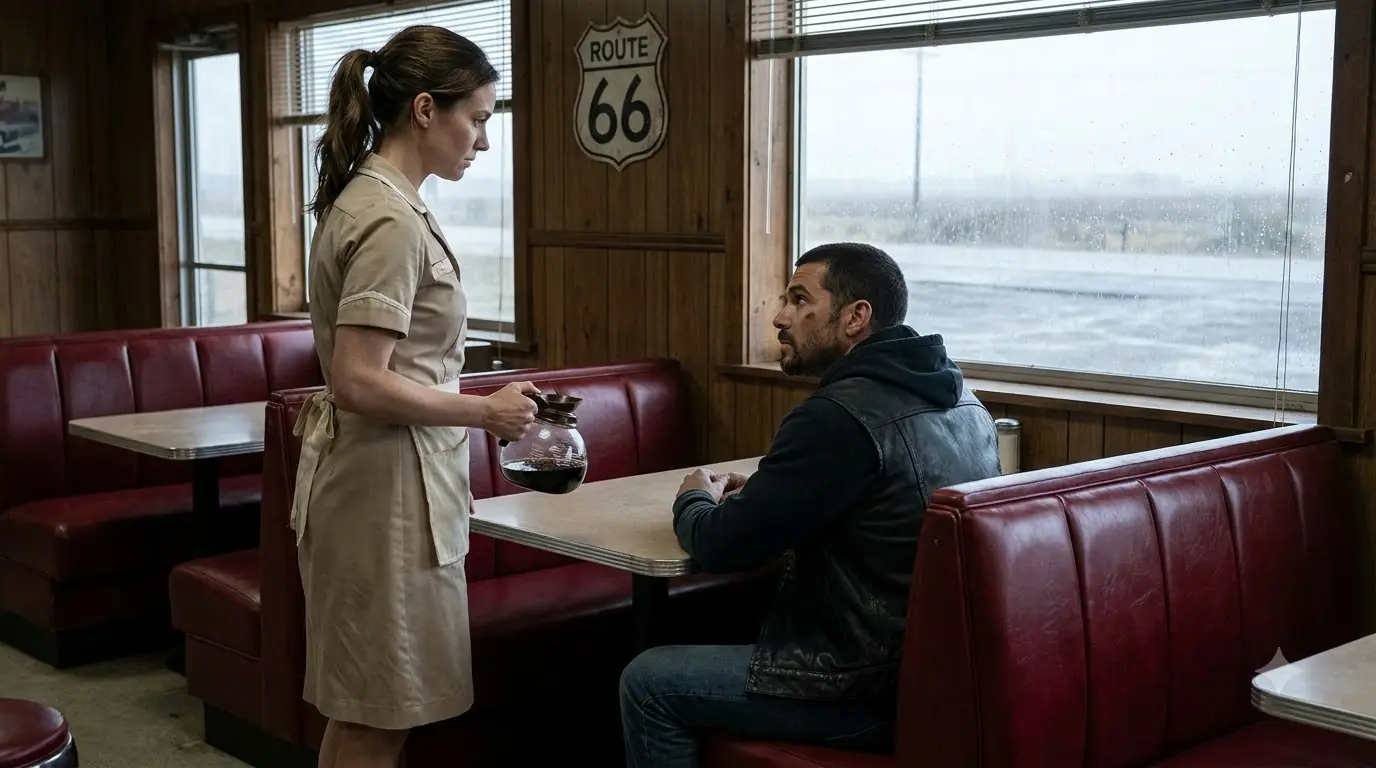
The air inside the diner had a different weight to it. Something tight, something held. Eleanor Hayes had been working that counter since before some of her regulars were born, 34 years. She knew exactly how to make a diner feel like the most comfortable room in the world. Warm light, familiar smells, the soft clatter of plates, a voice that never made you feel rushed.
But that morning she couldn't hold the coffee pot steady. Her hands were trembling. Just slightly. Just enough for someone paying attention to notice. And Gabriel was always paying attention.
He watched her glance toward the highway window twice before she even reached his table. She set the coffee down without her usual word or two. And when he looked up at her face, he saw something he had never seen there before in six years of Tuesday mornings. Fear. Not the surface kind.
The deep kind. The kind that's been sitting in a person's chest for weeks and has finally run out of places to hide. He asked her quietly, "You all right? " It wasn't a dramatic question. Just the kind of thing you ask someone when you already know the answer isn't yes.
She opened her mouth, started to give him the smile she gave everyone, the reflexive professional smile that had probably fooled a thousand customers over 34 years. Then she stopped. She put the coffee pot down on the edge of the table, looked at him directly, and said, "No. " Just that. No performance.
No apology. Just no. And then she leaned across the counter, close enough that only he could hear her over the hum of the refrigerators and the old country song bleeding quietly from the back kitchen. And she whispered something that made him set down his fork and go completely still. " Can you pretend to be my husband? "
He looked at her. She looked back. Neither of them moved. There was no punchline coming. She wasn't embarrassed.
She wasn't joking. She was asking him with every ounce of sincerity a person can put into a whisper, and her eyes were saying the rest of what her voice couldn't. That she was desperate, that she had thought about this, that he was not a random choice. Before Gabriel could even begin to form a response, the sound came from outside. Tires on gravel, slow and deliberate.
He turned toward the window and watched three black luxury SUVs pull into the parking lot one after another, evenly spaced, unhurried. The kind of entrance that doesn't need to announce itself because it already owns the moment. Eleanor's face went from pale to white. Her grip on the counter tightened until her knuckles matched the color of the laminate. She didn't move.
She barely breathed. And then she said, so quietly he almost missed it, "They're finally here. Please don't leave. " So, let’s start with the questions already hanging in the air before those SUVs even pulled in. Why did Eleanor choose Gabriel?
Out of every person she could have called, every regular who had sat in her diner for years, every neighbor who knew her name, why a biker she had never had a real conversation with? Why not the police? Why not a lawyer? Why not someone with a badge or a briefcase? What did she know about Gabriel Mercer that made her trust him with something this urgent and this dangerous?
And what had those men in the SUVs come to take? Because the look on Eleanor's face when those vehicles pulled in was not the look of someone who was surprised. It was the look of someone whose worst prediction had just come true. She had been waiting for this. She had known they were coming.
She just hadn't known exactly when. What Eleanor was hiding that morning had absolutely nothing to do with romance and everything to do with a promise she had made 20 years earlier in a hospital room to a dying woman who was running out of time. Eleanor Hayes had started at that diner when she was 27 years old, newly arrived in town, newly heartbroken after losing her fiance in an accident the year before, looking for work that would keep her hands busy enough that her mind couldn't wander too far. She took the job as a temporary thing. Temporary became a month.
A month became a year. A year became a decade. And somewhere along the way the diner became the one constant in a life that had lost most of its other anchors. She learned the names of everyone's kids. She remembered that the county commissioner took two sugars on weekdays and none on Sundays because his wife was watching his diet.
She knew which farmers were struggling before the bank did. She knew which marriages were in trouble before the couples admitted it to themselves. 34 Years of coffee and she had become, without ever meaning to, one of the quiet emotional centers of that entire community. Everyone knew Eleanor. The whole town knew her name, but very few of them knew what she carried.
20 Years before that Tuesday morning, her younger sister got sick. Ovarian cancer. The aggressive kind that doesn't wait and doesn't negotiate. Eleanor drove to that hospital every single day after her shift, still in her uniform, still smelling like the diner, and she sat beside her sister's bed and talked to her about nothing important because the important things were too hard to say out loud. Toward the end, when her sister had run out of energy for conversation, she just held her hand.
And one evening, in the particular quiet that settles over a hospital room when everyone already knows how the story ends, her sister turned her head on the pillow and said, barely above a breath, "What's going to happen to Nathan? " Nathan was her son, 17 years old. His father had died years earlier in a workplace accident. There was no other family, no safety net, nowhere for a 17-year-old boy to land except the foster system. And her sister knew exactly what that meant.
Eleanor looked at her and said the only thing she could say, the only thing that was true, "He's mine. I'll take care of him. " Her sister died 3 days later. Eleanor went home that night, sat at her kitchen table under a single overhead light, and laid out the reality of her life in front of her. She had no savings worth speaking of.
She had rent due. She had a car that needed tires. She had no idea how the adoption process worked or what it cost. She called the county clerk's office the next morning and started asking questions. She filed the paperwork herself because she couldn't afford an attorney.
She worked double shifts for months to cover the court fees. She sold her house, the small starter home she had been slowly making into something, and moved into a two-bedroom apartment above a laundromat on the edge of town. She missed holidays because she was working. She missed her own birthday more than once. She gave up the version of her future that had included rest and travel and maybe, eventually, someone to share a life with.
And she did all of it without complaint, without performance, without asking anyone to notice. Nathan moved in and she never, not once in 20 years, referred to him as her nephew. He was her son. Full stop. No asterisk.