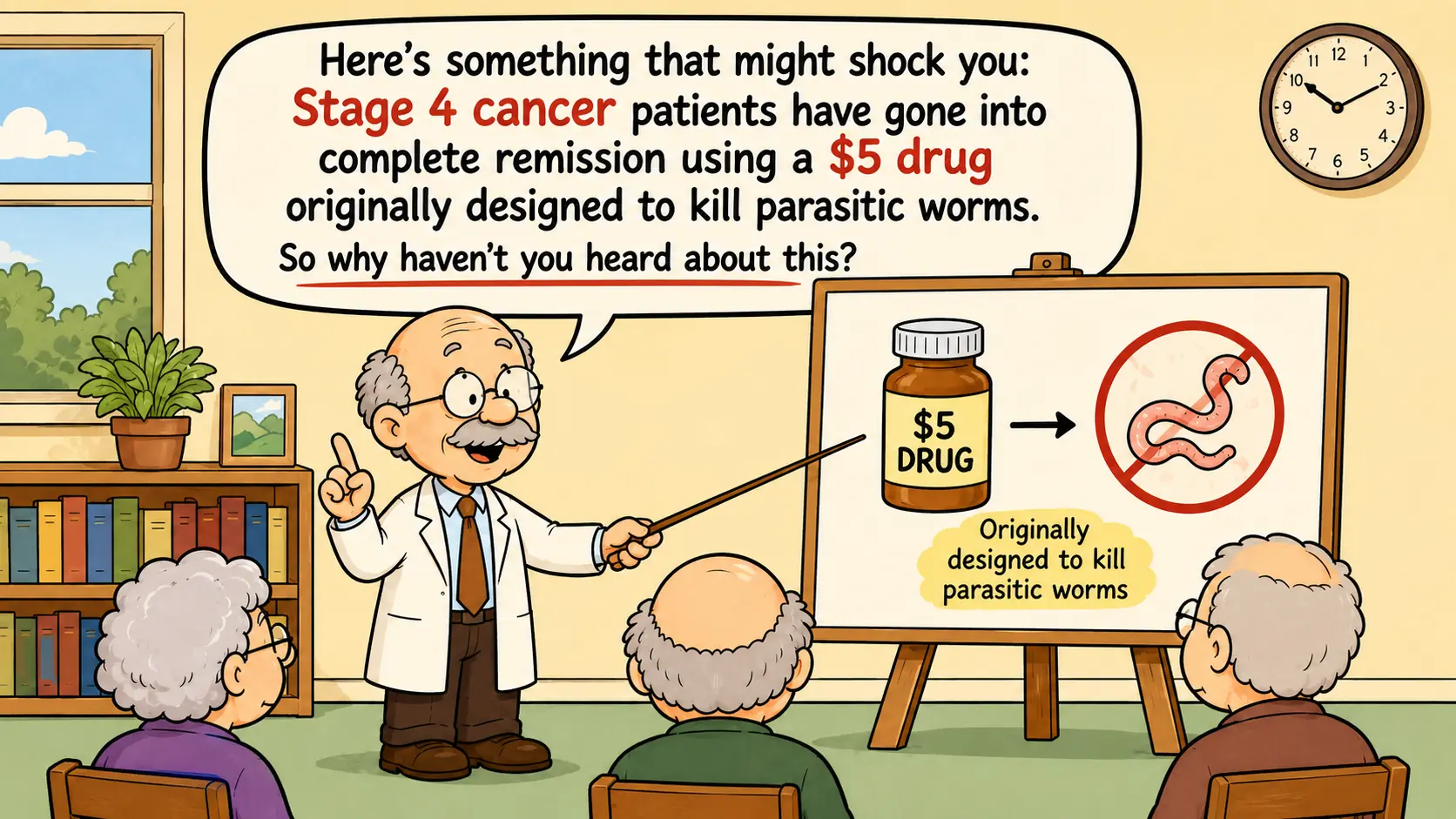
1. Are stage 4 cancer patients really going into complete remission because of a deworming drug?
This claim is not supported by reliable clinical evidence.
Many viral stories rely on personal testimonials or small case reports involving fenbendazole, a veterinary antiparasitic medication. While these individual accounts are interesting, they cannot prove that the drug caused a patient's cancer to disappear.
In many cases, patients were also receiving chemotherapy, immunotherapy, radiation therapy, surgery, or combinations of standard cancer treatments. Without carefully designed clinical trials, it is impossible to know which treatment—or combination of treatments—was responsible for the outcome.
Researchers have published small case series describing self-administered fenbendazole and possible anticancer activity, but these studies lack randomized comparison groups. As a result, they cannot establish that fenbendazole is effective against cancer.
At present, fenbendazole is not approved by the U.S. Food and Drug Administration (FDA) as a treatment for human cancer.
The most accurate conclusion is that some antiparasitic drugs are being investigated for potential anticancer effects, but there is currently no reliable clinical evidence that fenbendazole cures stage 4 cancer.
2. Are cancer centers refusing to study it because the patent expired?
No.
A common claim is that pharmaceutical companies will not invest in fenbendazole because it is inexpensive and off-patent, and that this prevents meaningful research from taking place.
While expired patents can reduce commercial incentives for drug development, they do not prevent scientific research.
In reality, universities, government agencies, nonprofit organizations, and major academic medical centers routinely study repurposed medications. Off-patent drugs have been investigated for decades across many areas of medicine.
For example, mebendazole, another antiparasitic drug in the same drug family, has been evaluated in clinical trials for malignant glioma and recurrent pediatric brain tumors. Researchers have also explored ivermectin in combination with cancer immunotherapy in early-stage clinical research.
Scientific interest in inexpensive drugs clearly exists when there is sufficient biological evidence to justify further investigation.
3. Does the low cost of the drug explain the lack of proof?
Not necessarily.
Some online posts claim that no one will spend enormous sums of money studying a medication that costs only a few dollars.
While large phase III cancer trials can indeed be expensive, not every clinical trial requires such massive funding. Research usually begins with laboratory experiments, followed by animal studies, then small human safety trials before progressing to larger effectiveness studies.
Before any drug can become a standard cancer treatment, researchers must determine:
-
Whether effective doses can be safely achieved in humans.
-
How the drug is absorbed, distributed, and eliminated.
-
Whether it interacts with chemotherapy or immunotherapy.
-
Which specific cancers may respond.
-
Whether it improves survival compared with existing treatments.
The price of a medication does not eliminate the need for careful scientific testing.
4. Is cancer basically a parasite?
No.
This statement oversimplifies how cancer develops.
Cancer is not a parasite, fungus, bacteria, or infectious organism. It arises from a person's own cells after genetic mutations disrupt the normal systems that regulate cell growth, repair, and programmed cell death.
It is true that cancer cells and parasites share some broad survival characteristics. Both consume resources, avoid destruction, and can adapt to their environment. However, these similarities are biological observations—not evidence that cancer should be treated as a parasitic infection.
Modern cancer treatments are selected based on the molecular characteristics of individual tumors rather than the idea that cancer behaves like a parasite.
5. Can antiparasitic drugs damage cancer cells?
Possibly—but laboratory findings are not the same as successful human treatment.
Researchers have found that benzimidazole drugs such as fenbendazole and mebendazole interfere with structures called microtubules. These structures help cells maintain their shape and divide during growth.
Because cancer cells divide rapidly, disrupting microtubules has become an important strategy in oncology. In fact, several established chemotherapy drugs also target microtubules.
This explains why scientists became interested in studying certain antiparasitic medications in laboratory cancer models.
However, many compounds that successfully kill cancer cells in laboratory dishes ultimately fail during human clinical trials because:
-
Safe doses may not achieve effective concentrations.
-
The drug may not reach tumors efficiently.
-
Cancer cells may develop resistance.
-
Healthy tissues can also be affected.
-
Animal results often fail to translate into meaningful improvements in human survival.
Laboratory promise is an important first step—but it is not proof that a treatment works in patients.
6. Does fenbendazole remove the immune system's "don't kill me" signals?
There is currently no clinical evidence demonstrating this effect in humans.
The phrase "don't kill me" generally refers to immune-evasion mechanisms used by cancer cells, including pathways such as CD47 and immune checkpoints.
Modern immunotherapy drugs are specifically designed to target certain immune pathways, and several have dramatically improved outcomes for selected cancers.
Some laboratory studies suggest that antiparasitic drugs may influence immune signaling, oxidative stress, apoptosis, or cellular metabolism. These observations are scientifically interesting and deserve further investigation.
However, laboratory findings should not be interpreted as proof that fenbendazole restores immune recognition of cancer in human patients.
7. Is most of the research coming from South Korea and India?
Researchers from many countries have investigated antiparasitic drugs in cancer research.
Scientists in South Korea, India, the United States, Europe, and numerous other countries have published laboratory studies exploring these medications.
What matters is not where a study is conducted, but how well it is designed.
Reliable scientific evidence depends on:
-
Careful study design.
-
Adequate sample size.
-
Appropriate comparison groups.
-
Independent replication.
-
Peer review.
-
Human clinical outcomes.
Many encouraging findings involving fenbendazole remain preclinical, meaning they were performed in cells or animals rather than in human patients.
Preclinical success is valuable, but it does not establish that a treatment improves survival in people with cancer.
8. Are independent laboratories where the "real cures" are found?
Independent researchers have made many important medical discoveries throughout history. Likewise, industry-funded research has also produced life-saving treatments.
Neither funding source automatically determines whether research is trustworthy.
High-quality science depends on transparency, reproducibility, careful methodology, ethical oversight, and independent verification—not on who paid for the study.
Extraordinary medical claims require equally strong evidence.
For this reason, organizations such as the FDA continue to warn patients about products promoted online as unproven cancer cures. Delaying evidence-based cancer treatment while relying on an untested therapy can reduce the opportunity to receive treatments that have been proven to improve survival.
An important safety reminder
Fenbendazole products are primarily intended for veterinary use.
Self-treatment has been associated with reports of suspected liver injury, and safety concerns have also been raised regarding prolonged extra-label use. Because these products have not been approved for treating human cancer, their effectiveness, proper dosing, and long-term safety remain unknown.
Anyone diagnosed with cancer should discuss any supplement or repurposed medication—including fenbendazole, mebendazole, or ivermectin—with their oncologist before taking it. These products may interact with cancer therapies, affect liver function, or complicate the management of treatment-related side effects.
The bottom line
The idea that an inexpensive deworming drug could treat cancer is scientifically intriguing, and researchers continue to investigate whether some antiparasitic medications have anticancer properties. Laboratory experiments have produced encouraging findings, but laboratory success is not the same as proven clinical benefit.
At this time, there is no high-quality clinical evidence showing that fenbendazole cures stage 4 cancer, and no major medical organization recommends it as a standard cancer treatment.
The best approach is to remain open to emerging research while relying on treatments that have been rigorously tested for safety and effectiveness. Science advances by carefully evaluating promising ideas—not by accepting or rejecting them based on viral stories alone.