The afternoon heat sat heavy over the community park, pressing down on the grass, the cracked basketball court, and the football field where a group of boys had been playing since school let out. Their backpacks were thrown in a pile near the fence, their sneakers were coated with dust, and their voices carried across the open space every time someone made a catch or missed a tackle. At the edge of the field, beneath the thin shade of a maple tree, Ethan Miller sat in his wheelchair with a football resting on his lap and hope sitting quietly behind his eyes.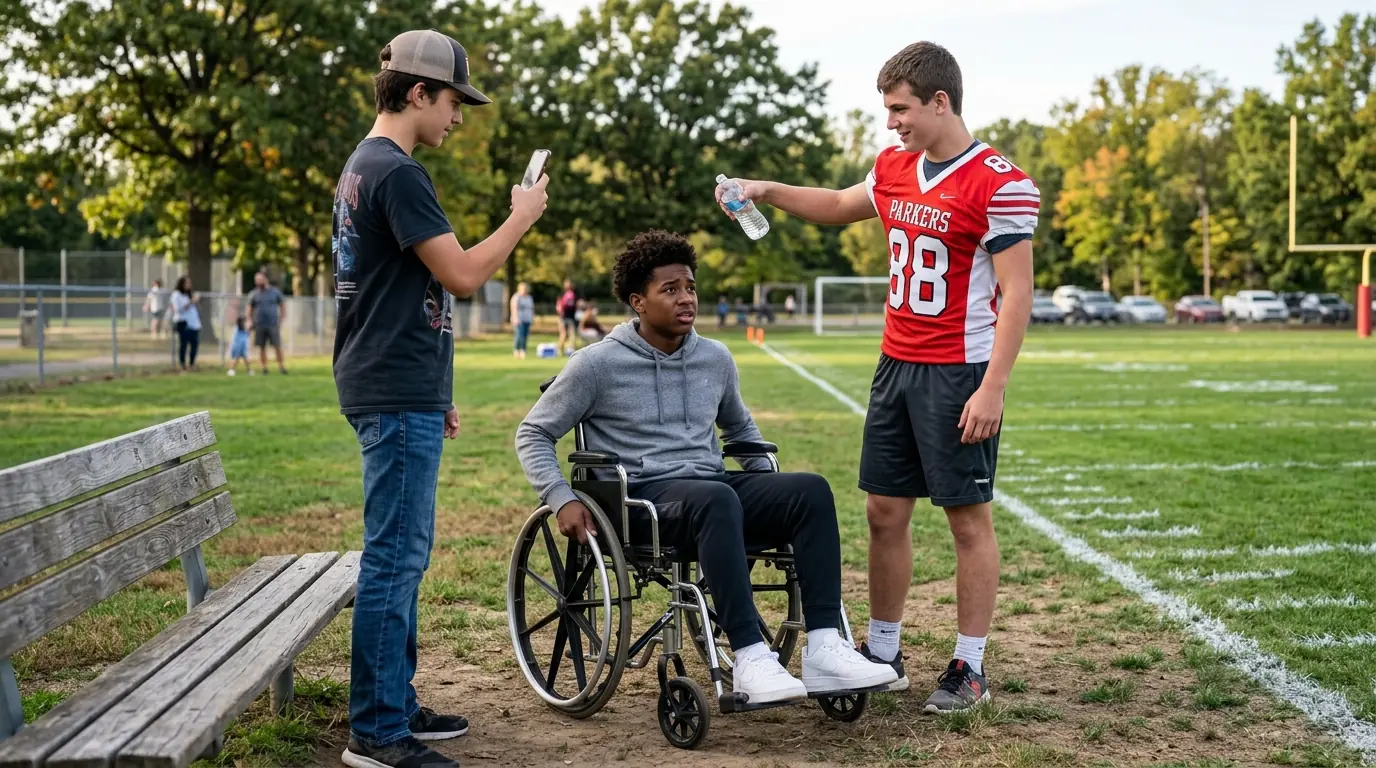
Ethan was fourteen years old, with sandy brown hair that always fell across his forehead and a smile that appeared more easily than most people expected. He had been born with a spinal condition that left him unable to use his legs the way other kids did, but his arms were strong from years of pushing his chair through hallways, sidewalks, ramps, and places that were never designed with him in mind. He loved sports anyway. He watched games, studied plays, memorized statistics, and believed with stubborn faith that being in a wheelchair did not mean he had to sit on the sidelines of his own life.
That day, he had rolled closer to the football field than usual. Chris Walker and his friends were playing, and Chris was the kind of kid everyone noticed whether they wanted to or not. He was loud, athletic, and confident in a way that made younger kids move aside when he walked past. He had dark blond hair, expensive sneakers, and the habit of smiling right before he said something cruel, as if the cruelty was just another joke everyone else was supposed to laugh at.
Ethan watched them run another play. The ball flew through the air, bounced off one boy's hands, and rolled across the grass until it stopped near the front wheel of Ethan's chair. He picked it up and held it for a moment, feeling the worn leather under his fingers. When Chris jogged over, breathing hard and grinning, Ethan lifted the ball toward him.
"You guys mind if I play?" Ethan asked.
Chris stopped so suddenly that the boys behind him nearly ran into his back. For one second, nobody spoke. Then Chris looked at Ethan's wheelchair, then at the ball, and then back at Ethan's face. His grin widened, but it was not friendly.
"Let me get this straight," Chris said. "You want to play football with us?"
"Yeah," Ethan said. "I know I'm different, but I can still keep up. You can make me center, or I can pass, or I can run routes with the chair. I promise it will be fun."
A boy named Tyler laughed first. Another boy, Mason, covered his mouth like he was trying not to, but he laughed too. Chris took the ball from Ethan's hands and tossed it up once, catching it easily.
"Nobody wants to play football with someone in a stupid wheelchair," Chris said.
Ethan's face tightened, but he kept his voice steady. "You don't know that. Just give me a chance."
"Okay, Wheels," Chris said, backing up. "Let's see what you got. You want the ball?"
He held the football out just far enough that Ethan had to roll forward to reach it. Ethan pushed his wheels and leaned out, but before his fingers touched the ball, Chris stepped back. The others laughed. Chris held it out again, lower this time. Ethan reached again. Chris moved again.
"Come on," Ethan said quietly. "Can I just have it?"
"Maybe if you weren't crippled, you'd have a chance," Tyler said. "Too bad."
"He could be a kicker," Mason added, laughing. "Oh wait, his legs don't work."
"Look at me," Ethan said, gripping his wheels. "I'm coming for you now."
He pushed forward faster than they expected. Chris laughed and stepped aside, but Ethan angled his chair sharply, grabbed the football as it slipped from Chris's hand, and spun away. For one brief second, he had it. For one brief second, his heart lifted.
Then Chris shoved the back of the wheelchair.
It was not hard enough to flip him, but it jolted Ethan forward and made the football drop from his lap. Chris scooped it up and danced backward.
"Boom," Chris said. "You just got clowned on."
Tyler slapped Chris on the shoulder. Mason laughed so hard he bent over. Ethan pressed his hands to the wheels to stop his chair from rolling. His throat felt tight, but he would not cry in front of them.
"Why are you doing this?" Ethan asked.
Chris's smile faded into something uglier. "Because I don't care about people like you. Everybody acts like we have to treat you special, like you're some brave little hero just for existing. But if it were up to me, you would all stop taking up space."
Ethan stared at him. "I'm not worthless just because I'm in a wheelchair. It doesn't mean I'm any different from you."
"Oh yeah?" Chris said. "Then get up and do something about it."
The park seemed to go quiet around them. Even Tyler and Mason stopped laughing for a second. Ethan's hands curled into fists on his lap.
Chris bent down until his face was close to Ethan's. "That's what I thought. Worthless."
Then he grabbed a water bottle from the grass, twisted off the cap, and poured it slowly over Ethan's head.
Cold water ran down Ethan's hair, over his forehead, into his eyes, and across his shirt. Tyler laughed again, louder this time, as if silence had scared him. Mason pulled out his phone.
"Hold up," Mason said. "We need a picture."
"Yeah," Chris said, stepping beside Ethan and putting one foot on the frame of the wheelchair like it was a trophy stand. "Caption it, this is how he ended up in a wheelchair."
Ethan wiped water from his face. He wanted to disappear. He wanted the ground to open up and swallow the chair, the football, the boys, and every inch of the park. Instead, Mason took the picture, Chris laughed, and the three boys walked away, leaving Ethan alone under the tree with his shirt soaked and the football abandoned in the grass.
For a while, Ethan did not move. He listened to the fading sound of their voices and the buzzing of insects near the fence. He had been stared at before. He had been pitied, ignored, helped too much, helped too little, spoken to like a child, and treated like a problem in rooms where adults should have known better. But this felt different. This was not misunderstanding. This was someone looking directly at him and deciding his life was worth less.
When Ethan finally rolled home, his mother knew something had happened before he said a word. Linda Miller opened the front door and saw the wet shirt, the red eyes, and the way her son tried to smile like the whole afternoon had not carved something out of him.
"Ethan," she said softly. "What happened?"
"Nothing," he said. "I just got splashed."
Linda looked at him for a long moment. She had raised him long enough to know the difference between water and humiliation. But she also knew there were moments when forcing the truth out of a wounded child only made the wound deeper.
"Go change," she said. "Dinner's almost ready."
In his room, Ethan peeled off the wet shirt and sat quietly beside the bed. His phone buzzed. A message from an unknown account appeared with the photo Mason had taken. Under it was the caption Chris had suggested. Ethan stared at it until the words blurred. Then he deleted the message, turned off his phone, and promised himself he would not go back to the park for a while.
Chris Walker did not think about Ethan that night. He thought about the picture, the laughs, the way Tyler and Mason had repeated his lines like he was the funniest person alive. He thought about how good it felt to be the one everyone followed. At home, his mother told him to put his phone away during dinner, and he rolled his eyes. She reminded him that his driving permit required responsibility, and he told her she worried too much.
"Chris, I'm serious," she said. "No texting when you're driving. No showing off. No speeding."
"Mom, I'm not stupid," Chris said. "I'm the best driver in my class."
"Being confident doesn't make you safe."
"I'm fine."
The next afternoon, Chris borrowed his older brother's car to meet Tyler and Mason. His mother called as he pulled out of the driveway, and he answered with one hand on the wheel.
"Yes, Mom, I have my seat belt on," he lied. "No, I'm not texting. Yes, I'm driving carefully."
He ended the call and tossed the phone onto the passenger seat. Thirty seconds later, it buzzed with a message from Tyler asking where he was. Chris grabbed it without thinking. He typed, almost there, and looked up too late.
The curve came faster than it should have. A parked delivery truck narrowed the lane. Chris jerked the wheel. The car jumped the curb, slammed into a metal light pole, and folded around it with a sound that seemed too loud to belong to one moment.
By the time the ambulance arrived, Chris was barely conscious. His right leg was pinned beneath crushed metal, and blood streaked his forehead. He remembered flashing lights, his mother's scream, the sharp smell of gasoline, and a paramedic telling him to stay awake. Then everything disappeared.
When Chris opened his eyes again, the hospital ceiling was white and still. His throat felt raw. His body felt heavy. His mother sat beside the bed, both hands wrapped around his left hand, her face swollen from crying.
"Mom?" he whispered.
She stood so fast the chair scraped against the floor. "Chris. Oh, thank God."
He tried to sit up, but pain tore through him. He looked down. Blankets covered most of his body. Something was wrong with the shape beneath them.
"What happened?" he asked.
His mother's face broke. "You crashed. The doctors did everything they could. They saved your life."
Chris stared at her. "What does that mean?"
She could not answer at first. A doctor came in and spoke gently, explaining injuries, blood loss, infection risk, and emergency surgery. Chris heard pieces of it but not all. The only words that stayed were the ones that landed like stones.
They had removed his right leg above the knee.
At first, Chris refused to believe it. He shouted. He pulled at the blanket until the nurses stopped him. He demanded another doctor, another surgery, another answer. His mother cried beside him, saying his name over and over, but he could not hear her through the roaring in his head.
The weeks that followed were nothing like the life Chris had known. Pain came in waves. Physical therapy exhausted him. He hated the walker, hated the wheelchair, hated the mirror, hated the empty space where his leg had been. People told him he was lucky to be alive, and he hated that too. Lucky felt like a word invented by people who still had both legs.
When he finally returned to school part-time, Tyler and Mason promised they would be there for him. They lasted three days.
At first, they acted awkward but loyal. They carried his bag, made jokes that were too loud, and told him he would be back to normal soon. But Chris was not normal to them anymore. He moved slower. He could not play football. He could not race them to lunch. He could not be the fearless center of everything the way he used to be.
On Friday, Chris found them behind the gym after school. He had been using crutches that day because he was tired of the wheelchair, and every step made his arms ache.
"Hey," he said. "You guys still coming over?"
Tyler looked at Mason. Mason looked away.
"We might be busy," Tyler said.
Chris frowned. "Doing what?"
"Stuff," Mason said.
Chris forced a laugh. "Come on, don't be weird."
Tyler's expression shifted, and Chris recognized it with a cold drop in his stomach. It was the same face Tyler had made at the park when Ethan asked to play. The same cruel amusement. The same need to push someone lower so he could feel taller.
"You look like a pirate now," Tyler said. "No offense."
Mason laughed nervously. "Yeah. Like, one-legged Chris."
Chris stared at them. "That's not funny."
"It's a little funny," Tyler said. "I mean, what are we supposed to do? Hang out and watch you struggle across the room?"
"I'm still me," Chris said.
Tyler shrugged. "Not really. You're just another crippled person now."
The words hit harder because Chris had said things just like them. He heard his own voice from the park, sharp and merciless, thrown back at him through someone else's mouth.
"Don't call me that," Chris said.
Mason picked up a carton of chocolate milk from the ground near someone's lunch trash. "He looks thirsty."
"Don't," Chris said.
Tyler took it from Mason, pulled off the top, and dumped it over Chris's head.
Milk ran down Chris's hair, into his shirt, and over the hospital brace beneath his jeans. His crutches slipped. He caught himself against the brick wall. Tyler and Mason laughed, took a picture, and walked away.
Chris stood there shaking, unable to chase them, unable to pretend it did not hurt, unable to escape the memory of Ethan under the maple tree with water dripping from his face.
"Hey," a voice said softly. "Are you okay?"
Chris turned.
Ethan Miller sat a few feet away in his wheelchair. He had a library book on his lap and a backpack hanging from the handles of his chair. His face showed no anger. No satisfaction. No victory. That made it worse.
Chris looked away. "You saw that?"
"Yeah," Ethan said.
"Great."
Ethan rolled closer. "Do you need help getting to the nurse?"
Chris laughed once, but it sounded broken. "Why would you help me?"
Ethan looked at the chocolate milk on the ground, then at Chris's crutches. "Because you look like you need help."
Chris swallowed hard. "I remember you."
"I know."
"I was awful to you."
"Yeah," Ethan said. "You were."
Chris leaned back against the wall. He wanted to make a joke, to act tough, to say something that would protect him from the shame rising in his chest. But there was no joke left. There was only the truth.
"I got into an accident," Chris said. "I was texting. I thought I was too good to crash. The doctors had to take my leg so I could live. Now my friends don't want to be around me. I guess they're not really my friends."
Ethan said nothing. He let the silence do what it needed to do.
Chris wiped milk from his face with the sleeve of his hoodie. "I'm starting to understand what I did to you. Not completely, probably. But enough to know it was wrong. Really wrong. I treated you like you weren't even a person. I'm sorry."
Ethan looked at him for a long moment. "I forgive you."
Chris blinked. "Just like that?"
"Not because it didn't hurt," Ethan said. "It did. I went home that day and cried in my room. I hated that picture. I hated that you made me feel small. But I don't want to become the kind of person who only feels strong when someone else is hurting."
Chris's mouth tightened. "I don't deserve that."
"Maybe not," Ethan said. "But forgiveness isn't always about what someone deserves. Sometimes it's about what you refuse to carry forever."
Chris slid down the wall until he was sitting on the ground. His crutches fell beside him. For the first time since the accident, he cried in front of someone who was not his mother.
Ethan stayed.
After a while, Chris wiped his face. "You can go. I know you don't want to hang out with me. Not after what I did."
"Don't say that," Ethan said. "Just because you're different now doesn't mean you're worthless."
Chris looked at him, and the words landed in the exact place where he had once tried to wound Ethan.
Ethan continued, "I won't lie to you. Being different in a world built for everybody else is hard. Some days people stare. Some days they help when you don't want help and disappear when you actually need it. Some days you feel like your whole body is an argument you have to keep explaining. But you can still matter. You can still be funny, useful, annoying, brave, scared, talented, and kind. You're not less human because something changed."
Chris gave a weak laugh through his tears. "You sound like you've had that speech ready."
"I've had to give it to myself a lot," Ethan said.
Chris looked down at his missing leg. "I don't know how to be this."
"Nobody does at first. You learn. You mess up. You get angry. You start again. And you stop letting people like Tyler decide what your life is worth."
"I was Tyler," Chris whispered.
"You were," Ethan said. "Now decide if you still want to be."
That was the first real choice Chris had made since the accident. Not the choice to crash, not the choice to lose his leg, not the choice to be stared at, pitied, or abandoned. This choice was different. It was smaller and bigger at the same time. He could let shame turn him meaner, or he could let it teach him.
"I don't want to be that anymore," he said.
Ethan nodded. "Then don't."
Over the next few weeks, Chris began sitting with Ethan at lunch. At first, people stared. Some whispered that Ethan was too nice. Some said Chris was only hanging out with him because nobody else would. Ethan ignored them. Chris tried to, though it was harder for him because he was used to controlling the room, not surviving it.
Physical therapy remained brutal. There were days when Chris threw his crutches across the living room and told his mother he hated everyone. There were days when he refused to go to school because he could not stand another person asking what happened. But Ethan kept showing up. He sent videos of wheelchair basketball players, adaptive athletes, musicians, artists, and veterans who had built lives around new bodies and new limits. He challenged Chris to races in the school hallway after the last bell. He teased him when he got dramatic. He also listened when Chris admitted he was scared.
One Saturday, Ethan brought a football to the same park where everything had started. Chris arrived on crutches, nervous and quiet. The maple tree was still there. The field looked the same. For Ethan, the memory rose immediately: the water, the laughter, the picture. Chris saw it on his face.
"We don't have to stay," Chris said.
"Yes, we do," Ethan said.
They started slowly. Ethan showed Chris how to throw from a seated position and how balance came more from the core than the legs. Chris learned how to pivot with one foot and crutches tucked under his arms. They made up rules that fit both of them. No tackling. No pity points. No pretending anything was easy.
A younger boy from the neighborhood watched from the fence. He wore thick glasses and held a soccer ball under one arm.
"Can I play?" the boy asked.
Chris opened his mouth. For one terrifying second, Ethan wondered which version of Chris would answer.
Then Chris smiled. "Yeah. Come on. We'll figure out the rules as we go."
By the end of the afternoon, five kids were playing. The game looked nothing like regular football. It was messy, slow, full of arguments, laughter, made-up penalties, and impossible plays. It was also the most fun Ethan had ever had on that field.
Tyler and Mason appeared near the basketball court before sunset. They watched for a while, whispering. Finally, Tyler shouted, "Look at the cripple team."
Chris froze. The old instinct flashed across his face, the instinct to laugh with the loudest voice in the room. Then he looked at Ethan. He looked at the younger boy with glasses. He looked down at his own missing leg.
He turned his crutches and faced Tyler.
"Say it again," Chris called.
Tyler smirked. "What? You going to chase me?"
"No," Chris said. "I'm going to make sure everyone here knows you only feel strong when you're picking on someone you think can't hit back. I used to be like that. It was pathetic then, and it's pathetic now."
Mason looked uncomfortable. Tyler's smirk faded.
Chris continued, voice shaking but clear. "You dumped milk on me when I was already hurting because you thought losing a leg made me less than you. I did the same kind of thing to Ethan before my accident. I was wrong. You are wrong. And if you post one more picture, one more caption, one more joke about anybody's body, I'm taking it to the school, your parents, and every coach who still thinks you're worth putting on a team."
The park went quiet.
Tyler muttered something under his breath and walked away. Mason followed. Chris stood still until they were gone. Then he exhaled like he had been holding his breath for weeks.
Ethan rolled up beside him. "That was pretty good."
"Pretty good?" Chris said. "That was heroic."
"Don't push it."
Chris laughed. This time, there was no cruelty in it.
Months passed. Chris learned to use a prosthetic leg. He fell more times than he could count. He hated it, then tolerated it, then slowly started to trust it. He never became the exact person he had been before the accident. That person had been fast, loud, careless, and cruel. The new Chris was still loud sometimes, still dramatic, still competitive, but he listened more. He apologized faster. He noticed ramps, narrow doors, uneven sidewalks, and people sitting alone.
Ethan changed too. He stopped waiting for permission to enter spaces that should have belonged to him already. With Chris beside him, he started an adaptive sports club at school. At first, only a handful of students came. Then a teacher sponsored it. Then a local news station did a small story. Then the park district agreed to host monthly inclusive games where kids with and without disabilities played together under rules that changed depending on who showed up.
At the first community game, Ethan sat at midfield with a whistle around his neck, pretending to be more official than he was. Chris stood beside him on his prosthetic leg, holding the football under one arm.
"You ready?" Chris asked.
Ethan looked across the field. Kids in wheelchairs, kids with braces, kids with no visible disabilities, kids who were shy, loud, fast, slow, uncertain, eager, all waited for the game to begin.
"Yeah," Ethan said. "I'm ready."
Chris tossed him the ball. Ethan caught it and smiled.
Before he blew the whistle, he remembered the day under the maple tree. He remembered the water on his face and the laughter behind him. For a long time, that memory had felt like proof that people could be cruel for no reason. Now it meant something else too. It was proof that cruelty did not get the final word unless you let it.
Ethan blew the whistle.
The game began.
Years later, when people asked how the inclusive sports league started, Chris always told the truth. He said it began because he was a bully who thought he understood strength until life knocked him down and the boy he had hurt chose to help him up. Ethan always rolled his eyes when Chris told it that dramatically, but he never corrected him, because in the simplest way, it was true.
Strength was not running the fastest, laughing the loudest, or making someone else feel small. Strength was admitting when you were wrong. Strength was forgiving without pretending the pain had never happened. Strength was learning how to live in a changed body and still finding a way to make room for others.
And kindness, Ethan learned, was not weakness. Kindness was the kind of power that could take a cruel boy, a broken moment, and a field full of old memories, and turn them into a place where no child had to sit on the sidelines alone.