The first thing Nia Brooks noticed about the man in the leather vest was that he thanked her for the coffee. The second was that he sat where he could see both the highway and the door. By the time the police cruiser threw blue and red light across the windows of Mabel's Route 66 Diner, she had decided he was not looking for trouble. She had no idea that trouble had spent three years looking for him, or that the morning would end with two officers in handcuffs and a silver badge laid on a table beside a half-eaten slice of cherry pie.
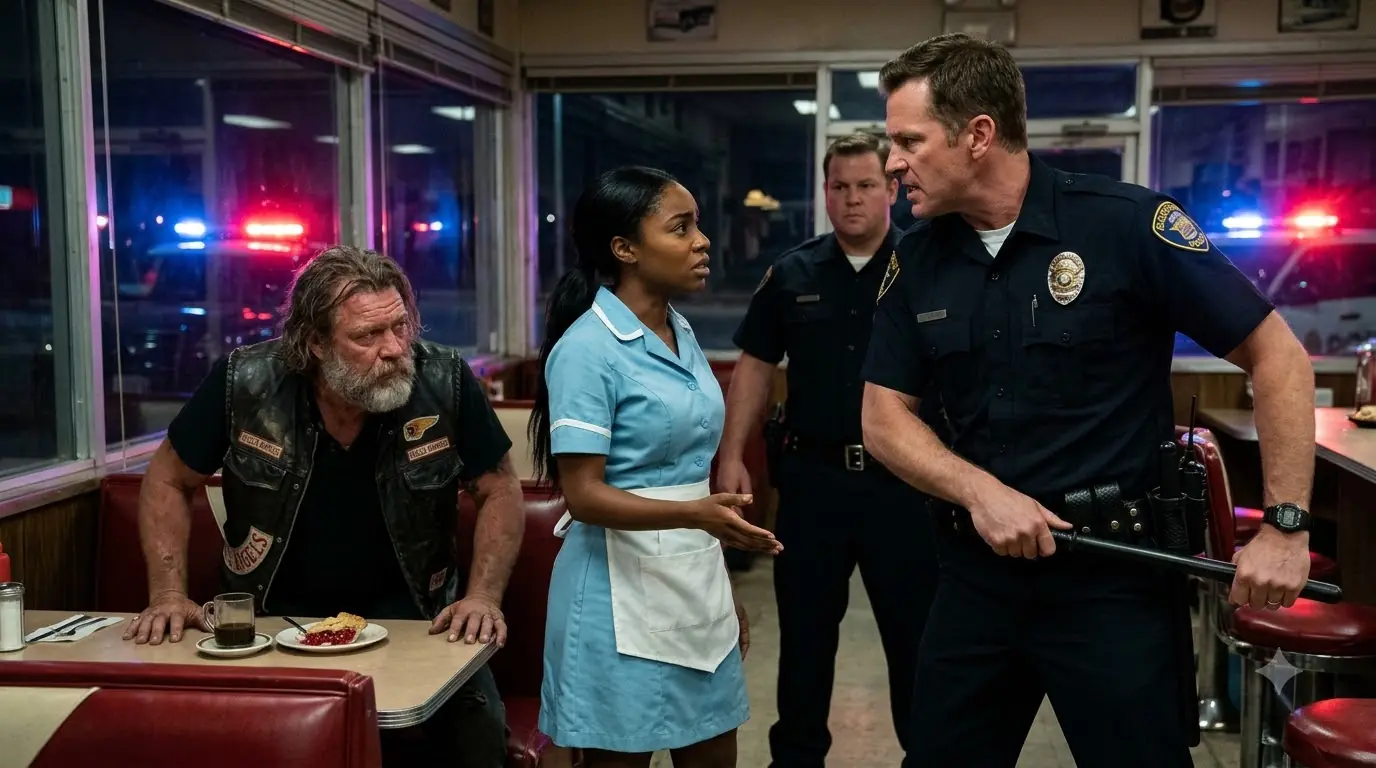
On ordinary nights, Mabel's looked like a place the desert had forgotten to finish swallowing. The sign had two letters that stopped working whenever the wind came out of the west, and the yellow vinyl booths were patched along their seams with tape the owner insisted was temporary. Trucks came off Interstate 40 to idle in the gravel lot, their engines ticking as they cooled. The coffee tasted better than the building looked, and people who had learned to keep driving through disappointment sometimes stopped for a quiet meal because Nia remembered how they liked their eggs.
She was twenty-eight, a Black woman raised in San Bernardino by a mother who considered promises serious business. Her mother had worked in a hospital kitchen and taken extra shifts whenever bills came due. After a stroke took her life three years earlier, Nia had inherited a box of recipes, an aging Honda Civic, and responsibility for a brother eight years younger who was still finishing high school. Their father had left when Jordan was a baby, so the two of them had grown into the habit of planning around the person who was actually there. Nia did not call what she did sacrifice. She called it Tuesday.
Jordan Brooks was now a junior studying mechanical engineering at a state university extension program. The scholarship covered tuition but not rent, books, the laptop he needed for design software, or the occasional emergency that seemed to locate them every month. He worked part time in a campus fabrication lab, drove a twelve-year-old sedan Nia had helped him buy, and sent her photographs of every project as though she were his professor. She loved those photographs enough to look at them during the slow stretches of the graveyard shift. She also knew exactly how many extra cups of coffee she needed to sell to keep his housing deposit from becoming another problem.
Mabel Rivera, who owned the diner, pretended she had no favorites and then saved the better aprons for Nia. Mabel had bought the place with her late husband in the late eighties and refused to sell it to developers who offered more money than she had ever seen in one place. Her right knee hurt before rain, and her daughter wanted her to retire. She insisted that a diner could still be useful if there was somebody behind the counter who noticed when a stranger needed water before being asked. Nia agreed, though lately she had begun wondering whether Mabel's would survive another winter.