The first person to notice the old man was the youngest student in the gym.
Fourteen-year-old Caleb Morris had been sitting near the equipment wall, wrapping his knuckles before the evening class, when he saw the stranger lower himself carefully into a chair beside the entrance.
The man appeared to be in his early sixties.
He wore plain gray slacks, a white button-down shirt, and a brown jacket that had been repaired at one elbow. His silver hair was neatly combed, and his hands rested loosely on the wooden cane positioned between his knees.
He did not look dangerous.
He looked tired.
That was probably why no one paid much attention to him at first.
Iron Summit Martial Arts occupied the second floor of a converted warehouse outside Denver, Colorado. The gym had polished floors, expensive equipment, and a wall covered with photographs of tournament victories.
At the center of that wall hung a large portrait of Marcus Kane.
Marcus was thirty-one years old, six feet three inches tall, and built like a professional fighter. He had won three national karate championships and had never lost a match inside Iron Summit.
His black belt had five narrow gold stripes embroidered near one end.
The students treated him like royalty.
Marcus had begun treating himself the same way.
He stood in the middle of the mat that evening demonstrating a spinning hook kick while nearly twenty students watched.
His heel cut through the air and stopped inches from his assistant’s face.
The class erupted in applause.
Marcus smiled.
“Control,” he said, lowering his foot. “That’s the difference between a trained fighter and someone who merely knows how to throw a punch.”
The old man watched without reacting.
Marcus noticed.
He had grown accustomed to admiration. When someone failed to show it, he became curious.
“Can I help you, sir?” he called.
The old man raised his head.
“I’m waiting for my grandson.”
His voice was quiet but clear.
Several students glanced toward Caleb.
The boy looked embarrassed.
“That’s my grandfather,” he said.
Marcus folded his arms.
“You didn’t tell us you were bringing an audience.”
“I didn’t know he was coming.”
The old man smiled faintly at Caleb.
“Your mother asked me to pick you up.”
Class should have continued.
Instead, one of the senior black belts, Dylan Price, whispered something to the student beside him.
Both men laughed.
Marcus heard them.
“What’s funny?”
Dylan nodded toward the old man’s cane.
“Maybe Caleb’s grandfather wants to learn a few moves.”
More laughter traveled across the mat.
Caleb’s face reddened.
“Leave him alone.”
Dylan lifted both hands.
“I’m only being friendly.”
He turned toward the old man.
“What do you think, sir? Want to show us what they taught back in the old days?”
The students laughed again.
The old man remained seated.
“No, thank you.”
Marcus should have stopped it there.
A good instructor would have.
But Marcus enjoyed the attention too much.
He walked toward the edge of the mat.
“Come on,” he said. “It might be educational.”
“For whom?” the old man asked.
A few students stopped smiling.
Marcus gave a short laugh.
“For everyone.”
The old man looked toward Caleb.
The boy shook his head slightly.
“Grandpa, you don’t have to.”
Marcus stepped closer.
“We’ll keep it light. One simple exchange.”
“I haven’t come prepared to train.”
“You don’t need a uniform.”
Dylan leaned against the wall.
“Unless the jacket is hiding a black belt.”
The laughter returned.
The old man’s eyes moved across the room.
He saw the expensive pads.
The polished trophies.
The young men standing with the careless confidence of people who had never been made to question themselves.
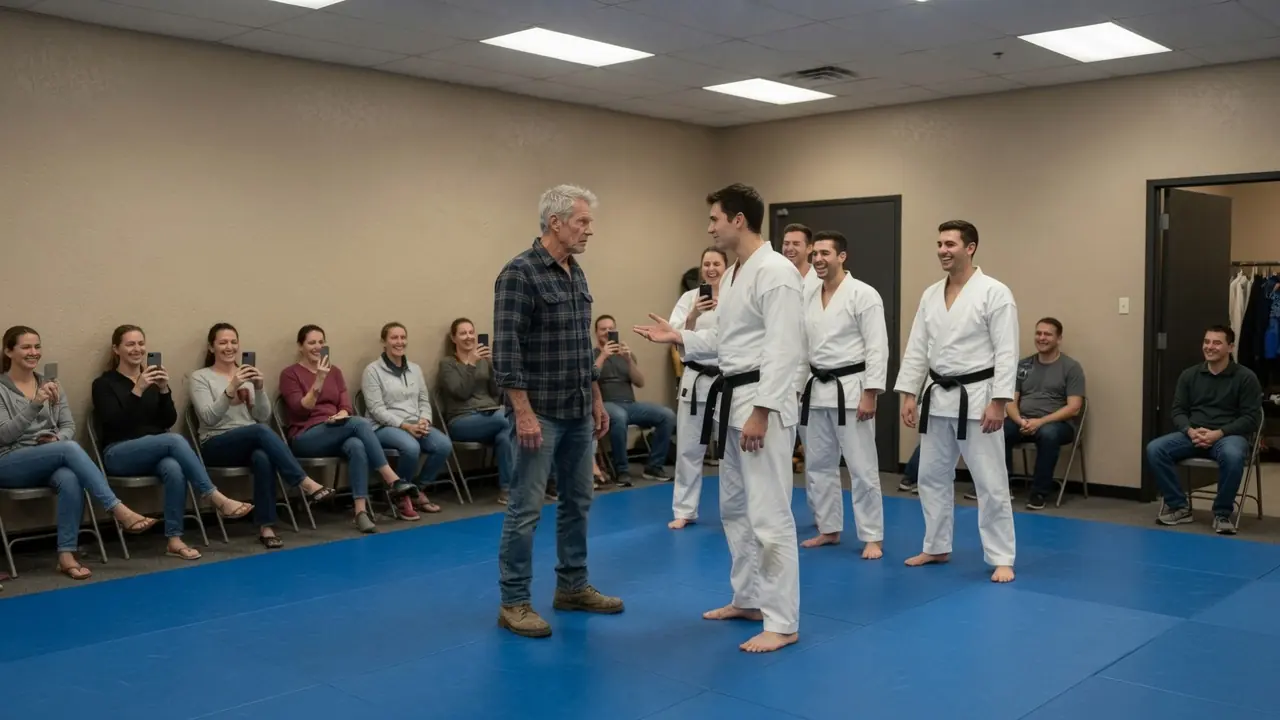
Then he looked at Marcus.
“I don’t believe this would be useful.”
Marcus’s smile tightened.
“You believe you might get hurt?”
“No.”
The answer came without hesitation.
Marcus’s expression changed.
The old man continued.
“I believe you might misunderstand what happens.”
The room grew quieter.
Dylan pushed himself away from the wall.
“What’s that supposed to mean?”
The old man placed one hand on his cane and rose.
Slowly.
There was no dramatic movement.
No sudden transformation.
But as he stood, something about him changed.
His shoulders aligned.
His chin lowered slightly.
The tiredness seemed to leave his posture without leaving his face.
Caleb had seen that change once before.
Two years earlier, a large dog had broken free from a yard and charged toward him. His grandfather had stepped between them.
He had not shouted.
He had not run.
He had simply become still.
The dog stopped less than six feet away.
Now the same stillness entered the gym.
Marcus felt it, although he did not understand it.
“What’s your name?” he asked.
“Thomas Hale.”
The name meant nothing to most of the students.
It meant something to one person.
At the far end of the gym, seventy-year-old janitor George Benton stopped pushing his mop.
He stared at the old man.
Then he looked toward the framed photographs on the wall.
“Thomas Hale?” he whispered.
No one heard him.
Marcus stepped onto the mat.
“Well, Mr. Hale, I’m Marcus Kane.”
“I know.”
“Then you know I’ll take it easy.”
Thomas removed his jacket.
He folded it carefully and handed it to Caleb.
Beneath it, he wore a plain white shirt with the sleeves buttoned at the wrists.
He removed his watch and placed it on the chair.
Then he picked up his cane.
Marcus smiled.
“You won’t need that.”
“It isn’t for fighting.”
Thomas walked to the edge of the mat and leaned the cane against the wall.
His steps were controlled.
He did not limp.
Dylan’s grin faded slightly.
Thomas stepped onto the mat in his socks.
Marcus pointed toward the center.
“Basic rules. No strikes to the eyes, throat, or groin. Stop when I call it.”
Thomas looked at him.
“You should let someone else call it.”
A few students exchanged glances.
Marcus laughed.
“Fine. Dylan can referee.”
Dylan entered the mat.
“This should be quick.”
Thomas stood several feet from Marcus with his arms relaxed.
He did not raise his fists.
He did not take a conventional fighting stance.
His left foot rested slightly forward. His knees were loose. His breathing appeared almost too calm.
Marcus circled him once.
“You’ve trained before.”
“A long time ago.”
“What style?”
Thomas considered the question.
“Enough of them.”
Marcus’s smile became sharper.
“Ready?”
Thomas looked at Dylan.
“Is he?”
The room reacted with a mixture of laughter and disbelief.
Marcus’s jaw tightened.
Dylan lifted one hand.
“Begin.”
Marcus moved first.
He stepped forward with a fast jab intended to stop several inches from Thomas’s face.
It was not a serious attack.
It was designed to make the old man flinch.
Thomas did not.
He shifted his head less than an inch.
Marcus’s fist passed beside his cheek.
Before Marcus could withdraw it, Thomas touched his wrist with two fingers and turned his body slightly.
Marcus stumbled forward.
Only one step.
But the students noticed.
Marcus straightened.
“Lucky.”
Thomas said nothing.
Marcus attacked again.
This time, he threw a sharper combination.
Jab.
Cross.
Low kick.
Thomas moved as though he had seen the sequence before Marcus began it.
He redirected the jab.
Stepped outside the cross.
Lifted his leg just enough for the low kick to pass beneath him.
Then he placed one palm against Marcus’s shoulder.
A small push.
Marcus lost balance and dropped to one knee.
No one laughed.
Dylan stared.
Marcus stood immediately.
His face had reddened.
“You said you hadn’t trained in a long time.”
“I haven’t.”
“Then stop holding back.”
Caleb stepped forward.
“Mr. Kane, that’s enough.”
Marcus ignored him.
He removed his uniform jacket and threw it toward the edge of the mat.
Underneath, he wore a black compression shirt.
His muscles tightened across his shoulders.
“This time I’m coming properly.”
Thomas looked toward Dylan.
“Stop it now.”
Marcus heard him.
“You don’t give orders in my gym.”
“No.”
Thomas’s voice remained quiet.
“But I recognize when pride is about to become an injury.”
The statement landed harder than an insult.
Marcus charged.
He threw a right hook with real force.
Thomas stepped inside it.
His left forearm guided Marcus’s arm past his shoulder while his right hand controlled the elbow.
Thomas turned.
Marcus’s momentum lifted him from the floor.
For one impossible second, the champion’s body seemed to hang in the air.
Then Thomas lowered him onto the mat.
Not slammed.
Lowered.
Marcus landed flat on his back with Thomas’s knee beside his shoulder and one hand controlling his wrist.
The position was complete.
Marcus could not move without injuring himself.
The entire exchange had taken less than two seconds.
Silence filled the gym.
Thomas released him immediately and stepped away.
Marcus remained on the floor.
He stared upward, breathing hard.
He had not been hurt.
That made it worse.
The old man had controlled him so completely that he had been able to choose how gently he fell.
Thomas extended a hand.
Marcus did not take it.
He pushed himself upright.
“What was that?”
“A mistake you made twice.”
“What technique?”
“It doesn’t matter.”
“It matters to me.”
Thomas studied him.
“You attacked the person in front of you instead of the balance beneath him.”
Marcus stood.
“I wasn’t ready.”
“You said you were.”
“I slipped.”
“No.”
The single word carried no cruelty.
Only certainty.
Marcus’s students watched him.
That was what he could not tolerate.
Every victory, every demonstration, every story about his championships had reinforced the image of a man no one in the room could touch.
Now a sixty-two-year-old stranger in a white shirt had placed him on the floor without effort.
Marcus raised his fists again.
“Once more.”
Thomas shook his head.
“We are finished.”
“You’re afraid I’ll adjust.”
“No.”
Thomas walked toward the edge of the mat.
Marcus moved behind him.
Caleb saw it.
“Grandpa!”
Marcus reached for Thomas’s shoulder.
Thomas turned.
This time, there was no slow lesson.
He caught Marcus’s hand, stepped beside him, and folded the champion’s arm behind his back.
Marcus’s knees hit the mat.
Thomas held him there with almost no visible effort.
His voice lowered.
“Never attack someone whose back is turned.”
Pain crossed Marcus’s face.
“Let go.”
“You teach children.”
Thomas tightened the control by a fraction.
“You teach them that a belt means discipline.”
Marcus clenched his teeth.
“Let go.”
“Then behave like the man that belt says you are.”
Thomas released him.
Marcus remained kneeling.
No one moved.
George Benton dropped the mop handle.
The sound echoed through the room.
He walked slowly toward the mat.
His eyes remained fixed on Thomas.
“I knew it was you.”
Thomas turned.
George stopped several feet away.
“You’re Thomas Hale from Fort Carson.”
Marcus looked between them.
“You know him?”
George laughed softly in disbelief.
“Know him?”
He faced the students.
“Half the instructors in this state built their schools from what this man taught.”
Thomas lowered his eyes.
“That was a long time ago.”
George shook his head.
“No. History doesn’t stop being history because people forget it.”
Dylan stepped closer.
“What did he teach?”
George looked at Thomas, seeking permission.
Thomas did not give it.
George spoke anyway.
“In the late seventies, the Army sent Thomas to Japan and South Korea as part of a close-combat training exchange. He trained in judo, karate, hapkido, and military defensive tactics.”
Marcus frowned.
“There are thousands of soldiers who trained overseas.”
“Not like him.”
George pointed toward an old black-and-white photograph hanging near the far corner of the gym.
It showed a group of young martial artists standing outside a small dojo.
Most students had never looked closely at it.
A much younger Thomas stood in the back row.
Beside him was Master Kenji Watanabe, the Japanese instructor whose teaching system had influenced Iron Summit’s founder.
George continued.
“Thomas became one of the first Americans Watanabe allowed to teach his defensive principles.”
Dylan looked at the photograph.
“That’s him?”
Thomas had been younger, leaner, and darker-haired, but the eyes were the same.
George nodded.
“He competed for only three years. Twenty-six matches. Never lost.”
Marcus stared at Thomas.
“Why isn’t your name on the tournament records?”
“It was,” George said. “Before he asked for it to be removed.”
“Why would anyone do that?”
Thomas picked up his jacket.
“Because winning started making me someone I didn’t like.”
He buttoned one sleeve.
The students waited.
Thomas glanced at Caleb.
The boy held his watch.
For years, Caleb had known his grandfather as a retired carpenter who repaired old furniture in a small workshop behind his house.
He knew Thomas had served in the Army.
He knew there were photographs his grandfather never explained.
But he had never seen him fight.
“Why didn’t you tell us?” Caleb asked.
Thomas accepted the watch.
“You never asked.”
The answer sounded familiar.
George smiled faintly.
Marcus stood near the center of the mat.
His humiliation had begun changing into confusion.
“You walked away because you were too successful?”
Thomas put on his jacket.
“No.”
His fingers paused near the buttons.
“I walked away because I injured someone.”
No one spoke.
Thomas looked toward the old photograph.
“His name was Peter Walsh. He was twenty-three, talented, proud, and determined to prove he belonged in the ring with me.”
Marcus’s expression shifted.
“We were competing in a regional final. I knew his right knee was damaged. I had seen it buckle during the previous match.”
Thomas’s voice became quieter.
“I attacked it anyway.”
“Wasn’t that legal?” Dylan asked.
“Yes.”
The answer came immediately.
“That was the problem.”
Thomas looked around the gym.
“I won the match. Peter never competed again.”
George lowered his head.
“He needed three surgeries.”
Thomas continued.
“People congratulated me. My photograph appeared in newspapers. Everyone said I had fought intelligently.”
His eyes moved toward Marcus.
“But I knew the truth. I had chosen a trophy over another man’s future.”
The room remained silent.
“I stopped competing. Later, I taught soldiers and police officers how to survive violence. I taught children only when their parents understood that discipline mattered more than victory.”
He looked at the photographs covering the walls.
“Then my wife became ill. I returned home. I worked as a carpenter. Life moved on.”
Caleb stared at him.
“You never stopped training.”
Thomas smiled.
“Carrying lumber keeps the legs strong.”
A few students laughed softly.
The tension eased.
Marcus did not laugh.
He walked toward Thomas.
The students watched carefully.
Marcus stopped several feet away.
“Why did you agree to fight me?”
Thomas looked at Caleb.
“Because he was watching.”
Marcus followed his gaze.
The boy stood holding his grandfather’s cane.
“What does that have to do with me?”
“A child learns more from what adults permit than from what they say.”
Thomas faced him again.
“You allowed your students to mock an old man because you believed strength gave you permission.”
Marcus’s eyes lowered.
“I wanted Caleb to see that silence is not weakness.”
The words seemed to settle over the gym.
Dylan removed his black belt.
He looked at it for several seconds.
“We were joking.”
Thomas nodded.
“Most cruelty begins as something the cruel person calls a joke.”
Dylan’s face changed.
“I’m sorry.”
Thomas accepted the apology with a slight movement of his head.
Dylan looked toward Caleb.
“To both of you.”
Caleb did not answer immediately.
Then he nodded.
Marcus remained silent.
Thomas picked up his cane.
He did not need it to walk across the mat.
Caleb knew that now.
“Come on,” Thomas said. “Your mother will be waiting.”
They reached the door.
“Mr. Hale.”
Marcus’s voice stopped them.
Thomas turned.
Marcus had removed his black belt.
He held it in both hands.
The five gold stripes caught the overhead lights.
For the first time since Thomas entered, Marcus did not look like a champion.
He looked like a man uncertain of who he was without people applauding him.
“I owe you an apology.”
Thomas waited.
“I tried to embarrass you.”
“Yes.”
“I attacked you after you ended the match.”
“Yes.”
Marcus swallowed.
“I don’t deserve this belt tonight.”
Thomas looked at the belt.
“Then do not wear it tonight.”
Marcus appeared surprised.
“You’re not going to tell me I deserve another chance?”
“You do.”
Thomas stepped closer.
“But chances are not the same as excuses.”
Marcus looked down.
“How do I earn it back?”
“Teach tomorrow’s class without wearing it.”
Marcus frowned.
“What would that prove?”
“That you are willing to enter your own gym without the symbol that tells everyone how important you are.”
Thomas nodded toward the students.
“See whether they still listen.”
Then he left.
The following afternoon, Marcus arrived at Iron Summit wearing a plain white uniform.
No black belt.
No gold stripes.
A simple white belt circled his waist.
The students gathered quietly.
Dylan wore a brown belt instead of his black one.
Two other senior students had removed theirs as well.
Marcus stood at the front.
“Yesterday, I failed as an instructor.”
No one had ever heard him speak that way.
“I confused status with character. I allowed disrespect because it entertained me. Then I responded to embarrassment with anger.”
He looked toward Caleb.
“I am sorry.”
Caleb sat at the edge of the mat.
Thomas had brought him again.
This time, the old man stood beside the door rather than sitting.
Marcus bowed deeply.
Not the quick ceremonial bow he used before demonstrations.
A genuine one.
Caleb returned it.
Marcus faced the class.
“For the next thirty days, no one in this gym above the rank of green belt will wear a belt.”
The students looked surprised.
“We will train without visible rank. Partners will rotate. Senior students will clean the mats. Instructors will perform the basic drills with beginners.”
Dylan raised a hand.
“What are we studying?”
Marcus looked toward Thomas.
“Balance.”
Thomas did not smile.
But he removed his jacket.
For the next hour, he taught.
He began with standing.
Nothing else.
“Most people believe fighting begins with the hands,” he said. “It begins with the feet. Before that, it begins with attention.”
He walked between the students, adjusting a knee here, a shoulder there.
He showed them how tension made movement slower.
How pride made distance difficult to judge.
How the desire to appear powerful often created the openings an opponent needed.
Marcus trained beside the newest student.
He fell repeatedly.
Each time, he stood without complaint.
At the end of class, Thomas gathered everyone near the center of the mat.
“A martial art is not measured by what you can do to another person,” he said.
“It is measured by what you can prevent yourself from doing when anger offers you permission.”
No one wrote the sentence down.
They remembered it anyway.
Thomas returned the next week.
Then the week after that.
He never accepted a salary.
Arthur Kane, Marcus’s father and the founder of Iron Summit, offered him an official teaching position.
Thomas refused the title.
“Titles become heavy.”
He agreed to teach one evening each week.
Students began calling the session Hale’s Fundamentals.
Thomas disliked the name.
It remained.
The culture of the gym changed slowly.
Tournament photographs stayed on the walls, but another frame was added beside them.
Inside was a copy of the old black-and-white photograph of Thomas with Master Watanabe.
Beneath it were the words:
STRENGTH WITHOUT HUMILITY IS ONLY ANOTHER FORM OF WEAKNESS.
Marcus eventually wore his black belt again.
But he removed the gold stripes.
When students asked why, he said they represented victories that mattered less to him now.
He still competed.
He still won.
But he stopped humiliating weaker opponents.
He withdrew from one tournament after learning that his scheduled opponent had concealed a shoulder injury.
The old Marcus would have seen an advantage.
The new Marcus saw Peter Walsh.
Months later, Marcus located Peter through George Benton.
Peter was sixty-seven and lived in Oregon.
Marcus traveled there with Thomas.
Peter answered the door using a cane.
For several seconds, he and Thomas stared at one another.
“I wondered whether you’d ever come,” Peter said.
“I should have come forty years ago.”
“Yes.”
Thomas did not defend himself.
He did not explain the tournament or claim youth as an excuse.
“I hurt you because winning mattered more to me than you did.”
Peter’s expression tightened.
“I hated you for a long time.”
“You had the right.”
“And then I got tired.”
Thomas lowered his head.
“I’m sorry.”
Peter looked at Marcus.
“Who’s this?”
“Someone who nearly made the same mistake.”
Marcus stepped forward.
“I’m trying not to.”
Peter studied him.
Then he opened the door wider.
“Coffee?”
The three men spoke for nearly four hours.
Peter had become a school counselor after leaving competition.
He had spent his career helping troubled teenagers find purpose through sports.
He showed them photographs.
Not of medals.
Of students who had graduated, married, become parents, and returned years later to thank him.
“My knee ended one life,” Peter told Thomas. “It forced me to build another.”
“That does not excuse what I did.”
“No.”
Peter smiled faintly.
“But it means neither of us has to remain inside that moment forever.”
When Thomas returned to Iron Summit, something inside him seemed lighter.
Caleb noticed first.
His grandfather laughed more during class.
He allowed students to ask about Japan.
He demonstrated old training exercises and told stories about Master Watanabe, who believed the best student should always be assigned to help the weakest.
Caleb began taking training seriously.
Not because he wanted trophies.
Because he wanted to understand the stillness he had seen in his grandfather’s eyes.
Two years later, Caleb earned his black belt.
The promotion ceremony was small.
Marcus tied the belt around his waist.
Then Caleb removed it.
The room looked confused.
He walked toward Thomas.
“I don’t think I’m ready to wear it outside the gym.”
Thomas raised an eyebrow.
“Why?”
“Because I still like when people see it.”
Several students smiled.
Thomas accepted the belt.
“That is an honest reason.”
“When will I be ready?”
“When you stop asking.”
Caleb laughed.
Thomas placed the belt back into his hands.
“You earned it. Now learn not to need it.”
Marcus watched from the side.
After the ceremony, he approached Thomas.
“Do you remember the first night?”
“Yes.”
“I’ve replayed it a thousand times.”
“That seems excessive.”
Marcus smiled.
“I thought you destroyed my reputation.”
“No.”
Thomas looked around the gym.
“I interrupted it.”
Marcus nodded.
“You saved this place.”
Thomas shook his head.
“You changed it.”
Outside, snow had begun falling over the parking lot.
Thomas put on his old brown jacket.
The repaired elbow had torn again.
Caleb noticed.
“I can buy you a new one.”
“This one works.”
“You say that about everything.”
“Most things work longer than people think.”
They walked toward the car together.
Behind them, the students began cleaning the mats without being asked.
No one laughed at the old man anymore.
But that was not the lesson Thomas wanted them to remember.
Respecting someone after discovering he was powerful was easy.
The real test was respecting the person before knowing what he could do.
The stranger in plain clothes.
The quiet worker.
The tired parent.
The elderly man sitting alone at the edge of the mat.
Marcus Kane had challenged Thomas Hale because he believed an old man would make an entertaining target.
Seconds later, he discovered that history had walked into his gym wearing worn slacks and carrying a wooden cane.
But the throw that placed Marcus on the floor was not what changed Iron Summit.
It was what Thomas did after.
He offered a hand.
He told the truth.
And he gave the man who mocked him a chance to stand again without pretending he had never fallen.