“Get your dirty hands off my table.”
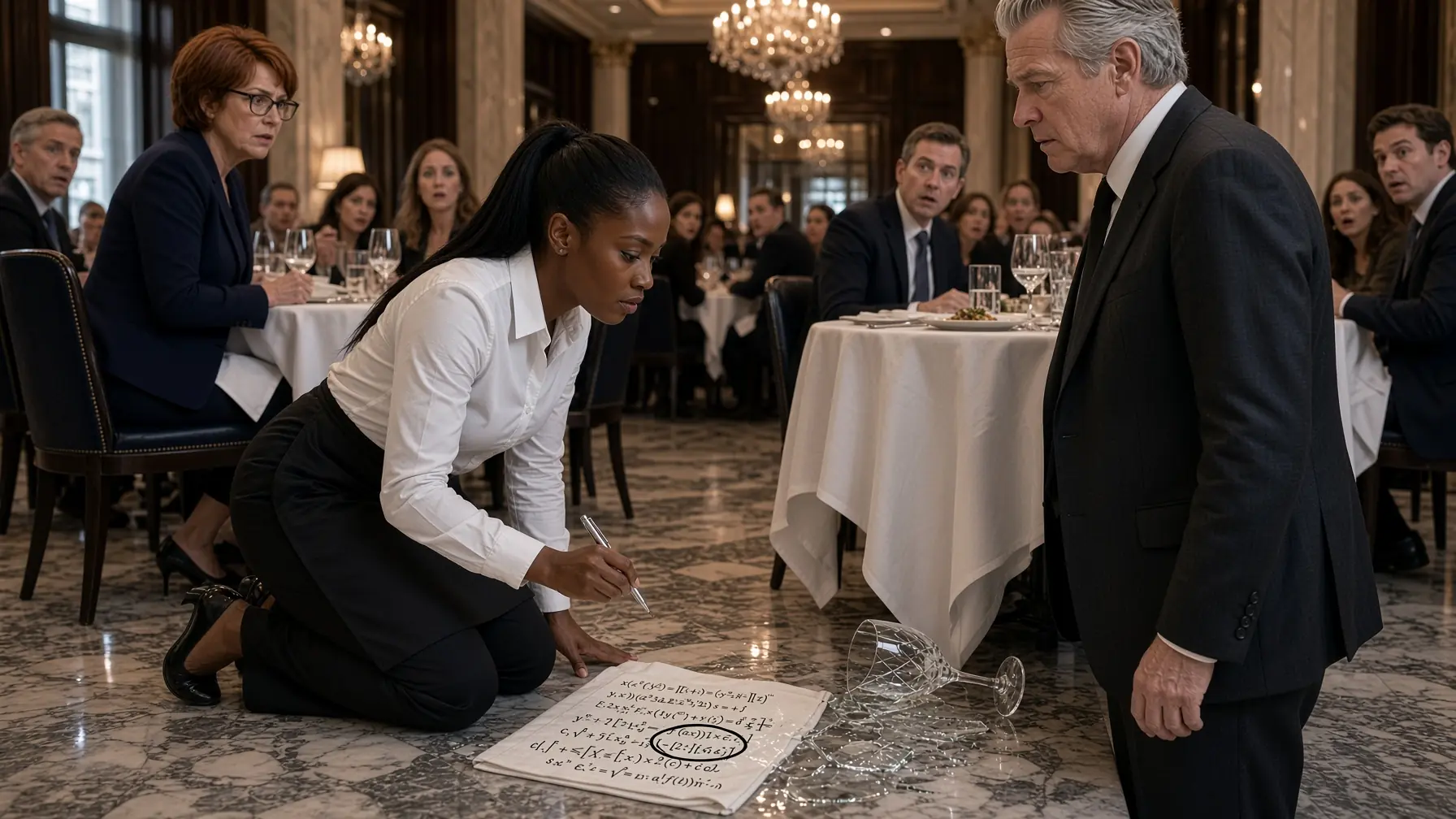
Richard Hartwell said it loudly enough for the surrounding tables to hear.
Kesha Williams froze with the water pitcher still in her hand.
Le Bernardin’s private dining room had been nearly silent a second earlier—crystal glasses, muted conversations, the soft clink of silverware.
Now half the room was watching her.
Richard Hartwell, billionaire founder of Hartwell Systems, shoved her wrist away.
Water splashed across three linen napkins covered in handwritten equations.
His chair scraped backward.
“Look what you did.”
“I’m sorry, sir. I was refilling your—”
“My research team has been working on this proof for months.”
Kesha immediately reached for a clean cloth.
Hartwell snatched the wet napkin away.
“No.”
He held it up.
Ink had begun bleeding across the fabric.
Several people at his table laughed.
Hartwell looked Kesha up and down.
Black slacks.
White shirt.
Server’s vest.
Nothing about the twenty-nine-year-old woman standing beside his table suggested she belonged in his world.
That was precisely why he enjoyed the moment.
“You know what?” he said.
Kesha remained silent.
Hartwell flattened the napkin on the table.
“Solve it.”
The man beside him chuckled.
Kesha looked at the equations.
Hartwell leaned back.
“Go ahead.”
Another laugh.
“You ruin the proof, you fix it.”
Kesha’s eyes moved across the lines.
Infinite sequences.
Boundary conditions.
An iterative transformation.
She recognized the structure immediately.
Hartwell interpreted her silence as confusion.
“Too complicated?”
Kesha looked closer.
There.
Seventh line.
A sign change.
Then another inconsistency four steps later.
Her pulse changed.
Hartwell smiled.
“I thought so.”
He swept the wet napkins toward the edge of the table.
A pepper shaker and two wine glasses fell with them.
Glass shattered against the marble floor.
“Clean it up.”
Kesha stared at him.
Hartwell lowered his voice.
“That part should be within your skill set.”
The laughter this time was smaller.
More uncomfortable.
Kesha crouched.
She began gathering the broken glass.
But her mind was no longer in the restaurant.
It was still on equation seven.
Three years earlier, Kesha Williams had spent most nights inside MIT’s mathematics building.
She had been one semester from completing her doctorate.
Topology and dynamical systems were her specialty.
Her adviser, Professor Miriam Feldman, once told her:
“You see structure before other people realize there is structure.”
Kesha had laughed.
“That sounds like a polite way of saying I make strange connections.”
“It is.”
Her research had been good.
Very good.
Then her father fell from scaffolding at a construction site in Boston.
Multiple surgeries followed.
Her mother’s diabetes became harder to manage.
Her younger brother, Andre, needed therapy and support their insurance barely covered.
Kesha tried to continue.
She took teaching shifts.
Tutored undergraduates.
Stopped sleeping.
Borrowed money.
Then borrowed more.
Eventually the numbers became impossible in a way no theorem could solve.
So Kesha left.
Not expelled.
Not academically dismissed.
She simply chose her family.
The plan had been to return within a year.
A year became two.
Two became three.
Her loans came due.
Her father still could not work full-time.
The restaurant paid better than tutoring.
And mathematics slowly became something Kesha practiced alone after midnight, filling cheap notebooks with ideas nobody would ever read.
Until Richard Hartwell spilled his arrogance across a wet napkin.
Kesha’s shift ended at 7:17 p.m.
Her manager, Jeff Kaplan, caught her removing her apron.
“Table twelve complained about you.”
“Of course they did.”
“Williams.”
Kesha stopped.
Jeff lowered his voice.
“Those people spend more in here in one night than some customers spend in a year.”
“He pushed my hand.”
“I’m not saying he was right.”
“He knocked glasses onto the floor.”
“I know.”
“And somehow I’m the problem?”
Jeff rubbed his forehead.
“I need this night to end without another incident.”
Kesha looked at him.
“Fine.”
She folded the apron.
Then reached into her pocket.
Inside was one of Hartwell’s discarded napkins.
She had almost thrown it away.
Almost.
Instead, when she finished clearing the table, she had folded it and slipped it into her pocket.
Jeff stared.
“What’s that?”
“Garbage.”
She walked out.
Twelve blocks north, Avery Fisher Hall at Lincoln Center was filling for the annual Hartwell Mathematical Challenge.
Richard Hartwell had created the event fifteen years earlier.
The idea was simple.
His research division presented one unresolved mathematical problem each year.
Selected mathematicians were given a fixed amount of time to attack it publicly.
A verified solution earned a one-million-dollar prize.
Nobody had won the final challenge in seven years.
Hartwell loved that statistic.
It made excellent television.
By the time Kesha reached Lincoln Center, Hartwell was already onstage.
She could see him on a giant screen in the lobby.
Same tailored suit.
Same confident smile.
Only now the audience treated arrogance as charisma.
Dr. Sarah Carter, chair of the competition committee, stood beside him.
Three invited mathematicians waited at separate workstations.
Professor Marcus Webb from Harvard.
Dr. Elena Kowalski from Oxford.
And Dr. James Liu from MIT.
Kesha stopped when she saw James.
They had entered graduate school the same year.
He had finished.
She had disappeared.
Hartwell raised a hand.
The auditorium quieted.
“Tonight’s final problem comes from work my own research division has pursued for nearly three years.”
The screen behind him filled with equations.
Kesha stopped breathing.
It was the napkin.
Not exactly.
The formal version.
The same proof.
Hartwell continued.
“We call it the Hartwell Convergence Problem.”
Kesha almost laughed.
Of course he did.
“The challenge is not simply to calculate a limit. Contestants must prove whether this class of iterative systems converges under the proposed transformation.”
Kesha pulled the napkin from her pocket.
Equation seven.
Same mistake.
Onstage, James Liu had already begun writing.
Elena Kowalski stared at the first page.
Marcus Webb entered values into a laptop.
Kesha looked from the napkin to the screen.
Then she saw something worse.
Hartwell’s sign error was not a typo.
It appeared inside the formal problem itself.
The entire challenge had been constructed around a false assumption.
Kesha started walking toward the auditorium entrance.
A security guard stepped in front of her.
“Ticket?”
“I need to speak with Dr. Carter.”
“Ticket?”
“I don't have one.”
“Then the public viewing area is behind you.”
Kesha held up the napkin.
“There’s an error in the challenge.”
The guard looked at her uniform.
She had forgotten she was still wearing her restaurant shirt.
“Ma’am.”
“I’m serious.”
“So are a hundred other people out there.”
“I can identify the exact line.”
He gestured backward.
“Public viewing area.”
Kesha didn't move.
“I need thirty seconds with someone from the mathematics committee.”
The guard reached for his radio.
“Ma’am, don't make this difficult.”
A voice behind him interrupted.
“Kesha?”
She turned.
James Liu stood twenty feet away.
He had apparently stepped offstage during the setup interval.
For several seconds he simply stared.
“Kesha Williams?”
The guard looked between them.
James walked closer.
“My God.”
Kesha smiled awkwardly.
“Hi, James.”
“What are you doing here?”
She held up the napkin.
“Trying to stop your evening from getting embarrassing.”
Ten minutes later, Kesha stood in a side room with James and Dr. Sarah Carter.
Sarah examined the napkin.
“You wrote these notes?”
“Yes.”
“When?”
“About an hour ago.”
Sarah pointed at the correction.
“You believe the iteration changes sign here?”
“It does.”
“The published formulation assumes that transition.”