Victoria Sinclair was used to rooms changing the moment she entered them. In boardrooms, men straightened their backs before pretending they were not nervous. In hotel lobbies, managers smiled too quickly and whispered into headsets. In restaurants, servers recognized her face before she removed her sunglasses, and strangers tried to turn chance encounters into introductions, favors, or photographs.
That afternoon, all she wanted was a quiet cup of coffee. She had spent six hours in meetings at Sinclair Global Holdings, listening to projections, legal updates, and a tense report about one of her charitable foundations. The Children’s Horizon Medical Fund had grown quickly, helping families pay for surgeries, medication, travel, and emergency treatment. Growth should have made her proud, but lately it only made her tired because every number on the page represented a child whose parents had run out of options.
She entered the downtown café wearing a plain beige coat, dark sunglasses, and her hair pulled back under a simple clip. The café was crowded, filled with office workers, students, tourists, and families escaping the late afternoon rush. Every table was occupied except one small wooden table near the window, where a tired-looking man sat alone with paperwork spread beside his coffee. Across from him, one chair remained empty.
Victoria paused near the entrance, scanning the room. She could have left, but the day had drained her too much to keep walking. She saw the man glance up briefly, then return to his papers without recognition, expectation, or curiosity. That alone made him different from almost everyone she had met that week.
She walked toward him slowly, holding her coffee cup with both hands. “Excuse me,” she said, her voice quieter than usual. The man looked up fully this time, his tired eyes gentle but cautious. Victoria gestured toward the empty chair. “Can I sit with you?”
The man immediately gathered his papers into a neat stack and moved them to one side. “Of course,” he said. “Sit with me. No one should feel alone after a hard day.” The words were simple, but they landed strangely in Victoria’s chest. They had not been polished, rehearsed, or spoken to impress her.
She sat down, surprised by the warmth of the invitation. “Thank you,” she said, removing her sunglasses. A young woman two tables away recognized her and whispered to her friend, but the man across from Victoria did not react. Either he did not know who she was, or he had decided it did not matter.
His name, she learned after a few minutes, was Daniel Foster. He was thirty-eight years old, worked as an operations coordinator for a shipping company, and had the exhausted politeness of someone who carried more responsibilities than he admitted. He wore a modest blue button-up shirt with the sleeves rolled once, and his hands were rough in a way that suggested weekends spent fixing things rather than resting. He spoke gently, never rushing to fill silence.
Victoria introduced herself only as Victoria. She did not mention Sinclair Global, the private jet waiting at an airport hangar, the foundation board meeting, or the article that had called her the youngest self-made billionaire in the country. Daniel did not ask what she did for a living. That omission felt like a gift.
“You look like you’re working through something important,” Victoria said, nodding toward the papers. Daniel glanced at them and smiled faintly. “Bills, school forms, work schedules. Important in the way ordinary life is important.” His tone held no bitterness. “My daughter has a science project due Friday, and somehow I’ve become assistant engineer, financial planner, cook, driver, and emotional support staff.”
Victoria laughed softly despite herself. “That sounds like more responsibility than running a company.” Daniel’s expression warmed. “Probably harder. Companies don’t look at you with sad eyes when you forget poster board.” His smile faded slightly, but not with pain exactly, more with the weight of memory. “She’s a good kid, though. Emma makes the hard days worth it.”
Victoria noticed the way his voice changed when he said his daughter’s name. There was pride in it, and tenderness, and a sadness he had learned to keep folded neatly behind both. She asked if he was married, then immediately regretted it when his eyes lowered. Daniel touched the edge of his coffee cup with one thumb. “My wife passed away when Emma was two.”
“I’m sorry,” Victoria said, and this time the words felt too small. Daniel nodded. “Thank you. It’s been years now, but some parts of grief don’t leave. They just learn where to sit.” He looked out the window for a moment, then back at her with a kind smile. “Sorry. That’s a heavy answer for a stranger sharing a table.”
“No,” Victoria said quietly. “It’s an honest one.” For a moment, neither of them spoke. Around them, the café hummed with small sounds: cups touching saucers, espresso steaming, chairs scraping, people laughing over things that did not matter as much as they sounded. Victoria felt oddly safe inside that ordinary noise.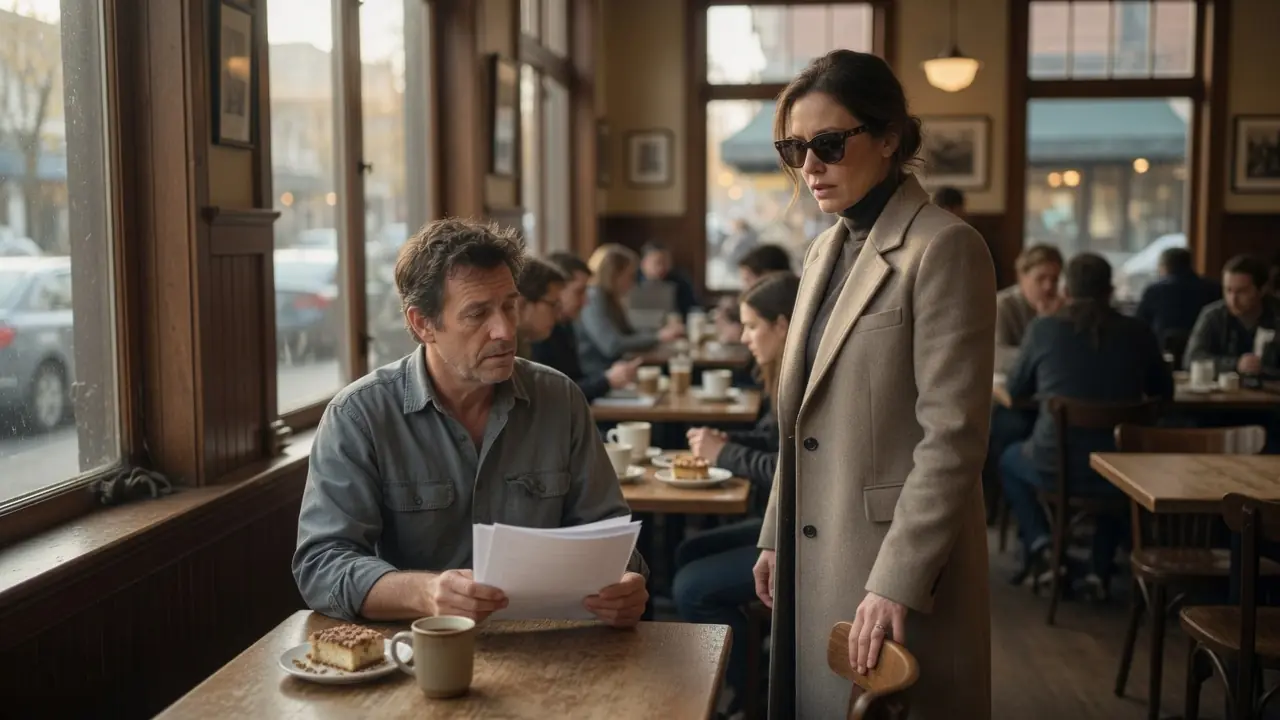
After a while, Daniel pushed a small plate toward her. A slice of chocolate cake sat in the center, half untouched. “You should have some,” he said. Victoria blinked. “Oh, no, that’s yours.” Daniel smiled. “I already promised someone that cake tastes better when it’s shared.”
Victoria hesitated, then took the fork he offered. She could not remember the last time someone shared something with her without knowing what they might get in return. Most gifts offered to her came wrapped in strategy. This was different; this was just cake, coffee, and kindness from a man with tired eyes.
They talked for nearly half an hour. Daniel asked nothing personal enough to feel invasive and nothing shallow enough to feel fake. Victoria told him she worked with companies and charities, leaving out the scale of both. Daniel told her about Emma’s love of astronomy, his late wife’s kindness, and the rhythm of being a single parent when money was never quite enough but love had to be.
When Victoria stood to leave, she felt reluctant in a way that surprised her. “Thank you for the seat,” she said. Daniel gathered his papers and nodded. “Thank you for making the table less quiet.” She looked at him, touched by the unguarded sincerity. “Maybe we’ll meet again.”
Daniel gave a small shrug. “The city is big, but strange things happen.” Then he smiled. “Take care, Victoria.” He said her name like it belonged to a person, not a headline.
For the next two weeks, Victoria thought about that café encounter more than she expected. She thought about Daniel’s calm voice, his worn hands, the way he made room for a stranger without asking who she was. The world around her kept demanding decisions, signatures, statements, and appearances, but that one quiet moment remained stubbornly alive in her memory. It bothered her in the best possible way.
Then the charity gala came. The Children’s Horizon Medical Fund held its annual donor reception inside a bright event hall overlooking the city. Victoria attended because she chaired the foundation’s expansion board, though she disliked the attention that came with it. Wealthy guests moved through the room with champagne glasses, posing for photographs beside banners that described generosity in expensive fonts.
Victoria smiled through speeches and shook hands with donors who gave large checks while making sure photographers captured the moment. She did not judge them harshly; large donations saved lives, even when pride came attached. But she had always wondered about the quieter donors, the ones whose names appeared in small print, the ones who gave without gala tables or social media posts. They were easy to overlook because they did not ask to be seen.
Near the registration table, she saw a name on a printed donor list that made her stop. Daniel Foster. The letters were ordinary, but her pulse changed. She leaned closer, scanning the category beside the name: recurring donor. Monthly contributor.
Victoria called over Clara Whitman, the foundation’s donor relations director. “Clara,” she said, keeping her voice low, “do we have records for Daniel Foster?” Clara followed her gaze. “Yes, I believe so. He’s one of our long-term small donors.” Victoria looked up. “How long-term?”
Clara checked the tablet in her hand. Her eyebrows lifted. “Nearly eight years. Monthly donations, never missed.” Victoria stood very still. “How much?” Clara scrolled. “It varies. Twenty dollars, sometimes fifty, once a hundred around Christmas. Nothing large individually, but remarkably consistent.”
Victoria stared at the screen. Twenty dollars. Fifty dollars. Eight years. She thought of Daniel’s paperwork in the café, his careful humor about bills, his daughter’s school project, his ordinary life stacked with responsibility. He had been giving to her foundation while carrying grief, rent, child care, groceries, and the endless math of single parenthood.
“Has he ever attended an event?” Victoria asked. Clara shook her head. “No. Never accepted invitations. Never asked for recognition. Honestly, donors like him rarely do.” Victoria’s throat tightened. “Why did he start giving?”
Clara looked through the notes. “Initial donor form says he chose the fund because hospital staff once cared for his wife during a medical crisis.” She paused. “He wrote, ‘They couldn’t save her, but they tried like she mattered.’” Victoria had to look away.
That night, while wealthy donors applauded each other under crystal lights, Victoria kept thinking about the man who had shared cake in a café. Daniel had never mentioned donating. He had not hinted, not fished for gratitude, not used the charity as a way to impress her. He had sat across from the billionaire who funded the foundation and treated her like a tired stranger who needed a chair.
The next morning, Victoria requested a full donor history. The folder arrived by noon. It contained every donation Daniel Foster had made: the dates, the amounts, the notes, and the occasional holiday message he had written in the comments section. “For a family waiting outside surgery.” “For medication.” “For someone’s little girl.” “In memory of Rebecca Foster.”
Victoria read the name of his late wife and pressed one hand over the page. She had known wealth all her adult life, but this folder made her feel poor in a way she had never considered. Her own giving was measured in millions, but her sacrifice was often measured in time and decisions, not in whether she could afford a grocery bill after helping someone else. Daniel gave from the edge of his own life.
She invited Daniel and Emma to tour the foundation’s children’s center the following week. Daniel sounded surprised on the phone. “I’m not sure why you’d want us there,” he said. Victoria smiled, though he could not see it. “Because I think you should see what your kindness has touched.”
When Daniel arrived, he wore the same modest shirt and carried himself with the same quiet caution. Emma, ten years old, stood beside him with bright curious eyes and a backpack covered in star patches. Victoria greeted them at the entrance, and Emma immediately looked up at the colorful mural painted across the lobby wall. “Dad,” she whispered, “there are planets on the ceiling.”
Daniel smiled. “I see that.” Victoria watched them, feeling the tenderness between father and daughter fill the hallway like light. She led them through therapy rooms, family rest areas, reading corners, and the small emergency support office where parents could request help for medication, transportation, or lodging. Daniel listened closely to every explanation.
At one point, a mother in the waiting area spoke with them. Her son had needed a surgery her insurance would not cover in time. The foundation had paid the remaining balance and helped her stay near the hospital during recovery. Daniel’s face changed as he listened, his eyes lowering with quiet emotion.
“You all did that?” he asked Victoria. “The foundation did,” she said. “And the foundation exists because many people choose to give.” He nodded, but she could tell he still saw himself outside the meaning of that sentence. He believed his donations were too small to stand among the names on plaques and donor walls.
After the tour, Victoria led Daniel into a small conference room while Emma stayed with a staff member to finish a mural activity. Daniel looked around at the polished table, the folder waiting in the center, and the directors seated quietly along one side. His body stiffened. “Did I do something wrong?” he asked.
Victoria’s heart clenched at the question. It revealed too much about the life he was used to: formal rooms meant trouble, authority meant correction, attention meant danger. She shook her head. “No, Daniel. You did something right for a very long time.”
He looked confused. Victoria opened the folder and spread the records across the table. Daniel froze when he saw his name repeated page after page. His hand went to the back of a chair, gripping it tightly. “Victoria,” he whispered, “why is my name on every page?”
“Because you never missed a month,” she said. Her voice trembled despite her effort to control it. “For nearly eight years.” Daniel stared at the papers as if they belonged to someone else. “Those were small donations.”
Victoria shook her head. “No. They were steady donations.” She picked up one page. “Twenty dollars in March when your hours were cut.” She picked up another. “Fifty dollars in July when your daughter needed school supplies.” Another. “Thirty dollars in December with a note for a family spending Christmas in a hospital.”
Daniel stepped back, overwhelmed. “I didn’t think anyone read those.” “We read them,” Victoria said. “We kept them.” Daniel’s face tightened, not with pride, but with discomfort so deep it looked almost like shame. “I wasn’t trying to be important.”
Victoria’s eyes filled. “That is exactly why you are.” The room went silent. One of the directors lowered her gaze, wiping a tear discreetly from the corner of her eye. Daniel looked trapped between gratitude and embarrassment.
“I gave what I could spare,” he said. Victoria’s expression sharpened with emotion. “No, Daniel. You gave what most people protect.” He looked at her, shaken. She placed both hands on the folder. “You gave when money was tight. You gave when nobody was watching. You gave after losing someone you loved because you still wanted another family to have a chance.”
Daniel’s mouth trembled. “I only wanted one child to survive.” Victoria’s voice softened, but it carried the full weight of the room. “And because you kept giving, many children did.” The words broke something open in him.
He lowered himself into the chair slowly, one hand covering his eyes. His shoulders shook once, then stilled. Victoria did not rush him. She stood across from him, letting the truth settle where years of quiet sacrifice had been ignored even by the man who made it.
“I thought it barely mattered,” Daniel said after a while. His voice was rough. “Some months I almost stopped because it felt foolish. Twenty dollars against medical bills that big…” He shook his head. “It felt like throwing a cup of water at a house fire.”
Victoria sat across from him. “Sometimes that cup of water reached the one place burning hottest.” Daniel looked up. She slid a photograph across the table. It showed a little boy holding a toy airplane in a hospital bed, smiling with a bandage on his chest. “His medication was covered partly by donations from recurring donors like you.”
Daniel touched the edge of the photograph with trembling fingers. Victoria placed another beside it. A little girl with a shaved head painting a paper sun. Another, a teenage boy standing with crutches beside his mother. “You were never just giving money,” Victoria said. “You were staying with families you had never met.”
Daniel breathed in shakily. “Rebecca would have liked that.” Victoria knew Rebecca was his wife, though he had not said the name that day. “Tell me about her,” she said gently.
Daniel looked at the papers for a long time. “She was kind,” he said. “Not soft. Kind. There’s a difference.” A faint smile touched his face through the tears. “She used to say kindness should have work boots on, or it isn’t worth much.”
Victoria smiled sadly. “Then she would understand exactly what you did.” Daniel wiped his face quickly, embarrassed. “I’m sorry.” “Don’t apologize,” Victoria said. “Not here.”
At that moment, Emma knocked softly and peeked into the conference room. “Dad?” she asked. Daniel turned, trying to compose himself too quickly. Emma came closer, concern filling her young face. “Are you crying?”
Daniel gave a small laugh that broke halfway through. “A little.” Emma looked at Victoria, then at the papers. “Did something bad happen?” Daniel shook his head and opened one arm. She came to him immediately.
“No,” he said, holding her close. “Something good.” Emma leaned against him. “Are you famous now?” The question made everyone in the room laugh softly. Daniel smiled through his tears. “No.”
Emma looked relieved. “Good.” Daniel raised an eyebrow. “Why good?” She shrugged. “Because you’re still my dad.” Daniel closed his eyes and kissed the top of her head.
Victoria watched them and felt the room shift from recognition to something more profound. She had met billionaires who could move markets with a phone call and politicians who could fill auditoriums with speeches. Yet the strongest person in that room was a single father who had given quietly from the middle of his own struggle. He had never asked to be seen, and that made seeing him feel sacred.
The foundation board wanted to announce an award. Daniel refused at first, almost panicked by the idea of public attention. Victoria did not pressure him. Instead, she asked if they could create a small fund in Rebecca’s name to support parents who lost spouses during medical crises.
Daniel sat very still. “You would do that?” “With your permission,” Victoria said. “And with the foundation matching your eight years of donations many times over.” Daniel’s eyes filled again. “Rebecca Foster Family Bridge Fund,” Victoria suggested. “For families who need help standing after loss.”
Daniel looked at Emma. She nodded before he could speak. “Mom would like helping people,” she said. Daniel covered his mouth for a moment, then nodded. “Yes,” he whispered. “Yes, please.”
The announcement was made quietly the next month, not at a gala, but inside the children’s center lobby. There were no celebrity guests, no press wall, and no champagne glasses. Families gathered with staff, doctors, nurses, and a few longtime donors. Daniel stood beside Victoria, uncomfortable in a new jacket Emma had insisted he wear.
Victoria spoke first. She did not mention wealth, power, or corporate giving. She talked about consistency, sacrifice, and the kind of generosity that arrives every month even when nobody claps. Then she turned to Daniel and said, “The Rebecca Foster Family Bridge Fund exists because one man refused to let grief make him selfish.”
Daniel lowered his eyes, overwhelmed. Emma reached for his hand. The room applauded, but it was not the sharp applause of rich donors congratulating themselves. It was softer, deeper, and full of people who understood what the money meant because they had needed it.
Afterward, a woman approached Daniel with a baby on her hip. Her husband had died during her child’s treatment, and the new fund would help cover housing and counseling while she rebuilt her life. She tried to thank Daniel, but her voice failed. Daniel simply nodded, tears in his eyes, and said, “I’m glad you’re not alone.”
Victoria heard the words and remembered the café. Sit with me. No one should feel alone after a hard day. She understood then that Daniel did not say kind things because they sounded beautiful. He said them because he had lived their opposite.
In the months that followed, Victoria and Daniel crossed paths more often. Sometimes at the foundation, sometimes at the café, sometimes at school events where Emma proudly showed Victoria her science projects. The friendship that grew between them was quiet, careful, and built on mutual respect rather than need. Victoria never treated Daniel like a charity case, and Daniel never treated Victoria like a checkbook.
One rainy afternoon, they met again at the same café where everything began. The place was crowded, as usual, but this time Daniel arrived first and saved the chair across from him. Victoria stepped in shaking rain from her coat, tired from another long day, and saw him raise one hand. The simple gesture filled her with unexpected warmth.
“Can I sit with you?” she asked, smiling. Daniel pulled the chair out slightly. “Always.” She sat down, and for a moment neither of them needed to speak. Outside, the city moved in gray reflections across the windows.
Victoria looked at him over her coffee. “Do you know what I thought the first time I saw you?” Daniel smiled. “That I had too much paperwork?” She laughed. “I thought you were the first person in weeks who looked at me without wanting anything.”
Daniel considered that. “I did want something.” Victoria tilted her head. “What?” He pushed the dessert plate between them. “Someone to share cake with.”
She laughed again, softer this time. The sound surprised her because it came without effort. Daniel smiled, but his eyes held the same quiet depth she had noticed from the beginning. He was still the same man: tired, kind, careful with money, generous beyond convenience.
The world kept calling Victoria powerful, but her definition of power had changed. Power was not only ownership, wealth, influence, or the ability to open doors. Sometimes power was a man choosing to give twenty dollars when twenty dollars mattered. Sometimes it was a father teaching his daughter that kindness was not weakness.
Years later, the Rebecca Foster Family Bridge Fund would help hundreds of families. Some received housing. Some received transportation. Some received grief counseling, emergency bills, or simply enough support to breathe during the worst weeks of their lives. Many never knew the full story behind the fund’s name.
They did not know about the crowded café, the empty chair, or the billionaire who asked a single dad if she could sit with him. They did not know about the folder filled with small donations or the man who nearly stopped giving because he thought his gifts were too small. They only knew that, when life became unbearable, help arrived.
Daniel never became famous, just as Emma had hoped. He continued working, raising his daughter, packing lunches, checking homework, and living by the same steady routine. But he no longer believed his small acts disappeared into nothing. He had seen the faces, read the letters, and understood that quiet generosity could echo farther than he ever imagined.
Victoria kept one copy of Daniel’s donor history in her office. Not for accounting. Not for the board. She kept it because whenever wealth began to make people arrogant around her, she opened the folder and remembered the truth. Giving is not measured by how much leaves the hand; it is measured by how much love stays inside the act.
And every so often, when the city felt too loud and the world around her felt too hungry for status, Victoria returned to that downtown café. Sometimes Daniel was there. Sometimes he was not. But she always looked toward the small table by the window and remembered the afternoon a stranger made room for her before knowing her name.
That was where the real story began. Not with billions, not with a foundation, not with documents or donor records. It began with one simple question.
Can I sit with you?
And one kind answer from a single father who had already given more than anyone knew.