The bikers laughed loud enough to rattle the coffee cups on the counter. "Hey pops, the wheelchair ramps around back." The old man in the faded green field jacket didn't even turn his head. He just kept shuffling toward the counter, one hand gripping the brass handle of his cane, the other tucked into his jacket pocket like he was holding something fragile. The biggest of the three bikers, a man with a beard down to his belt buckle and a leather cut covered in patches, leaned out of the corner booth and called across the diner. "Sir, you sure you didn't take a wrong turn?
Bingo's at the church, not the truck stop." His two buddies cracked up, slapping the table hard enough to make the syrup bottles dance. The old man, all seventy-six years of him, finally lowered himself onto a chrome stool at the counter, set his cane against his knee, and quietly asked the waitress for a plain coffee. He never raised his voice. He never looked at the bikers.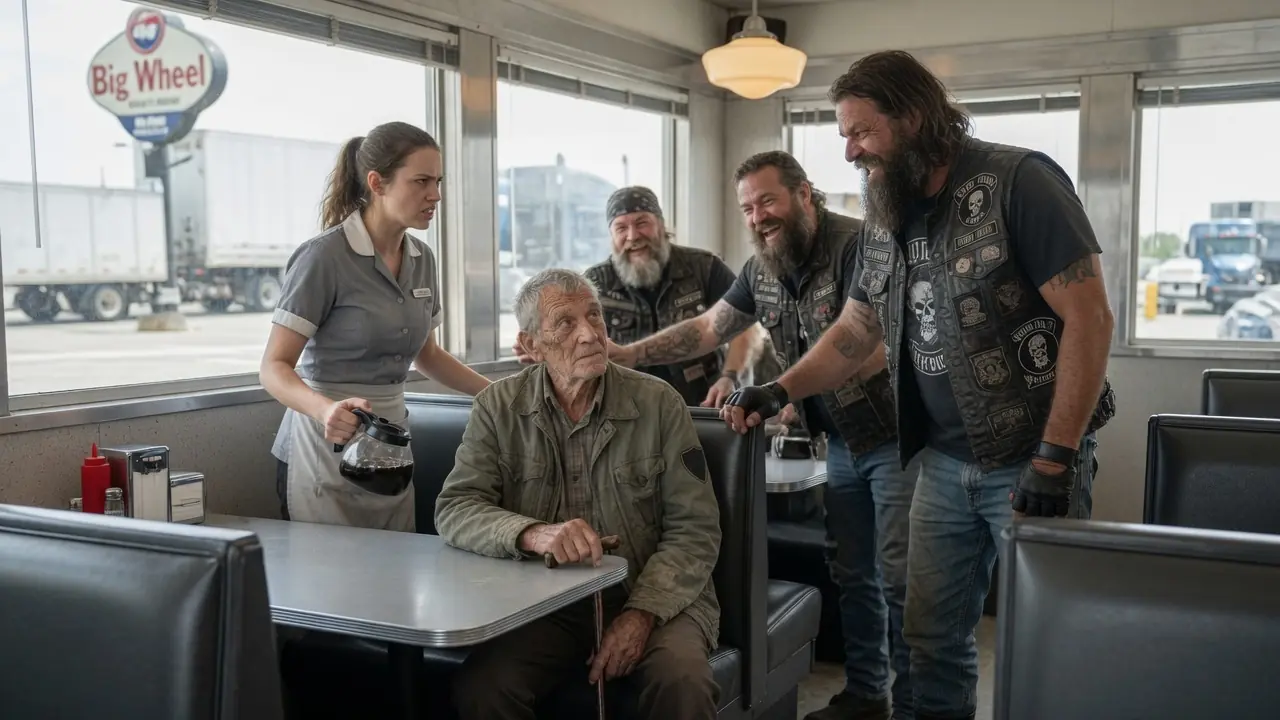
He just stared out the rain-streaked window at a parking lot full of sleeping eighteen-wheelers and waited for his cup. His name was Earl Hadley, and the diner he walked into that morning was the Big Wheel, a twenty-four-hour truck stop just off Interstate 40. The kind of place where the coffee was bitter, the bacon is crisp, and nobody asks you where you've been or where you're going. Earl had been coming to the Big Wheel for almost 30 years, ever since his wife Margaret passed and the silence in the house got too loud to sleep through. He'd drive the eleven miles from his little aluminum-sided home before sunrise, take the same stool at the counter, drink two cups of plain coffee, eat one slice of buttered wheat toast, and head back home before the morning rush filled the place up.
What none of them knew, what almost nobody in three counties knew, was that the quiet old man with the bad knee and the worn-out field jacket had once jumped out of airplanes into countries the United States government swore on the floor of Congress its soldiers had never set foot in. The bikers had rolled in around 4:30 that morning. Three of them, riding chrome-heavy custom bikes with engines loud enough to wake the dead. They'd taken the corner booth, ordered the trucker's special, and proceeded to talk at full volume about a brawl they'd been in the night before at a roadhouse outside Memphis. The biggest one, the one the others called Diesel, had a habit of finding someone in every diner they stopped at to make the butt of his jokes.
That morning, when the door chimed and Earl Hadley shuffled in slow and bent and gray, Diesel found his target. The first crack was about the cane. The second was about the field jacket, which Diesel said looked like Earl had stolen it off a scarecrow. The third was about Earl needing to ask permission from his nurse to be out so early.
Each joke got louder. Each one was met with cackles from the other two bikers, and each one slid right off Earl Hadley's back like rain off a windshield. He just sipped his coffee and watched the parking lot. What none of them noticed was the man at the far end of the counter. He was sitting alone in front of a half-eaten plate of eggs, a heavy-set man in his early 60s with a salt-and-pepper beard and grease worked deep into the creases of his hands.
His name was Mike Callaway, and he drove a long-haul rig out of Little Rock, hauling refrigerated freight up and down the eastern half of the country. Mike had pulled into the Big Wheel about ninety minutes earlier, parked his truck at the back of the lot, and come inside for breakfast and a chance to stretch his back before the next leg. He'd noticed Earl when the old man walked in. More precisely, he'd noticed Earl's jacket.
There was a small embroidered patch on the left shoulder, faded almost gray with age, almost invisible against the olive-drab of the wool. Mike had set his fork down the moment he saw it. He'd been staring at that patch for ten solid minutes, his eggs going cold, his coffee untouched, his eyes narrowing more and more with each new joke that came out of the corner booth. Diesel was on a roll now. He'd left the booth and was standing in the aisle between the booths and the counter, holding court for his two buddies, and for any trucker unlucky enough to be eating breakfast that morning.
"I mean, look at him, boys. The old-timer's still wearing his Halloween costume from Vietnam. You going to tell us war stories, pops? You going to tell us how you single-handedly won the war?
My uncle was in 'Nam. He had real stories, real medals, not some thrift-store jacket some old fool found at a yard-sale." The waitress, a young woman named Cassie, who couldn't have been more than twenty-two, shot Diesel a furious look and opened her mouth to say something. But Earl raised his hand a quarter inch off the counter, just enough for her to see, and gave the smallest shake of his head. "Don't," the gesture said. "It's not worth it." Cassie's jaw tightened, but she went back to refilling Earl's cup, her hand trembling with anger as she poured.
Diesel saw the gesture and laughed louder. "See that? Old man can't even fight his own battles. Probably never could." That was the moment Mike Callaway slid off his stool.
He did it slowly, deliberately, the way a man stands up at a funeral. He set his napkin on the counter. He squared his shoulders. He looked once at Earl Hadley, then once at the patch on Earl's shoulder, then once at Diesel, who was still grinning at his own punchline. And then Mike Callaway, 300 pounds of long-haul trucker with a faded tattoo of a Green Beret on his forearm, walked across the diner with his boots hitting the linoleum so hard that everyone in the place turned to look.
He stopped three feet behind Diesel. He didn't say a word. He simply walked around the bikers, planted himself directly in front of Earl Hadley's stool, came to attention like a much younger man, and brought his right hand up in a salute so sharp and so perfect that the diner went absolutely silent. Forks froze in midair.
Cassie nearly dropped the coffee pot. Even the cook, a grizzled old man named Hector, came out from the kitchen wiping his hands on his apron to see what was happening. Mike held the salute. He didn't waver. He didn't blink.
"Sergeant Major Hadley," Mike said, and his voice cracked on the second word. "I don't know if you remember me, sir. Specialist Callaway, Third Recon, November 1971. You pulled me and four other men out of a rice paddy across a border that didn't exist on a mission that never happened in a country we were never in.
I was nineteen years old. I had a sucking chest wound. The bird that was supposed to come for us got shot down. You walked 31 kilometers through enemy territory carrying me on your back because you said you don't leave anyone. I have spent fifty-five years looking for you to say thank you.
I am not letting another minute go by." He still hadn't lowered his salute. Earl Hadley turned slowly on the stool. He looked at the trucker's face. His own face, which had been so calm, so empty all morning, began to change.
The eyes filled first, then the mouth trembled, then his hand, the one with the liver spots and the trembling pinky, came up slow and shaky and returned the salute. "I remember you, Mike," he said softly. "You were lighter than you are now." You could have heard a pin drop in the Big Wheel diner. Diesel's grin had vanished. His two buddies in the booth had gone pale.
Cassie was crying openly, one hand pressed to her mouth, the coffee pot still clutched in the other. Hector the cook crossed himself. Mike Callaway lowered his salute, but he didn't sit down. He turned slow and deliberate to face Diesel and the two bikers.
His voice was quiet now, but it carried like a rifle shot. "The man you've been calling pops for the last twenty minutes," he said, "served three tours in a unit you have never heard of, doing things you will never read about, in places your government still pretends American boots never touched. He came home with two Silver Stars, a Distinguished Service Cross, and a Purple Heart with two oak leaf clusters. He came home and put it all in a box and never spoke of it because the men he served with mostly didn't come home at all. He has more honor in the cane he's leaning on than the three of you have in your entire bodies.
And you have been making jokes about his jacket." Diesel opened his mouth, closed it, opened it again. Nothing came out. The bearded biker who'd been laughing the loudest five minutes earlier was now staring at the floor like he was hoping it would swallow him whole. The smaller of the three got up from the booth and walked without a word straight out the front door.
He didn't even wait to pay for his breakfast. The third biker, a younger one with hollow cheeks and nervous eyes, slowly slid out of the booth and walked over to where Earl Hadley was sitting. He stopped about six feet away. He didn't know what to do with his hands. Finally, he said, "Sir, my dad was in the army.
He died last year. He would have he would have wanted me to." He couldn't finish the sentence. Earl looked at him with those wet old eyes and gave the smallest nod. "It's all right, son.
It's all right." The young biker turned and walked out of the diner, and from the window everyone could see him standing in the parking lot beside his motorcycle, his shoulders shaking. That left Diesel. Big Diesel, who had walked into that diner like he owned every inch of it. He was standing in the middle of the aisle now, and he looked smaller than he had ten minutes earlier, like the air had gone out of him. He took one heavy step toward the counter, then another.
Earl Hadley watched him come, his face calm, his coffee cup still steaming in his hand. When Diesel was three feet away, the big biker dropped his eyes and said, in a voice you could barely hear, "I didn't know, sir. I didn't know." Earl Hadley took a long sip of his coffee. He set the cup down.
He looked up at the man who'd been mocking him and said gently, "Son, that's the whole point. You're never going to know. Not by looking. Not at me. Not at the next old man you see.
Not at anybody. That's why my generation taught yours to be polite to strangers, because you're never going to know what they carried, so you could stand there and laugh in a warm diner at 5:00 in the morning. Diesel's mouth worked. A single tear rolled down into his beard.
He nodded once. He turned. He walked out without another word. The Big Wheel Diner stayed quiet for a long time after the bikers left. Mike Callaway sat down on the stool next to Earl, and the two old soldiers drank their coffee together in the kind of silence that only men who have shared the worst day of their lives can share.
Cassie brought them both fresh cups without being asked on the house, and slipped a slice of warm pie in front of each of them. Hector came out of the kitchen and shook Earl Hadley's hand with both of his. A trucker two booths down, a man named Ray, who had been quietly listening to the whole thing, stood up, walked over, and laid five $20 bills on the counter beside Earl's plate. "Your breakfast is paid for here for the rest of your life, Sergeant Major," he said.
"I'll make sure of it." One by one, every trucker in that diner came over. Some shook Earl's hand. Some just laid a dollar or two on the counter and walked away without a word. A young woman in a waitress uniform from the gas station next door, who had heard what happened, came running across the parking lot to bring Earl a fresh muffin she'd just baked. Earl Hadley finished his coffee that morning the way he always did, in two cups with one slice of buttered wheat toast.
But when he stood up to leave, the entire diner stood up with him. Mike Callaway walked him out to his old pickup truck, opened the door for him, and helped him in like a son helping a father. Before he closed the door, Mike said, "Sergeant Major, I'd like to bring my grandson by sometime if that's all right. He's 11.
He needs to know there are men like you in the world." Earl Hadley smiled, the first real smile he'd worn in a long time, and said, "Bring him by Sunday, son. I'll fix you both lunch." And as Earl drove out of the parking lot in the gray dawn light, the sun finally cresting over the row of sleeping eighteen-wheelers, Mike Callaway stood in the parking lot with his hand over his heart, and watched the old truck disappear down the on-ramp. Inside the diner, Cassie was already pinning Earl Hadley's name to the wall above the counter, where the regulars' names went, with one extra word written underneath it in permanent marker, "Hero." The lesson of that morning at the Big Wheel Diner is older than any of us, but somehow in this loud and busy world, we keep forgetting it. The old man at the counter, the woman pushing the cart through the parking lot, the quiet man in line behind you at the gas station, you don't know what they've done. You don't know what they've survived.
You don't know whose life they saved or what they gave up, so that you could stand there in a warm diner before sunrise and order a hot breakfast in a country safe enough to sleep in. The men of Earl Hadley's generation didn't ask for parades. Most of them came home to silence and built quiet lives in small houses and never told anyone what they had seen. They are walking among us right now, leaning on canes, wearing faded jackets, ordering plain coffee at counters all across this country, and one day soon, the last of them is going to be gone. So, the next time you see an old veteran, no matter what he looks like, no matter how slow he moves, give him your seat, hold the door, look him in the eye, and say two words, "Thank you." Because the salute Mike Callaway gave that morning at the Big Wheel Diner, that salute belongs to all of them.