"You think I drove six hours to be laughed at by boys playing dress-up in their fathers' leather?"
Elliot Whitmore's voice cut through the clubhouse like a blade drawn slowly from a sheath. It was not loud. It did not need to be. The room had been full of noise a second earlier, pool balls cracking, beer bottles tapping against the bar, young men laughing too hard at jokes that were not funny enough to deserve it. Then the old man spoke, and something in his voice made twenty-three men stop long enough to hear what would happen next.
He stood just inside the door with rainwater dripping from the brim of his weathered brown hat. His back was slightly bent, his gray hair was cut close, and his hands trembled around the strap of an old leather satchel hanging against his chest. To most of the men in the clubhouse, he looked like someone who had walked in from another century, a confused grandfather searching for the church basement or the veterans' hall. To Victor Hale, he looked like a nuisance. To Dean Mercer, he looked like a ghost wearing another man's skin.
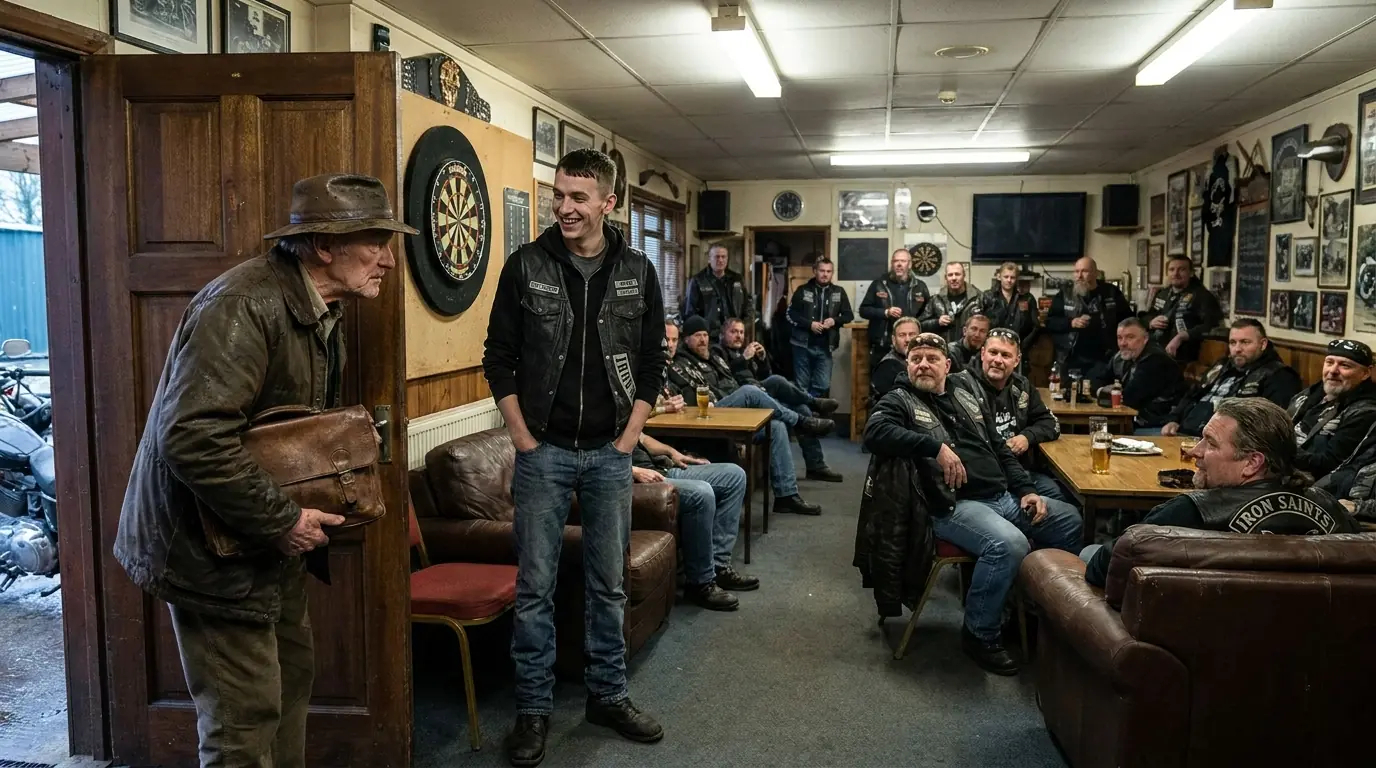
The first laugh had come from a young member near the dartboard, a narrow-shouldered kid named Lenny who had only been patched in six months earlier and still acted as if the vest on his back made him bulletproof. "Old timer's lost," Lenny said, loud enough for everyone to hear. "Somebody call his nursing home before he starts asking for bingo night."
The laughter spread fast. Men leaned back in chairs, slapped tables, and gave the old man exactly the kind of cruel welcome they thought made them powerful. Elliot did not laugh. He did not flinch. He did not even look embarrassed. He simply stood there and let the sound roll over him, the way an old stone wall lets weather pass across it year after year without ever asking the storm for mercy.
"Sir," a voice called from the back of the room, low and amused. "This is a private clubhouse. Whatever road you were looking for, you missed it about five miles back."
That voice belonged to Victor Hale. He stepped through the smoke and bar light with the slow confidence of a man accustomed to making rooms change shape around him. He was large, six-foot-three at least, broad across the shoulders, with a neatly trimmed salt-and-pepper beard and hard pale eyes that did not warm when his mouth smiled. The black leather vest across his chest carried patches that told anyone who knew the club that Victor was the sitting president of the Iron Saints Motorcycle Club, Mason County chapter. The men around him treated that title like a crown.
Victor treated it like ownership.
"You need to leave," he said.
Elliot looked at him for the first time. His eyes were tired, gray, and dry, the kind of eyes that had looked at hospital ceilings, funeral flowers, unpaid bills, and empty roads without surrendering to any of them. "I will," he said. "Once I finish what I came here to do."
A few men laughed again, but the laughter had thinned. There was something wrong with the old man's calm. It did not fit the room. It did not fit Victor's authority. It did not fit the joke they wanted him to be.
Victor stepped closer. "And what exactly could a man like you possibly have to do in a place like this?"
Elliot reached one hand into the satchel. Several men shifted. One young member near the bar lowered his hand toward his belt out of reflex, then stopped when he saw what Elliot pulled out.
An envelope.
It was old, yellowed at the edges, soft from age and handling. The flap was sealed with brittle tape that looked as though it had survived decades in a drawer nobody dared open. On the front was a name written in faded ink.
Dean Mercer saw it from his table near the back.
His beer bottle slipped from his hand and shattered on the concrete.
The laughter died completely.
"That's not possible," Dean whispered.
Victor glanced toward him, annoyed. "What?"
Dean had gone white. He was sixty-one, gray ponytail pulled tight behind his head, beard rough around his jaw, eyes lined by a life of highways and things he never explained to strangers. He had ridden with the Iron Saints since he was seventeen. He had buried brothers. He had seen men come in hungry and leave whole. He had also watched the club rot slowly under Victor's hand, though for too long he had told himself there was nothing one old road captain could do about it.
Now he stared at the envelope as if it had reached up from the past and closed fingers around his throat.
"Where did you get that?" Dean said.
Elliot turned his head toward him. Something softened in his face, not weakness, but recognition sharpened by grief. "Hello, Dean. You were eighteen the last time I saw you. You used to fall asleep on Samuel's porch waiting for him to come back from runs."
Dean took one uneven step forward. "No."
"You crashed your first bike outside Mill Creek and told everyone a deer jumped out," Elliot continued quietly. "Samuel knew you took the curve too fast. He fixed the front fork anyway and never told your mother."
Dean's lips parted, but no words came.
Victor looked between them, irritation deepening into suspicion. "Dean, sit down."
Dean did not sit down.
"Who are you?" he asked the old man.
Elliot placed the envelope on the bar with both hands, as carefully as a preacher setting a Bible on a pulpit. "My name is Elliot Whitmore," he said. "And this letter needs to be read tonight in front of every man in this room."
A strange murmur moved through the clubhouse. Elliot Whitmore was not a famous name, not to the younger men. It meant nothing to Lenny by the dartboard, nothing to Curtis Boyd near the back wall, nothing to the new prospects who had been taught only Victor's version of the club's history. But to Dean, the name struck like a match in a dark cellar.
Elliot Whitmore had been Samuel Callahan's closest friend.
Not a member, not exactly. He had never worn the patch. He had been the teacher who kept books for the club in the early days, the man who helped Samuel write bylaws when half the founding members could barely spell their own names sober. He had handled correspondence, legal paperwork, funeral arrangements, scholarship checks, and quiet favors nobody talked about outside the clubhouse. Men called him Professor because he always carried a fountain pen and corrected grammar on club notices even when a fight had broken out five minutes earlier.
Then Samuel Callahan died.
At least, that was the story.
After the funeral, Elliot disappeared too. Some said he had moved north. Some said grief had broken him. Some said the old club had no use for men with pens once men with fists took over.
Dean had assumed Elliot was dead.
Dean had assumed many things.
Victor leaned over the envelope but did not touch it. His eyes caught the name on the front. For one half second, confidence cracked across his face like ice under a boot.
Then he covered it.
"This is a sick joke," Victor said.
"No," Elliot replied. "It is a promise."
Victor gave a humorless laugh. "A promise from who? A dead man?"
"From the man who built the chair you're sitting in."
The room shifted.
Victor's jaw tightened. "You have thirty seconds to pick up your little envelope and walk back out before I have somebody walk you out."
Elliot looked at the younger men, then back at Victor. "Try it," he said. "And before sunrise, every man here will know exactly what you stole, who you paid, and which families went hungry while you called yourself president."
The room did not merely go quiet. It hardened.
Dean stepped forward. "Open it."
Victor turned on him. "Don't be stupid."
"Open it."
"This could be forged. It could be a setup from a rival club, or a cop, or some bitter old man with too much time left and not enough sense to stay away from things that don't concern him."
Elliot's expression did not change. "It concerns me because Samuel trusted me with it. It concerns Dean because he carried an empty coffin thinking he had buried the only man who ever believed in him. It concerns every brother in this room because most of you have no idea what this club was supposed to be before Victor turned it into a machine for fear and profit."
A few of the younger members exchanged uneasy looks. Victor noticed. He always noticed fear when it belonged to somebody else.
"You don't know anything about me," he said.
Elliot's voice cooled. "I know about the widow's fund."
Dean's head snapped toward Victor.
"I know about the warehouse on Route Nine," Elliot continued. "I know about the stolen parts moving through it under club protection. I know about the county detective whose payments come disguised under four different names. I know about the three families that stopped receiving checks after their husbands died even though the books still show the money going out. I know about Curtis's cousin being threatened when he asked why Marcus Doyle's daughter never got the education grant her father paid into for twenty years."
Curtis Boyd straightened near the back wall. His face had gone hard.
Victor's eyes flashed. "Careful."
"No," Elliot said. "I was careful for forty years. I am finished being careful."
For a long moment, the only sound was the buzzing neon beer sign above the bar and the distant hiss of tires passing on the wet road outside. Then Dean walked to the bar and placed one hand beside the envelope.
"Read it," he said.
Victor stared at him. "You answer to me."
Dean looked tired when he answered, and the tiredness made his voice stronger, not weaker. "Not if that letter says I don't."
That was the first crack.
Small, almost invisible, but everybody heard it.
Victor reached for the envelope because he understood what refusing would do. His fingers tore the brittle tape. The old paper inside unfolded with a dry whisper. Three pages, written in ink that had faded but not vanished. Victor's eyes skimmed the first lines.
His face changed.