“Get up, you worthless piece of trash; don’t bleed on my Persian rug.” That was my biological mother, Victoria, hissing as she nudged my shoulder with the toe of her designer shoe like I was a piece of garbage. My face was throbbing numb from the shock. I had just collapsed onto the floor after a brutal full-force strike from my own father, a United States Senator. The reason was that I refused to quit the military and act as a shiny PR prop for his upcoming political campaign.
My name is Julia. I’m 24 years old and a sergeant in the United States Army. I’ve eaten dirt and faced death in combat zones to serve my country, only to be crushed and degraded inside my own home. They thought I would just take it. They thought I’d submit.
But they forgot I was trained exactly how to dismantle manipulative dictators. Click. Clack. Click. Clack.
The sharp rhythmic sound of Victoria’s Manolo Blahniks echoed against the imported Italian marble floors, fading down the long, dimly lit hallway. She didn’t look back. Not a single glance over her shoulder to see if her only daughter was breathing unconscious or dead. She just walked away. From the other side of the heavy mahogany desk, I heard the distinct crisp clink of ice hitting crystal.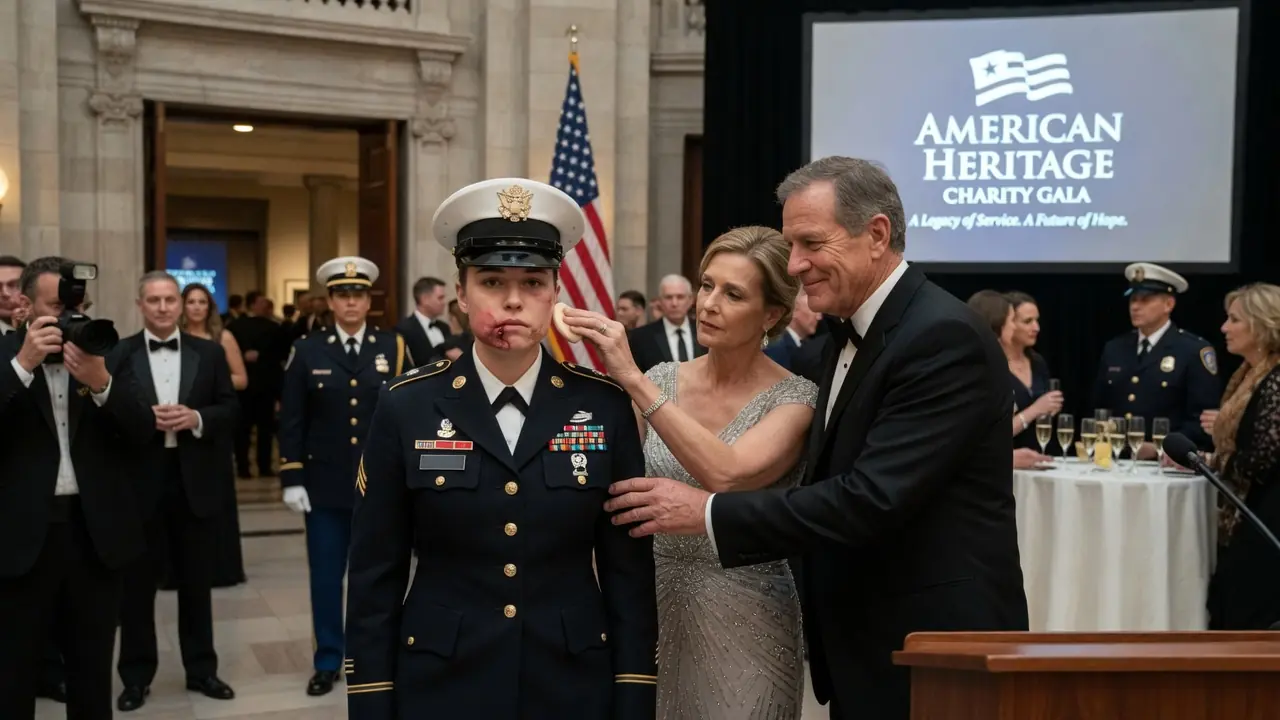
Richard was pouring himself another glass of bourbon. The smell of his expensive Cuban cigar hung thick in the air, choking the room, mixing with the sickening rusty taste of blood flooding my mouth. It was the scent of untouchable power. The silence in that sprawling DC mansion was absolute, a heavy suffocating blanket designed to crush any dissent. They expected me to lay there, to cry, to beg, to eventually crawl upstairs, ice my face, and come down the next morning ready to smile for the cameras.
I turned my head slowly feeling the grit of the expensive rug against my cheek. I worked a mouthful of saliva and blood together and spat it directly onto the intricate handwoven fabric. Screw her rug. My body bypassed panic and slammed straight into survival mode. The military doesn’t teach you how to cry when you’re hit.
It teaches you how to assess. I planted my palms flat against the hardwood border of the floor and pushed up. My arms shook for a fraction of a second before my muscles locked. I got my boots under me. I stood up straight.
No tears. Not a single sound escaped my throat. I didn’t look at the man sipping his drink in the leather chair. He was no longer my father. He was a hostile.
I turned and walked out of the study. My steps were measured, silent, and deliberate. Down the hall, the guest bathroom door was cracked open. I slipped inside and pushed the heavy oak door shut. I flipped the deadbolt.
Click. A solid metallic sound. Perimeter secured. I hit the light switch. Harsh, blinding, hospital-white fluorescent tubes flickered to life above the vanity bouncing off the pristine mirrors.
I gripped the edges of the marble sink and finally looked up. The person staring back at me wasn’t the senator’s daughter. That naive kid who spent two decades starving for a scrap of parental affection. She died on the floor out there. The person in the mirror was a casualty of war.
My left cheek was a massive disfigured lump of angry purple and raw red flesh. The skin around my eye was already puffing up threatening to swell shut. A deep, jagged split tore through my bottom lip leaking a steady stream of dark crimson down my chin staining the collar of my olive-drab T-shirt. I raised a trembling hand and pressed two fingers directly against my jawbone. A sharp, blinding spike of pain shot through my skull, making my vision white out for a second.
I ground my teeth together. Everything aligned. It wasn’t shattered. Fractured, maybe, but intact enough to speak. I turned on the brass faucet.
Freezing cold water blasted into the sink. I cupped my hands, brought the water up, and splashed it violently onto my face. The shock of the cold cleared the last bit of brain fog. I scrubbed the dried blood off my neck, rinsed my mouth, and spat a pink stream down the drain. I watched it swirl away.
I was done bleeding for them. I reached into the front pocket of my jeans and pulled out my phone. “Call 911.” I let out a short, breathy scoff. Not a chance.
Not in Washington, D. C. The chief of the Metro Police played golf with Richard Baker every other Sunday. If I called local dispatch, two-bit cops would show up, take one look at the senator’s shiny badge, and suddenly, I’d be the hysterical, PTSD-riddled veteran daughter having a mental episode. They’d have me strapped to a gurney and locked in a private psych ward before the sun came up, all neatly swept under the rug to protect his campaign.
I didn’t need the police. I had my own chain of command. I swiped the screen, opening the camera app. I flipped the lens to face me. I didn’t try to fix my hair or wipe the fresh blood welling up on my lip.
I held the phone up at eye level, making sure the harsh lighting caught every single contusion, every bruised capillary. I hit record. I stared dead into the black lens. My voice came out flat, cold, and entirely devoid of emotion. “Sergeant Julia Baker, 2240 hours; Physically assaulted by target Richard Baker; Injuries sustained to the left cranial region, jaw, and mouth; no provocation; Subject used full physical force.”
I hit stop. I didn’t review the footage. I immediately hit share and routed the file directly to an encrypted 256-bit offshore cloud server. The upload bar zipped across the screen and vanished. Weapon one secured.
Now, I needed an extraction. I opened my contacts and scrolled down to the letter M, Maya. She was a cybersecurity specialist, a Russian-born ghost in the machine, and the only person in this godforsaken city I trusted with my life. We shared dirt, blood, and secrets in the sandbox overseas. I tapped her name.
“Cipher, it’s Baker,” I said, my voice dropping to a low, urgent rasp. “Protocol Empty Quiver.” Silence fell over the line, a heavy, dead half-second of absolute quiet. In the military, empty quiver is the reporting term for the seizure, theft, or loss of a functioning nuclear weapon. It’s a top-tier, worst-case scenario.
But between Maya and me, it was our own personal code. It meant friendly fire. It meant I was trapped behind the wire in immediate lethal danger from our own side. The silence broke. Maya’s voice crackled through the phone speaker.
No questions, no panic. Just the sharp, mechanical precision of a soldier receiving coordinates. “Copy that; Tracker disabled; I’m on my way; ETA: 15 minutes.” Maya’s apartment in Arlington smelled like burnt black coffee, stale nicotine, and the sharp metallic ozone of overheated computer processors. It was cramped, suffocating.
Stacks of raw hard drives and tangled black cables covered every flat surface like thick plastic vines, but it was safe. It was a fortress hidden in plain sight. Maya did not hover around me. She did not offer the empty pathetic civilian platitudes people usually spit out when they see a busted face. She guided me by the shoulder, pushed me down onto a cracked, peeling leather sofa, and walked straight to her small kitchen area.
She ripped open her freezer, pulled out a bag of frozen peas, wrapped it tightly in a grease-stained kitchen towel, and walked back. She pressed it hard directly against my swollen cheek. I flinched, my breath hitching in my throat. The cold was a violent, biting shock against the throbbing unnatural heat radiating from my bruised flesh. Next, she grabbed a bottle of Tito’s vodka from the top of the humming refrigerator.
She poured three solid fingers of clear liquid into a heavy glass tumbler, and slammed it down onto the wooden coffee table right in front of my combat boots. “Drink or do not,” Maya said. Her voice was flat, utterly devoid of pity. She turned her back to me, sat down in her rolling desk chair, spun around to face a wall of glowing monitors, and started typing rapidly. That was the silence of one soldier pulling guard duty for another.
It was a heavy secure quiet. It was worth more than a thousand fake apologies from the blood relatives who put me in this state. I reached forward and grabbed the glass. I threw the vodka back. It burned a raw chemical path down my throat, making my eyes water.
But the freezing bag of peas against my skin was what really anchored me to reality. The biting cold seeped through the cheap towel, drilling past my bruised facial tissue. It pulled my mind away from the Arlington apartment, dragging me straight back to the bitter ice of a December night six years ago. Christmas Eve, I was 18 years old. I stood at the edge of the massive mahogany dining room table in the DC mansion, my fingers clutching a crisp piece of paper.
The heavy scent of roasted pine and expensive catering filled the room. It was an early acceptance letter to the United States Military Academy at West Point. It was my ticket out. It was the undeniable proof that I bled, sweated, and broke my back to be worth something in this world. Richard sat at the head of the table.
He did not even look at the letter in my shaking hands. He looked at my face, swirling his drink. The ice clinked against the crystal glass, a sound I would learn to hate. He let out a short nasal breath that sounded like a laugh, but held zero humor. “So?” he sneered, the corner of his mouth twisting up in pure, unfiltered disgust.
“You could not hack it at an Ivy League school, so you settle for this grunt work.” He did not even wait for me to defend myself. Victoria stepped right in, smoothing the front of her tailored silk dress, her eyes scanning the room as if the press were already there. “It is fine, Richard,” she said, waving her manicured hand like she was dismissing the hired help. “We will just tell the reporters that the senator’s daughter feels a profound patriotic duty to serve her country; it plays incredibly well with the middle-class demographic.”
Just like that. My blood and sweat, my escape route, stripped down, gutted, and repackaged as a shiny, cheap PR consolation prize for his upcoming political campaign. I was not a daughter. I was a campaign asset. But, that was not the deepest cut.
The real theft, the one that killed something inside me permanently, happened 3 years later. My grandfather, Colonel Thomas Baker, a retired United States Marine, the only person in that cursed bloodline who ever looked at me like I was a human being, not a political pawn. When I enlisted, he was the only one who stood tall and saluted me. When he died, he left me exactly one thing. A simple scuffed wooden cigar box holding his combat service medals.
It was the only tangible proof I had that honor actually existed in my family. One week after his funeral, that box vanished from my bedroom. I found them the next morning. I walked into Richard’s home office and stopped dead in my tracks. There, sitting in the center of a custom-built lockable glass display cabinet, were my grandfather’s medals.
They were arranged perfectly under blinding halogen lights pinned to a velvet backing. A carefully curated prop to make the corrupt senator look like a man of deep military patriotism. I walked up to the desk. I demanded them back. My hands were shaking so hard I had to ball them into tight fists, my nails digging into my palms until they bled.
Richard did not even look up from his legal paperwork. “Those are historical artifacts of the Baker family.” He set his tone dead heavy and final. “Not shiny toys for an ungrateful brat; they stay where they are.” He stole the legacy of a dead Marine to whitewash his own dirty hands.
A drop of freezing water from the thawing bag of peas hit my collarbone, snapping me violently back to the present. Maya was sitting across from me now. She had stopped typing. Her pale unblinking eyes were locked onto the grotesque purple lump on my face. “Why now, Baker?” she asked.
Her voice was low, but it cut through the room like a bone saw. “Why tonight, out of all the times they treated you like dirt?—Why did you finally walk?” I lowered the bag of peas. The throbbing pain in my jaw was still there, pounding with every heartbeat. But the blind panic was gone.
The heavy suffocating weight of trying to be the good loved daughter had completely evaporated. What was left in its place felt like cold, hardened steel. I set the heavy glass of vodka down on the table next to the dripping towel. “Because he thinks he is the law,” I said. My voice did not shake.
I reached into my pocket and pulled out my encrypted phone. The black screen reflected my ruined face. “But I have my own system of law, and I’m going to use the United States Army to crush him.” I unlocked the screen, pulled up my command contacts, and hit dial. Morning light bled through the cheap cracked plastic blinds of Maya’s apartment, catching the thick dust motes floating in the air.
The space smelled like stale coffee grounds and the dry metallic heat of running server fans. It was 0700 hours. The adrenaline from the night before had completely burned out of my system, leaving behind a hollow aching exhaustion. My jaw was a tight throbbing knot of agony. Every time my heart beat a fresh wave of pain radiated from the bruised bone up to my left temple.
But I could not stop moving. If I stopped, the reality of what just happened in that DC mansion would catch up to me. I sat at Maya’s cluttered desk, pushing aside a pile of tangled Ethernet cables. I booted up a secondary laptop and connected to her heavily encrypted VPN. I pulled up the secure dialer and punched in the direct line for my commanding officer, Captain James Carter.
The line clicked. Carter. I sat up straight, ignoring the sharp pull in my split lip. I did not use civilian words. I did not frame this as a family dispute.
I framed it exactly for what it was under the Uniform Code of Military Justice. “Sir, this is Sergeant Baker; I am reporting a severe security and safety breach.” “Go ahead, Sergeant,” Carter said. His voice was thick with sleep, but the military edge was already sharpening. “I have hard, time-stamped evidence of a physical assault against an active-duty service member; the perpetrator is a sitting United States Senator; he has also actively threatened my military career and physical safety if I do not comply with his civilian PR demands.”
Dead silence fell over the encrypted line. I could hear the faint static hum of the connection. Captain Carter was not an idiot. He knew exactly who my father was. He understood the sheer crushing weight of what I just dropped on his desk.
This was not a bar fight. This was a federal scandal involving a man who had the power to defund military bases. Where are you right now, Baker? Carter finally asked. His tone had completely shifted.
It was cold, focused, and strictly professional. Secure offsite location, sir. Uncompromised. Hold your position. Do not contact local law enforcement.
Do not speak to the press. I am pushing this up the chain immediately. The line went dead. I set the phone down. My stomach let out a low, hollow growl.
I needed fuel. My body was trying to heal blunt force trauma, and I had not eaten since yesterday afternoon. I pulled out my personal phone, opening a delivery app to order food from a greasy spoon diner down the street. Two eggs, burnt hash browns, and black coffee. Survival calories.
I tapped my primary Visa debit card on the checkout screen. A spinning wheel appeared, then a stark gray text box. Payment declined. Please contact your financial institution. I found a slow crawling sensation of dread creeping up the back of my neck.
I swapped the payment method to my secondary checking account. Payment declined. My breath hitched. I closed the delivery app and opened my Bank of America application. The biometric scanner read my face and the dashboard loaded.
I stopped breathing. Plastered across the very top of my screen was a solid blood red banner. Account frozen. Restricted due to suspicious activity. Please visit a local branch.
My balances were completely grayed out, inaccessible. Every single dollar to my name was locked behind a digital wall. Richard Baker did not need to leave voicemails screaming at me. He did not need to kick down the door of this apartment. He was a Washington elite.
He just picked up his phone, called some banking executive he played golf with, called in a heavy political favor, and cut my supply line. I stared at the red letters, my chest tightening until I felt like I was suffocating. That was my money. That was my hazard pay. I earned every single cent of that money choking on exhaust fumes, sleeping in Kevlar vests, and pulling night watches in 110° heat overseas.
I bled for those paychecks. And he just wiped it out with a single quiet phone call from his air-conditioned mahogany study. Financial abuse. It was silent. It did not leave massive purple contusions on your face, but it strangled you all the same.
He wanted to starve me out. He wanted me broke, desperate, and trapped. He wanted me to realize I could not survive in the real world without his money, so I would have no choice but to crawl back to his mansion on my hands and knees and beg for forgiveness. The walls of the cramped apartment suddenly felt like they were closing in on me. They controlled everything.
They always had. Maya walked out of her small kitchenette. She set two chipped ceramic mugs of black coffee down on the desk. She looked down her pale eyes landing directly on my glowing phone screen. She saw the red banner.
She saw my white-knuckled grip on the phone. She did not sigh. She did not offer a useless pitying look or ask me how I felt. Maya reached into the back pocket of her jeans and pulled out a worn black leather wallet. She flipped it open, slid out her personal American Express credit card, and threw it down.
Smack. The heavy piece of metal hit the raw wood of the desk like a gunshot echoing in the quiet room. “Use it.” Maya said. Her voice left absolutely zero room for debate.
“Gas, food, tactical gear, whatever you need to stay alive and stay in this fight.” I looked from the screen to the card. “Cipher, I can’t; my accounts are totally—” “I did not ask for a financial status report, Baker.” She cut me off, her tone sharp and uncompromising. “We are a unit; you cover my six, I cover yours; you will pay me back when we win this war; buy the damn breakfast.”
I stared at the heavy metal card. A simple piece of plastic and chip from a girl I met in a combat zone thousands of miles away. It held more trust, more loyalty, and more actual family values than the people who shared my DNA. Before I could even reach for the card, the encrypted burner phone on the desk started vibrating, violently buzzing against the wood. I picked it up.
“Captain Carter.” “Baker.” His voice came through the speaker. It was loud, hard, and echoing with the sheer crushing weight of the entire military machine behind him. “Listen to me very closely.”
“I am here, sir.” “I just handed your file over to the Judge Advocate General’s Corps; JAG has officially accepted the case.” Carter paused, letting the reality of the words sink in. “From this exact second forward, you are operating under the full legal and physical protection of the United States Army.” The drive to Fort McNair was quiet.
Maya drove her beat-up Honda Civic with a heavy foot navigating the DC traffic with aggressive precision. I sat in the passenger seat watching the Potomac River blur past the window. My jaw felt like a solid block of concrete throbbing with a dull heavy rhythm. We cleared the security gate and pulled up to a drab brick building. The Judge Advocate General’s office.
Inside it was a completely different universe from the sprawling multi-million dollar Baker estate. There were no imported Persian rugs, no hand-carved mahogany furniture designed to intimidate. The walls were painted a flat government issue gray. The air smelled like old paper, stale printer ink, and bleach. It was sterile.
It was perfect. I stood at parade rest in front of a standard pressed wood desk. Major Sarah Hayes sat on the other side. She was a woman in her late 40s with graying hair pulled into a tight regulation bun and eyes that looked like they could cut glass. She was reading the incident report Captain Carter had forwarded.
The video file of my destroyed face played on loop on her secondary monitor. She did not look at me with pity. She did not ask me how I was feeling. Major Hayes tapped her index finger against the cheap wood of her desk. Tap.
Tap. Tap. A hard calculated rhythm. She finally looked up her gaze locking onto the massive purple and black contusion dominating the left side of my face. I do not care if your father is a sitting United States Senator.
I do not care if he is the president, Hayes said. Her voice was cold iron. In this office and on this installation, you are an asset of the United States Army. And nobody gets to put their hands on my soldiers. Do we understand each other, Sergeant?
For 24 years, I’d built a fortress inside my chest. I had to. I lived in a house where the people who shared my DNA viewed me as a liability, a punching bag or a PR tool. I spent my entire life starving for just one person with actual power to stand up, look at the abuse and say, “That stops now.” Hearing it from a total stranger in an olive-drab uniform nearly broke me.
I swallowed the heavy lump in my throat. I kept my back rigid. “Yes, ma’am.” Hayes picked up the heavy black receiver of her desk phone. She punched in a three-digit extension for the military police command desk.
“Hayes, issue a military protective order; Target Richard Baker, civilian; Protected party, Sergeant Julia Baker.” She paused, her eyes narrowing slightly. “Make it airtight; if that man puts one toe past the security gate of any military installation in the National Capital Region, he is to be placed in handcuffs immediately; Felony trespass.” She slammed the phone down. Just like that.
The untouchable senator, the man who thought he owned the law, was now sitting in a federal database as a hostile threat. If he tried to drag me out of here by my hair, like he usually did, men with rifles would put him face down on the asphalt. “You are secure here, Baker.” Hayes said, stacking my paperwork. “Go get something to eat; That is an order.”
Maya and I left the base and drove into Alexandria. We pulled into the cracked asphalt lot of the Old Guard Diner. It was a local joint smelling heavily of fried hash browns, cheap bacon grease, and old vinyl booths. I slid into a corner booth, keeping my back to the wall. It was a habit I could not break.
The waitress dropped off a plate of heavy greasy meatloaf and mashed potatoes. I picked up my fork. Eating was a mechanical process. I had to chew exclusively on the right side of my mouth, wincing as the muscles in my left jaw pulled tight against the fractured bone. Two booths down, an old man sat alone.
He was wearing a faded green canvas jacket and a worn-out baseball cap with Vietnam vet stitched across the front in frayed yellow thread. A half-empty cup of black coffee sat in front of him. He was not staring, but his eyes kept tracking back to the side of my face. He recognized the look. It was not a bar fight.
It was the heavy dead-eyed stare of someone who had taken a severe beating from the inside. I kept my head down, forcing down another bite of potatoes. When Maya and I finally slid out of the booth 20 minutes later, Maya reached for her wallet to grab the check. The waitress walked over holding a dirty coffee pot and shook her head. She did not hand over the slip of green paper.
Instead, she pointed a finger toward the front door. “You’re good, hon.” The waitress said, wiping down the table with a damp rag. The old man took care of it. I looked toward the entrance.
The veteran was pushing the heavy glass door open, stepping out into the cold Virginia air. He paused, turned his head slightly, and gave me a single slow nod. He did not know my name. He did not know my rank or the political nightmare I was drowning in. But he saw a soldier bleeding and he covered the tab.
A quiet $5 gesture from a complete stranger. It carried more weight, more basic human decency than two decades of living under the roof of the millionaire senator and his socialite wife. I nodded back. The door swung shut behind him. By late afternoon, we were back in the cramped safety of Maya’s apartment.
A heavy green canvas duffel bag was sitting right in the middle of the small living room floor. Captain Carter had driven to the barracks himself, packed up my essential tactical gear and uniforms, and dropped it off while we were eating. I walked over and unzipped the heavy brass zipper. The smell of gun oil, starched cotton, and boot polish hit my nose. I pulled out a perfectly pressed ACU top.
I ran my thumb over the black Baker name tape stitched over the right breast pocket. This was my family. The people who threw down credit cards, issued federal protective orders, and hauled my gear across town just to make sure I could stay in the fight. I set the uniform top down on the sofa feeling a rare steady calm settle over my chest. I was safe.
I was backed by a machine that Richard Baker could not buy. Then the burner phone on the desk lit up. The harsh white glare of the screen cut through the dim room. It was not a text. It was a notification from my civilian email account.
I walked over the calm evaporating instantly. I picked up the phone. The sender was not my mother’s personal address. It was not my father’s government email. It was from pr_admin@bakerfamilyfoundation. org.
My finger hovered over the screen. The psychological warfare had officially breached the perimeter. The glare from my phone screen cut through the dim lighting of Maya’s apartment. I stared at the sender address. pr_admin@bakerfamilyfoundation. org. I did not want to open it.
Every instinct I had honed over the last 24 years screamed at me to lock the screen and walk away. But I tapped the subject line. Regarding our daughter’s mental health journey. My stomach dropped. I read the first paragraph.
It was not a message from my mother asking if my fractured jaw was healing. It was not an apology from Richard. It was a perfectly polished legally bulletproof piece of corporate garbage drafted by a team of DC crisis managers. “The Baker family is deeply saddened by the recent psychological struggles our daughter Julia is currently facing upon returning from her military service; we are committed to providing her with the intensive inpatient therapy she so desperately requires during this private family matter.” I stopped reading.
The words blurred together. They were laying the legal groundwork. If I took this to court, if I handed that video of my bruised face to a judge, Richard’s high-priced lawyers would not argue that he did not hit me. They would argue that I was unstable. They would paint me as a paranoid combat traumatized veteran having a psychotic break and claim he was just trying to restrain me.
They were going to use my military service, the only honorable thing I had ever done, as the weapon to destroy my credibility and whitewash his violent temper. Two days later, the psychological warfare moved from digital to physical. A heavy brown cardboard package arrived at Maya’s door. No return address, just my name scrawled across the front. I cut the heavy packing tape with my pocketknife.
Inside sat a thick hand-bound leather photo album and a single folded piece of paper. I picked up the paper. It was my mother’s custom gold-embossed stationery. The kind she only used for writing thank you notes to high-dollar campaign donors. The thick paper felt rough and expensive under my fingertips.
I unfolded it. The handwriting was neat, elegant, and completely devoid of warmth. “Julia, your father has sacrificed his entire life to give you the world; we do not understand this hostility; you are destroying everything he has built; you are breaking our hearts; please come home and let us get you the help you need.” I dropped the letter onto the desk and opened the leather album. Page after page of perfectly staged lies stared back at me.
There was a photo of me at 7 years old sitting on a rented pony at some campaign picnic. Richard smiling wide for the cameras with his hand resting heavily on my small shoulder. There was a shot of us standing in front of a massive decorated Christmas tree. Victoria wearing a forced, tight smile that did not reach her eyes. None of it was real.
I remembered that picnic. Richard had screamed at me in the car the entire ride there because my dress was wrinkled. I remembered that Christmas. That was the year they sent me to a boarding school across the country because my presence in the house was distracting to his re-election efforts. But looking at the glossy pages, a cold, heavy weight began to crush my chest.
The gaslighting was working. My breath started coming shorter. The edges of my vision went blurry. I stared down at the smiling faces. Was it me?
Was I the monster here? Was I really going to ruin a United States Senator’s career, rip apart my own family just because of one physical altercation? He provided for me. He paid for my clothes. Was I just being ungrateful?
The guilt was a physical thing. It wrapped around my throat and squeezed. I bent forward, resting my elbows on my knees, burying my face in my hands. The room felt like it was shrinking. The air was getting thin.
It felt exactly like the time an IED blew a concrete wall down on top of my squad in Kabul. Trapped, suffocating. “You are breaking our hearts, Julia.” The words echoed in my skull on a loop. I was a terrible daughter.
I was a failure. Smack. A violent, deafening crack echoed through the small apartment. I jerked my head up. Maya was standing directly over me.
Her face was a mask of cold Russian ice. She had snatched the heavy leather album right out from under my nose and slammed it shut with enough force to rattle the coffee mugs on the desk. “Look at me.” Maya ordered, her voice slicing through the thick fog of panic in my brain. I blinked, my chest heaving.
“That is not a photo album, Baker.” She snapped, tossing the heavy book onto a pile of junk mail like it was garbage. “That is psychological ammunition; they are taking your basic human need to be loved by your parents, weaponizing it, and shooting it right back into your chest.” She leaned in, dropping her voice to a harsh command-level whisper. “Assess the threat, Sergeant; Are they sorry, or are they trying to neutralize you?”
The fog broke. The cold water hit. I looked at the golden-bossed letter lying on the desk. She was right. There was no apology in those elegant words.
There was only a threat wrapped in guilt. They did not care that my jaw was fractured. They cared that their political asset was going rogue. The suffocating guilt evaporated instantly, replaced by a sharp, focused anger. I stood up.
I grabbed the heavy paper, crushed it into a tight ball, and threw it into the trash can next to the desk. I was done bleeding for them. I was done feeling guilty for surviving. “I am good, Cypher.” I said, my voice dropping back to its normal flat register.
“Threat assessed; Target remains hostile.” I thought the worst of their psychological warfare was over. I thought I had seen the absolute bottom of their depravity. I was wrong. The next morning at 0600 hours, Maya walked out of her bedroom.
She did not say a word. She just picked up her tablet from the kitchen counter, walked over to where I was lacing up my boots, and threw it onto my lap. The screen was open to the digital front page of the Washington Post. I looked down. The headline hit me harder than the punch that broke my face.
The ultimate weapon had just been deployed. Maya did not say a single word. She walked out of her cramped bedroom, the heavy rubber soles of her combat boots scuffing against the cheap linoleum floor. The apartment smelled like ozone and stale coffee. She walked straight over to where I was sitting on the edge of the peeling leather sofa, stopped, and threw her tablet onto my lap.
It hit my thighs with a heavy dull thud. I looked down. The screen was cracked in the top left corner, but the image dominating the digital front page of the Washington Post was crystal clear. My blood turned into Freon. It was a high-resolution photograph of Richard Baker.
He was standing behind a polished wooden podium. A massive, perfectly lit American flag hung in the background. His face was twisted into a flawless, agonizing mask of paternal grief. The camera had caught the exact moment a single, highly photogenic tear rolled down his cheek, catching the glare of the flashbulbs. I read the bold, black headline printed beneath his face.
“Senator Baker launches PTSD charity, honors war hero father.” My stomach gave a violent, sickening lurch. Thick, burning acid crawled up the back of my throat. I swiped my finger across the cracked glass, scrolling down past the fold to read the body of the article. The quote they pulled from his press conference was printed in large, italicized text.
“As the father of a female service member currently battling severe, debilitating psychological challenges, I understand the heavy toll war takes on our youth.” Richard was quoted saying. “This foundation is a promise to my daughter Julia that she is not alone; and it is a tribute to my late father, Colonel Thomas Baker, a true American patriot.” I stopped breathing. The air in the room completely vanished.
He was setting up a non-profit organization, a charity. In Washington, a charity was nothing but a legalized money-laundering machine, a tax shelter built to funnel unregulated campaign donations by political favors and secure the sympathetic suburban vote. He was taking the phantom mental illness his PR team had just invented to cover up the fact that he fractured my jaw, and he was monetizing it. He was weaponizing the physical damage he did to me to print money. But, that was not what made the edges of my vision go black.
It was the name. The Colonel Thomas Baker Veterans Foundation. He dragged the only decent man in our entire bloodline out of his grave to use as a cheap political prop. He was using the name of the man whose combat medals he stole from my bedroom. The sheer bottomless depravity of it defied human logic.
Inside my skull, something physical gave way. It sounded like a dry branch snapping under a heavy combat boot. A loud, silent crack. The suffocating guilt I felt 24 hours ago, the heavy crushing fear that I was the bad guy tearing my family apart. It evaporated into a total vacuum.
I did not want to cry. My hands were not shaking anymore. Every ounce of fear burned away leaving nothing behind but a pure distilled freezing rage. It was the kind of cold anger that drops your heart rate. The kind that makes your hands perfectly steady and strips all the noise out of the room.
Target acquired. Safety off. Let me know I’m not the only one who has had to deal with these masters of manipulation. We do not stay silent anymore. I shoved the tablet off my lap.
It clattered onto the wooden coffee table. I picked up the encrypted burner phone. I did not hesitate. I punched in his private unlisted cell phone number. The line reserved exclusively for high-dollar campaign donors and family emergencies.
I put the plastic receiver to my ear. It rang exactly one time. Well, the voice came through the speaker. It was Richard. He was not crying.
His voice was thick with expensive bourbon and dripping with an absolute sickening smugness. I could hear the faint murmur of a television in the background. He was probably watching the replay of his own press conference. “I knew you would see reason, Julia.” He said letting out a low arrogant chuckle.
“The whole world is on my side; the press absolutely loves a tragic veteran story; if you pack your bags, come home right now, and act the part for the cameras, I am willing to let this little tantrum of yours go.” I pressed the phone harder against my ear. My jaw throbbed, but I ignored it. “Listen to me very closely, Richard.” I said.
My voice was completely flat, dead, devoid of any daughterly affection. I did not call him Dad. I never would again. I heard his sharp intake of breath over the line. The sudden jarring shift in power.
“Excuse me!” he barked, the fake warmth instantly vanishing, replaced by the vicious attack dog I knew so well. “You listen to me, you ungrateful little—” “No,” I cut him off. A sharp verbal knife to the throat. “You are going to shut your mouth and listen.” Maya stopped moving in the kitchen.
She stood perfectly still watching me. “You made a fatal tactical error.” I said my words slow, measured, and lethal. “You used the colonel’s name; you dragged a real Marine’s legacy through the mud to cover up your dirty hands.” “I built you.”
He roared through the speaker. The mask was completely off. The politician was gone, leaving only the tyrant. “I own this city; I can crush you in a single day.” “I am not playing defense anymore.”
I said. The silence on his end was heavy. He was waiting for a threat. I gave him a promise. I am on the offensive now.
Every single lie you built your empire on, every scam, every fake smile, I am going to tear it down and burn it to ash. Look over your shoulder, Senator. I pulled the phone away from my ear. I hit the red button. The screen went black.
The declaration of war was official. Now it was time to drop the bomb. Maya’s living room officially became a war room. I cleared away the empty coffee mugs and the pizza boxes. I took a large folded paper map of Washington D.
C. I bought from a gas station and pinned it flat against the drywall. I grabbed a thick red marker and drew a hard jagged circle around a single building located on Constitution Avenue. The National Museum of American History. That was the target.
Richard Baker was not just hosting a press conference. He was throwing a massive black tie charity gala in the museum’s main hall tomorrow night to officially launch his fake PTSD foundation. Every major network news anchor, every deep-pocketed political donor, and half the Senate would be standing on that marble floor drinking expensive champagne. He wanted an audience. I was going to give him an execution.
Operation Trojan Horse is a go, I said capping the red marker. Major Hayes was handling the heavy legal artillery at JAG. Maya was running point on cyber infiltration. I was the inside man. A heavy knock rattled the apartment door.
Three short, two long. The standard MP knock. I unlocked the deadbolt. Captain Carter stepped inside wearing civilian clothes, a faded denim jacket over a plain black t-shirt. He did not say hello.
He reached inside his jacket and pulled out a thick sealed Manila envelope. The paper was old, frayed at the edges. He dropped it onto the table. It landed with a heavy satisfying slap. The final piece, Carter said, his voice grim.
I tore the seal open and pulled out a stack of legally bound documents. It was a sworn notarized affidavit from a former army sergeant named Miller. Three years ago, Miller filed a formal sexual harassment report against a civilian contractor. That contractor just happened to be the son of Richard Baker’s biggest super PAC donor. I scanned the heavy black text.
The outcome was exactly what I expected from my father. Richard used his seat on the Armed Services Committee to bury the report. But he did not stop there. He leaned on Miller’s chain of command and had the man transferred. They ripped Miller out of a cushy cybersecurity billet in Virginia and exiled him to a freezing miserable radar outpost in the middle of nowhere, Alaska.
Richard Baker was not just a domestic abuser who beat his daughter. He was a systemic parasite. He actively destroyed the careers of honorable soldiers just to keep the campaign checks clearing. “This is ironclad.” I said, looking up at Carter.
“This proves a pattern of abuse of power.” “It proves he is a federal criminal.” Carter corrected, crossing his arms. “JAG reviewed it an hour ago; the arrest warrant is drafted; we are just waiting for the green light.” In the corner of the room, the rapid aggressive clacking of Maya’s mechanical keyboard suddenly stopped.
“Gotcha.” Maya muttered. I walked over to her desk. The monitor was bleeding lines of bright green code over a black terminal screen. She cracked her knuckles, a tight vicious smirk pulling at the corner of her mouth.
“The event management system for that museum is stupid.” Maya said, shaking her head in disgust. “They contract out their audio-visual tech to a third-party vendor; I just spoofed a high-level admin work order.” She tapped the enter key. A wireframe layout of the museum’s main hall popped up on the screen dotted with little blue speaker and projector icons.
“I am in,” she said. “I have backdoor root access to the entire AV control board for tomorrow night; Every microphone, every PA speaker, every massive digital projector in that room; When the clock hits H hour, I own the airwaves.” The trap was set. Now we just needed the bait. The most dangerous, unpredictable moving part of Operation Trojan Horse was me.
At 1700 hours the next evening, I stood in front of the cracked mirror in Maya’s bathroom. I was wearing my Army dress blues. The dark blue fabric was pressed perfectly flat, the gold buttons polished until they looked like mirrors. The sharp creases in the trousers were exact. My real-earned medals, the Army Commendation Medal, the Combat Action Badge, were pinned precisely 1/8 of an inch above my left pocket.
Then came the sickening part. I opened a small expensive jar of heavy theater-grade concealer I bought from a drugstore. I dug my fingers into the thick paste. I brought my hand up to my face and started spreading the cold makeup over the massive, ugly, purple and yellow contusion covering my left jaw. It hurt.
Pushing down on the fractured bone sent hot spikes of pain shooting up into my temple. I ground my teeth together, forcing myself to keep working, layer after layer, blending the edges, hiding the physical proof of my father’s rage, hiding the truth so that I could maintain the illusion of the perfect, obedient daughter. I stared at my reflection. The bruise was gone, covered up by a flawless, flesh-colored lie. I looked exactly like the shiny, compliant PR prop Richard Baker expected me to be.
It made me want to throw up. I wiped the leftover makeup off my fingers with a rough paper towel. I grabbed my white service cap, adjusted it squarely on my head, and walked out the door. An hour later, a black Lincoln Town Car pulled up to the curb outside the National Museum of American History. I stepped out onto the concrete.
The cold night air hit my face. The flashing strobes of 50 different press cameras went off at once, turning the night blindingly white. Richard and Victoria were waiting at the top of the marble steps. Richard was wearing a custom $5,000 tuxedo. Victoria was in a floor-length silver gown.
They both wore identical plastic smiles. I walked up the steps. I did not flinch. “There is my brave girl,” Richard said through gritted teeth, grabbing my arm and pulling me close for the cameras. His fingers dug painfully into my bicep.
“Stick to the script, Julia; do not make me regret letting you come here.” I looked up at him. I gave him a perfect hollow smile. “Do not worry, Richard,” I said quietly, the cameras clicking around us. “I know exactly what to do.”
I linked my arm through his. We turned and walked through the heavy glass doors, stepping straight into the lion’s den. He thought he had won. He had no idea I was already holding the pin to the grenade. The main hall of the National Museum of American History was a blinding sea of crystal chandeliers and camera flashes.
Waiters in crisp white shirts moved silently through the crowd, carrying silver trays loaded with champagne flutes. The room was packed shoulder-to-shoulder with the absolute elite of Washington, D. C. Lobbyists, defense contractors, media anchors, and half the Senate. Hanging directly over the massive stage was a giant American flag serving as the backdrop for my father’s lies.
I stood off to the side of the stage, my hands resting at the seams of my dress uniform trousers. I kept my face perfectly blank. The heavy layer of concealer felt thick and suffocating over my bruised jaw, but it held. I looked exactly like the broken, traumatized, but dutiful daughter they needed me to be. Richard Baker stood at the polished wooden podium.
The massive digital projector screen behind him displayed the fake logo of the Colonel Thomas Baker Veterans Foundation. He gripped the edges of the podium, leaning into the microphone. He looked out at the crowd, his face twisted into a masterpiece of manufactured grief. “I launched this foundation because I had to look my own daughter in the eye,” Richard said, his voice cracking with perfect rehearsed emotion. “She is a soldier, a hero, but she returned to us battling severe psychological wounds—invisible scars that threaten to tear her apart.”
The crowd went completely silent. You could hear the faint high-pitched whine of the camera flashes charging up. “This foundation is my promise to her,” he continued wiping a completely dry eye. “and to every veteran suffering in the dark.” The room erupted into applause.
It was deafening. Victoria, standing near the front row in her silver gown, dabbed at her eyes with a tissue, nodding bravely for the cameras. Richard turned his head toward me. The grieving father mask slipped for a fraction of a second. He leaned off the microphone, motioned for me to come up, and as I walked past him, he exhaled.
The smell of expensive bourbon hit my face. “Get up there and read the damn script,” he hissed through his teeth, his voice barely a whisper. “Do not embarrass me.” I stepped up to the podium. The heat of the heavy stage spotlights hit my face.
I looked out over the sea of faces, hundreds of people holding their expensive drinks waiting for the broken soldier to cry and validate the corrupt politician. I saw the red recording lights of the national news cameras blinking in the back of the room. I adjusted the microphone. I did not look at the teleprompter. “Thank you, Senator,” I said.
My voice boomed through the massive PA system bouncing off the marble walls. The crowd quieted down leaning in. I paused. A solid heavy beat of silence. “To truly understand the sacrifice of our veterans,” I continued, my voice steady, cold, and echoing with absolute finality, “I want to share a few images of the support my family has given me behind closed doors.”
That was the trigger phrase. Somewhere in the city sitting in a dark apartment filled with computer servers, Maya’s finger came down hard on the enter key. The massive digital screen behind me flickered. The fake charity logo vanished. The room went black for a split second before the projector fired back up at maximum brightness.
A collective sharp gasp ripped through the crowd. It sounded like all the oxygen was sucked out of the room at once. Standing ten feet tall on the screen behind me was the high-definition photograph I took in the bathroom two nights ago. My left cheek was a grotesque swollen lump of purple and black tissue. My eye was nearly swollen shut.
A thick line of fresh dark red blood was leaking from my split lip staining the collar of my olive-drab shirt. The silence in the hall was absolute. It was thick, heavy, and completely paralyzed. You could hear the faint hum of the air conditioning vents in the ceiling. Then the audio kicked in.
Maya hijacked the museum’s main soundboard and maxed out the volume limiters. The audio file did not just play, it exploded out of the speakers shaking the floorboards under my boots. It was the recording of my father’s voice from his private office roaring with the unhinged rage of a tyrant. “I built you; I own this city; I can crush you in a single day.” The voice echoed like thunder.
The polished, grieving senator was gone. The monster was bare for the whole world to see. Chaos erupted. The silence shattered into a million pieces. People started shouting.
Waiters dropped trays of champagne, the glass shattering against the marble floor. The press pool in the back of the room lost their minds. A blinding, aggressive wave of camera flashes exploded, strobing violently. Every single lens was aimed directly at Richard Baker. He was standing frozen near the edge of the stage.
His face was dead white. The smug arrogance was completely wiped away, replaced by the rigid, wide-eyed terror of a man watching his entire empire burn to the ground in real time. He opened his mouth, but no sound came out. He looked at the giant picture of my bloody face, then out at the screaming crowd, then at me. Victoria was backing away from the front row, her hands covering her mouth.
Her eyes darting around like a trapped animal looking for an exit. The heavy brass-handled double doors at the back of the main hall violently swung open. They hit the walls with a loud crash. The crowd near the entrance scrambled frantically to get out of the way. Major Sarah Hayes walked into the room.
She was in her full Class A uniform. Flanking her were two massive, heavily built military police officers wearing duty belts and white MP brassards on their sleeves. They did not jog. They marched. A steady, relentless, terrifyingly calm pace straight down the center aisle of the panicked room.
The crowd parted for them like the Red Sea. Richard finally snapped out of his shock. He took a step toward the edge of the stage, raising his hands, his voice cracking in a desperate panic. “Hold on; Wait; I am a United States Senator; you have no jurisdiction here.” Major Hayes did not slow down.
She did not yell. She walked right up to the base of the stage, looked Richard Baker dead in the eye, and spoke clearly into the chaos. “Richard Baker, you are under arrest for the physical assault of an active-duty soldier of the United States Army.” The MP on her right stepped up, grabbed Richard’s arm in a heavy tactical lock, and spun him around. Click.
Clack. The sharp, heavy sound of cold steel ratcheting shut echoed through the noise. The handcuffs locked into place. The next morning, the Baker shockwave completely dominated every news cycle in the country. The image of my bloody, swollen face was plastered across every television network right next to the footage of Senator Richard Baker being frog-marched out of his own charity gala in federal handcuffs.
It was a complete media slaughter. The political machine he spent 30 years building disintegrated overnight. I was sitting in Maya’s kitchen drinking black coffee when my burner phone started vibrating on the cheap Formica countertop. It was an unknown number. I accepted the call.
“Julia.” The voice on the other end sobbed. It was Victoria. There was no screaming, no threats, just the high-pitched, desperate weeping of a woman watching her status, her country club memberships, and her wealth evaporate. “You have to drop the charges,” Victoria pleaded, her voice cracking.
“He is being forced to resign his Senate seat.” “Do you have any idea what you have done?—You owe this family; you owe us, Julia; you need to fix this.” I held the phone to my ear, staring out the cracked kitchen window at the gray Virginia sky. I felt absolutely nothing. No guilt, no anger, just a deep, hollow silence.
The enabler. The woman who watched her husband beat her child, stepped over the body, and worried about a Persian rug. And she still had the nerve to demand loyalty. “My debt is paid in full, ma’am,” I said. My voice was quiet, stripped of any emotion.
I did not call her mom. That word was dead. “What?—Julia, listen to me.” “I paid my debt with blood on your living room floor,” I cut her off. “I do not owe anyone in that house a damn thing.”
I pulled the phone away from my ear. I hit end call, then I hit block. I permanently severed the line. That afternoon I drove into DC. I pulled into the visitor lot of the federal detention center.
The air inside the facility smelled like bleach, stale sweat, and institutional food. I sat down in a hard plastic chair inside the visitation block. A thick sheet of scratched bulletproof Plexiglasss separated me from the other side. A heavy steel door buzzed open. Two federal guards escorted Richard Baker into the booth.
He was not wearing his $5,000 tuxedo anymore. He was wearing a standard-issue bright orange jumpsuit. His perfectly styled hair was flat and greasy. He looked small, shrunken. But when he sat down and picked up the black intercom phone, his eyes were still burning with that exact same arrogant entitled rage.
I picked up my receiver. “I did everything for you,” he hissed, his voice crackling through the cheap speaker. He leaned forward, pressing his hands against the glass. He was trying to assert dominance, trying to throw one last desperate hook into my brain. “Everything I built, I built to give you a life, and you stabbed me in the back like a traitor.”
He was waiting for a fight. He wanted me to yell at him. He wanted me to list all the times he hit me, all the times he degraded me, so he could twist my words and play the victim. I did not give him the satisfaction. I just looked at him.
“No,” I said, cutting him off before he could start another rant. “You did it for yourself to feed your own ego.” He opened his mouth to scream, but I raised my hand stopping him cold. “I did not come here to listen to your excuses, Richard; I did not come here for an apology,” I said, my voice steady and cutting through the thick glass like a scalpel. “I came here to take away the very last piece of power you hold over me.”
He glared at me, his chest heaving under the orange fabric. I looked dead into the black pits of his eyes. “I forgive you,” I said. Richard blinked. For a split second, a sick triumphant smirk flickered across his mouth.
He thought he had won. He thought the good obedient daughter had finally cracked under the pressure and come crawling back to submit. I immediately dumped a bucket of ice water over that delusion. “I am not forgiving you because you deserve it,” I said, pronouncing every single word with absolute clarity. “I am doing it because I deserve peace; I am leaving every ounce of anger and every bit of hatred I have for you right here in this room, and I am going to let it eat you alive in this cell for the rest of your life.”
I did not wait for his response. I set the heavy black receiver down on the metal hook. I stood up, turned my back to the glass and walked toward the exit doors. Behind me, I heard a dull heavy thud. He had slammed his fist against the Plexiglass.
I did not look back. I just kept walking. I drove straight from the prison to the National Mall. I parked the car and walked down the paved path until I reached the Vietnam Veterans Memorial Wall. The late afternoon sun hit the massive black granite wall reflecting the sky.
The air here was quiet, thick with a deep heavy respect. I walked slowly down the length of the wall trailing my fingers lightly over the rough engraved letters. I stopped. Carved into the black stone was the name Michael R. Baker.
I did not know him. He was not my grandfather. He was just a soldier from a different war who happened to share my last name. But standing there looking at that name carved in honor, I felt a stronger sense of family and bloodline than I ever felt inside that mansion in Georgetown. I reached into the pocket of my jeans.
I pulled out a heavy brass key. It was the key to the front door of Richard and Victoria’s house. I looked down at the base of the granite wall. There was a narrow dark gap between two of the heavy paving stones. I held the key out over the crack.
I opened my fingers. The brass key fell. Clink. A small metallic sound echoed for a second before the key disappeared completely into the darkness beneath the stone. I took a deep breath.
The air tasted clean. I turned away from the wall and started walking straight toward the setting sun. One year later. The wind cutting across the massive training fields of Fort Benning carried the heavy wet smell of damp Georgia red clay and crushed pine needles. It was cold.
The kind of raw biting chill that seeped straight through standard-issue cotton and settles deep into your bones. I stood at the edge of the asphalt track looking out into the predawn darkness. Pinned to the collar of my uniform was a single blindingly bright piece of metal. A gold bar. Second Lieutenant Julia Baker.
I traced the hard sharp edge of the brass with my thumb. It felt heavy. It felt earned. Just two days ago, I walked across the parade field for my Officer Candidate School graduation. I had looked up into the aluminum bleachers.
There was not a single person sitting in that crowd with the last name Baker. No mother holding a bouquet of overpriced roses. No politician father waving for the cameras. The seats reserved for my blood relatives were completely empty and I did not care because right in the front row wearing a beat-up leather jacket and drinking black coffee from a Styrofoam cup was Maya. She caught my eye and threw up a single solid thumbs-up.
Sitting next to her was Major Sarah Hayes out of uniform giving me a quiet respectful nod. And standing on the aisle clapping louder than anyone else in the section was Captain James Carter. That was my family. The people who stepped into the line of fire when the people who gave me life threw me to the wolves. My grandfather Colonel Thomas Baker finally got a real legacy.
When the dust settled on the federal indictment, I filed a massive civil suit against Richard Baker. I did not want his money to buy a house or a car. I wanted to bleed his offshore accounts dry. I took every single cent of that settlement and locked it into an irrevocable trust. I named it the Colonel Thomas Baker Memorial Scholarship.
I reached into my left breast pocket and pulled out a folded piece of notebook paper. The edges were worn soft from how many times I had opened it. It was a handwritten letter from a girl named Emily. She was a 19-year-old kid from Ohio and the very first recipient of the foundation’s full-ride college grant. “I saw your eyes on the television that night,” her letter read, the blue ink pressed hard into the cheap paper.
“I know that dead look; my dad gave me that same look right before he locked the door; this scholarship does not just pay for my textbooks, Lieutenant Baker; it bought my freedom; it gave me the cash I needed to pack a bag in the middle of the night and never look back.” I folded the paper and slid it back over my heart. Taking down Richard Baker did not just save my life. It pulled a pin on a grenade that blew the doors off cages I did not even know existed. I was reaching back into the mud and pulling other people out of the swamp.
I snapped back to the present. The digital watch on my wrist beeped. 0500 hours. I turned around and faced my platoon. forty fresh recruits. 18- and 19-year-old kids looking at me with wide, terrified eyes. They were shivering in the Georgia cold, their breath pluming into small white clouds in the dark air. They were waiting for me to scream at them.
They were waiting for the tyrant. I stepped closer. I did not yell. I raised my right hand and tapped the side of my face. The massive purple contusion from a year ago was gone, but the physical damage was permanent.
A jagged, pale white scar cut a harsh line right across my jawbone. I did not wear a single drop of heavy concealer to hide it anymore. It was not a point of shame. It was a battle scar. It was the absolute proof that I took the hardest hit a monster could throw, and I was still standing.
“Look at me,” I commanded. My voice was low, gravelly, but it carried across the silent asphalt. forty pairs of eyes locked onto my face. “The highest duty of a leader in the United States Army is not to bark orders,” I said, sweeping my gaze across the front rank. I looked at a young private whose hands were shaking from the cold. “Your job is to create an environment so secure, so absolutely safe, that the soldier standing next to you has the courage to speak the ugly truth.”
I let the silence hang for a heavy beat. “You will protect your own; you will stand up for the soldier on your left and your right, especially when the enemy is someone holding a position of power; you do not let rank, money, or blood dictate what is right.” I lowered my hand from my scar. “That is not a piece of friendly advice; That is a direct order; do we understand each other?” “Yes, ma’am!”
Forty voices roared back, echoing off the metal siding of the nearby barracks. I turned back around. The horizon was breaking. The bruised, dark purple sky was cracking open, bleeding into a blinding, brilliant shade of burning orange. The morning sun breached the tree line, throwing long, sharp shadows across the training grounds.
The air tasted clean, sharp, new. The cold air burned my lungs, but it was a good burn. It was the feeling of being alive on my own terms. “Platoon, attention!” I barked the command, ripping out of my throat.
Behind me, forty pairs of heavy combat boots slammed together on the asphalt. A sharp, unified crack of discipline. “Forward, march!” I stepped off on my left foot. The rhythm took over.
The heavy, synchronized thud of boots hitting the ground created a heartbeat for the entire base. We picked up the pace, shifting from a march into a steady, grueling airborne shuffle. The rhythmic pounding of our boots against the hard pavement drowned out any lingering ghosts from that mahogany study in Washington. The past had absolutely no right to dictate my future.
I had fought my way through a pitch-black tunnel of manipulation, abuse, and political corruption. I survived the crossfire of my own bloodline. Every step took me further away from the lies and deeper into the life I built with my own two hands. And now, I was running straight into the sunrise of my own life.