In the remote mining town of Black Hollow, Montana, a fierce blizzard forced an unexpected stop that would alter two lives forever. Evelyn Cross, fleeing a forced arrangement in Philadelphia, sought shelter in the local saloon after her train halted due to heavy snow. What began as a desperate escape soon turned into a night of deception and courage when a quiet cowboy named Colt Mercer stepped in. The events that followed tested the boundaries of protection, trust, and love in the harsh Montana frontier.
The voice came low, almost quiet, the way a rifle clicks before it fires. “Touch her again,” it warned, “and you’ll lose that hand before you feel the pain.” The saloon went dead silent. Every man in the room turned. Every breath stopped because the man rising slowly from the back corner wasn’t just any cowboy. He was Colt Mercer. Everyone in Black Hollow knew that name meant exactly one thing. When Colt Mercer stood up for someone, it was already too late for everyone else in the room.
The blizzard hit Black Hollow without mercy. It came down from the mountains the way bad luck always did, fast, mean, and without a single warning, turning the narrow main street into a wall of white and freezing the mud solid beneath boots that had nowhere left to run. Evelyn Cross had been running for four days.
She hadn’t slept properly since leaving Philadelphia, hadn’t eaten a real meal since Kansas City, hadn’t drawn a single breath that didn’t taste like fear. Since the morning she discovered exactly what kind of man Nathaniel Baron really was and exactly what her father had agreed to sell her into, she told herself she wasn’t afraid. She told herself that for four days straight and she almost believed it.
But standing outside that saloon in the Montana dark with the snowstorm tearing at her coat and her one suitcase growing heavier by the second, Evelyn Cross finally admitted the truth to herself. She had no idea what she was going to do next. The train had stopped in Black Hollow due to the weather.
The saloon was the only building with enough light to look like warmth. She pushed through the door. The noise hit her first, rough laughter, the clatter of glasses, a piano being played badly by someone who didn’t care. The smell hit her second, whiskey and woodsmoke, and the particular sourness of men who worked hard and bathed rarely.
Every face in the room turned toward her. Evelyn kept her chin up. She moved toward the bar the way her mother had taught her to walk into any room like she belonged there, and everyone else was simply visiting. She asked the barkeep for something hot to drink and a quiet corner to wait out the storm. The barkeep looked her over slowly. Then he nodded toward the far end of the bar without a word. She made it exactly eleven steps.
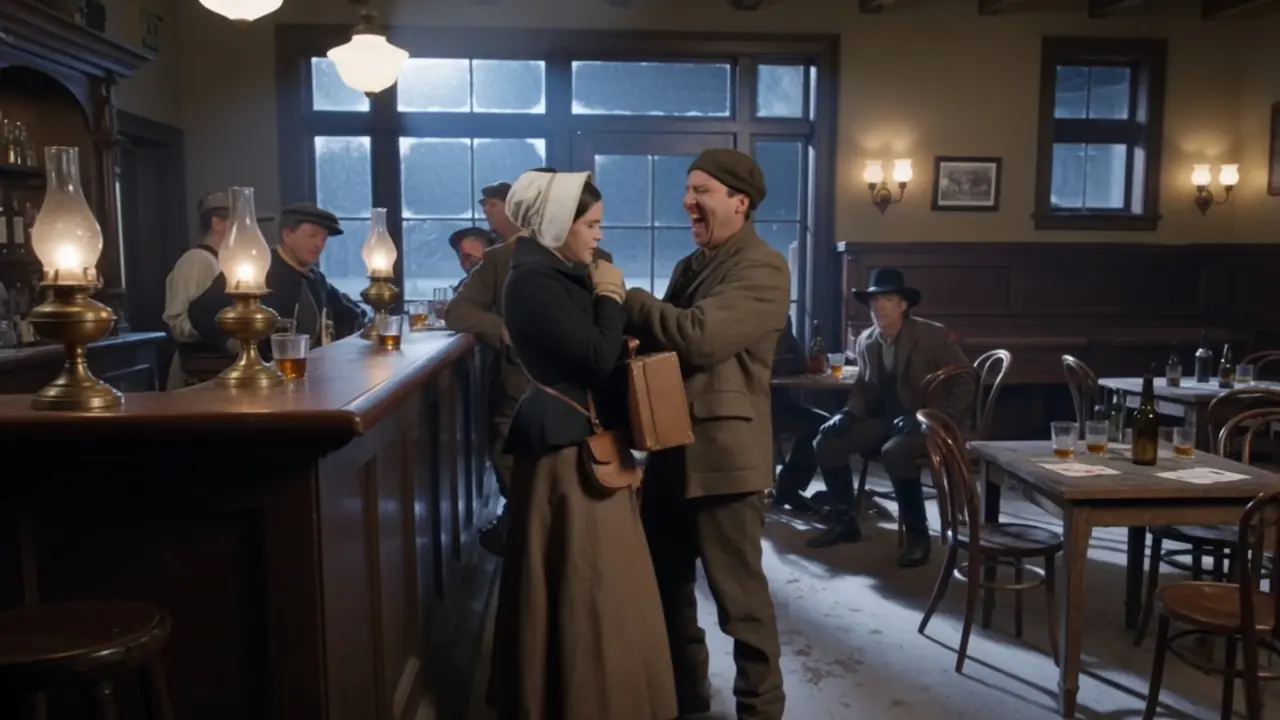
“Well, look at that,” the voice came from her left, lazy, amused, already slurring at the edges with whiskey. “Train must have brought us something worth looking at tonight.” Evelyn didn’t stop walking. “Hey,” louder now. A hand shot out and caught her arm. “I’m talking to you, darling.” She turned slowly and looked at the man holding her arm. He was big, wide through the shoulders with a red face and small eyes that had the particular gleam of a man who’d never once in his life been told no by anyone smaller than him. “Take your hand off me,” Evelyn said. He grinned.
The two men beside him grinned too. “Traveling alone,” he said, squeezing tighter. “In weather like this, that’s not smart, sweetheart. A woman alone needs somebody looking after her.” “I’m looking after myself just fine.” She held his gaze. “Which is more than I can say for your grip. Let go.”
He didn’t let go. Instead, he stepped closer and the men on either side shifted to cut off the space around her. The barkeep suddenly found something very interesting to study at the far end of the counter. The piano player kept playing and the rest of the room kept drinking. Evelyn Cross felt the first real spike of genuine fear run through her chest like a cold wire. She looked toward the back of the room instinctively, the way you look for a door when the walls start closing in. And that was when she saw him. He was sitting alone at a corner table with a glass of whiskey he hadn’t touched and a pair of eyes that had been watching her since the moment she walked through the door. He wasn’t a large man in the way the drunk was large.
He wasn’t wide or loud or puffed up with the need to prove something. But there was a quality to the stillness of him that made the air around him feel different, heavier, like standing near the edge of something very deep. He had dark hair gone slightly gray at the temples, a jaw that looked like it had been carved rather than grown, and a scar that ran along his left cheekbone, thin and old and silver in the lamplight that told the story of a man who had survived things most men hadn’t. He was watching her the way a man watches a situation he hasn’t decided to enter yet. Evelyn, without knowing why, without knowing anything about him at all, looked directly back at him and held his gaze.
The drunk yanked her arm. “Stop ignoring me.” “Touch her again,” the voice came low, almost conversational. The kind of quiet that’s louder than shouting because it means whoever’s speaking has nothing left to prove. “Touch her again and you’ll lose that hand before you feel the pain.” The drunk froze. The entire saloon froze.
The man from the corner table was standing now. He hadn’t moved fast. Evelyn hadn’t even seen him rise. He was simply standing, the way a mountain is simply there, with his right hand resting loose at his side and his eyes fixed on the drunk with an expression that contained no anger whatsoever. That was the part that was frightening. Not rage, not heat, just cold, absolute certainty. “Colt Mercer,” someone behind Evelyn whispered.
The name moved through the room like a current. The drunk’s grip went slack. His face changed, the bravado draining out of it so fast it was almost comic, replaced by something raw and pale and animal. “I didn’t. We were just talking.” “You weren’t talking,” Colt didn’t move. “You were holding. There’s a difference.” He looked at the man’s hand still loosely wrapped around Evelyn’s arm. “I’ll say it once more.” The drunk let go. He stepped back.
His two friends stepped back with him practically tripping over each other. All three of them were making their way to the far end of the bar with their drinks and their bruised pride and their eyes pointed carefully at the floor. The saloon exhaled. The piano started up again. Colt Mercer picked up his whiskey glass from the table, finished what was in it in a single swallow, and sat back down like nothing had happened at all.
Evelyn stood exactly where she was, her arm finally her own again, her heart still slamming against her ribs. She should have said thank you and found her corner and kept her head down. That was what she should have done. Instead, she walked directly to his table. He looked up when she stopped in front of him, not surprised, just watching. Those eyes up close were darker than she’d expected, the color of river water over deep rock. “Thank you,” she said. “Don’t mention it.” “I mean it. That could have gone badly.” “It wasn’t going to go badly,” he said it simply without pride. Just fact. “Not in here. Not tonight.” She stood there for a moment. Something in his tone suggested the conversation was over.
Something in her situation suggested she needed it not to be. “My name is Evelyn,” she said. He looked at her for a long moment. “I know who you are,” he said. Her blood ran cold. “What does that mean?” “It means the barkeep told me there was a woman on the train from back east traveling alone on a stolen ticket.”
He wrapped one hand around his empty glass. “Whole town knew before the train stopped.” Evelyn pulled out the chair across from him and sat down without being invited. “Then I need you to listen to me,” she said. “Because I think I have about twenty minutes before this gets significantly worse.” Something shifted in his expression. Not warmth exactly, more like the slight adjustment of a man recalculating something. “Talk fast,” he said.
She talked fast. She told him about Nathaniel Baron. Not everything, not the worst of it, but enough. Enough to explain why she’d taken a ticket that wasn’t hers and gotten on a train headed for the edge of the country instead of walking down the aisle of a church in Philadelphia like her father wanted. Colt listened without interrupting, without his expression changing much either, which was somehow worse than if he’d looked shocked or sympathetic.
He just listened the way a man listens when he’s deciding something. When she finished, the saloon doors burst open. Four men walked in. They weren’t dressed like miners and they weren’t dressed like cowboys. They were dressed like men who got paid to find things. Dark coats, flat eyes, the particular posture of people who’ve learned that everything in the world can be bought if you’re willing to pay. Evelyn’s chair scraped back half an inch before she caught herself. Too late. She’d already looked at them. One of them, the one in front with a face like weathered leather and eyes that missed nothing, had already looked back. “Railroad men,” Colt said quietly. Not a question. “Yes. They know your face.” She swallowed. “The man who sent them does. He would have shown them a photograph.”
Colt didn’t look at the men. He kept his eyes on his empty glass and he was very, very still for a count of three seconds. Then, without looking up, he said, “How much do you want to go back?” “I would rather die.” Another three seconds of silence, then “Stop talking,” he said. “And do exactly what I do.” He reached across the table and took her hand. Not gently, not tenderly. He took it the way you take hold of something you need, firm and deliberate, and his thumb pressed once against her knuckles as if to say stay still, stay calm, stop looking at them. The lead railroad man was scanning the room. His gaze moved across the tables systematically, professionally, the way a man searches who has done it many times before.
It reached their table and stopped because what he saw was a man and a woman sitting together in the easy settled way of people who belong to each other. The woman’s hand in the man’s hand on the tabletop, the man’s eyes moving slowly up from his glass to meet the railroad man’s gaze with the complete unhurried disinterest of someone who has absolutely nothing to hide. The railroad man’s eyes moved on. Evelyn didn’t breathe for thirty seconds. When the man finally turned away, she let the air out of her lungs so slowly it almost hurt. Colt released her hand. “They’ll do a full pass of the room,” he said quietly. “Then they’ll ask the barkeep about passengers. He’ll tell them about the woman traveling alone on the stolen ticket.
Then they’ll start asking if anyone’s seen her.” “How long does that give us?” “Twelve minutes, maybe less if the bar keeps nervous.” “What do we do?” Colt finally looked up at her. In the lamplight, his expression was unreadable. Not cold exactly, but sealed like a door that’s locked from the inside. “There’s one thing I can do,” he said. “That makes you invisible to them tonight. One thing that makes them walk out of this saloon without you.” She waited. “But you’re not going to like it,” he said. “Tell me anyway.” He set down the glass. From this moment on, he said, his voice dropping low enough that only she could hear it across the small table. “You are my wife.” Evelyn stared at him. “You’re my wife.” No apology in it. No softening. “Colt Mercer’s wife. Everybody in this county knows that name. And nobody who works for a railroad heir is going to risk the kind of trouble that comes with touching something of mine.” “I am not something of yours.” “You are tonight.” His eyes didn’t waver. “Or you’re theirs. Choose fast, Miss Cross. We’ve got eleven minutes now.”
She chose. God help her. She chose. When the lead railroad man made his second pass of the room and stopped at their table to ask if they’d seen a woman traveling alone, young, well-dressed, dark hair, Colt looked up at him with the same slow, total disinterest as before. “My wife,” he said. He reached over without looking at Evelyn and tucked a strand of hair behind her ear with a touch so unhurried, so completely natural that she nearly forgot it wasn’t real. “She’s been with me since the train stopped,” Colt said. “We’ve been sitting here for the better part of two hours. I don’t make a habit of noticing other women when mine is in the room.” The railroad man looked at Evelyn.
She smiled at him, the kind of smile that costs everything to hold steady. “Long trip,” she said. “We’re both exhausted.” The man looked between them for three long seconds, then he moved on. They sat at that table for another forty minutes until the railroad men gave up their search of the saloon and moved on to other buildings. Colt ordered two more whiskeys, one for himself, one he placed in front of her without asking. She drank it, all of it.
Neither of them spoke much. At some point, the piano player finally hit the right notes on something, and the drunk who’d grabbed her arm earlier left through the back with his friends, and the blizzard outside kept howling. Evelyn Cross sat across from a man she’d known for less than an hour, who had just told three railroad enforcers that she belonged to him. She thought about what that word meant to her. Belonged. What it had meant in her father’s house, what it had meant in Nathaniel Baron’s smile when he’d looked at her across the dinner table like she was a painting he’d already purchased.
Then she looked at Colt Mercer, who was staring at the window with the expression of a man working through something difficult, and she thought this is different. She didn’t know why she thought that. She didn’t know him. She didn’t know anything except that when he’d put his hand over hers, it had felt like a door closing between her and something that wanted to hurt her. She kept that thought to herself. “Thank you,” she said again when they were the last ones at their end of the bar. “Don’t thank me yet,” he said. “They’ll be back. Men like that don’t stop because they hit one dead end.” “I know. They’ll check the hotel, both of them. They’ll go room by room if they have to.” “I know that too.”
He turned and looked at her directly for the first time since they’d been sitting together. His eyes moved across her face in a way that was thorough without being unkind, reading her the way you read terrain before you cross it. “You said you’d rather die than go back,” he said. “I meant it.” “I believe you.” He paused. “I’ve got a ranch six miles out of town up in the hills. Nobody goes out there unless I invite them, and I don’t invite people.” Evelyn waited. “It’s one night,” he said.
The storm breaks by morning. The train runs again and you get on it headed somewhere else and you don’t look back. In exchange, he was quiet for a moment. “Nothing,” he said. “No exchange. You’re not in a position to offer me anything I need.” He said it without cruelty, just as a fact. “But I’ll tell you what the arrangement is. You come to my ranch tonight, you keep up the story, and at sunrise you’re gone. No emotions, no questions, no complications.”
Evelyn tilted her head slightly. “You make a habit of this, rescuing women from railroad men?” “No.” “Then why?” He was silent for longer than she expected. “I don’t like men who use their money to own people,” he said finally. Simple as that. She looked at him for a moment. Then she picked up her suitcase and stood. “All right, Colt Mercer,” she said. “Lead the way.” They rode out of Black Hollow in the dark and the snow. If anyone watched them go, they saw exactly what they were supposed to see. A man taking his wife home through the storm, moving together the way people do when they’ve done it a hundred times before. The road into the hills was rough and the wind cut sideways. Colt rode slightly ahead without speaking, which was fine because Evelyn didn’t feel like speaking either. She was thinking about her father.
She was thinking about the letter he’d sent three weeks ago, the one she’d read standing in the hallway of his house in Philadelphia, her hands perfectly still because she wouldn’t let them shake. The letter that explained in careful apologetic language that the arrangement with Nathaniel Baron had been finalized and that her feelings on the matter were unfortunately no longer a factor that could be considered. She was thinking about how long she’d been a daughter before she decided to become something else. About halfway up into the hills, Colt reined in his horse and she pulled up beside him. “Two things,” he said, still facing forward. “All right.” “The men who work my ranch, they’ll accept the story without question.
You don’t have to convince them. But you’ll behave like you mean it when they’re around because I’m not explaining myself to my own people.” “Understood.” “And the second.” He finally turned and looked at her in the dark. The snow had settled on the brim of his hat. In the cold, his breath came out in slow, even clouds. “My nephew lives with me,” he said. “Noah. He’s nine years old. He lost his parents eight months ago.” A pause. “He’s a quiet boy right now.
He doesn’t need to know this isn’t real. So, whatever else you do, don’t give him reason to get attached to something that isn’t going to stay.” There was something in the way he said it flat, controlled, the same level voice he’d used for everything else, that struck Evelyn somewhere low in her chest. He wasn’t asking her to protect himself. He was asking her to protect a nine-year-old boy from another loss. “I understand,” she said quietly. He nodded once, turned back toward the trail. They rode the rest of the way in silence.
The ranch appeared out of the dark gradually. First the shape of the big barn, then the main house with its wide porch and two warm squares of lamplight in the windows. They’d left a light on for him. That detail, small, domestic, almost heartbreaking in its ordinariness, caught Evelyn completely off guard. A young ranch hand named Pete came out to take the horses and stopped short when he saw her. His eyebrows went up. “Evening, boss. Didn’t know you were bringing my wife,” Colt said, swinging down from the saddle. He said it exactly the way he’d said everything else, flat, final, not open for discussion. “Storm came in fast. She was on the train.” Pete looked between them. Then he nodded, his face settling into careful neutrality. “I’ll get the horses settled,” he said. “Marta left supper on the stove.” Colt moved toward the house without waiting. Evelyn followed.
The inside of the house was warmer than she’d expected and more lived in than she’d feared. It didn’t have the feel of a bachelor’s fortress. It had the feel of a place that was trying to remember what it was like to be a home, dishes in a cabinet, a worn quilt over the back of a chair, a row of small boots by the door that could only belong to a child. A woman in her fifties came out from the kitchen, broad-shouldered, quiet, with the particular no-nonsense energy of someone who had run a large operation for a very long time. “Marta,” Colt said. “My wife needed a warm place to ride out the storm.” Marta looked at Evelyn with eyes that took in a great deal in a very short time. “Supper’s on the stove,” she said. “I’ll make up the room.” “The room’s fine as it is,” Colt said.
Marta looked at him steadily for a moment. “I’ll put fresh sheets on it anyway,” she said, which was apparently not a negotiation. She disappeared back toward the kitchen. Evelyn turned to find Colt watching her with that same sealed expression. “She doesn’t believe you,” Evelyn said quietly. “Marta doesn’t believe anything until she decides to,” he said. “It’s her best quality.” A door opened at the far end of the hall. The boy who appeared was small for nine and dark-haired with Colt’s same coloring. Evelyn noticed, though his eyes were different, lighter, more open. He was wearing a nightshirt and wool socks and holding a book against his chest with both arms, the way children hold things they want to keep safe.
He looked at Evelyn, then at Colt, then back at Evelyn. “Who’s she?” he said. “Her name’s Evelyn,” Colt said. “She’ll be staying tonight.” “Why?” “Because the storm’s bad and she needed somewhere warm.” Noah considered this. He had the particular gravity of a child who had been through enough that he’d stopped accepting easy answers as quickly as other children did. “Are you nice?” he asked Evelyn directly. She didn’t laugh.
She didn’t smile in the way adults smile at children to seem less threatening. She just looked at him straight. “I’m trying to be,” she said. “Some days are better than others.” Noah appeared to find this acceptable. He looked at the book in his hands. “I was reading,” he said to no one in particular. “Then go read,” Colt said. “It’s late.” The boy retreated back down the hall. Evelyn heard a door close softly. She stood in the middle of Colt Mercer’s house in the middle of a Montana blizzard with a stolen ticket in her coat pocket and a fake marriage that was supposed to end at sunrise. Somewhere outside six miles down the mountain, men with photographs were still looking for her.