“You should have just been a good girl and signed that loan paper, Julia; you didn’t have to force your own sister to take it this far.” Mark’s voice dripped with fake sweetness, but the tone was dead cold. He stood right above me. I was collapsed on the freezing hardwood floor, my ears ringing and my vision blurring from the massive blow delivered by my own flesh and blood. Linda stood three feet away.
Her pale knuckles maintained a death grip on the heavy metal trophy. She didn’t scramble for her phone to call 911. Not a single tear of regret. She just stood there breathing heavily, glaring down at the sister she just cracked open to steal from. Six months before that trophy split, my skull opened.
The extraction operation started at a corner table in Uptown Charlotte on Friday night. The restaurant was a high-end steakhouse dripping with oversized crystal chandeliers and pretentious waiters in black vests. It was the kind of place where people went to be seen, not to eat. I sat in a curved leather booth, my spine rigid and my hands locked together on the white linen tablecloth. Across from me, my brother-in-law Mark shoved his latest iPhone directly into my sister’s face.
“Smile, babe; let them see the lifestyle.” Linda forced a wide, blinding smile. Her teeth looked too perfectly bleached in the dim yellow light. Click. Mark immediately hunched over the screen, typing out some garbage caption, probably tagging it, family first, with a champagne emoji.
I watched their performance in total silence. Mark wore a tight silk shirt that looked ridiculous on him. Linda had a brand new designer handbag resting on its own designated chair. I knew exactly what they made at their mediocre jobs. Their combined monthly income couldn’t cover the valet parking outside, let alone the private booth we were sitting in.
My combat instincts hummed in the back of my skull. The hair on my arm stood straight up. This was an ambush. Just four weeks ago, I took a piece of jagged shrapnel to my left shoulder during a deployment. A close call, a messy one.
My collarbone still carried a dull, grinding ache every time I took a deep breath. We had been sitting here for 45 minutes. Neither of them had asked about my arm. They hadn’t asked if I was sleeping at night. They were too busy staring at my wallet.
A waiter materialized out of the shadows and poured $150 Cabernet into Mark’s oversized glass. Mark took a slow, arrogant sip. His eyes darted to the cheap sweating bottle of Sierra Nevada resting in front of me. “Still keeping that broke-soldier vibe, I see, Julia,” Mark smirked. He tapped his gold wedding band against the heavy oak table.
Tap tap tap. A sugar-coated insult. He needed to shrink my disciplined life down to size so he could justify his bloated one. Linda jumped right in on cue. She swirled her red wine and started reminiscing about the fifth grade. how she supposedly saved me from the neighborhood kids who stole my lunch money.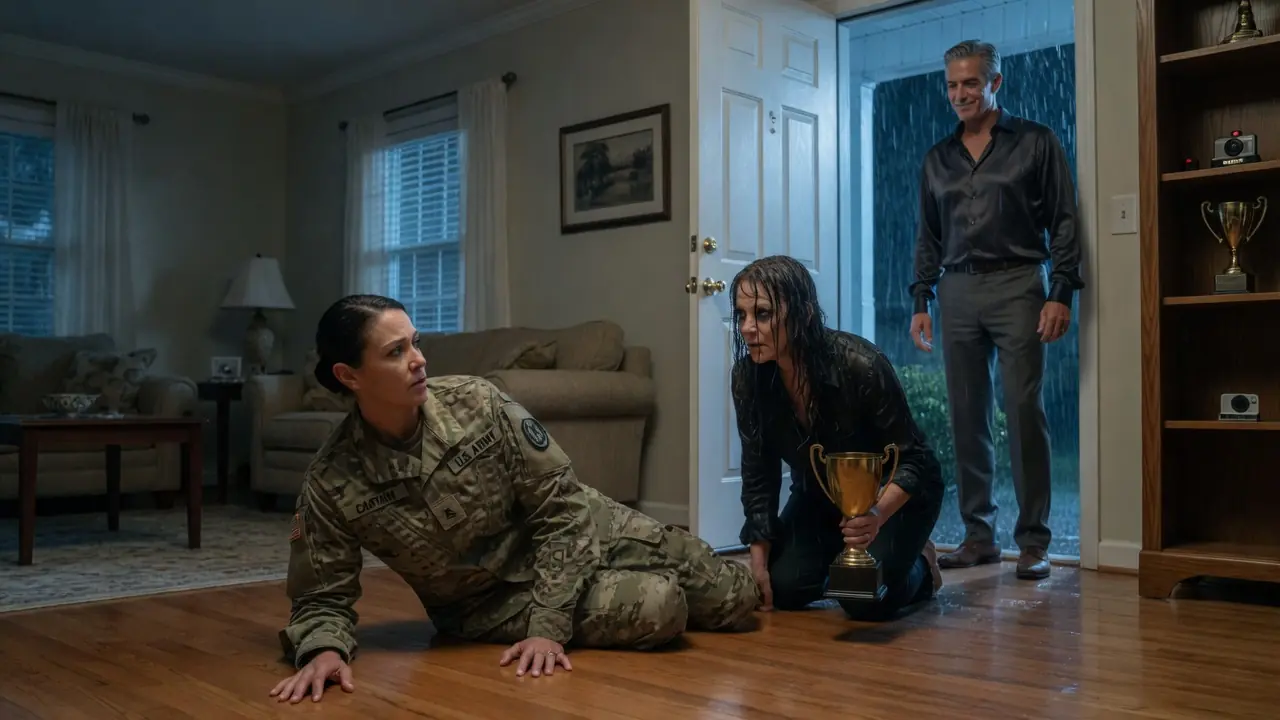
It was a tired, worn-out script. The psychological gas was leaking into the room. They were laying the groundwork, reminding me of some fabricated lifelong debt I owed them. Prepping the battlefield before moving in for the kill. The waiter returned, setting a massive bloody ribeye in front of Mark.
The heavy stench of charred animal fat crashed into the suffocating cloud of Mark’s Tom Ford cologne. My stomach turned. I took a slow drag of my bitter beer. I didn’t say a word. I just waited for them to drop the hammer.
Mark dropped his voice. He leaned heavily on the table, invading my personal space. Underneath the table, I saw the quick jerk of Linda’s pointed shoe kicking his shin. The signal. “We found the house, Julia,” Mark said, his eyes locked onto mine, suddenly desperate and hard.
“A gorgeous six-bedroom colonial down in South Park; the market is brutal right now, and, well, Linda’s credit got a little bruised last year.” Bruised? That was a real polite word for maxed-out credit cards, missed car payments, and looming repo men. “We need your VA loan,” Linda said. Her voice was totally flat, emotionless, like she was asking me to pass the salt.
They wanted me to sign my name on a federal military loan for a house I would never live in. Occupancy fraud. A federal felony that would instantly strip me of my rank, my security clearance, and my freedom. They knew that and they didn’t care. “It is your privilege,” Mark pressed.
His jaw tightened when I didn’t immediately cave. “You are single; you live on base half the time; you barely even use your benefits; you owe us this much for always looking out for you.” The word “owe” dropped onto the table and shattered. I looked at my sister, really looked at her. I thought about the hazard pay I earned sleeping in the freezing mud.
I thought about the firefights, the ringing in my ears, the blood I bled into foreign dirt just to earn my rank. They didn’t respect a single second of my service. To them, my military career was just a financial vehicle, a shiny mortgage tool they could hijack to buy a fake mansion they couldn’t afford. They didn’t see me as a human being. I was just a pristine credit score sitting in a uniform.
I let the silence stretch out until it became unbearable. I didn’t yell. I didn’t try to defend my life choices or explain the law. I kept my eyes deadlocked on Mark. “What is your contingency plan when your commissions drop next quarter?”
My voice was low, totally devoid of emotion. “I do not gamble my military record to underwrite your bad bets.” Mark’s face flushed deep red. The silk shirt suddenly looked like a noose around his neck. The fake wealthy mask completely slipped.
“Do not turn this into a damn base interrogation, Julia,” he snapped, slamming his fist down flat on the table. His silverware clattered loudly against the fine china. A few heads turned in the dining room. I didn’t flinch. I pushed my chair back.
The wood scraped harshly against the floor. I stood up towering over their table. Reaching into my uniform pocket, I pulled out a crisp $20 bill and dropped it onto the white tablecloth to cover my cheap beer. I didn’t look at Linda. I turned on my heel and started walking toward the exit.
Before I could take three steps, Mark’s voice cut through the noise of the restaurant like a rusty blade. He threw the final grenade. “Mom and Dad are going to be really disappointed when they hear you abandoned your own sister.” My boot froze on the floorboard. Mom and dad.
Mark’s parting threat scraped against the inside of my skull like coarse sandpaper. Mom and dad are going to be real disappointed. It tore open a wound that had been festering for over a decade. I pulled into my driveway. I did not turn on the living room lights when I walked inside.
The house was dead quiet. The shadows felt heavy. Everything was perfectly aligned just the way I left it. Boots squared by the door, keys resting on the brass hook. Order, control.
I needed it to keep my head from splitting open. I walked straight down the hallway to the spare closet. I reached up and dragged down the heavy wooden box hidden on the top shelf. Dust coated the lid dry and chalky against my fingertips. I set it on the kitchen counter.
There was no treasure inside this thing, no family heirlooms, just paper evidence of my own invisibility. I pulled out a faded photograph. Linda at 17. She was glowing, wearing an expensive dress, clutching a shiny debate trophy. Mom and dad stood on either side of her, beaming their hands, resting proudly on her shoulders.
And me, I was 14. Awkward, standing on the far edge. Whoever framed the picture had literally sliced my face in half to make it fit into a cheap store-bought frame. Half a face, half a daughter. The favoritism in that house was never a mistake.
It was a calculated daily campaign. When Linda turned 16, there was a refurbished Honda Civic sitting in the driveway with a massive red bow strapped to the hood. The backyard was filled with catered barbecue and 40 of her closest friends. The music shook the windows. My 16th birthday fell on a Tuesday.
We ate a frozen lasagna. Mom brought out a smashed sheet cake from the clearance rack at the local grocery store. The frosting tasted like cheap plastic. “Money is tight this year; Julia, you understand?” I did understand.
I understood it perfectly when exactly one week later, mom slipped Linda $500 in crisp cash so she could go on a weekend beach trip with her new boyfriend. I learned how to swallow that poison early. I swallowed it whole, digesting the hard truth that love in that house was a zero-sum game. If Linda won, I lost. So, I stopped playing their game.
I turned my eyes toward the military. I knew the army would be the only place that weighed me by my output, not my bloodline. The rank on my chest was the only thing nobody in that house could steal. Or so I thought, because they had already stolen everything else. The deepest cut did not happen with a knife.
It happened the summer I turned 15. I wanted to go to a wilderness survival camp. It cost $600. I got a job at a run-down ice cream parlor on the edge of town. I scrubbed the sticky, sour-smelling linoleum floors every night until the skin on both of my hands blistered, popped, and bled.
I did not spend a single dime. I folded every dirty dollar bill and shoved it inside a white envelope hidden directly under my mattress. Then came the phone call. Linda got drunk at a college frat party. She drove her shiny Honda straight through the neighbor’s wooden fence, snapping the posts like matchsticks.
No police were called. The neighbor wanted cash to keep quiet. That night, my bedroom door swung open. Dad walked in first. He stared at the floor carpet, his jaw tight, refusing to make eye contact with me.
Mom marched in right behind him. She did not ask. She did not hesitate. She grabbed the edge of my mattress and flipped it hard. I watched paralyzed as she snatched my white envelope.
The paper crinkled loudly in the quiet room. “Mom, please,” I whispered, my voice breaking. “That is for camp.” She stopped in the doorway and looked at me with completely dead eyes. “Family helps family, Julia; your sister made a mistake; you can go to camp next year.”
Her voice was absolute ice. There was no next year. The money was never paid back. I spent that summer scrubbing sour milk off the floor while Linda sat by a pool working on her tan. The script had never changed.
Not back then. Not tonight at the steakhouse. They hated my independence because it shattered their perfect little system. I was never meant to be a successful officer. I was meant to be the cleanup crew.
The human sandbag they used to absorb all of Linda’s failures. If I had money, it belonged to Linda. If I had a VA loan, it belonged to Linda. I stood in my dark kitchen, staring down at my half-face in that old photograph. My thumb flicked the metal wheel of my Zippo lighter.
A spark caught. The yellow flame flared up, casting long jumping shadows across the drywall. I brought the fire to the edge of the glossy paper. It curled instantly. The flame licked upward, devouring their fake beaming smiles.
The paper turned to black ash, sizzling and popping as the heat consumed the memory. I dropped the burning photograph into the stainless steel sink. I watched the last corner of Linda’s face turn into a glowing orange ember before crumbling into nothing. I reached out and twisted the heavy metal faucet. The cold water blasted out, hitting the ashes with a sharp hiss.
The black sludge washed down the drain in seconds, leaving the metal basin perfectly clean. If I did not build a fortress to protect myself, nobody else in this world was going to do it for me. And starting tonight, the gates were permanently locked. 4 in the morning. The digital alarm clock buzzed exactly once before my calloused hand slammed down on the plastic snooze button. I did not lie there staring at the ceiling.
I threw the heavy wool blanket off my body. The hardwood floor was freezing against my bare feet, sending a sharp shock straight up my spine. I reached for my field boots in the dark. I laced up the thick nylon strings, pulling them tight until the rigid leather locked my ankles in place. The pressure grounded me.
I grabbed the heavy metal chain collar hanging by the door. Ranger, my 90-pound German Shepherd, was already waiting. His tail hit the drywall with a steady rhythmic thud. We hit the North Carolina asphalt. The November air was razor sharp.
It scraped the back of my throat with every deep inhale. Plumes of white breath trailed behind us in the dark street lights. I pushed the pace faster, harder. I needed my leg muscles to burn. I needed the physical exhaustion to completely drown out the smell of burning photo paper still lingering in my kitchen sink.
Discipline was the only anchor I had left in this world. This house, the roof over my head, the silver bars pinned to my uniform. None of it came from them. Not a single red cent. I forged my own life out of cold steel and sweat, and nobody was going to take it from me.
My boots hit the pavement in a steady, heavy cadence. Left, right, left. The repetitive rhythm dragged my mind away from Charlotte and dropped it straight into the deep mud of Camp McCall. Special forces assessment and selection. It was raining sideways that morning.
The water was freezing. I had a 100-pound rucksack digging brutally into my shoulders, cutting off the blood circulation down to my fingertips. My left boot slipped deep into a hidden rut in the clay. My ankle twisted with a sickening audible pop. I went down hard.
I fell face first into the freezing Carolina mud. I tasted dirt, pine needles, and copper blood from my busted lip. I tried to push myself up. My arms shook violently under the weight of the wet gear. Before I could drag my knees under my chest, a shadow blocked the stinging rain.
Another candidate, a guy from Texas, whose last name I barely knew. He did not offer a hand. He did not offer empty pity or ask if I was okay. He just dropped to one knee in the muck, unbuckled the top canvas flap of my rucksack, and reached inside. He pulled out two heavy sandbags.
He shoved them into his own gear, fastened the straps tight, and gave me a single sharp nod. Then he stood up and kept walking into the storm. That was brotherhood. Real family does not stand over you while you bleed and ask what you can do for them. They carry the weight when your legs give out.
They do not strap a financial anchor around your neck and tell you to swim. Linda wanted to break my back for a down payment on a fake luxury life. A complete stranger took my rocks just so I could finish the march. The sun went down. The house was quiet again, but it was a different kind of quiet.
Not the suffocating, paranoid silence of last night. This was safe. Alex walked through the front door at 7. He did not knock. He dropped his keys heavily onto the granite counter.
His gold detective shield was still clipped to his leather belt, resting heavy against his hip right next to his service weapon. He looked completely exhausted. Deep dark circles bagged under his eyes from a 12-hour shift dealing with the worst criminals in the county. He did not ask how I was doing. He did not demand an emotional debrief about my sister.
He just took off his heavy jacket, opened the fridge, and pulled out a foil wrapped chicken casserole. He shoved it into the oven, closed the metal door with a clank, and leaned against the counter, crossing his arms in comfortable silence. 10 minutes later, the heavy brass knocker on my front door banged twice, loud, authoritative. I opened it. First, Sergeant Miller stood on my front porch. The man was built like a concrete cinder block.
He wore faded blue jeans and a plain gray t-shirt. The cold night wind whipped around his shoulders, but he did not seem to feel the temperature drop. He shoved a cheap scratched plastic Tupperware container into my chest. “Wife made these,” Sarge grunted. His voice sounded like grinding gravel.
“Let them in the oven too long; Edges are burned raw; Figure you could eat them anyway.” “I looked down at the dark, dense blocks of chocolate.” “Thank you, first sergeant.” “Welcome home, Captain,” he muttered. He turned on his heel and walked heavy back to his beat up Ford pickup parked on the curb.
He did not wait for a thank you or a goodbye. He just started the loud engine and drove away. rough, unpolished, but solid ground. A perimeter of steel built around my front door. I walked back into the kitchen. The smell of baked chicken and cheap chocolate filled the warm room.
Alex pulled two ceramic plates from the cabinet and set them down on the island. He scooped a massive portion onto my plate and slid it across the oak wood. “You are safe here,” Alex said. His voice was low. Steady.
I picked up my metal fork. I was finally ready to eat. Then the oak table violently vibrated. My iPhone lit up, piercing the dim kitchen lighting. The buzzing did not stop.
It was a relentless mechanical drilling noise tearing through the wood. The screen glared bright white, casting harsh, moving shadows across the deep lines around Alex’s eyes. Linda, you are a cold-blooded, selfish [ __ ]. Linda, you ruined everything for us. Mark, mom is crying on the floor because of you.
Mark, dad wants to know what the hell is wrong with your head. Mark, pick up the damn phone. The peaceful dinner shattered into a million pieces. The oxygen was sucked right out of the room. The toxic gas was seeping under the door again.
I stared at the glowing notifications stacking up rapidly on the glass screen. They were not asking for a conversation. They were calling in an air strike. I did not reply. I did not turn off the device.
I reached out and flipped the phone face down against the hard wood. The psychological siege had officially begun. The phone stayed face down on the oak table, but it did not stay quiet. For the next 24 hours, that piece of glass and metal turned into an active war zone. In the military, they put you through SE training, survival, evasion resistance, and escape.
They lock you in a box, cut off your sleep, and blast noise through the speakers to break your mind. They push you until you surrender. That was exactly what my family was doing. A coordinated, relentless psychological bombing campaign. The phone vibrated on the kitchen counter.
It buzzed in the cup holder of my truck. It rattled against my nightstand at 2 in the morning. 15 missed calls from Mark. I did not answer a single one. Then came the text messages. Linda sent a blurry photo of herself.
She was parked somewhere in the dark, her face buried in the leather steering wheel of her car. Mascara ran down her cheeks in thick black lines. You destroyed my dream. You are ruining my life. How can you be so cold, I did not type back.
I did not hit delete. My training as an investigator took over. You never destroy evidence. You document the threat. You let the enemy put their crazy in writing.
But Mark and Linda quickly realized the text messages were not breaking my perimeter. I was not caving. So they called in the heavy artillery, the flying monkeys. The screen lit up with a landline number, the Fayetteville area code, the house I grew up in. I stared at the glowing numbers for three long rings.
I reached out, pressed the green button, and hit the speaker icon. I set the phone flat on the cold granite countertop. Julia. Mom’s voice blasted through the tiny speaker. It was not a greeting.
It was a shrill piercing shriek. She did not ask how my shoulder was healing from the shrapnel. She did not ask if I was sleeping. Why are you so jealous of your sister’s success? Why are you trying to sabotage her?
I leaned my weight on my knuckles, staring down at the black screen. It is a federal VA loan, Mom. It is a felony for me to sign for a house I will not live in. Oh, stop being so dramatic,” she yelled, her voice cracking with pure venom. “She just needs to borrow your credit score for a little bit; you have free housing on base anyway; Why do you always have to make everything a big deal?
“Why do you always have to be so difficult?” I closed my eyes. The logic was completely gone. She took federal mortgage fraud, the risk to my security clearance and my entire military career, and swept it straight into the garbage. In her eyes, I was not an army captain.
I was not a combat veteran trying to protect my livelihood. I was just an ungrateful, stubborn brat standing in the way of her golden child. There was a muffled scuffle on the other end of the line. The heavy breathing shifted. Julia, listen to me.
Dad. He took the receiver. He dropped his voice an entire octave. It was the classic slow, disappointed tone, the exact tone he used to put me in my place when I was a teenager. I taught you to have principles, he said the words slow and heavy, dragging through the speaker.
I taught you to stand your ground. But family stands above principles, Julia. If you turn your back on your own flesh and blood over some damn paperwork, then what the hell does that uniform even mean? That was a heavy, dull knife straight to the gut. He grabbed the handle and twisted it deep.
My whole life, he hammered the idea of self-reliance into my head. Earn your keep. Follow the rules. Stand on your own two feet. He used those rules to justify giving me nothing while handing Linda the world.
But the second those rules inconvenienced his favorite daughter, he threw them right out the window. The principles he beat into my head were completely worthless. They were just chains meant to keep me in line while Linda got to do whatever the hell she wanted. The hypocrisy was so thick it was hard to breathe. The tight pain in my chest did not turn into tears.
It turned into ice. My heart rate actually slowed down. The kitchen felt incredibly still. I leaned closer to the phone. Principals do not have exceptions, Dad.
My voice was completely flat. Dead. Do not you dare speak to me in that. I tapped the red button. The call cut out instantly.
The kitchen was dead quiet. The only sound was the low, steady hum of the refrigerator. I picked up the phone. I tapped mom and dad’s home number. Scroll down.
Block this caller. I tapped Mark’s cell phone number. Block this caller. I tapped Linda’s number. Block this caller.
Three strokes of my thumb and they were gone. Erased from my grid. I walked out of the kitchen and went straight down the hallway to my bedroom. I pulled the heavy steel lock box out from under the bed. I punched in the code.
The heavy lid popped open with a solid mechanical click. I reached inside and pulled out my Glock 19. The black steel was freezing against my palm. I grabbed a rag and a small bottle of Hops number nine gun oil from the shelf. I sat on the edge of the mattress and wiped the metal down in the dark.
The sharp chemical smell of the solvent filled the room. I picked up a loaded magazine from the hard plastic case. I slammed it upward into the grip. Click. I gripped the slide with my left hand, ignoring the dull, grinding ache in my healing shoulder.
I pulled it back hard and let it slam forward. Clack clack. A round sat perfectly in the chamber. The boundary was set. Anyone who crossed it now was entirely on their own.
My silence drove them completely insane. 3 days after I blocked their cell phone numbers, the old landline in my kitchen started to ring. Nobody ever called that number except telemarketers and confused bill collectors. I stared at the flashing red light on the wall unit. I walked over and picked up the heavy plastic receiver. Julia, sweetheart, Aunt Carol.
Her voice dripped with fake sugary pity. It was the exact tone people reserve for sick dogs or tragic accidents. I am just checking on you, she whispered, lowering her voice like she was sharing a dangerous secret. Mark called us this morning. He’s really worried about you.
He said you have been acting paranoid lately. Aggressive. He thinks the shrapnel incident and your time over in Kandahar, well, he thinks your PTSD is getting worse. He told the family, “You are not in your right mind to handle your own finances anymore.” My grip on the plastic receiver tightened until my knuckles turned stark white.
The air in the kitchen suddenly felt razor thin. They were no longer just after my credit score. They were coming for my uniform, my honor. Mark was actively spreading a calculated smear campaign across the entire extended family. He took the actual blood I left in the sand in Afghanistan, the long nights I spent staring at the ceiling for soldiers who did not come home and weaponized it.
He was branding me a crazy, unstable, violent veteran just to cover up his own disgusting greed. I did not cry. I did not scream into the receiver. I did not try to explain myself or defend my sanity to Aunt Carol. Do not call this number again, I said.
I place the receiver back onto the wall cradle with a soft final click. In the military, when the enemy uses dirty tactics, you do not sit in a trench and feel sorry for yourself. You do not play defense. You find their weak point and you break it in half. Why was a supposedly wealthy middle-class couple so desperate for my VA loan that they were willing to commit federal fraud and destroy my military reputation?
I walked over to the kitchen window and yanked the heavy blackout curtains shut. I dumped two heaping scoops of cheap grounds into the coffee maker and hit the power switch. The smell of burnt, bitter coffee quickly filled the room. I carried a black ceramic mug into my home office and sat down at my heavy oak desk. I flipped open my encrypted laptop.
The pale blue light washed over my face in the dark room. I cracked my knuckles. I shifted my brain from a targeted victim into a military intelligence officer. Open-source intelligence os. If you know exactly where to look, people leave massive, careless digital footprints.
I bypassed their fake Instagram smiles and logged straight into the Meckllinburgg County public records database. Data does not lie. Data does not gaslight you. I typed Mark’s full legal name and social security number into the search bar. The mechanical click of my computer mouse echoed sharply in the quiet room.
Click. Mark’s tax and employment records loaded onto the screen. It was a complete graveyard. He was not a hot shot real estate broker. He was an empty shell.
The state unemployment registry showed he was terminated from his brokerage firm three entire months ago. He was unemployed. He was bleeding cash every single day, yet he was still posting pictures on the golf course with a $100 glass of scotch in his hand. I took a slow burning sip of the black coffee. I typed in Linda’s name.
Click. Her credit history was a massive pile of ash. Her credit cards were completely maxed-out. Two separate foreclosure notices were hanging by a thread on their current property. But that was not the detail that made the hairs on the back of my neck stand straight up.
I scrolled down to the county civil court records. The red text glared back at me from the bright LED screen. It was an active civil subpoena. Linda was buried deep in a massive web of predatory payday loans. Payday loan sharks.
The kind of dangerous people who do not just ruin your credit score. They show up at your front door in the middle of the night and break your kneecaps. I leaned back in my heavy leather desk chair. The metal springs groaned loudly in the silence. I stared blankly at the glowing red numbers on the screen.
There was no gorgeous six-bedroom colonial house in South Park. The luxury dreamhouse was a complete illusion, a theatrical prop. They were drowning in dirty water. The lone sharks were tightening a wire around their throats and they were suffocating. Their master plan was to use my pristine military record to extract massive amounts of clean cash from a federal VA loan.
They were going to dump the money onto their street debt, save their own skin, and leave me holding the bag when the federal investigators came knocking. They were literally trying to save their own legs by feeding me to the wolves. I set the coffee mug down on the wooden desk. I just saved myself from a total financial death sentence. All I needed to do was hand this hard data over to the right people.
I grabbed my cell phone from the desk. I dialed Alex’s number. He worked in the detective division. One look at this file and Mark would be wearing federal handcuffs before sunrise. I lifted the phone to my ear and listened to the first long ring.
Suddenly, a massive violent pounding erupted at my front door. Bang! Bang! Bang! The heavy wood shuddered violently in its frame.
The noise shattered the dead silence of the night like a shotgun blast. The frantic pounding on the door cut completely through the dial tone in my ear. 11:00 at night. A brutal Carolina storm was tearing through Fayetteville, but the fists slamming against my front door were louder than the thunder. I dropped the cell phone on the desk. I walked quickly down the dark hallway and pressed my eye against the cold brass peepphole.
Linda. She stood on the concrete porch, completely soaked by the freezing rain. Her hair was plastered to the sides of her face. Her makeup ran down her cheeks in thick, dark streaks. She was pounding on the wood with both fists shaking violently.
“Julia, open the door!” she screamed. Her voice was raw, tearing through the howling wind. “Mark hit me; he left me out here.” My military brain immediately flagged the situation. Threat risk!
Do not open the door. My training screamed at me to step back and dial 911. Let the local police handle the domestic dispute. But beneath the uniform, beneath the discipline, there was a tiny, stupid remnant of a little sister. The kid who used to sneak extra candy for her older sister.
The kid who still deep down foolishly believed blood actually meant something. I made the only fatal mistake in this entire war. I reached out and unlocked the deadbolt. The heavy door swung open. Linda stumbled inside, bringing the storm with her.
The freezing wind swept through the hallway, but it was immediately overpowered by a sickening sour stench. Cheap booze. She rire of bottom shelf vodka. I pushed the door shut, cutting off the storm. When I turned back around, Linda was not crying anymore.
The tears were gone. Her posture changed. She stood completely upright in my living room, her chest heaving. Her eyes were wide wild and darting around my clean house like a cornered animal. This is all your fault, she snarled.
The desperation in her voice was gone. It was replaced by pure toxic venom. You did this to us. You made us lose everything. I took a slow, calculated step backward, creating a physical gap.
I slipped instantly into deescalation mode. Keep the voice low. Keep the hands visible. You are drunk, Linda. Stand right there.
I am getting you a towel. I turned my body slightly to head toward the kitchen. One second. That was all it took. One single second of exposed vulnerability.
Out of the corner of my eye, I saw a sudden blur of motion. Linda lunged forward. Her hand grabbed the heavy solid brass debate trophy sitting on my bookshelf. The very same trophy she won when she was 17. The one my parents were so proud of.
Crack. The two-lb block of solid metal smashed directly into my left temple. The force of the blow was sickening. It was not a warning strike. It was the full force swing of a desperate person backed into a financial corner.
The world instantly exploded into a blinding white flash. A high-pitched deafening ring blew out my eardrums. Gravity completely vanished. I collapsed. I hit the hardwood floor hard.
Instinct took over. I threw my left arm out to break the fall, but the angle was wrong. My healing shoulder jammed upward. The joint popped completely out of the socket with a sharp blinding tear of pain. I laid on the cold oak floor, completely paralyzed by the shock.
Hot, thick blood immediately started pouring from the side of my head. It pulled fast, sticky, and warm running directly into my left eye and blurring my vision into a hazy red smear. Through the heavy fog of the concussion, through the violent ringing in my ears, I heard a sound. The front door hinges creaked open. Heavy calm footsteps walked into the hallway.
I could not move my neck, but my right eye tracked the movement. Mark walked into my living room. His expensive slacks were completely dry. His silk shirt was spotless. He did not drive away.
He never left. He was sitting in his car the entire time, waiting out in the dark rain. This was not a drunken outburst. This was not a domestic dispute. This was a fully premeditated setup.
He stopped right in front of me. He looked down at my body, twisted on the floor, bleeding out on the expensive wood. There was no panic in his eyes. No shock. He looked at me the same way a man looks at a piece of garbage blocking his driveway.
He lifted his foot. The soft toe of his suede shoe nudged my ribs, checking to see if I was breathing. You should have just been a good girl and signed that loan paper. Julia, he said. His voice was dead cold, perfectly matching the tone he used at the steakhouse 6 months ago.
They thought I was unconscious. They thought the heavy blow completely knocked me out. But beneath the mask of blood, my right eye was open just a fraction of an inch. I was not looking at Mark’s shoes. I was looking past him, straight at the bookshelf.
Right next to the empty spot where the brass trophy used to sit, there was a tiny unblinking red light, the pet cam. It was recording every single second of their performance in crystal clear highdefin video. I forced my lungs to stop heaving. I slowed my breathing down to a shallow, invisible rhythm. I laid perfectly still in my own blood.
I played dead. Let me know I am not the only one who had to learn this lesson the hard way. Mark turned away from my body. He looked at Linda who was still clutching the bloody brass trophy, her hands shaking violently. Wipe the base.
Mark ordered his voice flat, then grabbed her cell phone. We have work to do. The heavy front door slammed shut. The brass hinges rattled. They were gone.
Running into the dark like the cowards they were. I lay there on the cold hardwood floor, surrounded by my own blood. The massive spike of adrenaline flooding my system was the only thing keeping the room from spinning completely out of control. A normal person, a civilian, would have started screaming. They would have grabbed their phone and immediately dialed 911.
I did not. I was a soldier. If I called 911 right now, the local EMTs and patrol officers would rush in. The crime scene would be heavily trampled by muddy boots. Worse, Mark would eventually catch wind of the police scanner.
He would show up at the hospital flashing his fake worried smile using his status as family to gain access to my room. He would try to spin the narrative before I could even speak. I was not going to give him the chance to play the concerned brother-in-law. I bit down hard on my bottom lip to stop my teeth from chattering. Using my right hand, the one that was not currently attached to a dislocated shoulder, I awkwardly dug into the tactical pocket of my cargo pants.
I pulled out my cell phone. The screen was smeared with a sticky red fingerprint. I hit Alex’s speed dial. He answered on the first ring. Assaulted?
I gasped out. My voice was a weak rattling rasp. Weapon was a heavy metal trophy. Hostiles have retreated. Scene is uncontaminated.
Get here now. I dropped the phone on the wood. 10 minutes later, the deadbolt clicked. Alex used his spare key. He pushed the door open. He took one look at the blood smeared across the floor and his jaw locked into a hard, rigid line.
Despite the fact that he was my boyfriend, the gold detective badge clipped to his belt glowed with absolute cold professionalism. He did not rush over and fall to his knees crying. He did not pull me into a messy hug and contaminate my clothing. He stayed exactly where he was. He reached into his jacket pocket and snapped a pair of blue latex gloves over his hands.
The rubber snapped loudly in the quiet room. He stepped carefully around the massive pool of blood pulling out his camera. He started taking wide-angle shots of the entire room. The flash blinded my right eye repeatedly. “We will pop that shoulder back in later,” Alex said.
His voice was completely horsearo, strangled by the sheer effort it took to contain his rage. I weakly lifted my right index finger, pointing a shaky line toward the empty spot on the bookshelf. “Get the SD card out of that camera,” I whispered. “That is the final nail in their coffin.” 2 hours later, I was sitting on a stiff, sterile bed inside the emergency room at Capefir Valley Medical Center. The sharp chemical smell of iodine and bleach burned the inside of my nose.
The ER doctor just finished stitching up the deep gash on my left temple. Seven tight black stitches pulled the skin together. “Brace yourself,” the doctor muttered. He grabbed my left arm. He twisted it sharply outward and shoved upward with all his weight.
A sickening hollow pop echoed off the tiled walls as the bone forced its way back into the socket. A fresh wave of cold sweat broke out across my forehead. I squeezed my eyes shut, refusing to make a sound. The heavy wooden door to my hospital room swung open. It was not my mother running in to check on me.
It was not my father demanding to know who hurt his daughter. It was first Sergeant Miller. He walked into the sterile room, followed closely by three heavily built soldiers from our tactical unit. They were all wearing civilian clothes, jeans, boots, dark hoodies. But the way they moved, the way their eyes immediately scanned the room for exits and blind spots radiated pure raw combat energy.
They carried the heavy, unmistakable silence of men who just got back from a war zone. Nobody brought cheap balloons from the gift shop. Nobody handed me a card with a stupid poem inside. They did not say a word. They just quietly spread out.
One soldier leaned his back against the glass window, completely blocking the line of sight from the parking lot. The second soldier posted up directly outside my door in the main hallway, arms crossed. The third stood at the foot of my bed. Sarge Miller walked up to my side. He looked down at the bloody bandages wrapped around my head and the heavy sling securing my arm.
His face was carved out of stone. Get some sleep, Captain. Sarge said his voice a low grally rumble. Everything outside this room we handle. I closed my eyes.
The rigid tension in my chest finally cracked just a little. For the first time all night, I let a single hot tear slip out of the corner of my eye and soak into the stiff hospital pillow. I did not cry because of the pain in my shoulder or the throbbing in my skull. I cried because I finally realized that my real family was standing guard right outside that door. The sun came up, casting long, pale shadows across the linoleum floor.
The door opened. Alex walked back into the room. His suit jacket was badly wrinkled. His tie was loose and his eyes were bloodshot from being awake all night. He reached into his breast pocket and pulled out a small clear plastic evidence bag.
Inside the bag was a tiny black SD card. Along the plastic edge of the card, there was a single dried brown smear of my blood. He held the bag up to the fluorescent light. He smiled. It was not a happy smile.
It was a cold, calculated sneer. Full 1,080p resolution. Audio is crystal clear, Alex said softly. Welcome to hell, Mark. 3 months later, Cumberland County Courthouse. The air inside the building smelled like industrial floor wax and old dry oak.
I pushed through the heavy swinging gate and took the long walk to the wooden witness stand. I did not wear a cheap department store suit. I did not sit there with my head bowed playing the role of the fragile weeping victim. I wore my army dress blues. The dark fabric was immaculate.
The creases in my trousers were ironed razor sharp. The brass buttons caught the harsh glare of the overhead fluorescent lights. My left arm was still strapped tight against my ribs in a heavy black medical sling. I raised my right hand, placed my palm flat against the worn leather cover of the Bible, and swore to tell the truth. I sat down and looked out into the gallery.
Mom was sitting in the second row. She was clutching a crumpled floral tissue in both hands, her knuckles completely white, but her anxious red-rimmed eyes were not looking at me. She did not care about the stitches buried in my hairline or the torn ligaments in my shoulder. She was staring directly at the defense table. She was staring at Linda.
My sister sat there in a cheap gray blazer, trembling, trying to play the part of a terrified housewife. My mother’s deep, unconditional love was on full display in that courtroom. It just never included me. Mark’s defense attorney stood up. He buttoned his custom-tailored suit jacket and walked slowly toward the stand.
He was expensive. You could smell the arrogant, overpowering cologne from three feet away. He had one card left to play to keep his clients out of a concrete cell, and it was the dirtiest trick in the book. “Captain John,” he began, keeping his voice smooth and condescending. He leaned his forearms against the wooden railing.
“Is it true that during your deployment to Kandahar, your unit experienced heavy sustained combat?” “Yes.” “And since returning stateside, you have received medical counseling through the VA for PTSD; Correct?” I stared at him. I did not blink.
My breathing stayed perfectly even. “Is it possible,” the lawyer pressed, pacing slowly in front of the jury box, “that your untreated combat trauma caused you to misread the situation that night, that you suffered a severe paranoid episode, became aggressive, and forced your terrified sister to defend herself with whatever she could find?” There it was, the ultimate smear campaign brought to life in a court of law. He wanted to weaponize my service. He wanted to take the blood and the nightmares of a combat deployment and twist them into an excuse for their greed.
I leaned slightly forward into the black microphone. “No.” The lawyer stopped pacing. He frowned, waiting for me to elaborate. I did not give him the satisfaction.
I kept my answer clinical and cold. “My situational awareness was completely clear,” I said. My voice was flat, echoing sharply off the wood-paneled walls. “There was no misunderstanding; I did not threaten anyone; In the military, we call it a calculated ambush.” The defense attorney’s jaw tightened.
He had nowhere else to go. He turned on his heel and sat down. The lead prosecutor immediately stood up. He did not waste time with grand speeches. “Your Honor, the state requests permission to publish Exhibit 4 to the jury.”
The overhead lights in the courtroom dimmed. A massive flat screen monitor mounted on a rolling black cart flared to life. The entire room held its breath. The video filled the screen. Crystal clear 1080p high-definition video ripped straight from the camera on my bookshelf.
The audio was flawless. The jury watched the storm raging outside the window. They watched Linda lunge forward. They watched her grab the heavy brass trophy. Crack.
The sickening wet sound of solid metal violently hitting bone blasted through the courtroom speakers. Half the jury physically flinched. One older woman in the front row actually gasped and slapped a hand over her mouth. The screen showed me collapsing hard onto the hardwood floor, bleeding out in the dark. Then the door opened.
Mark walked into the frame. He did not look panicked. He did not rush to my aid. He looked down at my bleeding body, casually nudged my ribs with the toe of his suede shoe, and spoke the words that would end his life as he knew it. “You should have just been a good girl and signed that loan paper, Julia.”
The video ended. The screen went pitch black. You could hear a pin drop on the carpet. The silence was absolute. No expensive lawyer in the world could spin that footage.
It was not a tragic accident. It was not a PTSD-fueled misunderstanding. It was a cold, premeditated hit. The wealthy upper-middle-class mask Mark wore was completely ripped to shreds right in front of the judge, exposing the greedy, violent parasite crawling underneath. The lights flickered back on.
The silence in the room felt heavy, suffocating. The judge did not look at the defense table with a single ounce of pity. He picked up his wooden gavel. Bang. The sound snapped through the stale air like a rifle shot.
Linda was sentenced to four years in a state penitentiary for assault with a deadly weapon. Mark the architect of the extortion and the mastermind behind the attack caught 6 years without the possibility of parole. A guttural, ugly wail ripped through the gallery. Mom. She collapsed forward, burying her face into the wooden pew, sobbing uncontrollably for her golden child.
Dad sat completely frozen beside her. All the color drained from his face. He stared at Mark as if he was looking at a monster he had never seen before. “Court is adjourned.” The bailiffs moved in fast.
The sharp metallic clicks of heavy steel handcuffs ratcheting around Mark and Linda’s wrists echoed over my mother’s crying. I stood up from the witness chair. I did not smile. I did not feel the need to gloat or celebrate. The mission was complete.
I smoothed the front of my dark blue uniform jacket, stepped down from the wooden box, and walked straight down the center aisle. I approached the second row. Dad looked up at me, his mouth opened slightly, and he reached a shaking, trembling hand out toward the aisle, as if he suddenly remembered he had another daughter. I did not break my stride. I kept my eyes locked on the heavy double doors at the back of the room.
I walked right past my parents, leaving them to rot in the wreckage of their own making. I pushed the heavy brass handles open and walked out into the bright, clean daylight. One week after the gavel came down in Cumberland County, the USPS mail truck dropped a single white envelope into my black aluminum mailbox. I stood in the driveway under the hot North Carolina sun. There was no return address, just my name written in familiar frantic cursive, my mother’s handwriting.
I walked back into the quiet of my kitchen and tore the paper flap open. I did not expect an apology. I did not expect her to ask how the seven stitches on the side of my head were healing. But the sheer delusion inked onto that cheap notebook paper still managed to be breathtaking. “How could you put your own sister in a cage?—You broke this family into pieces; I hope your money keeps you warm at night, Julia; I really hope you’re happy.”
I read the four sentences twice. My face did not move. My heart rate did not spike. A year ago, a letter like this would have wrecked me. It would have sent me into a spiral of guilt and self-doubt.
Now, I felt absolutely nothing. The muscle inside my chest was completely calloused over. The blindness of my mother could no longer hurt me. She was actively mourning the criminal, completely ignoring the daughter who survived the attack. I folded the paper in half.
I walked out the sliding glass door to the back patio. I kept a shallow aluminum fire pit on the concrete slab. I tossed the letter directly onto the blackened metal grate. I reached into my pocket, pulled out a cheap gas station lighter, and struck the flint. The flame caught the dry edge of the notebook paper.
I stood there in the heavy afternoon humidity, watching the fire eat the words. The heat radiated up, stinging my cheeks. The black ink curled and blistered. You broke this family. The sentence turned bright orange, then gray, and finally dissolved into black ash.
A warm breeze swept across the concrete, catching the fragile ashes and scattering them out into the tall grass. It was a quiet, private cremation, the final funeral for the concept of blood relation. I wiped a smudge of gray soot off my thumb. From this second forward, I was a voluntary orphan, and I was completely fine with that. I turned around, walked back inside, and grabbed my truck keys.
I had one final tactical objective to clear. The Raleigh Correctional Center for Women smelled like industrial bleach, stale sweat, and cheap institutional food. It was a bleak concrete fortress. I sat in a hard plastic chair in the visitation room. The fluorescent lights overhead hummed with a constant annoying buzz.
A heavy steel door opened on the opposite side of the room. A female guard escorted Linda into the visitation booth. She looked entirely broken. The designer handbag and the expensive highlights were gone. Her dark hair was greasy plastered flat against her skull.
Deep, bruised bags sagged under her eyes. The bright orange cotton jumpsuit hung loosely on her frame. She looked small, pathetic. She sat down on the metal stool. A thick pane of scratched plexiglass separated us.
She immediately picked up the black plastic receiver from the wall. Her hands were shaking uncontrollably. I picked up my receiver and held it to my ear. The line cracked with cheap static. “Julia,” she choked out.
Her voice was thin and desperate. Tears immediately started spilling over her eyelashes, dropping onto the collar of her orange uniform. “Please, I am so sorry; I was drunk that night; Mark pushed me into it; he was manipulating me; Julia, you know how he gets.” Always the victim. Always someone else’s fault.
Even sitting inside a state penitentiary, she was still trying to use me as a sandbag to absorb her own failures. “You have to help me,” Linda begged, pressing her palm flat against the cold, smudged plexiglass. “You have money; you can hire a real lawyer for me; we can file an appeal; please, Julia, I cannot survive in here; I am your sister.” She was still looking at me like an ATM, a rescue boat she could hijack. I sat perfectly straight in my chair.
I did not reach out and touch the glass. I looked directly into her frantic bloodshot eyes. The absolute calm of a soldier crushed the panicked scrambling of a parasite. “You do not need an appeal,” I said. My voice was flat and cold like a frozen lake.
“You need to pay.” Linda froze. Her mouth hung open slightly. The fake crying act faltered. “I did not drive up here to fix this,” I continued, speaking slowly so the cheap microphone caught every single syllable.
“I came here to forgive you, Linda; I forgive you for the trophy; I forgive you for the money; I forgive you so I do not have to carry your poison around inside my head for another single day of my life.” “Julia, please.” “But we are done,” I cut her off. The words hit like hammer strikes. “This is the end of the line; do not write to me; do not call me; never speak my name again.”
I did not wait for her to respond. I did not care what excuse she was about to pull out of her throat. I pulled the receiver away from my ear. I slammed the heavy black plastic down onto the metal cradle. Clack.
The sharp sound echoed in the tiny booth. The line was permanently cut. Linda’s mouth was still moving behind the glass, but the words were just silent empty air. I stood up from the plastic chair. I turned my back to the plexiglass and walked straight toward the exit.
I did not look over my shoulder. I pushed the heavy metal door open and stepped out of the room. The heavy steel slammed shut behind me, locking the past inside a concrete box forever. Two years later, present day. The fluorescent lights inside the briefing room at Fort Liberty hummed with a low, annoying electric buzz.
The room smelled like industrial floor wax, stale coffee, and the nervous sweat of 30 fresh-faced recruits. They sat in rigid rows, wearing crisp camouflage uniforms, their eyes locked straight ahead on the whiteboard. I stood on the low wooden podium at the front of the room. My army dress blues were packed away in a heavy garment bag. Today I wore my standard operational camouflage pattern.
My black boots were planted shoulder-width apart on the cold linoleum. I held a black dry-erase marker in my right hand. I was running a mandatory base class called the operator’s ledger, a financial survival course for young soldiers. I turned and slapped the plastic marker against the whiteboard hard. The sharp crack made a few of the privates in the front row physically flinch.
“The most dangerous enemy you face in this uniform does not always carry a rifle,” I said. My voice projected clear to the back wall. No microphone needed. “Sometimes the enemy is sitting at a desk; sometimes they carry a mortgage application; and sometimes they call you family.” I walked slowly down the center aisle.
The squeak of my rubber soles was the only sound in the room. “Predatory lenders and desperate relatives look at your uniform and see a walking ATM; I continued making direct eye contact with a young kid from Ohio who looked like he barely shaved; they will ask for your VA loan; they will ask you to co-sign a car; they will weaponize your loyalty; do not ever hand over your federal privileges to anyone; you protect your own financial flank before you protect anyone else; Understood?” “Yes, Captain!” Thirty voices barked back in perfect unison. I gave a short, sharp nod.
“Class dismissed.” At 1700 hours, I walked out of the heavy glass doors of the command center and climbed into my truck. I rolled the windows down. I did not drive back to the cold, suffocating matchbox house in Fayetteville. I sold that place 30 days after Mark and Linda were locked inside a concrete cell.
I drove out into the county. The smooth asphalt turned into rough, packed dirt. Thick walls of massive Carolina pine trees swallowed the noise of the city, leaving nothing but the sound of the wind and the heavy rumble of my engine. I pulled into a long driveway and threw the truck into park. I did not live in a subdivision anymore.
I bought a wide custom-built log cabin sitting on 10 acres of absolute silence. Before I even pulled the keys from the ignition, the front screen door rattled. Ranger, my 90-pound German Shepherd slammed his front paws against the mesh, barking a deep hollow greeting. I stepped out of the cab. The late afternoon sun hit my face.
I reached up and ran my thumb over the left side of my head. The deep jagged scar on my temple was fully healed. It was just a faded raised white line now, a permanent physical medal of survival. It did not hurt anymore. It just reminded me that my skull was thicker than their greed.
I walked around the side of the cabin to the massive wraparound back porch. Alex was standing on a wooden ladder. He wore a faded gray t-shirt and heavy work boots. His arms and jeans were completely covered in pale yellow sawdust. He held a heavy metal socket wrench, violently ratcheting a thick steel lag bolt into the main support beam of the roof.
He was hanging a brand new hand-built cedar porch swing. The smell of fresh-cut wood and metal grease hung heavy in the warm air. He stopped ratcheting, wiped the sweat off his forehead with the back of his wrist, and looked down at me. He did not say a word. He just gave me a slow, quiet smile.
Behind me, heavy rubber tires crunched loudly over the loose gravel of the driveway. I turned around. First, Sergeant Miller’s beat-up dark-blue Ford pickup truck rolled to a stop right next to mine. The engine ticked loudly as he killed the ignition. Sarge stepped out, slamming the rusted metal door shut.
He wore faded denim and a plain black t-shirt. His wife, Sarah, hopped out of the passenger side. She carried a massive sweating glass pitcher filled to the brim with dark iced tea and thick slices of yellow lemon. Tucked under her other arm was a hot aluminum tray covered in silver foil. We did not go inside.
We sat right there on the rough wooden steps of the back porch. There were no white linen tablecloths, no $150 bottles of wine, no fake blinding smiles for a camera. Nobody here was sizing up my bank account or trying to figure out how to hijack my credit score. Nobody was dropping guilt trips about bloodlines and obligation. Alex handed me a thick glass mason jar.
I clinked it against Sarge’s glass. The heavy glass chimed perfectly in the quiet evening. I took a long drink. The Southern sweet tea was ice cold hitting the back of my throat with a sharp sugary bite of citrus. The conversation was sparse, short sentences, comfortable, heavy silence.
The kind of silence you only get when you are surrounded by people who would actually take a bullet for you. The kind of people who carry your heavy rocks when you fall in the mud. This was the family I built from scratch. Forged in steel respect and hard boundaries. I set my glass down on the wooden planks.
I walked over to the new cedar swing. I sat down. The thick ropes groaned and stretched, taking my weight. Alex walked up behind me. He placed his large, rough, calloused hands flat against my shoulders.
He gave a firm, gentle push. The heavy wooden swing glided forward, lifting off the floorboards. I leaned my head back. The warm Carolina breeze rushed over my face, carrying the sharp, clean scent of the pine needles and the damp earth. I looked out at the deep green tree line, bleeding into the bright, burning orange sunset.
I took a massive deep breath, expanding my lungs until my ribs ached. The greatest mission of my entire life was not deploying overseas. It was extracting myself from the suffocating toxic grip of my own bloodline. I did not owe my parents a single damn thing.
I did not owe my sister a second thought. Captain Julia John was completely off their grid, permanently out of their reach. I closed my eyes as the swing rushed backward. I was completely free.