The banker read the number on the screen and laughed before he could stop himself. It was not a loud laugh, not the kind that shakes a room, but it was sharp enough to cut through the quiet marble lobby of Crown Meridian Bank in Charlotte, North Carolina. The old man standing at the counter heard it clearly. So did the woman waiting with a folder behind him, the young couple near the loan desk, and the elderly man in the immaculate gray suit standing two places back in line.
Walter Graham, eighty-two years old, stood with both hands resting on the marble counter. His brown overcoat was old but clean, the collar slightly frayed, the buttons worn smooth from years of use. His white hair was neatly combed, and his face carried the deep lines of a man who had lived through boardrooms, factories, funerals, and lonely mornings without needing to tell strangers any of it. He had come in quietly, waited his turn quietly, and asked a simple question about a retirement payment that had arrived smaller than expected.
Bradley Cole, the young banker behind the counter, leaned closer to the screen with a smirk pulling at one side of his mouth. He was twenty-eight, polished, confident, and proud of the slim blue tie that matched the bank’s corporate colors. He tapped the monitor as if the number itself amused him. “Forty years running a company, and this is what you get?”
The words hit the lobby harder than the laugh. Walter did not move at first. His hands stayed folded on the counter, one thumb gently rubbing the knuckle of the other. He had heard men speak cruelly before, but age made public humiliation feel different, not because it hurt less, but because it revealed more.
Bradley glanced at the paper Walter had brought in. “Three hundred and eighteen dollars?” he said, letting the number carry across the counter. “That’s not a retirement payment, sir. That’s a weekend grocery bill.” The young couple near the loan desk looked down, uncomfortable, but said nothing. A teller at the next window stopped counting cash for half a second, then lowered her eyes.
Walter’s voice was calm when he answered. “That paper is my life, not your punchline.” Bradley looked up, surprised by the steadiness in the old man’s tone. For a moment, the smirk slipped. Then pride returned, and he leaned back as though the counter belonged to him personally.
“Sir, I’m just being honest,” Bradley said. “You came in here acting like there was some mistake. Maybe the mistake was thinking the account was worth our time.” Walter’s jaw tightened, but he did not raise his voice. He had spent most of his life learning that a quiet man could still be stronger than a loud one.
Behind him, an elderly man in a perfectly tailored gray suit stepped forward. His shoes touched the marble with one soft sound. He had silver hair, a straight back, and the composed expression of someone who had spent a lifetime making rooms turn silent without needing to demand it. His name was Arthur Whitmore, though Bradley had not bothered to look closely enough to recognize him.
Arthur stopped beside Walter, not behind him, as if the matter had become his the moment Bradley opened his mouth. “It concerns me,” Arthur said, his voice cold and clear, “that you can read his pension and still not recognize his sacrifice.” The lobby quieted instantly. Bradley finally looked at Arthur, then frowned, irritated that another old man had entered what he considered his conversation.
“Sir, please wait your turn,” Bradley said. Arthur did not move. Walter turned slightly, surprised by the support, but Arthur kept his eyes on the banker. “I am waiting for something,” he said. “I am waiting to see whether you understand what you just did.”
Bradley let out a short, annoyed breath. “What I did was deal with a difficult customer.” Arthur’s face did not change. “No. You found a small number on a screen and decided it gave you permission to insult a man.” Bradley’s cheeks flushed, but he still mistook embarrassment for anger.
Walter gathered his papers slowly. “I only wanted to know why the deposit changed.” Bradley snatched the top sheet and held it up between two fingers. “And I told you. The account was adjusted. There’s nothing else to discuss.” Then he looked Walter up and down, taking in the old coat, the worn shoes, and the faded leather wallet on the counter. “Maybe instead of arguing, you should be grateful anything comes in at all.”
A faint gasp moved through the lobby. Walter closed his eyes for one second, then opened them again. Arthur’s hand tightened on the silver handle of his cane. The younger banker did not notice, because arrogance often makes a man deaf before it makes him fall.
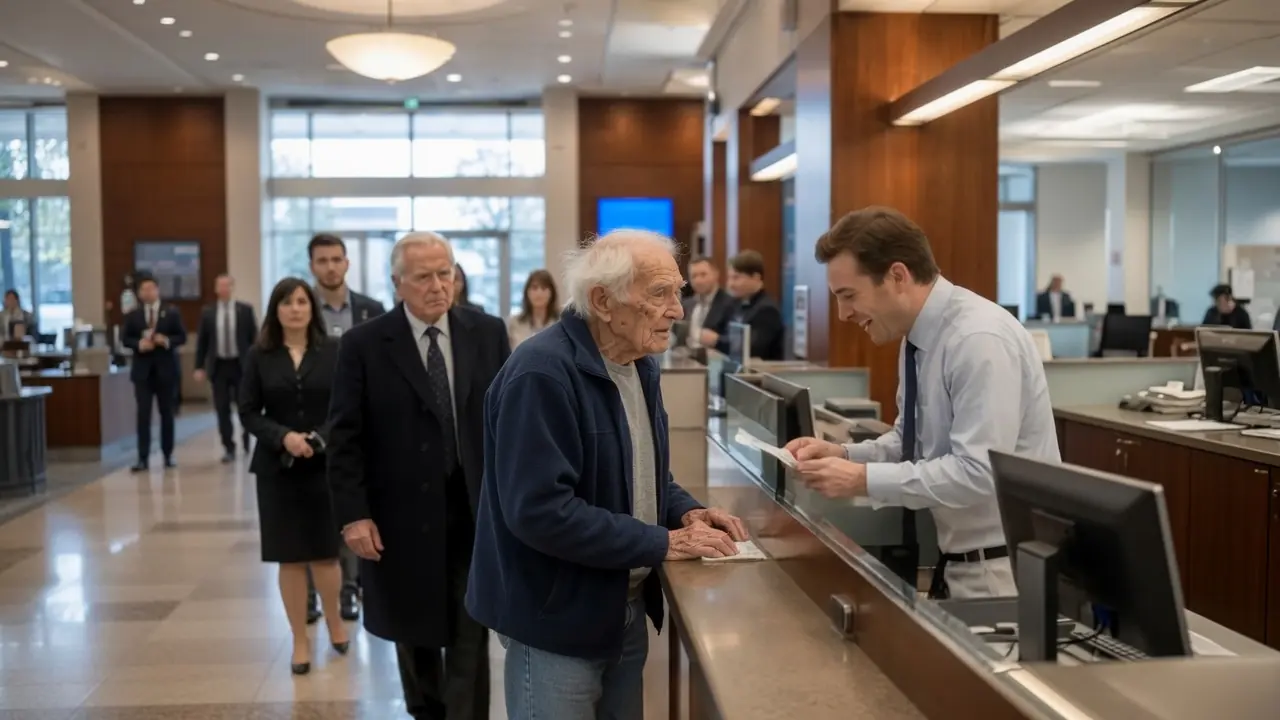
Bradley shoved the paper back across the counter. “Now step aside. You’re holding up real clients.” Walter did not touch the paper. “Real clients?” he repeated softly. Bradley pointed toward the doors. “Security will drag both of you out before that pension buys another second in my bank.”
The sentence froze the room. Even Bradley seemed to realize he had gone too far, but the realization came too late to save him from having said it. Walter looked at the marble floor, then at the young man behind the counter. He was not angry yet. He looked deeply tired, and somehow that was worse.
Arthur stepped fully to the counter. “Your bank?” he asked. Bradley lifted his chin. “The bank I work for.” Arthur’s eyes sharpened. “That distinction will matter very shortly.”
The teller beside Bradley whispered his name, trying to warn him. He ignored her. The branch manager, a nervous man named Peter Lang, had emerged from his glass office at the edge of the lobby and was now walking toward them with a forced smile. “Is there a problem here?” he asked.
Bradley immediately pointed at Walter. “This gentleman is creating a disturbance over a small retirement account.” Peter looked at Walter, then at Arthur. His smile faltered when he saw the man in the gray suit. Recognition moved across his face slowly, like ice cracking.
“Mr. Whitmore,” Peter said. Bradley blinked. “You know him?” Peter’s face drained of color. “Bradley, step away from the counter.” The command was quiet, but it carried panic beneath it. Bradley looked from Peter to Arthur, finally sensing that something had shifted beyond his control.
Arthur did not smile. “No, Mr. Lang. Let him stay exactly where he is.” Peter swallowed. Walter remained silent, studying Arthur with growing curiosity. He had met many powerful men in his lifetime, but he did not yet know why this one had chosen to step beside him.
Arthur turned to Walter. “Mr. Graham,” he said, softer now, “I apologize that this happened here.” Bradley’s mouth parted. Peter’s eyes widened. The teller beside them looked like she might drop the cash in her hand.
Walter looked at Arthur carefully. “You know my name.” Arthur nodded. “I know more than that.” He reached into the inside pocket of his suit and removed a slim black folder embossed with the bank’s seal. “I know Crown Meridian spent two years trying to win the Graham Family Trust account after your company sale.”
Bradley’s face changed. The smirk vanished entirely. He looked at Walter again, but this time his eyes moved differently, searching for signs he had missed. The worn coat suddenly seemed less like proof of poverty and more like a disguise he had been too foolish to question.
Arthur placed the folder on the counter. “I know you founded Graham Precision Components in 1969 with seven employees and one rented warehouse.” Walter’s expression tightened at the name. “I know you built it into one of the largest private manufacturing firms in the Southeast.” Arthur looked directly at Bradley. “And I know this bank was honored when Mr. Graham allowed us to manage a portion of his charitable foundation.”
The lobby went still. Bradley gripped the edge of the counter. “I didn’t know,” he said. Arthur’s eyes hardened. “That is not a defense. That is the whole indictment.”
Walter exhaled slowly. “Arthur Whitmore,” he said at last. “I thought I recognized the name.” Arthur finally gave a small nod. “Former chairman. Still on the advisory board. I came today for the board review.” He turned toward Bradley. “And apparently, I arrived at the right counter.”
Peter Lang looked like a man watching his career unravel thread by thread. “Mr. Graham,” he said quickly, “I am deeply sorry. This is not how we treat clients.” Walter looked at him. “I have been standing here for several minutes. Is it not?”
Peter’s mouth closed. The question did what shouting could not have done. It forced every person in the lobby to remember that the mistreatment had not happened in secret. It had happened under lights, under cameras, in front of employees who waited until power entered the room before finding their courage.
Bradley tried to recover. “Sir, I misunderstood the situation.” Walter turned toward him. “No. You understood exactly the situation you believed you saw.” Bradley flushed. “I was trying to manage the line.” Walter looked at the papers on the counter. “By laughing at a number you thought made me small.”
The banker looked down. For the first time, he seemed young, not polished. “I apologize,” he said. Arthur watched him. “To whom?” Bradley looked confused. Arthur’s voice sharpened. “Do not apologize to the room. Apologize to the man you insulted.”
Bradley faced Walter fully. “Mr. Graham, I’m sorry.” Walter studied him for a long moment. “Are you sorry because you embarrassed me, or because you embarrassed yourself in front of the wrong people?” Bradley’s face tightened with shame. He had no answer ready because the truthful one made him look worse than silence.
Arthur turned to Peter. “Open a private conference room.” Peter nodded quickly. “Of course.” Arthur lifted one hand. “And bring the complete account history for Mr. Graham’s retirement payment, the adjustment record, and the employee notes attached to this interaction.”
Bradley flinched. “Employee notes?” Peter looked at him sharply. The teller beside him lowered her eyes again. Walter noticed the movement. He had run companies long enough to know when a room held more truth than its people wanted to admit.
In the conference room, the glass walls looked out over the lobby. Walter sat at the table with his papers neatly stacked before him. Arthur sat beside him, while Peter stood across from them with a tablet in his hands. Bradley remained near the door, pale and silent.
Peter pulled up the account history and began explaining. The payment had been reduced because of an internal processing error tied to an old executive retirement account that had been migrated to a new system. It was not supposed to affect Walter’s funds. The bank had made a mistake.
Walter listened without interrupting. That made Peter more nervous. A man who interrupts can be answered; a man who listens calmly is harder to escape. Peter finally said, “The amount will be corrected immediately, with reimbursement.”
Walter nodded once. “Good.” Then he looked toward Bradley. “But the money is not why I am still sitting here.”
Arthur leaned back slightly. “Then tell them why.” Walter folded his hands on the table. “When I built my company, every receptionist knew a rule I repeated for forty years. The person who walks in wearing work boots may own the warehouse. The woman counting coupons may be the one who kept your factory running. The old man with a small check may have signed bigger checks than you can imagine.”
Bradley swallowed hard. Walter continued. “But even if none of that is true, they still deserve dignity.” The words filled the room without needing volume. Peter stared at the table. Bradley blinked quickly, fighting tears or fear.
Arthur opened the black folder and slid a document across the table. Peter looked at it and went rigid. “This is the preliminary transfer agreement,” Arthur said. “The Graham Foundation was considering moving sixty million dollars in educational grants and community lending funds through this bank.” Bradley closed his eyes.
Walter looked at the document, then at Peter. “I came today to see how your people treat someone they believe has nothing.” Peter’s face turned gray. The entire morning suddenly rearranged itself into something more than bad behavior. It had been a test, and the branch had failed it publicly.
Bradley stepped forward, panicked. “Mr. Graham, please, one mistake should not cost the entire branch an opportunity like that.” Walter’s gaze remained steady. “It was not one mistake.” Bradley froze. “It was a laugh, then an insult, then a threat. Three chances to stop.”
Arthur nodded slowly. “And none taken.” Peter turned toward Bradley with a look that held anger and fear in equal measure. “You are suspended immediately pending formal review.” Bradley’s mouth opened. “Mr. Lang—”
“No,” Peter said. “You threatened to have an elderly client dragged out after mocking his retirement payment.” His voice shook, but he forced himself to continue. “Leave your badge on the table.”
Bradley removed the badge with trembling fingers. For all his earlier cruelty, the sight of him doing it was not satisfying to Walter. He had fired men before. He knew that consequences were necessary, but they rarely felt clean when pride had caused the damage. Bradley placed the badge on the table and left the room without looking back.
After he was gone, Arthur turned to Walter. “What will you do about the foundation account?” Walter looked through the glass wall at the lobby. People were moving again, but more carefully now. Some customers still glanced toward the conference room. Employees avoided each other’s eyes.
“I will not decide today,” Walter said. “A man should not move sixty million dollars while angry.” Arthur’s face softened with respect. “That sounds like the CEO I heard about.” Walter gave a faint smile. “Retired CEO. The title left before the habits did.”
Peter spoke carefully. “Mr. Graham, I understand if you no longer trust us.” Walter looked at him. “Trust is not lost in one moment. It is revealed.” Peter absorbed the words as if they weighed something. “Then give us a chance to become worthy of it.”
Walter did not answer immediately. He looked down at his old coat sleeve, where the thread had worn thin near the cuff. He knew he could have worn a tailored suit that morning. He could have arrived with lawyers, assistants, and a private banker greeting him at the door. But that would have taught him nothing.
“Start with the lobby,” Walter said. Peter frowned slightly. “The lobby?” Walter nodded. “Train your staff to see people before accounts. If the smallest client is not safe at your counter, the largest client should be ashamed to stand there.”
Arthur smiled faintly. “I would put that in the staff manual.” Walter glanced at him. “You should.” Peter nodded quickly. “I will.”
That afternoon, Crown Meridian Bank changed more than a payment error. Peter closed the branch for thirty minutes after the last waiting customer was served and gathered every employee in the lobby. Walter did not want to speak at first, but Arthur asked him to say one sentence. Walter agreed to one, and only one.
He stood where Bradley had mocked him and looked at the staff. “Never make a person prove they matter before you treat them like they do.” Then he sat down again. The sentence stayed in the lobby longer than any lecture would have.
Bradley did not return to the counter. His formal review uncovered complaints that had been minimized before: impatience with elderly clients, sarcasm toward customers with small balances, a pattern of treating wealth as a measure of worth. By the end of the week, his employment was terminated. The bank framed it as a personnel decision, but everyone inside the branch knew when it began.
Walter did not celebrate. He came back two weeks later wearing the same brown overcoat. A new banker greeted him respectfully, but not with panic. That mattered to him. Respect caused by fear was only another costume.
Peter met him near the entrance. “We corrected your payment,” he said. “And we completed the branch training you requested.” Walter nodded. “Good.” Peter hesitated. “We also created a new policy. No employee may comment aloud on balances, deposits, or retirement payments unless the client requests clarification.”
Walter looked toward the counter. “That should have existed already.” Peter lowered his head. “Yes.” Walter appreciated that he did not make excuses.
Arthur arrived a few minutes later, again in his gray suit, though this time he was smiling. “Mr. Graham,” he said. “I hoped I’d find you here.” Walter raised an eyebrow. “Do you spend all your mornings rescuing old men from bankers?”
“Only when the banker deserves it,” Arthur said. Walter laughed softly, the first easy laugh he had allowed inside that building. The sound startled Peter, then relieved him.
They sat together in the small conference room. Walter reviewed the new account safeguards, the community lending program, and the educational grant framework. He asked difficult questions, the kind that revealed why he had once built companies men still studied. Arthur answered some. Peter answered others. This time, everyone listened.
By the end of the meeting, Walter agreed to leave a smaller pilot fund with the bank for one year. Not sixty million, not yet. Ten million, enough to test whether Crown Meridian could handle money without forgetting people. Arthur called it fair. Peter called it generous.
Walter called it probation. “Banks are very good at measuring risk,” he said, signing the limited agreement. “Consider this mine.” Arthur smiled. Peter nodded as if he understood the privilege inside the warning.
Months passed, and the Charlotte branch became known inside Crown Meridian for something unusual. Its customer satisfaction scores climbed. Complaints dropped. Older clients returned after hearing that the branch had changed. Small account holders stopped being rushed away from counters as if their presence lowered the room’s value.
A framed sentence appeared near the employee entrance, approved by Peter and suggested by Arthur: Never make a person prove they matter before you treat them like they do. Under it was no name, at Walter’s request. He had never liked slogans that turned people into decorations. But employees learned the story anyway.
One rainy morning, nearly a year later, Walter returned to the bank with a young woman who ran a neighborhood business incubator funded by his foundation. She wore a thrifted blazer and carried a folder full of hopeful numbers. The banker at the counter greeted both of them with the same courtesy. Walter watched closely and said nothing.
The young woman opened an account that day. It was small, barely enough to cover her first month of office expenses. No one laughed. No one smirked. No one made her feel like the size of the deposit measured the size of her dream.
As they left, Arthur called Walter from the lobby seating area. “You saw that?” he asked. Walter nodded. “I did.” Arthur leaned on his cane. “Better?” Walter looked back at the counter where the young woman was smiling down at her receipt. “Better is not finished. But it is better.”
Arthur chuckled. “Once a CEO, always impossible to satisfy.” Walter’s eyes warmed. “That is how things improve.” The two old men walked slowly toward the exit, side by side.
Outside, Charlotte sunlight reflected off the glass towers. Walter paused before stepping onto the sidewalk. He touched the worn cuff of his old coat, the same cuff Bradley had judged before knowing anything true. He kept wearing it because it reminded him how quickly people reveal themselves when they think status is absent.
The small retirement payment had been corrected long ago. The sixty million dollars eventually came, but only after the bank proved it could respect ten dollars as carefully as ten million. Arthur remained on the advisory board. Peter became a better manager because shame, properly faced, can become discipline.
And Bradley Cole became a story told quietly in training rooms, not as gossip, but as warning. He had mistaken a number for a life, a coat for a value, and a quiet old man for someone without power. By the time he understood the difference, the whole bank had already learned it.
Walter Graham never again had to explain why that morning mattered. Anyone who heard the story understood. A bank may count money, but its true worth is measured by how it treats the person standing at the counter when the balance looks small.
Because sometimes the old man with the smallest payment in the lobby is the one who once signed the largest checks. And sometimes the man behind him in the gray suit steps forward not to create power, but to reveal what arrogance failed to see.