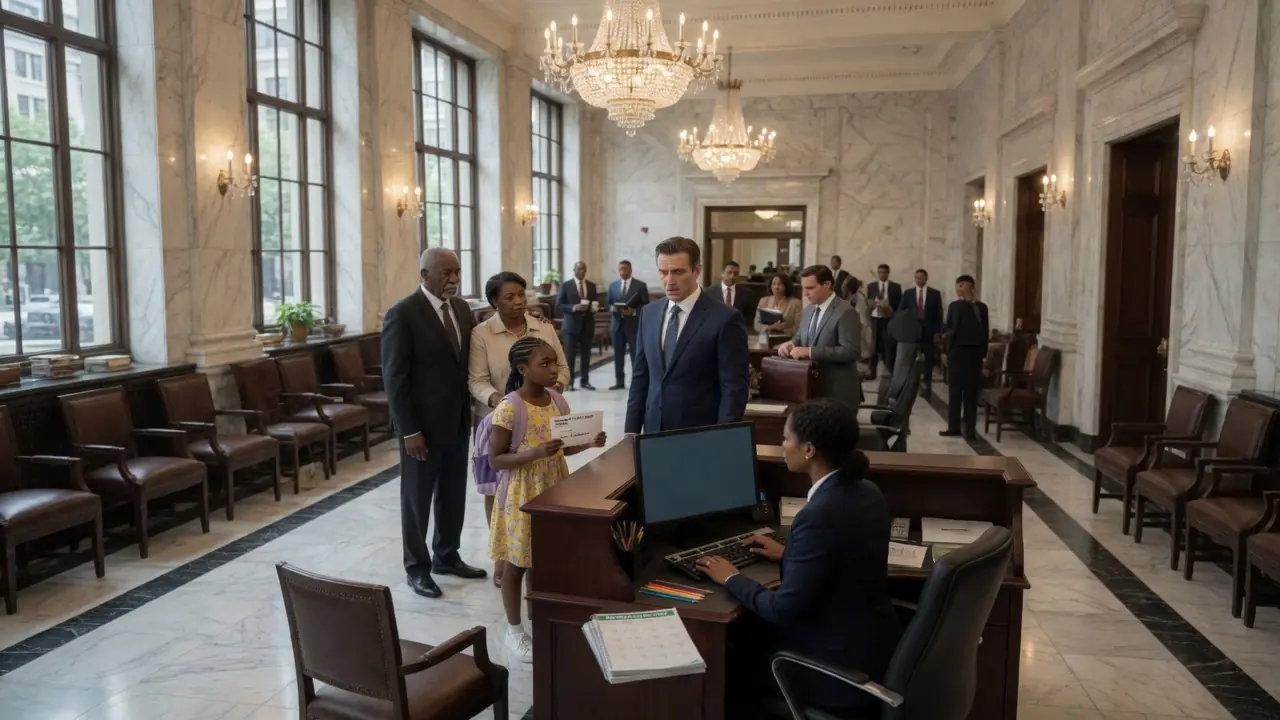
The marble lobby of Sterling National Bank’s Buckhead branch in Atlanta was built to make ordinary people feel small. Crystal chandeliers hung from the ceiling, mahogany desks lined the walls, and leather chairs sat beneath tall windows that looked out toward a street filled with expensive cars. Every sound inside the branch seemed controlled, from the soft clicking of computer keys to the quiet footsteps of wealthy clients crossing the polished floor. It was the kind of place where people lowered their voices without being told, as if money itself demanded silence.
That Tuesday morning, nine-year-old Grace Henderson walked through the glass doors carrying a white deposit envelope in both hands. She wore a yellow sundress, white sneakers, and a small purple backpack that bounced lightly against her shoulders. Her hair was braided neatly, her eyes were wide and observant, and her steps were careful on the shining marble. She had been to this bank many times before, but that morning the familiar branch felt strangely colder than usual.
Grace was not there to play, beg, hide, or wander. She was there to make her monthly deposit, just like her grandfather had taught her. Inside the envelope were ten crisp twenty-dollar bills, savings from her allowance, carefully counted and labeled in her own handwriting. On the front of the envelope, in rounded letters, she had written: March Deposit, $200.
Her grandmother, Denise Henderson, had kissed her forehead before letting her walk to the branch alone. The bank was only a block away from the Henderson estate in Tuxedo Park, and the regular branch manager knew the family well. Grace had done this little walk before, always straight there and straight back. She liked the feeling of placing her savings on the counter and watching her balance grow, because her grandfather always said consistency built wealth, not luck.
But the regular manager was not there that morning. Philip, the kind man who always smiled when Grace arrived, was away on vacation. Sitting in the manager’s office instead was Bradley Ashton, a forty-four-year-old banker temporarily assigned from a suburban branch in Marietta. Bradley had wanted the Buckhead assignment badly, because this branch served some of the richest clients in Atlanta, and he believed it was the kind of place where his career could finally rise.
Bradley liked the lobby because it looked expensive enough to match the version of himself he wanted other people to see. He wore a tailored navy suit, a crisp white shirt, an expensive tie, and polished Italian leather shoes that clicked sharply whenever he walked. He had spent the first hour of the morning correcting small details no one cared about, moving brochures half an inch, adjusting a flower arrangement, and reminding the tellers to greet clients properly. In his mind, the branch was a kingdom, and for the next two weeks, he was its ruler.
From behind the glass wall of his office, Bradley noticed Grace sitting in the waiting area. She had taken a number, chosen a chair, and placed her deposit envelope on her lap like any customer would. She was not loud, messy, or disruptive. She simply sat there, swinging her feet slightly because they did not quite reach the floor.
Bradley’s expression changed the moment he saw her. He did not see a child waiting her turn. He saw a little Black girl in simple clothes, sitting alone in a lobby where many accounts held millions. His jaw tightened, and he set down his espresso slowly. He did not ask a teller whether she was known to the branch, and he did not check the customer records.
Instead, he walked toward the security desk near the entrance. Officer Dean Sutton was sitting there, a thickset man in his fifties who had learned to follow instructions before asking questions. Bradley leaned close to him, but not quietly enough to avoid being heard. He said there was a child in the lobby who clearly did not belong there and that Sutton needed to handle it.
Sutton looked toward Grace and hesitated. She was small, neatly dressed, and sitting politely with an envelope in her hands. Still, Bradley’s eyes stayed fixed on him, hard and impatient. Sutton stood up, adjusted his belt, and walked across the marble floor toward the waiting area.
Grace looked up as his shadow fell over her. “Can I help you?” she asked softly. Sutton cleared his throat and told her she could not sit there by herself. He asked where her parents were, using a tone that was not exactly cruel, but not kind either.
“I’m here to make a deposit,” Grace said. She lifted the envelope so he could see it. “I have an account here.” Her voice was small, but steady, because her grandmother had raised her to speak clearly even when adults made her nervous. Sutton glanced at the envelope, then back toward Bradley.
Before Sutton could answer, Bradley walked over himself. His shoes cracked against the marble with sharp, confident steps. He stopped directly in front of Grace, towering over her chair. “Sweetie,” he said, though there was nothing sweet in his voice, “this is a private bank for people with real accounts.”
Grace blinked once. “Yes, sir,” she said. “I have an account.” She began to say her account number, but Bradley cut her off with a dry laugh. He turned his head slightly, making sure the nearby clients could hear him. “Of course you do,” he said. “And I suppose you drove here in a Mercedes too.”
A woman in pearls looked up from her phone, then quickly looked away. A man in a gray suit shifted in his leather chair and studied his coffee cup like it had suddenly become fascinating. Nobody spoke. Grace felt the silence around her, and for the first time that morning, her hands tightened around the deposit envelope.
She opened the envelope and pulled out the ten twenty-dollar bills. “This is my deposit,” she said. “Two hundred dollars.” She held the money up carefully, wanting him to understand that she was not lying. “I save my allowance every month, and I bring it here.”
Bradley looked at the cash, and for one second, surprise passed across his face. He had not expected her to have money. But his surprise quickly hardened into suspicion. To him, the bills did not prove she belonged; they only gave him something else to question.
“Where did a child like you get two hundred dollars?” he asked. Grace lowered the bills slightly. “It’s my allowance,” she said. “My grandfather gives it to me, and I save it.” Bradley smirked as if she had told an amusing story. “Sure,” he said. “That must be some allowance.”
Behind the teller counter, Tamara Wells had been watching with growing discomfort. She was a young Black teller in her mid-twenties, sharp with numbers and warm with customers. She had worked at the branch long enough to know that Grace came in regularly, though she had never personally handled her account. She also knew Bradley well enough after only a few days to understand that challenging him carried consequences.
Still, the sight of a grown man humiliating a child made Tamara’s stomach twist. She stepped closer to her computer and said, “Mr. Ashton, maybe we should check the account number.” Her voice was careful, but it carried across the lobby. “It would only take a few seconds.” Grace turned toward her with a flicker of hope.
Bradley’s face went cold. He walked toward Tamara’s teller window and placed both hands on the marble counter. “I do not need a teller telling me how to manage my branch,” he said quietly. The lower volume made his words feel more threatening, not less. “When I want your opinion, I will ask for it.”
Tamara swallowed and lowered her eyes. Bradley waited until she said, “Yes, sir.” Then he turned back toward Grace with a smile that showed teeth but no warmth. “Now,” he said, “where were we?” The lobby had gone completely still again.
Grace sat with her back straight, trying very hard not to cry. Her grandmother had told her that tears were not weakness, but Grace did not want Bradley to see them. She took a slow breath. “My name is Grace Henderson,” she said. “My account number is 8840-5512. I would like to make a deposit, please.”
Bradley did not write the number down. He did not walk to a computer. He did not ask Tamara to verify anything. He simply looked at Officer Sutton and said, “Get her out.” Grace’s face changed then, not with anger, but with disbelief.
Sutton stepped forward and reached for Grace’s arm. Grace pulled back instinctively, and her backpack slipped from one shoulder. “I didn’t do anything,” she said. Her voice shook for the first time. Bradley looked down at her backpack, and his eyes narrowed.
“What’s in the bag?” he asked. Grace held the strap close. “My school things,” she said. Bradley turned to Sutton. “Check it.” A few customers shifted uncomfortably, but again, no one spoke.
Grace looked around the lobby, searching for one adult who might say this was wrong. The pearl necklace woman avoided her eyes. The gray-suited man turned his body away. Another customer near the water cooler picked up a brochure and pretended to read. In that room full of powerful people, the only person who looked back at Grace with sympathy was Tamara.
Sutton unzipped the backpack in full view of everyone. He removed a math workbook, a box of colored pencils, a small juice box, and the white deposit envelope. He placed each item on the counter as if he were searching for evidence. Grace stood beside him, cheeks burning with humiliation.
Bradley picked up the money and fanned the bills between his fingers. “Two hundred dollars,” he said. “A little girl walking around with cash, no parents, no identification.” He looked at Grace as if he had solved some hidden crime. “Are you sure this is yours?”
Grace’s whole body stiffened. “I didn’t steal anything,” she said, each word careful and tight. “That is my money.” Bradley set the bills down, but pushed them out of her reach. “Then you can wait while we verify that,” he said.
He suggested he might need to call the authorities if the money could not be explained. The word hit Grace like a cold hand around her chest. She was nine years old, standing in a bank she had visited many times, with her school supplies on display and her savings taken from her. For the first time, fear showed plainly in her eyes.
Bradley walked back toward his office, satisfied that order had been restored. Grace remained near the entrance with Sutton beside her, not allowed to leave, not allowed to complete her deposit, and not treated like a customer. The branch slowly resumed its quiet rhythm, as if nothing serious had happened. Keyboards clicked, papers shuffled, and adults returned to pretending they had not watched a child be humiliated.
After several minutes, Grace asked if she could call her grandmother. Sutton glanced toward Bradley’s office and said it was not a good idea right now. Grace lowered her eyes to the floor. She blinked hard, once, twice, refusing to let the tears fall in front of them.
Tamara could not stand it anymore. When Bradley’s office blinds were half closed and his attention had shifted to a phone call, she reached beneath her station and pulled out her own cell phone. She walked to the edge of her teller counter and slid the phone quietly toward Grace. She did not say anything. She only gave the smallest nod.
Grace picked up the phone with trembling fingers and dialed the number she knew by heart. It rang twice. When Denise Henderson answered, Grace whispered, “Grandma.” That one word broke the wall she had been trying to hold up.
Denise’s voice turned sharp with concern. “Grace, baby, what’s wrong?” Grace turned slightly toward the wall and told her what had happened. She said the manager called her homeless, searched her backpack, took her money, and would not let her make her deposit. She said he had threatened to call someone on her.
There was silence on the other end of the line. It was not confusion or hesitation. It was the silence of a storm gathering itself before it arrived. When Denise spoke again, her voice was controlled and cold. “You stay exactly where you are,” she said. “Do not say another word to that man. We are coming.”
Grace returned the phone to Tamara and whispered, “Thank you.” Then she sat on the bench near the entrance with her backpack on her lap and waited. She kept her hands folded, her chin lifted, and her eyes fixed on the glass doors. Fifteen minutes had never felt so long.
Bradley remained in his office, laughing into his phone as if the morning had become amusing. He had already dismissed Grace from his mind, reducing her to a small inconvenience. Sutton stood near the door with his arms folded, looking increasingly uncomfortable. Tamara watched the entrance without pretending to work.
Then the glass doors opened, and Gerald Henderson walked in. He was six feet two, silver-haired, dressed in a charcoal suit that fit him with quiet precision. His face showed no anger, no panic, no confusion. It showed something far more dangerous: control.
Behind him came Denise Henderson in a cream blazer and pearl earrings, her face set like stone. Behind her walked Reginald Davis, the family attorney, carrying a leather briefcase. Two additional associates followed in dark suits, silent and serious. The five adults entered the bank in a formation that made every head turn.
Grace stood when she saw them, and all the strength she had been holding finally broke. Gerald crossed the lobby in three long strides and knelt in front of her. He placed his hands gently on her shoulders and pressed his forehead to hers. “I’m here, baby,” he said softly. “Grandpa is here.”
Grace began to cry then, quietly at first, then with the exhaustion of a child who had tried too hard to be brave. Denise placed one hand on her back and closed her eyes. For a few seconds, Gerald simply held his granddaughter in the middle of the marble lobby. Then he stood, straightened his jacket, and turned toward Bradley’s glass office.
He did not knock. He opened the door so sharply it struck the wall behind it. Bradley nearly dropped his phone. His feet came down from the desk as he scrambled to stand. “Can I help you?” he asked, his voice suddenly higher than before.
“You are the man who called my granddaughter homeless,” Gerald said. It was not a question. Bradley’s mouth opened, then closed. His eyes darted toward the lobby, where Denise held Grace close and Reginald Davis was already setting his briefcase on the counter.
“There seems to be a misunderstanding,” Bradley said. Gerald looked at him without blinking. “My name is Gerald Henderson.” The effect was immediate. The color began to drain from Bradley’s face.
Bradley knew the name. Everyone in Atlanta business knew the name. Sterling National’s Buckhead branch sat on Henderson Plaza, land connected to the Henderson family’s foundation and commercial trust. Gerald Henderson was one of the largest private depositors in the region, founder of Pinnacle Dynamics, and a man whose financial decisions could affect entire institutions. Bradley had walked past the Henderson name on the building’s cornerstone every morning without understanding who it represented.
Gerald stepped back into the lobby and called for Reginald. The attorney approached Tamara’s teller window and asked her to pull up account number 8840-5512. Tamara typed quickly, her fingers shaking slightly. The screen loaded, and she froze.
Slowly, she turned the monitor so it faced the lobby. On the screen was the account holder’s name: Grace A. Henderson. Custodial account. Balance: $4,200,000.
The lobby went silent in a way that felt almost unreal. Bradley stared at the screen, his lips moving without sound. The girl he had mocked, searched, and tried to throw out had more money in her account than most adults in that room would ever see. Grace stood beside her grandmother, still holding the deposit envelope, her cheeks wet but her posture steady.
Reginald opened his briefcase and placed a folder on the counter. “Mr. Henderson’s family trust holds eighty-five million dollars in deposits across six accounts at this branch,” he said calmly. “That makes his family the largest depositor in Sterling National’s southeast region.” Then he looked directly at Bradley. “And you just accused his granddaughter of not belonging here.”
Bradley gripped the counter as if the floor had tilted beneath him. His confidence had disappeared completely, leaving only panic. Gerald stepped closer, his voice low and steady. “I want every dollar transferred out of this bank today,” he said. “Every account, every fund, every trust.”
Bradley tried to speak. Nothing came out. Gerald continued, saying he wanted the regional director in the branch within the hour. Reginald added that formal complaints would be filed if Sterling National did not respond immediately. Every customer in the lobby heard every word.
Bradley finally found his voice and rushed forward. “Mr. Henderson, please,” he said. “If I had known who she was, I would never have—” Gerald turned on him so sharply that Bradley stopped mid-sentence. “That is the problem,” Gerald said. “You believe your behavior would have been acceptable if she were someone else’s child.”
The words landed harder than shouting could have. Bradley had no answer. Gerald looked at him with cold disappointment. “You searched a child’s backpack, accused her of theft, and humiliated her because you decided what she was before asking who she was.” He paused. “That is not a misunderstanding. That is character.”
The regional director, Lorraine Crawford, arrived less than thirty minutes later. She walked into the lobby in a navy pantsuit, silver-blonde hair pulled into a tight bun, and read the room almost instantly. Gerald stood near the windows with his arms crossed. Denise sat beside Grace, stroking her hair. Bradley stood near his office, pale and sweating.
Lorraine approached Gerald and apologized, saying the incident did not reflect Sterling National’s values. Gerald’s expression did not change. “Your employee showed us your values,” he said. “He showed them to a child.” Lorraine understood then that polished language would not save the bank from the truth.
She turned to Bradley and suspended him immediately pending investigation. Bradley protested, saying he had been protecting the branch. Lorraine’s voice hardened. “There is no protocol that tells you to humiliate a child,” she said. She ordered him to surrender his badge and keys.
Officer Sutton stepped forward, the same man who had searched Grace’s backpack. This time, he stood in front of Bradley with his hand out. Bradley unclipped his badge and placed it, along with his keys, into Sutton’s palm. The metal clinked softly in the silence. Then Bradley walked out through the same glass doors he had tried to push Grace through.
Grace watched him leave without saying a word. She did not smile. She did not insult him. She simply watched, and somehow her silence said everything. Sometimes dignity does not need a speech.
Before leaving, Gerald stopped at Tamara’s window. Tamara looked frightened, as if she expected trouble for giving Grace the phone. Gerald placed one hand gently on the counter. “You were the only person in this room who tried to help my granddaughter,” he said. “I will not forget that.”
Tamara’s eyes filled with tears. She nodded because words were suddenly difficult. Denise thanked her too, and Grace whispered another small thank you. Then the Henderson family walked out together into the Atlanta sunlight.
But the story did not stay inside that bank. A customer near the water cooler had recorded the moment Grace’s balance appeared on the screen and Bradley’s face collapsed. That evening, the video spread online with a simple caption about a banker assuming a little Black girl was homeless before learning she had millions in her account. By the next morning, millions had seen it.
The outrage was immediate. People shared stories of being judged in banks, stores, restaurants, hotels, and offices because of what they looked like before anyone asked their name. Grace became a symbol, but Gerald reminded every interviewer that the story was not about money. “My granddaughter had four million dollars in her account, and they treated her like a suspect,” he said. “Imagine what they do to children who do not.”
Sterling National launched an internal investigation under public pressure. It revealed prior complaints against Bradley from clients of color at his old branch. Those complaints had been minimized, delayed, and quietly buried. The bank could no longer pretend the problem began with Grace.
Bradley was fired within a week. His banking career ended not because he insulted a wealthy child, but because the truth of his behavior could no longer be hidden. Sterling National lost major accounts, including the Henderson family’s deposits, which were moved to a Black-owned financial institution in Atlanta. The bank was forced to change policies, create oversight for discrimination complaints, and fund financial literacy programs for underserved youth.
Grace turned ten the following spring. She still made monthly deposits, but now she walked into a different bank where the staff greeted her by name. She started a savings club at school, teaching classmates how to count money, set goals, and track deposits in notebooks. When her teacher asked what she wanted to be when she grew up, Grace answered without hesitation. “I want to own a bank.”
Tamara Wells left Sterling National and joined the new bank where the Henderson family moved their accounts. With Gerald’s recommendation, she entered a management training program and later became an assistant branch manager. She often said she had not done anything heroic, only what any adult should have done for a child. But Grace always remembered that Tamara had been the first person in the bank to see her as human.
As for Grace, she never forgot that day in the marble lobby. She remembered the humiliation, the silence of the adults, the weight of her backpack being searched, and the moment her grandfather walked through the doors. But she also remembered standing tall when Bradley tried to make her feel small. She learned early that dignity should never depend on a bank balance, a last name, or a powerful person arriving just in time.
That was the lesson the entire branch learned too late. Grace Henderson had never been lost, homeless, or out of place. She had walked into her own bank with her own savings, asking only to make a deposit. And by the time she left, everyone understood that the richest person in the room had not been the banker in the expensive suit, but the little girl who kept her head up when everyone else looked away.