Brandon Coleman’s alarm went off at 6:15 a.m., the same way it had every morning for the last five years. The sound was sharp, ordinary, and almost insulting for a day that did not feel ordinary at all. He sat up in his small Philadelphia apartment, rubbed one hand across his face, and looked toward the kitchen where his nine-year-old daughter, Maya, was already making toast. It smelled slightly burned, which meant she had tried to do it herself again.
“Morning, baby,” Brandon said, stepping into the kitchen in socks and a gray T-shirt.
“Morning, Daddy,” Maya answered, proud of the toast even though one corner had gone black. “Big day?”
Brandon smiled and poured coffee into the chipped mug he had owned since college. “Bank day.”
Maya wrinkled her nose. “Boring.”
Brandon almost laughed. If only she knew what sat inside the old leather briefcase by the door. One check. Ten million dollars. Coleman Software Incorporated, the company he had built from late nights, hard pitches, rejected meetings, bad coffee, and five years of hearing people call his ideas promising while their eyes said they were not sure a man like him could really deliver.
Premier Logistics had not needed convincing forever. They had needed data, proof, results, and patience. Brandon gave them all of it. His routing algorithm had cut freight delays by twenty-two percent across three regional markets, then by thirty-one percent after the third update. By the time they offered to buy the company, Brandon had twenty-three employees, clients in six states, and a quiet confidence that had taken years to earn.
He could have accepted a wire transfer. He could have deposited the money from his phone, let the number appear in his account without ever stepping into a branch. But his father, Gerald Coleman, had believed in walking through front doors. Gerald had been a machinist for thirty-eight years, a man with scarred hands, precise habits, and one piece of advice he repeated whenever Brandon came home angry from school or work. “Do not let anyone make you small.”
Gerald died when Brandon was twenty-six. He left behind a cracked leather briefcase with a repaired handle, a few tools polished by decades of use, and that sentence. Brandon carried the briefcase whenever something mattered. Inside it that morning were incorporation documents, acquisition papers, tax records, business statements, two forms of identification, and the check itself. He knew he should not need all of it.
But he also knew the world.
The drive to First Heritage Bank took eighteen minutes. It was a newer branch in downtown Philadelphia, all marble facade, glass doors, polished counters, and professional promises. Brandon parked, checked his watch, and looked at the briefcase on the passenger seat. It was 12:13 p.m. Lunch rush. The bank would be full, which he thought was good. Witnesses mattered when things went right.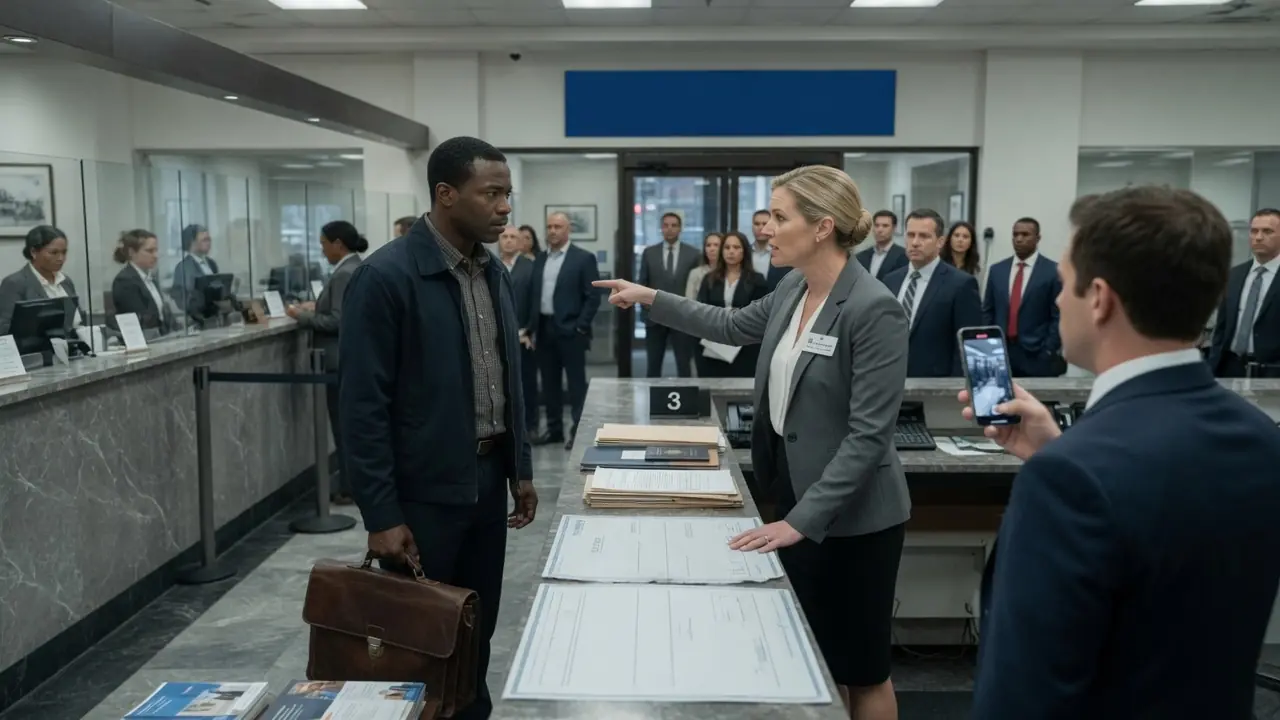
He did not yet know they would matter more when things went wrong.
Brandon stepped through the glass doors at 12:16 p.m. The lobby smelled like fresh paper, office carpet, and expensive cologne. Fluorescent lights hummed overhead. A security camera watched from the corner. Three teller windows were open, two service desks were occupied, and a small line of customers waited near the ropes. Counter three had a woman seated behind it, professional, rigid, and already looking at the next person like she had decided the day was testing her patience.
Her name badge read Sarah Winters, Branch Manager.
Brandon approached with the briefcase in one hand and the check in his inside jacket pocket. “Good afternoon,” he said. “I would like to deposit this check.”
He placed it on the counter carefully.
Sarah looked down.
Ten million dollars, payable to Brandon Coleman, signed by Premier Logistics’ chief financial officer, dated March 11. Fresh. Legitimate. Real. Then Sarah looked up at Brandon, and something shifted across her face so quickly that someone less familiar with it might have missed it. Brandon did not miss it.
It was the look.
The one that said the money did not match the man.
The one that said she had decided a story before asking for facts.
The one that said his presence in front of her had turned from customer service into suspicion.
“Is there a problem?” Brandon asked.
“Of course.”
Brandon handed over his driver’s license. She examined it, typed into her computer, paused, then typed again. Her eyes moved from the screen to his face and back to the license, as if she expected the photograph to confess something. “Do you have another form of ID?”
Brandon opened his wallet and handed over his passport. Current. Valid. Same face. Same name. Sarah held it up beside his face longer than necessary, making the comparison public enough for the customers behind him to notice. A man in line shifted. An older woman with silver hair looked away, then looked back.
“And do you have business documentation?” Sarah asked.
Brandon’s jaw tightened just slightly. “For a deposit?”
“This is a very large amount,” Sarah said, her tone sharpening under the polished words. “We need to verify the source of funds. Standard procedure.”
Standard for whom, Brandon thought.
But he did not say it.
Instead, he opened his father’s briefcase and removed a business card, the acquisition announcement, incorporation papers, and the press release from Premier Logistics. “Coleman Software Incorporated. I am the founder and president. Premier Logistics acquired the company three days ago. The check is part of the closing payment.”
Sarah barely glanced at the documents. “Do you have tax returns? Bank statements?”
“I have five years of statements, tax returns, and business records,” Brandon said. “Anything else you would like to see?”
His voice stayed level, but an edge had entered it. Not anger yet. Recognition. The old tired recognition of a man who understood he was no longer completing a transaction. He was being tested.
Sarah’s smile tightened. “I am just trying to protect you, sir. Fraud is very common with checks of this size.”
“From companies like Premier Logistics?”
“From any source.”
She picked up the phone and dialed an extension. “Security, can you come to counter three, please?”
The words hit the lobby like a small explosion. Security for a deposit. Security for a man who had handed over legal ID, business records, and verification documents. Brandon felt the familiar heat rise in his chest, but he forced his hands to remain visible. A security officer named Thomas Mitchell approached and stood beside the counter with the awkward posture of someone who did not yet know what role he was expected to play.
“Everything okay here, Miss Winters?” the officer asked.
“This gentleman has presented a check I need to verify,” Sarah said. “Can you wait with him while I make some calls?”
Wait with him.
Like he was a flight risk.
Like he had already done something wrong.
Like the check had not been placed on the counter, but seized during a crime.
Brandon reached slowly into his jacket pocket, pulled out his phone, and placed it on the counter with the screen turned down. “I will be recording this interaction.”
Sarah’s eyes narrowed. “You cannot record in here without permission.”
“Pennsylvania is a one-party consent state,” Brandon said. “I do not need your permission.”
“Sir, I need you to step aside so I can assist other customers.”
“No.”
The word stopped the lobby cold.
Sarah blinked. “Excuse me?”
“I said no,” Brandon replied. “I am not stepping aside. I am not leaving this counter. You will either process this deposit or provide a written explanation for why you are refusing a legitimate transaction.”
Sarah stood up. Now her voice was loud enough for everyone to hear. “Sir, this check appears fraudulent. I cannot process it until I verify its authenticity.”
“Then call Premier Logistics,” Brandon said, sliding a card across the counter. “That is the CFO’s direct line.”
Sarah did not take the card.
Instead, she picked up the check between two fingers, holding it as if it were dirty. “Where did you get this?”
Not receive.
Not earn.
Get.
Brandon’s eyes hardened. “I earned it from the sale of my company.”
“What company?”
“Coleman Software. Logistics AI. Twenty-three employees. Five years in operation. Forty percent year-over-year revenue growth.”
He recited the facts like evidence, because that was what this had become. A trial. Twelve people in line watching. One security officer silent. A branch manager asking questions she did not intend to believe answers to.
“And what exactly does Coleman Software do?” Sarah asked.
“I just explained that.”
“I need you to explain it clearly.”
Brandon took one slow breath. “Supply chain optimization. Routing algorithms. Business-to-business logistics software. Clients in six states. Revenue in the millions before acquisition.”
Sarah nodded as if she were listening, but her eyes had already delivered the verdict. “I am calling fraud.”
“Then call them,” Brandon said. “I will wait.”
She turned her back to him and made the call loudly enough for the room to hear. “Yes, I have a customer here with a ten-million-dollar check that seems inconsistent. Can you run a verification?”
Inconsistent.
Brandon almost smiled, but nothing about the moment was funny. Inconsistent with what? His jacket? His briefcase? His skin? The way he stood there refusing to shrink?
Sarah listened for a moment, then hung up. Something in her face suggested the answer had not been as useful as she wanted. “Sir, we will need additional documentation before we can process this.”
“What documentation?”
“Corporate verification, business license, proof of ownership.”
“I have all of that in my briefcase,” Brandon said. “Do you want to see it, or do you want to keep making this about something else?”
Sarah’s face went hard. “I do not appreciate your tone.”
“And I do not appreciate being treated like a criminal for trying to deposit money I earned.”
The lobby held its breath.
That was when Sarah Winters made the decision that would change everything. She lifted the check, stared directly at Brandon, and tore it down the middle. Slowly. Deliberately. Not in a burst of temper, but with the careful cruelty of someone who wanted the act to be seen.
The sound of ripping paper cut through the bank.
Then she tore it again.
Four pieces.
Someone behind Brandon gasped, but no one spoke. Sarah stepped around the counter, threw the torn pieces toward Brandon’s chest, and watched them fall near his shoes and briefcase.
“This check is fraudulent,” she declared. “You are attempting to commit fraud. Security, escort this man out. I am calling the police.”
Brandon did not move.
He did not bend immediately to pick up the pieces. He did not raise his voice. He stood in the middle of the bank lobby while twelve customers stared, the security officer shifted uncomfortably, and Sarah Winters looked satisfied with herself. The humiliation was public, but so was the evidence. His phone recorded every word.
Then Brandon bent down.
He picked up the four pieces of the check, one by one, and placed them carefully inside an envelope from his briefcase. His hands were steady. That steadiness frightened Sarah more than shouting would have. He looked at her name badge, then back at her face.
“What is your full name?”
“Sarah Winters, branch manager,” she snapped. “And you need to leave before I have you arrested.”
“Thank you, Miss Winters.”
He took a photo of her name badge, the torn check pieces, and the security camera timestamp above the lobby wall. Evidence. Clean, simple, undeniable evidence. Sarah started to say something else, but the glass doors opened before she could finish.
James Anderson walked in at 12:52 p.m.
Regional vice president. Fifty-one years old. Tailored suit. Twenty-five years in banking. He was not supposed to be there. He had attended a lunch meeting three blocks away and decided to stop by the new branch to see how Sarah handled the lunch rush.
He walked into silence.
Twelve customers frozen in line.
A security officer standing beside counter three.
Sarah red-faced and pointing toward the door.
A Black man with a worn leather briefcase, a phone on the counter, and torn paper in an envelope.
“I said get out before I call the police,” Sarah was saying.
Anderson’s first instinct was to support his branch manager. Sixteen years with the bank. Experienced. Reliable on paper. But then he looked at the man standing at counter three. Something about the posture hit him first. Not aggressive. Not pleading. Present. Like a man who belonged exactly where he stood.
Anderson stepped closer.
Then he saw the face.
Recognition hit him so hard his stomach dropped.
“Oh no,” he whispered before he could stop himself.
Sarah turned toward him. “Mr. Anderson, thank God. This man—”
Anderson ignored her.
“Mr. Coleman,” he said.
The lobby froze in a deeper way.
Brandon turned slowly. “Mr. Anderson.”
They knew each other.
Sarah’s pointing finger dropped.
Anderson’s eyes moved to the envelope, then to a piece of paper still near the counter leg. He bent down and picked it up. One corner of the check. He saw the amount. He saw Brandon’s name. He saw enough.
“What happened here?” Anderson asked, but his voice already knew the answer.
Sarah rushed forward. “Sir, this man attempted to deposit a fraudulent check. Ten million dollars. Obviously fake. I refused the transaction, called security, and he became aggressive. He started recording without permission and refused to leave.”
“Stop.”
The word cracked across the lobby.
Sarah blinked. She had never heard that tone from him.
“Stop talking,” Anderson said.
Then he looked at Brandon again, now with respect and panic tangled together. “Mr. Coleman. Sir, could we please speak in my office?”
Sir.
The word landed like thunder.
Sarah’s face drained of color. The customers exchanged glances. The security officer stepped back. It was not the empty, condescending “sir” Sarah had used like a blade. It was a real sir. A sir with status, recognition, and fear behind it.
Brandon did not move. “Your branch manager destroyed my property, accused me of fraud, called security, threatened to have me removed, and now you want to talk in private?”
“Mr. Coleman, please. I can explain.”
“Explain what?” Brandon’s voice stayed quiet, but steel lived underneath it now. “Explain why your manager assumed a ten-million-dollar check could not possibly belong to a Black man? Explain why she did not make one direct call to Premier Logistics before tearing it up? Explain why I had to provide multiple forms of ID while the woman behind me only had to show one?”
The elderly woman behind him, Helen Davis, straightened. “He is right,” she said softly. “I only showed my driver’s license.”
Anderson closed his eyes for half a second.
Sarah tried again. “I was following protocol.”
“What protocol?” Anderson snapped, turning on her. “What policy tells you to destroy a customer’s check before verification? What policy tells you to call security for a deposit? What policy tells you to throw a customer’s property at him?”
Sarah’s mouth opened, then closed.
There was no policy.
There was only assumption.
And now everyone in the lobby knew it.
Anderson turned back to Brandon. “Mr. Coleman, sir, I apologize completely. This should never have happened. I know you. I know your company. We met last year at the fintech conference. I pitched you our business banking services.”
“I remember,” Brandon said. “You talked about relationship banking. Personalized service. Respect. Understanding that success looks different for different people.”
Anderson’s face tightened. “I meant every word.”
“Did your branch manager get that memo?”
No one spoke.
Anderson tried again. “Please allow me to make this right.”
“You cannot make this right,” Brandon said. “You can start by getting her away from me.”
Anderson did not hesitate. “Miss Winters. My office. Now.”
Sarah looked ready to protest, but Anderson’s expression stopped her. She walked toward the back office stiffly, humiliated, still not fully understanding that her career had changed shape in the last five minutes. Brandon picked up his phone and stopped the recording. Fifty-two minutes and eighteen seconds.
“I am leaving,” Brandon said. “Premier Logistics will reissue the check. I will deposit it at another bank. One that treats me like a human being.”
“Please let us replace the check,” Anderson said. “At least let me do that.”
“You cannot replace it,” Brandon replied. “It was issued by Premier Logistics. What you are offering is a bank check, which makes your bank the middle of the transaction and gives you control of the narrative. I understand banking, Mr. Anderson. Do not patronize me.”
Anderson stared at him, realizing too late this was not a man who could be handled with apology language and a closed-door meeting.
Brandon looked toward the lobby. “One more thing. Get the name of the woman behind me. Get her statement. If your bank tries to call this a misunderstanding, she is my witness.”
Helen Davis stepped forward before Anderson could ask. “My name is Helen Davis. I have banked here for thirty years. I saw everything. He did nothing wrong. Your manager profiled him. It is as simple as that.”
She wrote her number on a deposit slip and handed it to Brandon.
“If you need a witness, call me.”
“Thank you,” Brandon said.
Then he walked out.
In the parking lot, Brandon sat in his car for fifteen minutes with both hands on the steering wheel. They were not shaking from fear. They were shaking from rage. The recording sat on his phone. Fifty-two minutes of questions, assumptions, condescension, security, torn paper, and the word sir arriving when recognition finally made respect convenient.
He could have let it go.
He could have called Premier Logistics, gotten the check reissued, moved banks, and taught Maya that silence was safer.
Instead, he called Jordan Hayes.
Jordan was a civil rights attorney Brandon had met at a conference two years earlier. They had stayed loosely connected through professional networks, mostly liking each other’s posts and exchanging congratulations after big wins. When Brandon said, “I need an attorney,” Jordan’s voice changed immediately.
“What happened?”
Brandon told him everything.
The check. The questions. The security call. The torn paper. Anderson saying sir. The recording. Helen Davis. The twelve witnesses.
When Brandon finished, Jordan was silent for a long moment.
“You have the recording?”
“Yes.”
“And the witness?”
“Yes.”
“Send me everything,” Jordan said. “I am taking this case.”
“I do not want quiet money,” Brandon said. “I want accountability.”
“You may get both,” Jordan replied. “But understand something. If we do this, we do it publicly. Quiet complaints become quiet settlements, and quiet settlements let systems survive.”
“I know.”
“Are you ready for your name to be in the news?”
Brandon looked at the briefcase on the passenger seat, the one his father had carried for decades. “I am ready.”
That night, after Maya went to bed, Brandon opened his laptop and wrote a LinkedIn post. He did not name the bank at first. He did not post the recording. He simply wrote the truth. Today, I walked into a bank with a ten-million-dollar check from the sale of my company. I walked out with torn paper and a reminder that success does not erase assumptions. I am sharing this because silence protects systems, and I am done protecting systems that do not protect us.
He hit post.
Within an hour, hundreds of comments appeared. By morning, thousands. People shared similar stories, some from other banks, some from First Heritage itself. A Black doctor described being asked for tax returns to deposit a check smaller than the one a white customer deposited with one ID. An engineer said she was forced to wait forty minutes while her employment was “verified.” A business owner said Sarah Winters had denied his loan years earlier and called his plan unrealistic despite strong financials.
The story expanded before Brandon had to push it.
Elena Martinez from the Philadelphia Chronicle contacted him the next day. She was an investigative reporter with a record of covering financial discrimination. They met at a coffee shop. Brandon brought the torn check pieces, the recording, Helen Davis’s number, and the timeline. Elena listened without sensationalizing. She asked exact questions, wrote clean notes, and understood quickly that this was not merely one manager losing control.
“This is bigger than one torn check,” Elena said.
“I know.”
“If we publish this, other people will come forward.”
“Good.”
“You understand the bank will fight?”
“Let them.”
The article went live on April 8. The headline was precise and brutal: Banking While Black: One Torn Check, Fifty-Two Minutes of Audio, and a Question About Who Deserves Respect. It included Brandon’s story, Helen’s witness statement, excerpts from the recording, the sound of paper tearing, and Anderson’s “Mr. Coleman. Sir.”
Elena’s analysis cut deeper than outrage. Respect had arrived at minute fifty-two. Humiliation had begun at minute one. Why did recognition have to come before dignity?
By noon, the article had hundreds of thousands of views. By evening, more than a million. The comments became a public record of quiet harm. People who had signed settlements. People who had been made to feel suspicious for having money. People who had believed their incidents were isolated until Brandon’s story gave them language.
Jordan filed a formal complaint with the Pennsylvania State Banking Commission. At first, it was Brandon Coleman versus First Heritage Bank. Within a week, it became much larger. Twenty-three people contacted Jordan. Then thirty-one. Different branches. Different years. Same pattern. Excessive verification. Hostile service. Assumptions dressed as fraud prevention.
Then the leak arrived.
An anonymous source sent Elena a confidential training manual: Customer Risk Assessment Protocol, version 3.2. It listed “enhanced due diligence triggers” including large deposits from non-established customers, transactions from “high-risk zip codes,” and vague “customer presentation” factors. The zip codes were overwhelmingly Black and Latino neighborhoods. The language never said race. It did not have to.
Another document showed Sarah Winters had received a performance bonus for “proactive fraud prevention.” Twelve incidents. Eleven complaints from customers of color. In other words, she had not only been allowed to make assumptions. She had been rewarded for them.
When Elena’s follow-up article published, First Heritage’s defense collapsed. This was not a rogue manager problem. It was a policy problem disguised as caution. Banking regulators announced a formal review. The bank suspended Sarah. Then they offered Brandon a confidential settlement for $2.5 million.
Jordan handed him the letter.
“No one would blame you for taking it,” Jordan said.
Brandon looked at the number. He thought of Maya’s college fund, retirement, safety, ease. Then he looked at the word confidential. He thought of thirty-one people. He thought of his father’s briefcase. He thought of Sarah throwing paper at his chest and Anderson saying sir only after recognition arrived.
“No.”
Jordan smiled slightly. “Good.”
At the public hearing, Sarah testified first. Under oath, she said the check seemed inconsistent with normal deposits. Jordan asked inconsistent with what. She said the amount was large. Jordan showed video of three white customers depositing large amounts with one form of ID. Brandon had provided multiple IDs, business documents, and a direct verification contact, and she still refused.
“What was different about Mr. Coleman’s situation?” Jordan asked.
Sarah’s attorney objected.
The commissioner overruled.
Sarah sat in silence.
That silence answered more clearly than any sentence.
James Anderson testified next. He admitted he recognized Brandon when he entered the lobby and called him sir afterward. Jordan played the recording of Sarah using sir as dismissal and Anderson using it as respect. Then he asked the question that froze the room.
“If you had not recognized Mr. Coleman, would you have called him sir with respect?”
Anderson lowered his eyes. “I do not know.”
“That is the problem,” Jordan said. “Respect should not require recognition.”
When Brandon testified, he looked toward the commissioner, then toward the live stream camera. “I felt like respect was being given to the version of me he recognized,” he said. “The CEO. The successful entrepreneur. But respect was not given to the version of me who walked in fifty-two minutes earlier, the Black man with a check. Dignity should not require credentials. Respect should not require recognition. Sir should have been there from the beginning.”
The room went still.
The commission’s preliminary findings came that afternoon. Probable cause for systematic discriminatory practices. A $4.3 million fine. Mandatory independent monitoring. Public disclosure of previous settlements. Sarah Winters terminated and barred from banking. James Anderson formally reprimanded and required to undergo retraining. First Heritage ordered to establish a victim compensation fund.
Three weeks later, the final order added a $5 million fund and annual demographic reporting.
Brandon received $850,000, not the $2.5 million they had offered for silence. He donated part of it to a civil rights legal fund and created the Gerald Coleman Scholarship at Temple University for students who refused to be made small. When he told Maya the name, she asked if Grandpa would have liked it.
“He would have pretended not to cry,” Brandon said. “Then he would have cried.”
Months later, Brandon walked into a different bank with a new check for $750,000 from a contract payment. The teller looked up and smiled.
“Good morning, sir. How can I help you?”
Sir.
At minute one.
Before documents.
Before recognition.
Before proof.
Brandon deposited the check without extra IDs, raised voices, security, suspicion, or torn paper. It was ordinary, almost boring, and that ordinary respect nearly broke him more than the humiliation had. He drove home thinking about March 14, the lobby, the paper falling near his shoes, and the word that arrived fifty-two minutes too late.
That evening, Maya asked him if the fight had been worth it.
Brandon looked at his father’s briefcase sitting near the door.
He thought about the thirty-one people who came forward. He thought about the training manual destroyed, the complaints reopened, and the next person who might walk into a bank and receive respect before recognition. Then he looked at his daughter and smiled.
“Yes, baby,” he said. “It was worth it.”
Because dignity should not need proof.
Respect should not need recognition.
And the word sir should never come too late.