Back in 1974, I taught sixth grade at Lincoln Elementary, and one boy in my class came to school hungry.
Not sometimes.
Always.
His mother was gone, his father was proud, and a boy raised by a man like that wouldn’t accept a sandwich from a teacher’s hand. I tried once. The shame in his eyes taught me never to try that way again.
So every morning, I arrived before the other teachers and slipped a folded dollar through the vents of locker 114.
No note. No explanation. No expectation of thanks.
I did it for nearly three years.
Then his family moved without warning, and I never saw him again.
My name is Eleanor Whitaker. I am eighty-two years old now, and until last month, I believed that little boy had disappeared from my life forever.
The morning sun strikes the front porch of my house on Elm Street at a sharp, blinding angle around seven o’clock. For forty-two years, that light was my cue to finish my black coffee, collect my keys, and drive to Lincoln Elementary.
I retired more than fifteen years ago, but a teacher’s internal clock never stops completely. You spend a lifetime worrying about other people’s children, and some of them follow you into old age.
You remember the child who always fell asleep during reading time. The girl who wore the same sweater every day. The boy who became angry whenever anyone asked if he was all right.
You wonder where they went.
You hope life became kinder to them.
In 1974, our town was struggling. The local mill had laid off nearly a third of its workers. Storefronts closed, families disappeared overnight, and arguments about money spilled from kitchens into school hallways.
That was the year Leo Bennett entered my classroom.
He was twelve, smaller than most of the other boys, with thin wrists and dark hair he cut himself. He wore an oversized denim jacket even when the classroom radiators were running so hot that everyone else complained.
At first, I thought he was simply shy.
Then I began noticing the signs.
Leo never brought a lunchbox. When the lunch bell rang, he slipped outside and claimed he preferred shooting baskets alone. He avoided classroom celebrations when parents sent cupcakes or cookies. If another child offered him food, he became defensive.
One afternoon, I saw him through the teachers’ lounge window. He was leaning against the chain-link fence while the other children ate inside.
He wasn’t playing basketball.
He was staring at the ground with a hollow, exhausted expression no twelve-year-old should ever wear.
I asked our school secretary about him.
His mother had left the previous winter. His father was a mechanic whose hours had been cut at the same time the mill layoffs spread through town. The school had offered free lunch vouchers, but his father refused to sign the forms.
“He says his family doesn’t take charity,” the secretary told me.
Pride is complicated.
Sometimes it helps people survive circumstances meant to break them. Sometimes it becomes another locked door between a suffering person and the help they need.
Leo had inherited all of his father’s pride.
The first time I tried helping him, I made the mistake of being direct.
I called him to my desk after class and offered him a turkey sandwich. I told him I had packed an extra one by accident.
Leo looked at the sandwich, then at me.
His cheeks turned red. His lower lip trembled, not from sadness but from an anger created by shame.
“I’m not a beggar, Mrs. Whitaker.”
“I didn’t say you were.”
“I don’t need your food.”
He turned and ran out of the classroom.
I sat behind my desk for a long time after he left.
I had meant well, but intention does not erase impact. I had tried to meet his hunger while overlooking his dignity.
That evening, I kept seeing his face.
I knew I couldn’t let him continue going without food. But I also understood that if I wanted to help him, I had to become invisible.
The next morning, I arrived at school an hour early.
The building was nearly silent. The hallways smelled of floor wax, chalk dust, and old pipes beginning to warm. I walked to locker 114 and listened for the custodian’s cart.
Then I removed a one-dollar bill from my purse.
A dollar was enough for a hot school lunch and milk in those days. It wasn’t an insignificant amount on a teacher’s salary, especially because my husband and I were raising two children of our own.
But I could afford to lose a dollar.
Leo couldn’t afford to lose another lunch.
I folded the bill into a tight square and pushed it through the narrow vents in his locker. It landed against the metal bottom with a soft click.
My heart hammered as though I were committing a crime.
I didn’t watch Leo open his locker. I stayed in my classroom and graded spelling tests.
At lunchtime, however, I saw him standing in the cafeteria line. He held a tray with a hamburger, green beans, and a carton of milk.
He sat alone and ate every bite with his head lowered, chewing slowly as if he wanted the meal to last as long as possible.
That became our unspoken routine.
Every school morning, I slipped one folded dollar into locker 114. I never left a note. I never asked if he found it. Leo never mentioned it.
Inside my classroom, we remained teacher and student.
I corrected his grammar. He complained about fractions. I reminded him to raise his hand before speaking, and he pretended not to enjoy the adventure books I kept recommending.
Outside the classroom, an anonymous dollar kept him fed.
There were mornings when I almost stopped.
I worried his father would find the money and accuse the school of interfering. I worried Leo would feel deceived if he discovered the truth. I worried I was handling the situation incorrectly.
But then I would see color returning to his face. His concentration improved. He stopped falling asleep during afternoon lessons. By seventh grade, he joined the school’s small woodworking club and discovered he could build almost anything with his hands.
The dollars continued.
Two years became nearly three.
Then, halfway through Leo’s eighth-grade year, I entered the office and saw his student file marked withdrawn.
His father had found work three states away. They had packed their belongings and left in the middle of the week without providing a forwarding address.
Leo was simply gone.
I walked to locker 114 after school.
It had already been cleaned. Nothing remained except a few pencil shavings and a torn piece of notebook paper caught in one corner.
I stood there longer than I care to admit.
Teachers rarely receive endings. Children move, graduate, or drift away. We invest pieces of ourselves in them and then release them into a world we cannot control.
For years, I wondered about Leo.
Did he finish school? Did his father find steady work? Did he ever have enough to eat? Did he remember Lincoln as the place where he had been hungry, or as the place where someone tried to help?
Life continued.
I taught hundreds of other children. My own children grew up and moved away. My husband, Thomas, and I became grandparents. Eventually, I retired.
Then Thomas died.
After his death, the house on Elm Street changed. Every room seemed too large, and every object carried a memory heavier than its actual weight.
By eighty-two, the house felt less like a home and more like a museum I was responsible for guarding.
My daughter convinced me to move into a smaller assisted-living apartment near her family. I resisted for months, but finally admitted she was right.
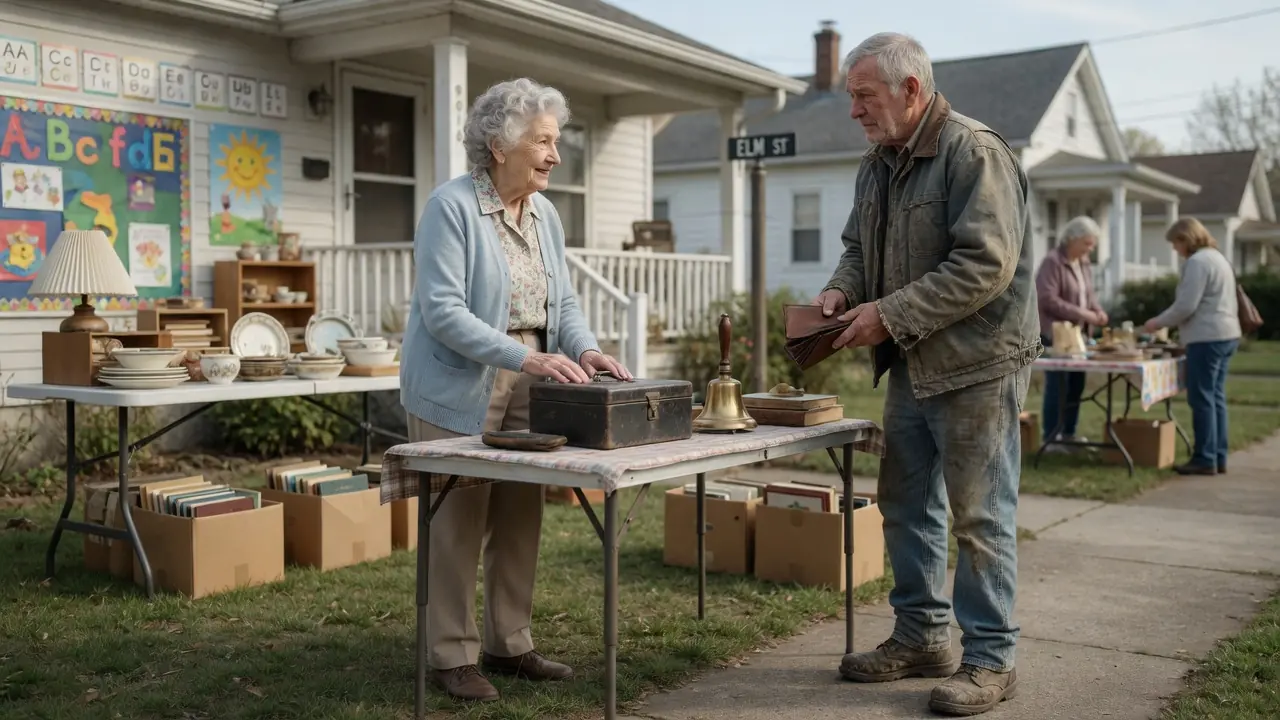
Last month, I held a moving sale.
Fifty years of accumulation covered the front lawn—books, dishes, lamps, garden tools, old classroom decorations, and furniture Thomas and I had purchased when we were newly married.
The sale began early on a Saturday morning. People bargained over glassware, searched through boxes, and carried away pieces of my life for a few dollars at a time.
Around ten o’clock, I noticed a man standing near the old oak tree at the edge of my property.
He appeared to be in his mid-sixties. His hair was gray, and deep lines framed his eyes. He wore a canvas jacket and work boots marked with dried concrete.
He wasn’t looking at anything for sale.
He was watching me.
Whenever our eyes met, he looked down. But he never left.
At first, I wondered if he was waiting for someone. Then an hour passed. Another followed.
By early afternoon, most customers were gone. My daughter had gone inside to make sandwiches, and only a few boxes remained on the driveway.
The man finally approached.
His steps were slow and careful, like someone walking toward a place both sacred and frightening.
“Can I help you find something?” I asked.
He stopped several feet away.
“Are you Mrs. Whitaker?”
“I am.”
“Did you teach sixth grade at Lincoln Elementary?”
The question sent a small jolt through me.
“I did. A very long time ago.”
His eyes filled with tears.
He reached into his back pocket and removed a worn brown wallet. From inside, he carefully pulled out a dollar bill.
The bill was faded and creased. Its paper had been worn soft from decades of handling, almost like a scrap of cloth.
“I found this in my locker in February of 1977,” he said. “Locker 114.”
The sounds of traffic and birds seemed to disappear.
I looked at his face—at the shape of his jaw and the familiar seriousness around his eyes.
“Leo?”
His mouth trembled.
He nodded.
For a moment, neither of us spoke.
Then he took my arthritic hands in his rough ones and placed the dollar in my palm.
“My father told me never to accept handouts,” Leo said. “But I was so hungry the first morning that money appeared. I thought maybe God had dropped it through the vents.”
A laugh escaped me through my tears.
“God had more graceful hands than I did.”
“I didn’t know it was you at first. Then, during my last week at Lincoln, I arrived early and saw the edge of your green sweater disappearing around the hallway corner.”
I remembered that sweater.
It had wooden buttons and sleeves that were always too long.
“That was when you knew?”
“Yes. This was the dollar I found that morning. I kept it instead of buying lunch. I wanted to have something that proved kindness had really happened.”
“You went hungry that day?”
He smiled faintly.
“Only that day. The next morning, another dollar was waiting.”
I closed my fingers around the fragile bill.
“I wish you had told me.”
“I wanted to. But I was ashamed of being poor. Then Dad woke me up two days later and said we were moving. We left before I could say goodbye.”
He wiped his face.
“I carried that dollar every day after that. Through high school, job sites, marriage, divorce, the birth of my children—everything. Whenever life tempted me to become hard, I took it out and remembered that someone had seen me without making me feel small.”
Tears blurred my vision.
“You didn’t need to return it. Knowing you survived is more than enough.”
“I didn’t come only to return it.”
Leo walked back to his truck and removed a thick ledger.
He placed it on the folding table beside my old cash box.
“In 1989, I started a construction company,” he explained. “At first, it was just me, a borrowed truck, and a toolbox. Eventually, I hired a crew. For the first time in my life, I had money left after paying the bills.”
He opened the ledger.
Page after page contained the names of public schools, dates, payment amounts, and handwritten notes.
“In September of 1989, I called the principal of the poorest school in our county. I asked how much unpaid lunch debt the students had.”
He pointed to the first entry.
“I paid it anonymously.”
My hand rose to my mouth.
“I did it again the next year. Then I added another school. As the company grew, the program grew.”
The pages continued for decades.
“Every school year, we contact districts with families caught in the gaps—the children who don’t qualify for enough assistance but still can’t afford lunch. We clear their meal debts and maintain emergency accounts so teachers don’t have to choose between watching a child go hungry and paying from their own pockets.”
“How many children?” I whispered.
“We stopped counting individual names years ago. Tens of thousands of meals, at least. Last year, the program covered twenty-three schools.”
I stared at him.
“Because of one dollar?”
“Because of what the dollar allowed me to keep.”
I didn’t understand at first.
“My dignity,” he said. “You didn’t make me stand in front of anyone and admit I was hungry. You didn’t ask me to thank you. You gave me a way to eat without making me feel like less of a person.”
That was when I began crying fully.
For fifty years, I had wondered whether I had done enough. I had remembered the empty locker and worried that Leo’s hunger had followed him into adulthood.
All that time, the dollar I slipped through a metal vent had been traveling farther than I ever could have imagined.
Leo turned to the final page of the ledger.
At the top, written in careful block letters, were the words:
LOCKER 114 LUNCH FUND
Beneath the title was a new entry.
Lincoln Elementary—permanent annual meal assistance.
“I went back last year,” he said. “The old lockers are gone, but the school is still there. No child at Lincoln will be denied a meal because of money again.”
I reached for him.
Leo bent down, and I wrapped my arms around the boy I had worried about for half a century.
We stood together in my driveway—an old teacher and her once-hungry student—surrounded by boxes containing the remains of my past.
Before leaving, Leo noticed the small brass handbell I had used in my classroom. A strip of masking tape on the handle still carried my faded name.
“How much?” he asked.
“You don’t need to buy anything.”
He placed one new dollar in my cash box.
“I’d like this.”
He picked up the bell, then placed the worn bill from 1977 back into my hand.
“That one belongs to you now.”
A week later, I moved into my new apartment.
The rooms were smaller, but the morning light was gentle. On the desk beside my chair, I placed the old dollar in a simple glass frame.
Under it, my daughter helped me print a small sentence:
Kindness is never wasted. It simply travels where we cannot follow.
For most of my teaching career, I believed my legacy existed in report cards, lesson plans, and the names written in old yearbooks.
Leo taught me otherwise.
A teacher rarely knows which moment a child will carry into adulthood. It may not be the perfect lesson or the inspiring speech. Sometimes it is the quiet decision to protect a child’s dignity when life has already taken almost everything else.
I slipped a dollar through a locker vent because one boy needed lunch.
Leo turned it into meals for thousands of children.
And fifty years later, when I feared that age had made my life smaller, he returned to show me how far one unseen act of kindness had traveled.