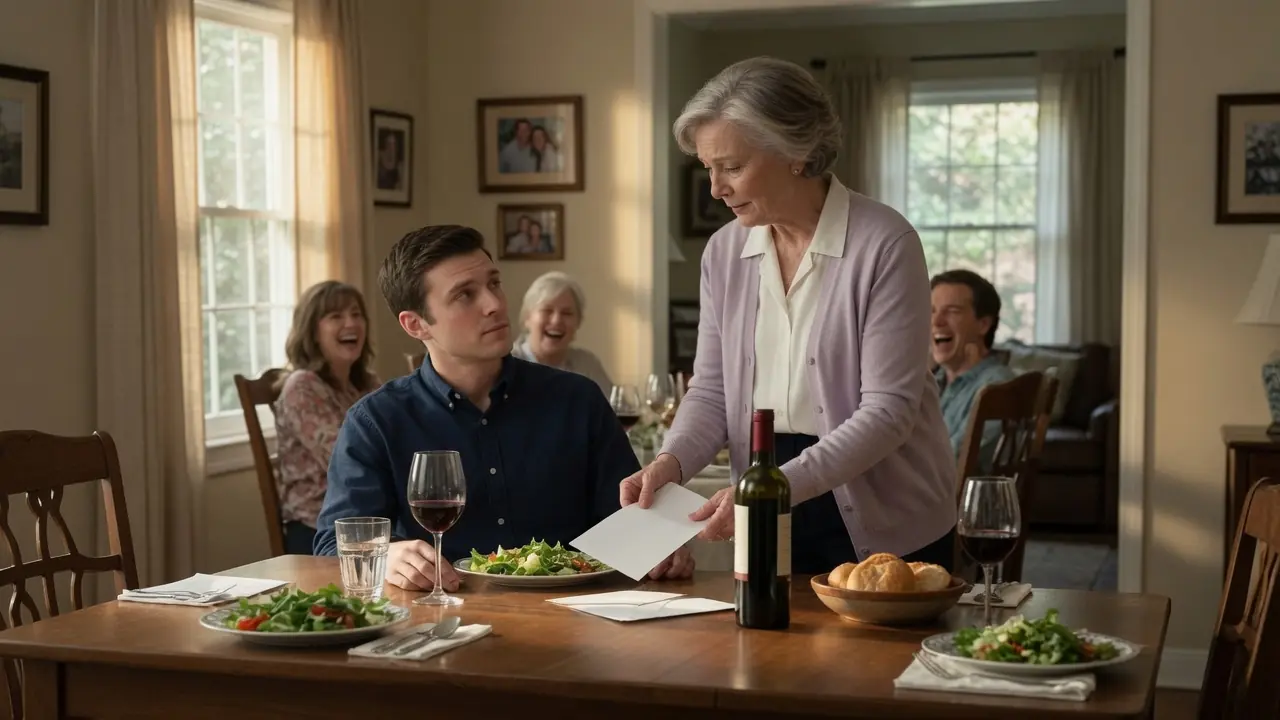
I held the envelope a little too tightly as I stepped inside Mason’s house. Inside were the printed boarding passes, hotel confirmation, rental car details, and the cruise documents I had spent weeks organizing. I thought the trip might help us feel like a family again. I even brought a bottle of wine, the same kind Mason used to sneak tiny sips of during holidays when he thought I was not looking.
The dining room was already buzzing when I arrived. Jenna was plating salad near the sideboard, Mason leaned back in his chair while half-listening to a story from his brother-in-law, and everyone else seemed settled into their own small circles. When I entered, no one paused. No one said hello.
I set the wine bottle down quietly, took a breath, and smiled anyway. “I can’t wait for our trip,” I said, lifting the papers slightly. Mason did not even look at me at first. He just laughed.
“You’re not coming, Mom,” he said, loud and casual, like he was correcting a child who had misunderstood a joke. “It’s just family.” The whole table burst out laughing. Jenna blinked, gave me that guilty little shrug she always hid behind, and mouthed, “Sorry.”
No one else flinched. No one said, “Come on, that’s not fair.” No one corrected him. They just kept laughing like it was the most natural thing in the world.
I stood there with my hand still on the envelope and felt heat crawl up my chest. The wine bottle sat unopened on the table, still cold from the fridge at home. I had imagined us toasting with it on the first night of the trip. I had imagined laughter, ocean air, and maybe one evening where Mason remembered I was his mother before I was useful.
I did not say a word. Not when Mason started talking about beach gear. Not when Jenna asked who was picking up the airport snacks. Not when someone at the end of the table whispered something and laughed again.
I simply placed the envelope on the table beside the wine, turned around, and walked out. No one followed me. I heard one of them say something behind me, something like, “She’s so sensitive.” But the door was already closing.
I did not cry in the car. I did not even start the engine. I just sat there, gripping the steering wheel, replaying it all in my head. By the time I got home, I already knew what I had to do next.
Back home, I did not turn on the lights. I set my purse down, kicked off my shoes, and sat at the kitchen table in the dark. The silence was not peaceful. It throbbed.
I could still hear the laughter that paused before Mason delivered the punchline. “You’re not coming, Mom. It’s just family.” Those words kept moving through the room like they were looking for somewhere to land. Eventually, they landed right in the place I had been trying not to examine for years.
I opened my laptop. The reservation email was still there, bright and neat and official. Confirmation for six people. I stared at it for a long moment.
I was the one who had paid the deposit. Mason had texted two months earlier saying they were tight that month and that if I could just spot the down payment, he would reimburse me. I never expected him to. That was never the point.
It was not just about this trip. It had been happening slowly for years, in little ways that were easy to excuse if you were desperate enough to keep belonging. My name was not on the family Christmas card one year. “Just a printer error,” they said.
At my birthday dinner last year, they forgot to make the reservation. No one asked if I would be bringing someone to Matt and Claire’s wedding. When I showed up alone, they seated me at the back between people I had never met. I kept telling myself these were little things I was overthinking.
I used words like harmless oversight and honest mistake. I defended them to Carol when she once asked why Mason never visited unless he needed something fixed. I told her, “He’s just busy. Kids are busy.” But the truth had been sitting heavy in my chest for a long time.
I used to like being the one who could help. Fixing Mason’s HVAC, picking up prescriptions for Jenna’s mother, babysitting on short notice, filling gaps when money was tight. It gave me a role. It gave me a purpose.
But somewhere along the line, helping stopped feeling like love and started feeling like currency. The more I gave, the less they saw me. I looked at the total on the trip invoice again. The deposit alone was nearly three thousand dollars.
My name was nowhere on the guest list. My email was not copied on any itinerary updates. It was not an oversight. They knew exactly what they were doing.
And worse, they did not expect me to do anything about it. That was the part that finally settled me. They had become comfortable in my silence. They had mistaken my restraint for permission.
I did not call. I did not text. I did not ask Mason for an explanation. I simply let the silence sit like a closed door, and neither side tried to open it.
For five days, nothing changed. Mornings started, coffee brewed, mail came, and the world moved forward. But the quiet held a charge. A truth was waiting for a trigger.
It arrived on a Wednesday at 8:17 a.m. A notification lit up my phone screen. Withdrawal attempt: $2,870. I did not swipe it away.
I read it once. Then I read it again. My pulse stayed oddly steady, like my body had already rehearsed this moment. That number was the exact remaining balance for the cruise.
The cruise I was not family enough to attend. I opened the banking app and logged in. The joint travel account stared back at me, untouched except for the failed transaction. Mason and Jenna had not tried to hide it.
They had not asked first. They did not think they needed to. They assumed the account was theirs by default, because it always had been. I used to think generosity was language enough.
It turns out they thought it was permission. My thumb hovered over the settings menu. I did not shake. I did not cry.
I imagined them sitting at their kitchen counter, irritated that the money had not moved instantly. I imagined them blaming delays, banking apps, errors, anything but me. First, I changed the password. Then I removed the saved devices.
Then I scrolled to the account name: Mercer Family Trip. The words looked naive now, pale and embarrassed. I deleted each letter slowly, as if giving them a funeral. Then I typed new words.
Not Your Wallet. No exclamation point. No warning. Just a sentence. When I hit save, something unhooked inside me.
It was not rage. It was not sadness. It was something cleaner, something like recognition. The silence I offered them had spoken louder than anything I could have said. But the next five minutes would speak louder still.
By noon that day, I was logged into the booking portal. The confirmation number still worked. I clicked through the details: one suite, six guests, departure from Miami in two weeks. I looked at the passenger list one last time.
Then I canceled it. All of it. It took less than five minutes. I did not flinch.
The cancellation email arrived with a dull chime, and I filed it into a folder marked Old Business. Then I opened a new tab. Same cruise. Same dates.
Same suite. But this time, only two guests. I entered my name first. Then I typed Carol Whitmore and smiled.
Carol had spent thirty-eight years as a trauma nurse and never once taken a proper vacation. She had once told me, “Lorraine, if I ever see ocean water that isn’t in a saline bag, I might faint.” I transferred the miles, reconfirmed the flight, and rerouted the luggage tags to my house. All the details clicked into place like they were meant to.
The trip was back on, just not for them. I kept quiet. No announcements, no posts, no dramatic reveal. The only thing I changed was the shipping address on the ticket packet.
I watched each update email come in and archived them like receipts of my own reclamation. Then Mason texted me. “Hey, can you check if our passes came? Jenna thinks they got lost.” I stared at the message for a long time before replying.
“You’ll need to speak with the agency,” I wrote. He replied, “Do you have their number?” I did not respond. He did not know that I was the agency.
The only reason the trip existed was because I had quietly built it, booked it, paid for it, and handed it over like it did not cost me more than money. This time, I was not building it for them. For once, I was not going to explain that decision to anyone. Explanation had become another form of service, and I was done serving.
Carol and I boarded early, just after ten in the morning. The sky was clear, the breeze was warm, and the ship’s white hull gleamed like it had been waiting for us. Carol took everything in slowly: every sign, every smiling crew member, every inch of polished brass. She looked like she could not believe any of it was real.
“It’s like stepping into someone else’s life,” she whispered. I smiled at her. “No,” I said. “It’s ours now.”
We checked in without a hitch. Our key cards were tucked into a small envelope labeled Whitmore Mercer. The suite was ready. I placed my bag on the bed and opened the balcony door.
Below us, buses and taxis were still pulling up. I poured two glasses of champagne from the bottle waiting on the coffee table and handed one to Carol. Then we took our spots on the upper deck right above the check-in line. It did not take long.
Mason appeared first, tugging their suitcases behind him. Jenna was on her phone, probably trying to pull up a confirmation number that no longer worked. Their smiles faded as the conversation at the front desk dragged on. I could not hear the words, but I recognized Mason’s wide, frustrated gestures.
Jenna leaned in, shaking her head. One of the cruise staff pointed at a screen, then shook his own head. They had no room, no tickets, no backup plan, and no idea why. For a moment, I simply watched.
Mason took out his phone. I did not wait to see if he was calling me. I slipped mine into airplane mode and set it beside my glass. Carol glanced over.
“Problem?” she asked. “Nothing that can reach us out here,” I said. The ship’s horn sounded, long and final. Crew members pulled in the ropes.
The deck began to shift as we eased away from the dock. I did not wave. I did not gloat. I just leaned back into the chair, let the sea breeze touch my face, and finally exhaled.
They had not lost me. They had simply never expected I would leave on my own. That was the mistake they made. They thought I would stay where they placed me forever.
When we docked in San Francisco, the trip had stripped something out of me. Maybe it was noise. Maybe it was weight. Carol hugged me before the gangway and whispered, “You look taller.”
I did not feel taller. I just felt finished. I turned my phone back on in the car. It buzzed like it was coming apart.
Seventeen missed calls. Three voicemails. One hundred and two unread messages. I opened the first few out of habit.
Mason wrote, “This was cruel, Mom.” Jenna wrote, “You made a fool out of us.” Mason wrote again, “You could have just said something.” Then another: “You humiliated us in front of everyone.”
Then there was Ellie. “Why did you do that to Daddy? He was so excited for the trip.” That one stuck in my chest longer than I expected. Ellie was a child.
She did not know. She only saw the surface: her parents disappointed and flustered at a cruise terminal. I wondered what story they had given her. I did not respond.
Instead, I opened the shared account again. I scrolled through the charges, noting every deposit I had made, every time I covered a gap until payday, every bill I paid when their account dipped below zero. Then I screenshotted it all. Every single page.
Next, I gathered the cruise emails. The original booking. The receipt. The cancellation notice. The rebooking under my name.
I saved the text where Mason had asked for help and the message where he confirmed they could not afford it right now. I forwarded everything to my lawyer. Not because I planned to sue. I did it because I was tired of rewriting the past with people who did not respect facts.
No messages. No explanations. Just a clean, complete record. I did not need revenge. I needed a line drawn clear and quiet.
The messages kept coming. Mason called three more times. Jenna sent a long paragraph about family and forgiveness. I did not open any of it.
The next move was theirs. The porch light was still off when I pulled into the driveway, but Mason’s car was already there. It was parked at an angle, like he had not meant to stay long or had not cared about blocking anyone else in. I knew before I unlocked the door that he was inside.
I heard him pacing before I stepped in. Heavy, impatient footsteps moved across the hardwood. The kitchen light was on, his silhouette moving behind the frosted glass like a storm. He did not wait for me to speak.
“This is how you treat your family?” he snapped, spinning to face me like he was the one who had been ambushed. “You lock us out, cancel everything, block calls after all we’ve done?” I closed the door behind me and leaned against it. “All you’ve done?” I asked calmly.
“You mean the trip I paid for? Or the account you tried to drain behind my back?” His jaw tightened. “You didn’t even talk to us.” I looked at him and said, “Neither did you, Mason.”
“You didn’t talk to me when you erased me from the plans.” Before he could answer, Jenna entered through the back like it was her house, sliding the glass door quietly and stepping inside with a practiced softness that made my skin crawl. I straightened. “You need to leave. Both of you.”
Mason scoffed. “Are you serious right now?” I reached for my phone. “If you don’t leave, I’ll call the police.” Jenna raised her eyebrows like I had insulted her.
“You’d do that to your own son?” she asked. I stared at her, then looked at Mason. “You made that choice for me.” Something in his expression shifted just slightly.
Maybe it was the realization that this was not a game anymore. Maybe he had expected tears, pleading, or some speech about forgiveness. But all I gave him was the truth. He stepped back.
“You’ve changed,” he said. “I had to,” I replied. They left without another word. I watched from the window until the taillights disappeared.
Then I sat at the kitchen table, steadying my hands against the wood grain, and waited for the next knock. Deep down, I knew it would not be the last. People rarely accept a boundary the first time it is built. They test it like a locked door.
The bank was quiet the next morning, just the low hum of printers and the muffled clicks of keyboards. I took a seat across from a teller, a young man with a neat haircut and kind eyes. He smiled like this was any other transaction. It was not.
“I’d like to close a joint account,” I said, handing over my ID and the account number. He typed a few things, then paused. “It’s listed as Family Emergency. Are you sure you want to close this?”
I nodded. “Yes.” He hesitated and said there was still a balance, not much, but something. “It’s not about the money,” I told him.
He looked at me differently then, like he understood without asking more. As he clicked through the steps, I thought of the first time I opened that account. Mason had just turned twenty. He needed a car to get to work.
I co-signed the loan and drained part of my savings. I called it a small sacrifice. Then came the apartment. The credit card.
The wedding deposit. Every time, it was just this once. I used to carry pride in that account title: Family Emergency. It made me feel like I had purpose, like I was someone they could turn to.
Now it felt like a story I no longer believed in. The teller turned the monitor so I could sign. “Would you like to rename it before closing?” he asked. I stared at the words Family Emergency and slowly erased them.
I did not replace them. I just hit save. Then I signed. That night, I opened my laptop and drafted a new email to my estate planner.
I asked for updated documents, a new will, clear terms, and new beneficiaries. I did not name names yet, but I knew who would not be on it. I added one line at the bottom of the message. “Let’s start fresh. I’m ready now.”
I hit send and closed the screen. The house was quiet, but for once it did not feel empty. It felt like the first page of something honest. Then the relatives started.
The first message came from my cousin Teresa. “Lorraine, I heard you canceled Mason’s trip without warning. What’s going on?” No hello. No how are you?
Just the question. Like I had flipped a table at Thanksgiving. I did not argue. I did not explain.
I scrolled through my files until I found the booking confirmation, the cruise manifest, my name removed, and Carol’s name added. I screenshotted it and sent it back with four words. “That’s all I’ll say.” She never replied.
By the end of the week, I heard from two more relatives. They were careful and polite, but clearly repeating someone else’s version. Mason had been busy. I had abandoned the family.
I was unstable. I ruined my own trip out of spite. I did not bother defending myself. I did not correct every lie.
I had learned by then that the louder you protest, the guiltier people think you are. Instead, I started unsubscribing. First, I left the cousins’ game night thread. Then the holiday potluck planning group.
I scrolled through photos of birthday cakes I had baked, centerpieces I had arranged, and casseroles I had dropped off at doors that never opened for me. One by one, I hit leave chat. No explanation. No drama. Just space.
There was relief in it. Not vengeance, just the end of a long one-sided conversation. For years, I had stayed in those threads like I was hoping for proof I still belonged. I was done hoping.
Mason tried to call again that Friday. The screen lit up with his name and the same photo from five years earlier, when we were still smiling at each other. I let it ring. Then I opened my phone settings and changed the photo to a blank gray icon.
No history. No warmth. Just a number. When it rang again, I did not feel anything.
Not guilt, not anger, not even sadness. Only clarity. I poured myself a glass of water, sat at the table, and opened a clean notebook. There were other stories I wanted to tell, ones that did not end with an apology.
It took me weeks to notice the quiet was not an accident. At first, I kept waiting for the next message, the next angry voicemail, or some veiled warning disguised as concern. But the silence held. Eventually, I stopped bracing for it.
Some mornings, I still woke early with my heart racing, thinking I had forgotten something. Someone’s rent. A birthday. A flight confirmation. Then I would remember none of that was mine anymore.
One morning, I opened my banking app, not because I needed to, but just to see. The balance was fine. Not high, not low, just enough to live and move freely. But the name at the top of the account stopped me.
Not Your Wallet. I stared at it longer than I meant to. It did not sting. It did not gloat.
It just sat there like a page in a book I did not need to read again. I thought about changing it back to something softer, something neutral. I did not. It was not revenge anymore.
It was a boundary. A sentence I wrote once and decided to keep. That afternoon, I called Carol. “You still want to see Alaska?” I asked.
She did not hesitate. “Do you even have to ask?” We picked dates and booked tickets. No family thread.
No itinerary link sent to a dozen people who would never ask if I wanted to sit by the window. Just two names, mine and hers. We chose a room with a balcony and early morning coffee service. I paid for it without flinching.
Later that evening, while folding laundry, I found one of Mason’s old birthday cards tucked inside a drawer. A child’s handwriting, a stick figure drawing of me holding his hand. I did not cry. I just placed it back in the drawer and closed it gently.
Some parts of the past do not need deleting. They only need sealing. I went to bed early, with no buzzing phone beside me and no family calendar alerts. Just quiet.
In that stillness, I realized something. I was not waiting anymore. I was choosing. For the first time in years, that was enough.