I walked into my son’s first wedding anniversary party, only to hear my daughter-in-law’s insults shatter the elegant atmosphere. Look, everyone, did they really let this pig farmer in tonight? My heart tightened and my hands, calloused from 68 years of hard labor, began to shake uncontrollably.
I stood lost amidst the crystal chandeliers, watching in choked silence as my own son bowed his head. The sting of contempt was nothing compared to the bitterness of blood betrayal. Little do they know, the one holding a 45-year-old secret is about to make them pay a devastating price.
This story starts quietly, but it won’t leave you unchanged. I walked into my son’s first anniversary party and heard my daughter-in-law call me a pig farmer in front of 80 Manhattan elites. The words hit before I’d cleared the ballroom entrance.
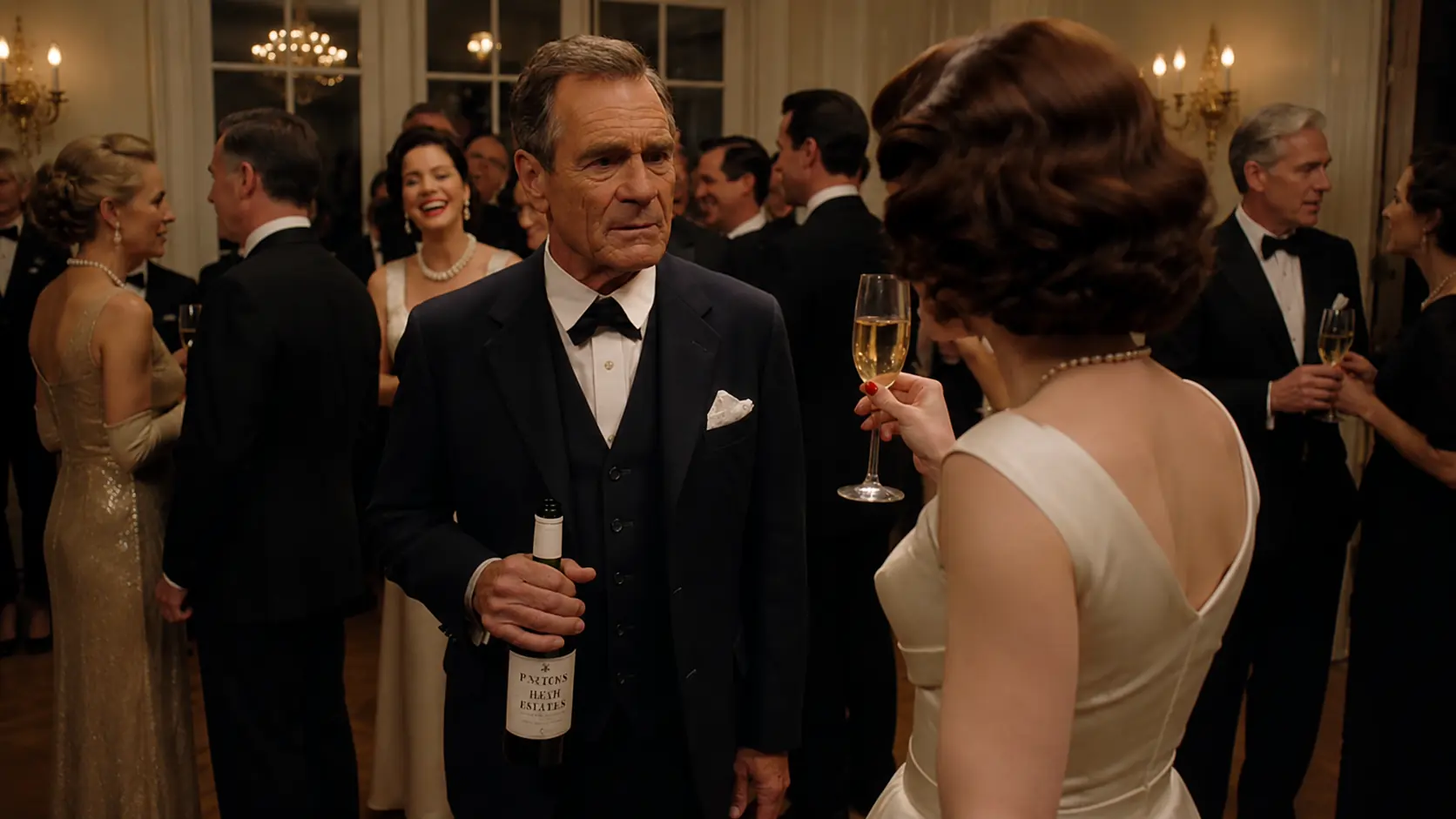
Meadow Ashford, 32, Wharton educated, polished, wearing a dress that cost more than my mortgage, raised her champagne glass and announced it to the entire Stanton estate. “Look, everyone,” she said, her voice cutting through the jazz quartet. “They let the pig farmer in tonight.”
Eighty guests turned. Eighty faces in designer labels I couldn’t pronounce, holding champagne in the kind of oceanfront Hamptons ballroom that made my 300-acre Seneca Falls farm look like a shed. Crystal chandeliers threw light across hardwood floors worth more per square foot than my tractor.
I stood there at 68, wearing the same suit I’d owned for two decades, my calloused hands gripping a cheap bottle of Finger Lakes wine. Twenty-five million dollars in the bank from Monsanto corn patents, and I still looked like I’d walked in from the barn.
My son Dashel appeared at the head table, 35 and anxious beneath his Silicon Valley polish. His two-thousand-dollar suit couldn’t hide the nervous energy as he gestured toward a chair. “Dad, over here.” I didn’t belong here. I never had.
Havana Mercer, the private investigator I’d hired six months ago, sat at table 14 near the exit, 30 years old with calculated calm that made me trust her. She wore a simple black dress, her dark eyes tracking every face like she was cataloging evidence.
“How wonderful,” Meadow continued as I crossed the ballroom. “To have such authentic people at our table. Dad Calvin, you bring such a charming rustic quality.” Polite laughter rippled through the crowd. It tasted like copper.
Orville Stanton stood near the bar, 65 with old Manhattan money arrogance. Those same calculating eyes from our Cornell dorm room 45 years ago. He raised his glass with a smile that held secrets I couldn’t access. Something about that expression made my chest tighten.
Edna Stanton, his wife, sat beside Meadow, 60 years old, draped in pearls that concealed maxed-out credit cards. She leaned toward her neighbor in a stage whisper designed to carry. “People like him belong in a barn,” Edna said. “Not a dining room.”
My blood rushed to my face. I pulled out the chair beside Havana with hands that wanted to shake. Meadow tapped her champagne glass. “We’re so grateful, Dad. Calvin could take time from his farming to join us. It’s important to remember our roots even when we’ve moved on to better things. Dashel and I have built such a beautiful life here. And it’s sweet to see where he came from.”
I looked at my son. Dashel stood beside his wife, face flushed, eyes darting between us like a trapped animal. Our eyes met for half a second. Then he looked away. “Dad,” Dashel said with that nervous childhood laugh in his voice. “Please don’t embarrass us tonight. Just try to fit in, okay?”
My own son, my own blood. I’d raised this boy, changed his diapers, paid for Stanford by selling 100 acres my father died protecting. And now he asked me not to embarrass him. I placed both hands on the chair arms, ready to walk out.
Havana’s hand clamped around my wrist, a grip that could break bone if needed. She whispered close enough that only I heard. No panic in her voice. Just cold fire. “Sit down. They have no idea who they’re messing with. Everything’s about to change.”
Starting tomorrow, I turned to look at her. Really look at her. I’d hired Havana six months ago when money started disappearing from Dashel’s accounts. Small amounts at first, five thousand here, ten thousand there. Amounts I might have missed, except I’d spent 40 years balancing farm budgets to the penny.
She’d spent six months digging into my son’s marriage, his finances, his in-laws, and I’d never seen her like this. Not worried. Certain. “How long have you been planning this?” I asked beneath the jazz quartet. “Long enough,” she said, pouring water with steady hands. “Trust me. Just get through tonight.”
I sat back down, gripped my water glass to hide trembling fingers. Across the ballroom, Orville watched me with those eyes that had haunted my memory for 45 years. Eyes carrying a secret my mind wouldn’t surrender. I’d seen them before. But where?
The rest of the evening blurred. Meadow’s toast. Edna’s cruelties. Dashel’s careful avoidance of anything requiring him to choose between his wife and father. Eighty guests looking at me like dinner entertainment. Havana sat beside me the entire time, calm as a surgeon.
When the party ended three hours later, I stood to leave. Orville appeared at the exit, blocking my path. “Calvin,” he said, extending his hand. “Good to see you. It’s been too long.” I didn’t take it. He dropped his hand, smile widening. “I hope you enjoyed yourself. Family is so important. Don’t you think we should all treasure the time we have together?” Something in his voice made my spine go cold. Not a threat. A promise.
The two-hour drive to Seneca Falls was silent. Havana drove my pickup while I stared at highway lights, trying to remember where I’d seen Orville’s eyes. She didn’t speak until we pulled into my driveway at two a.m. “Tomorrow,” she said, killing the engine. “Nine a.m. My office. Everything you need to know.” Then she disappeared into November darkness.
I sat alone in my truck, looking at the farmhouse my father built in 1952, wondering what tomorrow could possibly change. Havana’s office would have to wait until morning. First, I had to escape the Hamptons.
At eleven p.m., I pushed through the ballroom exit toward cold November air and freedom, but Orville Stanton blocked the marble foyer. He stood framed by the doorway, ocean breeze turning sharp behind him, his tuxedo jacket unbuttoned like he’d been waiting. That same calculating smile from 45 years ago. “Professor,” he said, extending his hand again. I didn’t take it.
“So glad you could grace us tonight. We must have you back next year if you’re still around.” The words landed soft but deliberate. If you’re still around. Not if we’re hosting. Not if schedules permit. If I was still around.
Havana’s fingers wrapped around my elbow, firm enough to feel like a warning. “Come on, Pop,” she said, pulling me past Orville toward the valet stand. “Let’s go.” I caught something in Orville’s eyes as we passed. A flicker of recognition, of satisfaction, of something my mind refused to name. I’d seen that look before. Somewhere the memory sat just beyond reach, like a word on the tip of my tongue.
The valet brought my fifteen-year-old Ford pickup, dusty and out of place among the Mercedes and Teslas. I climbed in, started the engine that rattled like old bones. Havana slid into the passenger seat, pulled out her phone, and started typing. For two hours from the Hamptons to Seneca Falls, she didn’t stop. Route 495 stretched dark and empty through Long Island. My headlights caught highway signs, exit markers, the occasional semi-truck hauling goods toward destinations I’d never see.
Havana’s phone screen glowed blue in the darkness, her thumbs moving constantly. I wanted to ask what she was doing, what she’d been planning, how long she’d known tonight would end in humiliation, but I said nothing. The humiliation replayed in my head instead. Meadow’s voice. The pig farmer they let in tonight. Eighty guests laughing. Edna’s comment about barns and dining rooms. And worst of all, Dashel’s nervous laugh. “Dad, please don’t embarrass us tonight.” My own son.
Two hours of silence. Two hours to remember every word Meadow said. Every laugh from people I’d never meet again. Every moment Dashel chose them over me. Havana typed through it all. Whatever she was working on required complete concentration. The kind of focus I recognized from my years teaching graduate students who discovered something that changed their entire thesis.
“Pop,” she said once around the New York State Thruway exit. Just that one word. Then back to typing. “Just trust me, please.” I trusted her. I’d hired her six months ago when money started disappearing from Dashel’s accounts. Small amounts at first, then larger, then patterns I couldn’t explain with legitimate expenses.
She’d spent half a year digging into my son’s life while I pretended everything was fine. We pulled into my driveway at one thirty a.m. The porch light was on. Strange since I’d left at five p.m. and never left lights burning. Waste of electricity. Havana grabbed a laptop bag from the back seat. First time I’d noticed she’d brought it.
“Go to bed, Pop,” she said, heading toward her car parked near the barn. “We’ll talk in the morning.” “I can’t sleep,” I said. Not after tonight. She looked at me across the pickup bed, her face half-lit by the porch light. “Then make coffee,” she said. “I’ll be there at six a.m., not a minute later.” She drove away, tail lights disappearing down the dirt road toward town.
I stood in my driveway, looking at the farmhouse my father built in 1952. Three hundred acres of land I’d fought to keep through two recessions, a wife’s cancer bills, and a son’s Stanford tuition. The place smelled like turned earth and coming frost. It felt different tonight, like something had shifted that I couldn’t name.
I went inside, didn’t bother with sleep. Made coffee at four a.m., wearing yesterday’s suit, staring at the photograph of Eleanor on the kitchen shelf. Taken thirty years ago before the cancer, before everything fell apart. She’d known how to handle people like Meadow, known how to protect our son from himself. I didn’t.
At exactly six a.m., headlights swept across the kitchen window. Havana walked in carrying the laptop bag and a three-inch legal folder that looked like it weighed ten pounds. She sat both on the kitchen table without speaking. Jasper Sterling appeared in the doorway, seventy and weathered from three decades managing my farm, moving through the kitchen with the quiet grace of someone who knew every secret the Dalton family held. He’d worked for my father before me, knew when to stay and when to disappear. He stayed this time, leaning against the counter, arms folded.
Havana opened the laptop, pulled up a file directory. Forty-seven folders filled the screen, each labeled with a name. “Pop,” she said, her voice steady in the pre-dawn darkness. “We need to talk about eight months of work.” Eight months. How long had she known something was wrong? How long had she been investigating while I smiled through Sunday dinners and ignored the signs?
The first folder, Havana said, clicking it open, is Meadow Stanton. Her screen filled with surveillance photographs, timestamps, location data, a spreadsheet I couldn’t read from across the table. The second, she said, her finger hovering over another folder, is Dashel Dalton, my son’s name, in an investigation file on my private investigator’s computer. I stared at that second folder like it might explode.
“You’ve been investigating my son,” I said, not a question, a statement. “For eight months,” Havana confirmed. Since you hired me, since you told me money was disappearing and you didn’t know why, since you asked me to find out what your daughter-in-law was really doing with your family’s fortune.
She clicked open Dashel’s folder. More photographs appeared. My son at restaurants I didn’t recognize. Meeting people I’d never seen. Signing documents in offices that looked expensive and wrong. I need you to look at something, Havana said. And I need you to not react until I’ve shown you everything. Can you do that? Jasper moved closer to the table. Silent witness. Thirty years of loyalty concentrated in that one small gesture. I nodded.
Havana clicked the first photograph in Meadow’s folder. It showed my daughter-in-law sitting across from a man in a suit. The Plaza Hotel according to the timestamp. Two months ago, the same man appeared in six more photographs. Different dates, same location, same intimate distance across the table that suggested this wasn’t business.
The affair is only the beginning, Havana said. Havana’s finger hovered over the folder labeled Meadow Stanton for three seconds before double-clicking. My world began to crack open. The first subfolder was titled External Relations. A bureaucratic phrase that made my stomach turn before I understood why.
Surveillance photographs filled the screen. High-resolution images timestamped and geo-tagged like evidence exhibits. Meadow standing outside the Plaza Hotel entrance beside a man I’d never seen, late thirties. Expensive suit, the kind of casual confidence that came from old money or new power. This is Douglas Kramer, Havana said, her voice flat and professional, investment banker, Goldman Sachs vice president, 38 years old, divorced, lives in Tribeca.
She clicked through more photographs. Meadow and Kramer at the Plaza lobby bar. Champagne glasses catching afternoon light. Meadow and Kramer at the elevator bank. Her hand on his arm. Different dates. Same hotel. Same intimate distance that didn’t require explanation. The timestamps told the story. April 2016, May 2016, June 2016, August 2016, September 2016, October 2016. Six times. Six times.
While my son thought everything was fine, she they never left together. Havana said, scrolling through more images. Arrived separately, departed separately. Professional surveillance protocol would call this establishing pattern of behavior. They thought they were being careful.
I stared at a photograph of Meadow smiling at this stranger, Douglas Kramer, Goldman Sachs, destroyer of my son’s marriage with the same smile she’d used at last night’s party. The one that never reached her eyes. It’s not just an affair, Pop, Havana said quietly. Look at the dates.
She opened a second subfolder labeled financial analysis. Bank statements filled the screen. Wire transfer records. Screenshots of encrypted emails with subject lines like Q3 restructuring and offshore asset movement. Numbers that made my eyes blur.
Havana walked me through it like she was teaching a Cornell seminar on white-collar crime. Every meeting preceded a transfer, she said, highlighting dates on a spreadsheet. April 15th, Meadow meets Kramer. April 18th, Stanton Realty transfers two million to a Cayman account. May 20th, another meeting. May 23rd, another transfer. The pattern holds across six months.
The twelve million total, I said, reading the bottom line. The coffee in my stomach turned to acid. Twelve million that we can trace. Havana corrected. The shell companies go deeper than this. These are just the transactions my investigator could document with certainty. Six meetings, twelve million. My daughter-in-law was destroying my son’s marriage and multiple family savings simultaneously.
They’re not just stealing from me, I said, understanding blooming like nausea. They’re already stealing from someone and from everyone. Havana confirmed. Investors, business partners, probably the IRS. Kramer’s specialty at Goldman is offshore restructuring, moving assets through jurisdictions that don’t cooperate with US law enforcement. He’s not Meadow’s boyfriend. He’s her financial accomplice.
She clicked through more documents, corporate filings, partnership agreements, names I recognized from Dashel’s wedding, Stanton family associates who’d smiled at me while planning this. Stanton Realty is bankrupt, Havana said. Has been for eighteen months. They’ve been hiding it through a network of shell companies, moving money faster than auditors can follow. Kramer designed the structure. Meadow executed it. Her parents provided the Stanton name as camouflage.
Jasper, still standing silent by the counter, poured himself coffee with hands that didn’t shake. Thirty years on this farm had taught him to absorb bad news like a sponge absorbs water. I looked at another photograph. Meadow at the Plaza wearing the same dress she’d worn to some family dinner I’d attended months ago. Laughing at something Kramer said, planning the destruction of how many lives.
And I knew, I said, the words coming out before I decided to speak them. From the first time I met her, I knew something was wrong. Havana closed the laptop gently, met my eyes. You tried to tell yourself you were wrong, she said. For Dashel. Because you wanted your son to be happy. Because questioning your daughter-in-law at a wedding seems petty and small.
How long have you known? I asked. The kitchen clock ticked. Six forty-five a.m. The sun was rising over fields I’d plowed for forty years, painting the frost orange and gold. I suspected eight months ago, Havana said, when you first hired me to investigate the missing money. I started with financial records, found patterns that didn’t make sense. So I brought in a former FBI investigator through the Columbia Law Alumni Network, someone who specializes in organized financial crime.
Sai, retired, Havana clarified. But still connected, still capable. He’s the one who got these photographs, tracked the shell companies, built the paper trail that proves Meadow isn’t just a cheating wife. She’s a criminal.
What could possibly be worse than proof that my son married a thief and a liar? I picked up my coffee mug, cold now. I drank it anyway, tasting yesterday’s bitterness. The affair and the money laundering, I said slowly. That’s what you wanted to show me. That’s why we’re sitting here at dawn going through surveillance photos and bank statements.
Yes, Havana said, and that’s the worst of it. She looked at me for a long moment. Something passed behind her eyes. An apology, a warning, a request for forgiveness before she destroyed what remained of my morning. “No,” she said quietly. “Pop, that’s not the worst of it.”
My phone slipped from my hand to the kitchen table. Not because of shock, because my fingers suddenly felt numb. The worst is in the next folder. Havana continued, her voice barely above a whisper. Dashel’s folder. And Pop, you need to sit down for this. I was already sitting. Sit down more, she said.
And despite everything, I almost laughed. Except her eyes were red. Actually red like she’d been crying before she arrived. And Havana Mercer didn’t cry. Not when she’d graduated law school. Not when she’d won her first major case. Not when she’d shown me photographs of my daughter-in-law’s calculated betrayal. But she was crying now.
“What did you find about my son?” I asked. She opened the second folder. “Everything,” she said.
The knock on the farmhouse door at eleven a.m. was firm and professional. The knock of someone who’d spent twenty years serving warrants. Havana had closed Dashel’s folder without showing me. Said we needed context first. Said I needed to understand the full picture before seeing what my son had done.
I opened the door to a man in his fifties, worn leather jacket over pressed shirt, reading glasses hanging from a lanyard. He carried a briefcase thick enough to bury a family. “Professor Dalton,” he said, extending his hand. “Alonzo Newell. I’ve been following the Stanton family since March.”
We moved to my study, the room where I used to grade papers and write research proposals before retiring. Windows overlooked harvested cornfields stretching toward the Finger Lakes. Alonzo Newell, fifty-two with two decades at the bureau behind him, spread files across my desk like evidence exhibits.
“She’s Pop,” Havana said quietly. “This is the investigator I hired eight months ago through my Columbia Law alumni network. Everything I’m about to show you, he documented it.” Eight months before the anniversary party, before last night’s humiliation, she’d known something was coming.
Alonzo opened the first file. Corporate documents, financial statements, legal filings that made my engineering degree useless. “Stanton Realty,” he began, his voice carrying the flat precision of courtroom testimony. “Publicly appears to be worth eighty million. Residential properties across Manhattan, commercial holdings in Brooklyn, development projects in Queens.”
He slid a second document across the desk. “Reality: negative twelve million. The company is underwater. Has been for three years. They’ve been hiding it through a network of shell corporations, offshore accounts, and creative accounting that would impress the Enron executives.”
Twelve million. I stared at the numbers. Five civil fraud lawsuits over ten years. Alonzo continued pulling out more files. All settled out of court with non-disclosure agreements. Pattern of behavior. Take investor money. Move it offshore. Claim business losses, declare bankruptcy on shell companies, while keeping the Stanton name clean.
Meadow’s affair with the Goldman Sachs banker suddenly made more sense. Not just romance. Financial infrastructure. But there’s a pattern here, Alonzo said, looking at me over his reading glasses. And it starts with you, professor.
The coffee from this morning turned cold in my stomach. It’s your past with Orville Stanton, he said. Cornell University, autumn 1973. Before we go further, there’s something you need to tell me. Or rather, that you’ve forgotten.
- The memory hit like ice water. Yellow leaves on Triphammer Road. Orville’s smile, the handshake that meant nothing. I was twenty-three years old that autumn. Second-year graduate student in agricultural engineering. Shared a lab with my roommate Orville Stanton, old money from Manhattan, slumming it in rural agronomy because his father thought it would build character.
We’d spent two years developing a drought-resistant corn hybrid. Late nights in the lab, careful cross-pollination, data collection that made my eyes blur. Orville handled the business side, patent applications, investor presentations, the parts I didn’t understand. October 1973, a Monsanto representative visited campus, looked at our research, offered fifty thousand dollars for the patent rights. Fifty thousand dollars, more money than I’d seen in my life. Enough to pay off my father’s farm debts. Enough to secure my future.
“Orville,” I’d said in the lab that afternoon, autumn light slanting through windows that overlooked Cayuga Lake. “We both sign. We split it fifty-fifty.” He’d smiled. That same smile I’d seen last night at the Hamptons estate. “Trust me, Cal,” he’d said. “I’ll handle the paperwork. Family lawyer knows this stuff inside and out. We’ll get a better deal if I negotiate.” I trusted him.
Two weeks later, I found out Orville had signed the contract alone, pocketed the full fifty thousand, dropped out of Cornell the next day, used my research, our research, to start a real estate empire while I finished my degree on student loans. I never spoke to him again until my son brought home his daughter.
The study came back into focus. Alonzo and Havana watching me. The files spread across my desk. Forty-three years collapsed into this moment. “You remembered,” Havana said softly. “Should he took everything?” I said, my voice sounding distant. “And now he’s trying to do it again.”
It wasn’t a coincidence, Alonzo said. Your son meeting Meadow Stanton. I’ve traced their first contact. San Francisco tech conference three years ago. Meadow flew from New York specifically to attend. She approached him, knew exactly who he was, knew his father was Calvin Dalton, the man Orville had stolen from.
The room tilted. How long had Orville been planning this? The words came out as a whisper. “Since that day in 1973?” “I don’t know,” Alonzo said. “But I know this. Meadow researched your son for six months before approaching him. Knew his job, his salary, his relationship history. She built a profile, then she executed.”
Havana placed her hand on my shoulder. “Pop,” she said. “That’s why I started investigating.” When Dashel announced the engagement two years ago, I looked up Meadow’s parents, found the Stanton name. Remembered you’d mentioned an Orville Stanton once, a roommate who betrayed you at Cornell.
“You never told me,” I said. She’d been protecting me or gathering evidence or both. “I needed to be sure,” she said, “before I accused your son’s fiancée of being part of a forty-three-year revenge plot.” So I hired Alonzo. And he found everything.
The sharp sting in my chest wasn’t a heart attack. It was understanding. My son hadn’t fallen in love. He’d been targeted, researched, groomed, married to a woman who’d been trained from birth to finish what her father started.
“Uh, this isn’t new,” I said, looking at the files covering my desk. “Evidence of fraud, affairs, money laundering, calculated destruction. This is forty-three years in the making.” Alonzo closed his briefcase. “Professor,” he said quietly. “That’s the context. Now you’re ready to see what Dashel has done.”
My hands shook as Havana opened her laptop again. Clicked on Dashel’s folder, the one she’d closed this morning. The one that was worse than everything else. Orville Stanton hadn’t just betrayed me once in a Cornell dorm room. He’d been waiting decades to finish what he started, and my own son had been the perfect weapon.
I needed air before Havana opened that folder. Needed to think before seeing what my son had done. Sunday afternoon light stretched long across the harvested fields. I sat on the old porch swing, the same one Eleanor and I used to share on summer evenings before the cancer took her. Eight years gone, and I still spoke to her like she was sitting beside me.
“Eleanor,” I said to the empty November air, “I failed our boy.” The swing creaked. No answer came. Never did. But I kept talking anyway. I knew Meadow was wrong for him from day one. Saw it in her eyes at that first dinner when she looked at our farmhouse like it was beneath her. And I said nothing. Thought if I questioned his choice, I’d become the controlling father who couldn’t let go.
A crow called from the barn roof. The sun painted the Finger Lakes orange in the distance. But that’s not the whole truth, is it? I continued, my voice catching. The whole truth is that Dashel knows. He has to know. You don’t marry someone like Meadow without seeing what she is. The vanity, the manipulation, the casual cruelty to anyone she considers beneath her.
The realization settled like ice in my chest. My son wasn’t just a victim. He’d chosen this. Chosen access to Stanton wealth and Manhattan society over the integrity Eleanor and I had tried to teach him. Chosen to look away from who his wife really was because looking away was easier than admitting he’d made a mistake.
What kind of father raises a son who makes that choice? I asked the sunset. The screen door opened behind me. Havana’s footsteps crossed the porch. She’d been watching from the doorway. I could feel it. “How long have you been standing there?” I asked.
“Ten minutes,” she said, sitting beside me on the swing. The chains groaned under the added weight. “Pop, we can stop this. Walk away. Let the Stantons have whatever they’re planning and disappear from your life.” I looked at her. “Or,” she continued, “we can threaten them privately. Show them what we know. Force them to back down without public exposure. Dashel never has to know you investigated his marriage.”
The swing moved slightly in the November wind. “Or option C,” Havana said quietly. “We do this right. Full exposure, legal prosecution, public reckoning. Everything we’ve found goes to law enforcement, goes to the media, goes into permanent record.”
I watched the sun sink toward the lake. Forty-three years since Orville Stanton stole my patent. Forty-three years of him building an empire on my work while I built this farm with my hands. “Option C, Havana,” I said. “We do this right. No mercy.” The words tasted like ash. But mercy was what got us here.
“That means no mercy,” Havana said as if reading my mind. “For any of them, including Dashel. If he’s complicit, he faces consequences. If he’s willfully blind, he faces consequences. No exceptions because he’s your son.” “I understand.” “Do you?” She turned to face me. “Because once we start this, Pop, you might lose him forever. He might choose her over you, choose the Stantons over his own father.”
The possibility had been sitting in my stomach since this morning. Since I saw those surveillance photos, since Alonzo explained the forty-three-year revenge plot. “Then that’s his choice to make,” I said. “Not mine. But I want to give him one last chance. When the time comes, when everything’s exposed and he has to choose a side, I want him to have that chance.”
Havana nodded slowly. “There’s one more person I need to bring into this,” she said. “A journalist who’s been researching you for five years, building a story about agricultural patents and corporate exploitation. She’s exactly who we need when this goes public.” “Who is she?” “That’s a conversation for later,” Havana said, standing. “First, you need to see the rest of what Alonzo found.”
Monday morning came cold and clear. I’d barely slept. Dreams of Orville’s smile. Meadow’s champagne glass. My son’s nervous laugh. Alonzo spread new files across the study desk. Thicker than yesterday’s. More photographs, more bank statements, more evidence of destruction.
“Professor,” he began. “Meadow Stanton has done this before. Twice.” He opened the first file. 2012 Wall Street derivatives trader named Marcus Sheffield, forty-two years old, divorced, recently inherited eight million from his father. Meadow met him at a charity gala, six-month relationship, convinced him to invest one point two million in a can’t-miss real estate development. The development was a Stanton shell company. Money disappeared into offshore accounts. Sheffield signed a non-disclosure agreement to avoid public embarrassment.
He opened a second file. 2014 Silicon Valley tech founder named Robert Hamilton, thirty-eight, sold his startup for twenty million. Meadow approached him at a conference in San Francisco. Eight-month relationship, convinced him to invest three million in emerging market opportunities. Same pattern, same shell companies, same NDA afterward.
How many families had Meadow destroyed before mine? “Both victims paid her to stay quiet,” I said, understanding the pattern, “to protect their reputations so she could move on to the next target.” “Exactly,” Alonzo confirmed. “You’re the third, professor, and the largest. Your twenty-five million fortune makes you the crown jewel of her career.”
Havana stood by the window, arms folded, watching me process this. But there’s a difference this time, Alonzo continued. Sheffield and Hamilton were single men she could seduce and abandon. You’re different. You’re her father-in-law. She can’t just take your money and disappear. She needs you gone.
The room went quiet. Alonzo removed his reading glasses, cleaned them on his shirt, put them back on. The gesture of a man about to deliver bad news. “Uh, professor,” he said slowly. “The third folder, the one we haven’t shown you yet. It’s not about what they’ve done. It’s about what they’re planning to do to you.”
My hands gripped the desk edge. “Uh, the affair, the money laundering, the forty-three-year revenge plot. That’s all background,” Alonzo said. “The third folder contains evidence of active planning, current conspiracy, future action.”