At 19 years old, still untouched by any man, Lena Hartwell was handed over like livestock to a stranger, a widowed rancher with five grieving children and a ranch full of ghosts. She expected cruelty. She expected to be used and discarded like every other unwanted soul before her.
But what she found in the barren hills of Wyoming would shatter everything she believed about survival, belonging, and what it means to be chosen. This is the story of a girl who arrived with nothing and became everything.
The train lurched to a grinding halt, metal screaming against metal, and Lena Hartwell’s stomach twisted with it. Through the smudged window, she saw nothing but dust, endless choking dust that rose from the Wyoming plains like the earth itself was trying to erase this place from existence.
The platform, if it could even be called that, was little more than weathered planks laid across packed dirt. No station house, no shelter, just emptiness stretching in every direction beneath a sky so wide it felt like punishment.
Lena pressed her palm against the glass, feeling the heat radiating through despite the autumn season. Her reflection stared back, pale skin, dark eyes too large for her thin face, brown hair pulled into a braid that had come loose during the two-day journey.
She looked exactly like what she was: unwanted cargo being delivered to its final destination.
“End of the line, miss.”
The conductor’s voice carried no sympathy, just the weary tone of a man who’d seen too many young women make this particular journey and knew how most of their stories ended.
Lena stood on legs that had gone numb from sitting, smoothing down the gray dress that had once belonged to her cousin, the cousin who’d married well and had no further use for cast-off clothing or cast-off relatives. The fabric was worn thin at the elbows and hem, respectable enough from a distance but revealing its poverty upon closer inspection, much like Lena herself.
She reached for her carpet bag, the only possession she’d been allowed to take. It wasn’t heavy. One change of clothes, a hairbrush missing half its bristles, a book of poetry she’d stolen from her aunt’s parlor the night before she left, and a small tin containing her mother’s wedding ring, the only proof Lena had ever been loved by anyone.
The conductor was already moving toward the next car, eager to be done with her. Lena stepped into the aisle, her boots echoing on the wooden floor.
Through the windows, she caught glimpses of the other passengers: a merchant in a fine suit who’d spent the journey reading newspapers and ignoring her completely, a mother with two small children who’d pulled them close whenever Lena walked past, as if poverty might be contagious.
The steps down to the platform were steep, and Lena gripped the railing with her free hand, feeling the splinters catch against her palm.
The moment her feet touched solid ground, the heat slammed into her like a physical force. It was nothing like the humid summers of Ohio, where she’d grown up in her grandmother’s house before the old woman died and left Lena to the mercy of relatives who saw her as a burden to be shuffled between households like a piece of furniture no one quite wanted but couldn’t justify throwing away.
The train behind her hissed and groaned, already preparing to depart. There would be no changing her mind, no buying a ticket back to anywhere. Even if she’d had the money, which she didn’t, there was nothing waiting for her in the places she’d left behind.
“You the girl?”
The voice came from her left, rough as the landscape, and Lena turned to face the man she’d been sold to. She didn’t let herself think of it any other way because pretty words wouldn’t change the truth.
Her aunt had made the arrangement through a series of telegrams, each one more terse than the last. A widower needed help with his children. Room and board provided. Wages minimal but sufficient.
Her aunt had presented it as opportunity, but Lena had read it between the lines. Here was a chance to be rid of an unwanted niece without the guilt of turning her out into the streets entirely.
Jonah Pierce was not what she’d expected, though she’d be hard-pressed to say exactly what she had expected. He was tall. She had to tilt her head back to meet his eyes, with the kind of build that came from decades of physical labor.
His face was weathered, carved by sun and wind into hard planes and deep lines. He might have been 40 or 50, or ageless in the way men became when the land had worked them over thoroughly. His hair, dark brown shot through with gray, needed cutting.
His clothes were clean but worn, patched in places with stitches that showed care if not skill.
But it was his eyes that caught her attention. Blue, like winter ice, and carrying an exhaustion so profound it seemed to radiate from him like heat from sun-baked stone.
“Yes, sir.”
Lena’s voice came out steadier than she felt.
“Lena Hartwell.”
He nodded once, a short jerk of his chin that might have been acknowledgement or dismissal. His gaze swept over her, taking in her slight frame, her worn dress, the carpet bag that held everything she owned. Whatever assessment he was making, his expression didn’t change.
“Jonah Pierce.” He gestured toward a wagon waiting in the shade of the platform’s overhang, the only shade visible for miles. “We’ve got a two-hour drive ahead. Best get started before the heat gets worse.”
He didn’t offer to take her bag, didn’t offer his hand to help her, just turned and walked toward the wagon with long strides that she had to scramble to match.
Lena clutched her carpet bag tighter and followed, her boots kicking up small clouds of dust with each step. The wagon was sturdy but old, its wood bleached gray by the sun. Two horses stood hitched to it, their heads low, tails swishing lazily at flies.
Jonah climbed up onto the driver’s seat with practiced ease, gathering the reins in hands that were scarred and calloused. He still didn’t look at her.
Lena eyed the wagon’s height, the gap between the ground and the seat that seemed suddenly insurmountable in her long skirts.
Before she could figure out the logistics, Jonah spoke without turning his head. “There’s a step. Left side.”
She found it, a small wooden block nailed to the wagon’s side, and used it to haul herself up. The seat was sun-warm through her dress, and she had to shift to find a spot where a protruding nail wouldn’t tear the fabric.
She set her bag at her feet and folded her hands in her lap, fingers intertwined so tightly her knuckles went white.
Behind them, the train whistle blew, a long, mournful sound that echoed across the empty land. Lena didn’t turn to watch it leave. There was no point in looking back.
Jonah clicked his tongue, and the horses lurched forward. The wagon wheels creaked, finding their rhythm, and the train station, such as it was, fell away behind them.
Within minutes, it disappeared entirely, swallowed by the dust and distance.
The silence between them stretched and settled like the dust coating everything. Lena had never been comfortable with silence, had learned early in her shuffled childhood that quiet meant people were thinking of ways to be rid of you, but she didn’t know how to break it.
What did one say to a man who’d purchased her services sight unseen? Thank you for the opportunity? I promise to work hard? The words all seemed equally absurd, so she said nothing, and Jonah seemed content with that.
His eyes stayed fixed on the horizon, his hand steady on the reins. The only sounds were the creak of the wagon, the plodding rhythm of the horses’ hooves, and the endless wind that swept across the plains like breath from some vast, invisible mouth.
The land around them was unlike anything Lena had ever seen. In Ohio, there had been trees, thick forests, and carefully tended orchards. Fields, yes, but broken up by stone walls and wooden fences, by barns and houses never more than a mile apart.
Here, there was nothing to break the monotony, just grass, brown and brittle from the summer heat, rolling away in every direction. The horizon seemed impossibly distant, the sky impossibly large. It made Lena feel small in a way that had nothing to do with her circumstances and everything to do with the sheer scale of emptiness.
“Never been this far west before.”
It wasn’t a question, but Lena answered it anyway.
“No, sir. I grew up in Ohio, near Marietta.”
Jonah grunted, which might have meant anything or nothing. Another five minutes passed before he spoke again.
“Your people farming folk?”
“My grandfather was a cobbler. My grandmother took in sewing.”
Lena hesitated, then added, “They died when I was 12. I’ve been with relatives since then.”
“And they sent you out here?”
Still not a question, but this time there was something in his tone, not quite judgment but close to it.
“They had their own families to worry about.” The words came out more defensive than Lena intended. She forced herself to soften her voice. “I’m grateful for the opportunity, Mr. Pierce.”
“Are you?”
It wasn’t sarcastic, exactly, but it wasn’t quite believing, either.
Lena felt her cheeks heat and was grateful he wasn’t looking at her.
“Your telegram said you needed help with your children.”
“Five of them.” Jonah’s jaw tightened, the only sign of emotion he’d shown since she’d arrived. “Abigail’s 11. Then Caleb, he’s nine. Ruth, seven. Micah just turned five, and June—”
He paused, and when he spoke again, his voice had gone rough.
“June’s barely two.”
Lena did the math quickly in her head. The youngest child was two, which meant—
“How long has your wife been gone?”
“Fifteen months.”
The words came out clipped, final, and Lena understood she wasn’t to ask more about that particular subject. Fifteen months, barely more than a year, and he was already bringing in a replacement.
The thought should have been bitter, but Lena found she couldn’t muster the energy for bitterness. What did it matter? She was here, and there was no going back.
“What happened to the last girl?” Lena heard herself ask, then immediately wished she could take the words back.
Jonah’s hands tightened on the reins.
“Lasted three weeks. Said the work was too hard, the isolation too much. Caught a ride back to town with a supply wagon and never came back.”
He cut his eyes toward her for the first time since they’d left the station.
“Before her, there were two others. One made it a month, the other barely a week.”
“Oh.”
Lena’s voice came out small.
“I’m not a cruel man, Miss Hartwell.” Jonah’s attention returned to the road ahead. “But I’m not a patient one, either. I’ve got a ranch to run, cattle to manage, and five children who need raising. I can’t keep stopping work to explain how a household runs or to comfort girls who thought frontier life would be some kind of adventure. You’ll work hard. The children can be difficult. The house needs a firm hand.”
He paused. “If you’re going to run, better to do it now than after I’ve wasted time trying to train you.”
Anger, bright and unexpected, flared in Lena’s chest. She’d spent 19 years being passed from relative to relative, each one making it clear she was a burden, an obligation, a problem to be solved.
She’d been grateful for scraps, apologetic for existing, so careful to make herself small and useful and invisible. And still, it had never been enough.
“I’m not going to run.” Her voice came out harder than she’d intended, sharp enough that Jonah’s eyebrows rose slightly.
“I’ve got nowhere to run to, Mr. Pierce. Whatever you and your children need, I’ll provide it. I don’t scare easily, and I’m not afraid of hard work.”
She lifted her chin.
“What I’m afraid of is being sent back to people who don’t want me. So, if you’re looking for someone who’ll stay, you’ve found her.”
Silence fell again, but this time it felt different, charged somehow. Jonah studied her from the corner of his eye, and Lena met his gaze steadily, refusing to back down.
She’d surprised him, she realized. Perhaps she’d surprised herself.
Finally, he nodded.
“Fair enough.”
They drove on.
The sun climbed higher, turning the wagon seat into a griddle. Sweat trickled down Lena’s back, soaking into her dress. Her throat grew parched, and she eyed the canteen hanging from the side of the wagon seat, wondering if asking for water would make her seem weak.
Before she could decide, Jonah unhooked it and held it out to her without a word.
“Thank you.”
She drank gratefully, the water warm and slightly metallic, but better than nothing.
Jonah took a long drink after her, then secured the canteen again.
“Another hour,” he said. “Maybe less.”
The landscape had begun to change, subtle at first, but growing more pronounced. The flat grassland gave way to rolling hills, and in the distance, Lena could see the dark outline of mountains. Occasionally, they passed signs of habitation: a fence line, a windmill spinning slowly in the breeze, a cluster of cattle grazing in a hollow.
But no houses, no people. Just space and more space.
“Is it always this empty?” Lena asked.
“Nearest neighbor’s five miles east, town’s eight miles south, but that’s just a general store, blacksmith, and a church. Anything else, you’ve got to go 30 miles to Casper.”
Jonah gestured vaguely toward the west.
“The ranch is 1,500 acres. Most of it’s grazing land.”
One thousand five hundred acres. Lena couldn’t even conceive of that much space. The yard behind her grandmother’s house had seemed large when she was small.
“How many cattle?”
“About 200 head right now. Had more before.”
He trailed off, and Lena understood. Before his wife died. Before everything fell apart.
“And you manage it all yourself?”
“Got a hired man, Tom Brennan, who helps with the heavy work. Lives in the bunkhouse down by the barn. He’s good with cattle, not so good with much else.”
Jonah’s expression darkened slightly.
“The children are afraid of him, though he’s never done anything to earn it. Just big and rough-spoken, so they keep their distance.”
Lena filed that information away. A hired man who frightened the children, intentionally or not, was something to be cautious about.
The wagon crested a hill, and suddenly, there it was: the Pierce ranch, spread out in the valley below like something from a painting, though not a particularly cheerful one.
The house was two stories, wood frame painted white, but badly in need of fresh paint. One of the shutters hung crooked, the porch sagged slightly on one side, but it was substantial, bigger than any place Lena had ever lived, with glass windows that caught the sunlight, and a stone chimney rising from the center of the roof.
Behind the house stood a large barn, red paint faded to dusty pink. Several smaller outbuildings, a chicken coop, what looked like a smokehouse, a structure that might have been a bunkhouse, dotted the property.
A vegetable garden, or what had once been a vegetable garden, stretched along the south side of the house, though it had clearly been neglected. Weeds had overtaken most of it. And everywhere, dust.
Dust coating the buildings, the fence rails, the lone tree that stood near the house like a sentinel. The whole place had the air of something slowly surrendering to the landscape around it.
“Home,” Jonah said, though the word carried no warmth.
As they descended the hill, Lena caught sight of movement on the porch. Children. She could make out their shapes even from this distance, clustered near the door, watching the wagon approach. Waiting.
Her heart began to pound.
This was it, then. The moment when they would see her and measure her and find her wanting, just like everyone else had.
She straightened her spine, smoothed her hands over her dress one more time, and tried to look like someone worth keeping.
The wagon rolled into the yard, chickens scattering with indignant squawks. Jonah pulled the horses to a stop and set the brake, but he didn’t immediately climb down.
Instead, he sat for a moment staring at the house, his expression unreadable.
“They’ll test you,” he said quietly. “They’ve learned not to get attached. Three women in 15 months, they’ve learned.”
“I understand.”
“Do you?”
He turned to face her fully for the first time, and Lena saw something in his eyes that might have been warning, or might have been plea.
“Abigail runs the house because she’s had to. She won’t give that up easily. Caleb barely speaks anymore. Ruth watches everything but trusts nothing. Micah’s angry, looking for a target. And June—”
His voice cracked slightly.
“June doesn’t remember her mother. She cries for her anyway.”
Lena’s throat tightened.
“I’ll do my best.”
“Your best might not be enough.”
Jonah climbed down from the wagon, his boots hitting the ground with a solid thud.
“But I suppose we’ll find out.”
He didn’t help her down, and Lena didn’t expect it.
She grabbed her carpet bag and used the step, her legs stiff from the long ride. The moment her feet touched the ground, she became aware of the silence.
The children on the porch had gone still, five pairs of eyes fixed on her with an intensity that made her skin prickle.
Jonah walked toward the porch, and Lena followed, her bag clutched in front of her like a shield.
As they got closer, the children’s faces came into focus, and Lena’s heart clenched with an emotion she couldn’t quite name.
The oldest girl, Abigail, stood at the front of the group, her posture rigid, her chin lifted in challenge. She had her father’s dark hair and blue eyes, but where his face showed exhaustion, hers showed something harder, determination carved into features too young to carry such weight.
She wore a faded blue dress that had been let out so many times, the original hemline was visible beneath the added fabric. Her hands were red and chapped, a woman’s hands on a child’s arms.
Behind her stood a boy who had to be Caleb, thin and wary, with brown hair falling into eyes that darted between his father and Lena without settling on either. He held himself apart from the others, as if he’d already decided that distance was safer than connection.
Ruth, smaller and quieter, pressed herself against the doorframe. Her hair, lighter than her siblings, had been braided by inexperienced hands, wisps escaping around her face. She sucked on two fingers, a habit she was probably too old for, and stared at Lena with huge, solemn eyes.
Micah stood with arms crossed, his whole body radiating hostility. He was a miniature version of his father, right down to the stubborn set of his jaw, and Lena could see the anger Jonah had mentioned simmering just beneath the surface.
His clothes were dirty, his face smudged, and he looked like he hadn’t allowed anyone to properly wash him in weeks.
And in Abigail’s arms, resting on her hip with the ease of long practice, was June. The baby, though she was hardly a baby anymore, stared at Lena with her mother’s face.
Lena knew this without being told, could see it in the fine bones, the delicate features that stood in sharp contrast to her older siblings’ more angular faces. June’s thumb was in her mouth, her free hand twisted in Abigail’s braid.
“Children,” Jonah said, his voice formal, careful. “This is Miss Hartwell. She’s come to help around the house.”
“Like the others,” Micah said, his young voice heavy with scorn.
“Micah.” There was warning in Jonah’s tone, but the boy just shrugged, unrepentant.
Lena stepped forward, setting down her bag so she could face them properly.
“Not like the others,” she said quietly. “I’m going to stay.”
“That’s what they all said.”
This from Abigail, her voice high and clear and absolutely certain.
“You’ll leave, too. They always do.”
She’d heard that same tone in her own voice in the mirror-dark hours when she’d allowed herself to feel the weight of being unwanted.
These children knew what she knew: that people left, that love was conditional, that you could never quite be good enough to make them stay.
“You’re right,” Lena said, and saw surprise flicker across Abigail’s face.
“I’m a stranger, and you have no reason to trust me, but I’m going to tell you something true, and you can believe it or not as you choose.”
She met each child’s eyes in turn, even Caleb’s, even Ruth’s.
“I have nowhere else to go, no family who wants me, no home waiting for me somewhere else. This is my last chance. Do you understand? Your father hired me when no one else would have me, so I’m going to work harder than anyone you’ve ever seen, and I’m going to stay until you’re sick of looking at me, and even then I’ll stay because I’ve spent my whole life being the person nobody wanted, and I’m done with it.”
Silence.
The wind rattled through the eaves of the house. A crow called from somewhere beyond the barn.
Then June, surprising everyone, reached out from Abigail’s arms. Her small hand stretched toward Lena, fingers opening and closing in the universal gesture of a child asking to be held.
“June, no.”
Abigail started, but Lena was already moving, her body responding before her mind could catch up. She took the little girl carefully, supporting her weight, and June came willingly, settling against Lena’s shoulder with a sigh that spoke of desperate bone-deep exhaustion.
Her thumb went back in her mouth. Her eyes drifted closed.
Lena looked up to find four children staring at her in shock, and one father whose expression had gone carefully blank.
“She doesn’t go to strangers,” Abigail whispered. “She never has. Not since Mama.”
But June was already asleep, her small body relaxing completely, trusting in a way that should have been impossible.
Lena felt the weight of her, solid and warm and alive, and something inside her chest shifted and settled.
“Well,” Jonah said after a long moment. “I suppose you’d better come inside.”
He turned and walked into the house without waiting for a response.
The children scattered like startled birds. Micah disappeared around the side of the house, Caleb slipped through the door after his father, Ruth retreated into shadows.
Only Abigail remained, staring at Lena with an expression caught between hostility and something that might have been hope if hope hadn’t been beaten out of her already.
“If you hurt her,” Abigail said, her voice low and fierce, “if you leave and break her heart like the others did, I’ll never forgive you. Never.”
“I won’t,” Lena promised, and meant it with every fiber of her being.
Abigail held her gaze for another long moment, then nodded once, sharp, decisive, and followed her father inside.
Lena stood alone in the yard with a sleeping child in her arms, her carpet bag at her feet, and the Wyoming sun beating down on her head.
The house waited, its door open like a mouth, ready to swallow her whole.
She picked up her bag, adjusted June’s weight against her shoulder, and walked forward into her new life.
The interior of the house was dim after the brightness outside, and Lena paused just inside the door to let her eyes adjust.
The front room served as a parlor with worn furniture arranged around a cold fireplace: a settee with faded upholstery, two wooden chairs, a rug that had once been colorful but was now beaten into submission by years of boots and weather.
Everything was clean, or as clean as possible in a place where dust was a constant invader, but there was an air of neglect that went deeper than dirt.
It was a house holding its breath, waiting to see if it would be allowed to live again, or if it would slowly suffocate under the weight of grief.
To the right, through an open doorway, Lena could see a dining table surrounded by mismatched chairs. Straight ahead, stairs rose to the second floor, the banister scarred by what looked like knife marks, a boy’s idle carving, probably.
To the left, another doorway led to what had to be the kitchen.
Jonah had disappeared somewhere, but Abigail stood in the dining room doorway, watching Lena with that same unsettling intensity.
“June’s room is upstairs,” she said. “First door on the right. You can put her down for her nap.”
Lena nodded and moved toward the stairs, each step creaking under her weight. The second floor hallway was narrow, with doors opening off both sides.
She found the first door on the right and pushed it open carefully.
The room was small but serviceable, with a narrow bed pushed against one wall and a crib against the other. Too small for June now, but clearly she hadn’t transitioned fully to the bed yet.
A wooden chest sat beneath the single window, and a rag rug covered the center of the floor. On the wall above the crib hung a sampler cross-stitched in careful letters: Bless this child, June Elizabeth Pierce, born March 14th, 1852.
Lena’s throat tightened.
March 14th. Less than a month before June’s mother died, if Jonah’s timeline was correct.
This woman had stitched this blessing for her daughter while pregnant, or perhaps in those first exhausting weeks of new motherhood, never knowing she had only weeks left with her baby girl.
Carefully, Lena laid June in the bed, pulling a thin quilt over her. The child stirred slightly but didn’t wake, her thumb still firmly in her mouth.
In sleep, she looked even younger, heartbreakingly vulnerable.
Lena stood for a moment watching her breathe, then forced herself to turn away. There would be time for tenderness later, or there wouldn’t be. Either way, she had work to do.
Abigail was waiting at the bottom of the stairs, her expression unreadable.
“I’ll show you the rest of the house,” she said, not quite offering, not quite ordering.
“Thank you.”
The tour was brief and efficient.
Kitchen: large but poorly organized with dishes stacked haphazardly, and a cast-iron stove that had seen better days.
Pantry: half empty, supplies clearly running low.
Back room for washing with a pump that Abigail demonstrated grudgingly, and a large copper tub hanging on the wall.
The necessary was outside behind the house.
Upstairs, four bedrooms besides June’s: Jonah’s at the far end of the hall, door closed, and Abigail didn’t offer to open it. Abigail and Ruth shared one room. Caleb and Micah shared another.
And the last room, smallest of all, would be Lena’s. It held a narrow bed, a washstand with a chipped basin, and a single hook on the wall for hanging clothes. That was all.
But it was more than Lena had had in years: a room of her own, a door that closed, a space where she could simply exist without justifying her presence.
“It’s perfect,” Lena said, and saw Abigail’s eyebrows rise in disbelief.
“The last girl said it was a closet.”
“The last girl was foolish, then.”
Something flickered in Abigail’s expression, not quite a smile, but close.
“She was. Cried the first night and wouldn’t stop. Father finally paid Tom to drive her back to town just to get some peace.”
They stood in the hallway, an 11-year-old girl and a 19-year-old woman, measuring each other.
“What do you need me to do?” Lena asked.
Abigail blinked.
“What?”
“Right now, today. What needs doing most?”
“I—” Abigail’s certainty wavered. “Dinner. We need dinner. I was going to make beans and cornbread, but we’re low on cornmeal, so maybe just beans, or—”
“Show me what we have,” Lena interrupted gently. “We’ll figure it out together.”
“Together?”
“Unless you’d rather I stumble around your kitchen making a mess of things while you watch.” Lena raised an eyebrow. “I’m a decent cook, but I don’t know where anything is or how your stove heats. Seems like I could use a teacher.”
It was the right thing to say.
Abigail’s spine straightened slightly, some of the defensive hostility easing from her shoulders.
“I suppose I could show you, just this once.”
“Just this once,” Lena agreed solemnly.
They went downstairs together.
The kitchen, in the light of late afternoon, showed its age and wear even more clearly. The table was scarred from years of knives and hot pans. The chairs were sturdy but unmatched, likely collected over time as others broke.
The stove was a beast, its surface marked with burns and scratches, but Abigail moved around it with the confidence of long practice.
“We’ve got beans, pintos. I soaked them last night. Salt pork in the cold cellar, but not much. Flour, but like I said, the cornmeal’s nearly gone. Some onions, a few potatoes that are starting to sprout, but they’re still good.”
Abigail rattled off the inventory without looking, her hands already pulling out what they needed.
“There’s a chicken we could kill, but Father likes to wait until we’ve got company or Sunday.”
Lena surveyed the ingredients, her mind already working.
“What about the garden? I saw it from the wagon. Is anything still producing?”
Abigail’s expression closed off.
“Mama’s garden died with her. I’ve tried, but I don’t—I can cook and clean and mend, but I can’t make things grow.”
“Then we’ll learn together,” Lena said firmly. “But for now, let’s work with what we have. Beans, certainly. And I can make a skillet bread with just flour, salt, and lard. No cornmeal needed. Not as good as proper cornbread, but it’ll fill bellies. Those potatoes, we’ll dice them small and fry them with the onions and salt pork. Make a hash to go alongside.”
Abigail stared at her.
“You’re really going to cook?”
“Did you think I was going to stand here and supervise while you did all the work?”
Lena moved to the pump and began washing her hands.
“I told you I’m here to help. That means actually helping.”
For the first time, something like cautious relief crossed Abigail’s face.
She moved to stand beside Lena at the counter, and together they began to work.
It was a dance of negotiation, Lena offering suggestions, Abigail providing knowledge of the kitchen’s quirks and the family’s preferences.
The stove ran hot on the right side. Caleb hated onions. Micah would eat anything if you put enough salt on it. Father liked his beans with a bit of molasses, but they’d run out two weeks ago.
As they worked, the other children began to drift in, drawn by the sounds and smells of cooking.
Ruth appeared first, silent as a ghost, climbing onto a chair by the table to watch.
Then Caleb, hovering in the doorway, ready to bolt at the first sign that he wasn’t wanted.
Even Micah eventually slouched in, trying to look indifferent, but unable to hide his hunger.
“Caleb,” Lena said without looking up from the potatoes she was dicing, “could you set the table? Abigail, where are the plates?”
“I’ll do it,” Abigail started, but Lena shook her head.
“You’re helping me with this bread. Caleb can handle plates and forks, can’t you, Caleb?”
The boy stared at her, clearly unused to being addressed directly, then nodded slowly.
Abigail pointed him toward the cupboard, and he moved with careful precision, laying out six plates, six forks, six cups.
Six.
Because even though June wouldn’t eat much, she would sit with them.
They were a family, even if barely holding together.
The beans were finished first, thick and savory with the salt pork. The hash came next, crispy at the edges, soft in the middle.
And finally, Lena pulled the skillet bread from the oven, golden brown, steaming, not quite cornbread, but honest and filling all the same.
“It’s ready,” Abigail called toward the front of the house.
Heavy footsteps sounded, and Jonah appeared, his hands freshly washed, but his shirt still dusty from whatever work he’d been doing.
He paused in the doorway, taking in the scene: the laden table, the children already seated, Lena with a dish towel over her shoulder, looking more settled than any of the others had after their first day.
“Smells good,” he said, and though his tone was neutral, it was also the first positive thing he’d said since collecting Lena from the train.
They sat down to eat, Lena taking the seat beside June’s high chair, Jonah at the head of the table.
For a few minutes, there was only the sound of eating, hungry children focused on full plates, adults lost in their own thoughts.
Then Ruth, small voice barely above a whisper:
“It’s good.”
“Thank you, sweetheart,” Lena said, and saw the little girl’s eyes widen at the endearment.
“Don’t call her that.”
Micah’s fork clattered against his plate.
“You’re not our mother.”
“Micah,” Jonah warned.
“Well, she’s not.”
The boy’s face had gone red, his hands clenched into fists.
“And she’s going to leave just like the others, so why are we pretending—”
“Enough.”
Jonah’s voice cracked like a whip, and Micah subsided, but his eyes shone with angry tears.
Lena set down her fork carefully.
“You’re absolutely right, Micah. I’m not your mother. I could never be her, and I wouldn’t try.”
She looked around the table, meeting each child’s eyes in turn.
“But I can be someone who stays. Someone who keeps promises. And I promise you all right now, I’m not leaving. Whatever happens, however hard it gets, I will be here.”
“Words,” Micah muttered, but there was less certainty in his voice.
“Yes,” Lena agreed. “Just words for now. But words are all I have to give you until time proves them true. So I’ll say them as many times as you need to hear them. I’m staying.”
Silence fell again, but this time it felt less hostile, more thoughtful.
Even Micah bent back to his plate, though his shoulders remained rigid.
After dinner, Lena insisted on cleaning up while Abigail saw to getting the younger children ready for bed. The girl looked like she wanted to argue, clearly unused to having her responsibilities taken away, but exhaustion won out.
She nodded and herded Ruth and Micah toward the stairs.
Lena worked in the darkening kitchen, washing dishes in water heated on the stove, her hands moving through familiar motions while her mind spun.
Her first day was nearly over.
She’d survived it, more than survived, perhaps.
June had taken to her. Abigail had accepted her help, however grudgingly. Even Ruth had offered that tiny compliment.
But Caleb remained distant, and Micah openly hostile, and Jonah—Jonah was an enigma, a man running on fumes, exhaustion carved into every line of his body, trying to hold together a family and a ranch while slowly drowning in the weight of it all.
The back door opened, and Jonah stepped in, carrying a bucket of fresh water from the pump.
He set it on the counter without speaking, then leaned against the doorframe, watching her work.
“You did well today,” he said finally.
Lena looked up, surprised.
“Thank you.”
“Don’t thank me yet. Today was easy. Tomorrow you’ll have the full weight of this place on your shoulders.”
He rubbed a hand over his face.
“The children will test you harder. They’ll push to see where you break. And the work—cooking’s just the start. There’s washing, mending, cleaning, the garden if you meant what you said about reviving it, eggs to collect, butter to churn, bread to bake.”
“I know.”
“Do you?”
He straightened, his blue eyes searching her face.
“You’re younger than I expected, younger than the others were. I’m not sure—”
“I’ll manage,” Lena interrupted firmly. “I’ve been managing since I was 12 years old, Mr. Pierce. I raised myself while living in other people’s houses. I think I can handle yours.”
A ghost of something—respect, maybe, or at least recognition—flickered across his expression.
“Jonah. If you’re staying, you’ll call me Jonah.”
“Jonah,” Lena repeated, testing the name.
He nodded once, then pushed away from the doorframe.
“I’ll see to the stock. Don’t wait up. I’ve got late work to finish.”
He left before she could respond, the door closing quietly behind him.
Lena stood alone in the kitchen, her hands in dishwater, listening to the sounds of the house settling around her. Footsteps overhead as Abigail moved between rooms, the creak of beds, the faint murmur of voices.
She was here. She had arrived at the edge of nowhere and been handed a family that didn’t want her, a houseful of ghosts, and work that would break her back if she let it.
But for the first time in years, Lena felt something unfamiliar stirring in her chest. Not hope, exactly, but possibility.
The possibility that she might finally be allowed to stop running, that she might build something here in this harsh landscape that no one could take away.
She finished the dishes, dried her hands on her apron, and went upstairs to the small room that was now hers.
Her carpet bag sat on the bed where she’d left it, and she unpacked her meager belongings with care.
One dress hung on the hook, the nightgown folded at the foot of the bed, the book of poetry on the washstand, the tin with her mother’s ring tucked safely in the drawer.
From down the hall, she heard June cry out in her sleep, a wordless sound of distress.
Lena moved without thinking, crossing to the child’s room and easing open the door.
Abigail sat on the edge of June’s bed, rubbing her sister’s back in slow circles. She looked up when Lena entered, her expression caught between resentment at the intrusion and relief at not being alone.
“She has nightmares,” Abigail whispered. “Almost every night. I usually sit with her until she settles.”
“May I?”
Lena gestured to the other side of the bed.
After a moment’s hesitation, Abigail nodded.
They sat together in the darkness, two strangers bound by the care of a grieving child, and waited for morning to come.
Dawn came too early and too bright, slicing through the thin curtains of Lena’s room like an accusation.
She woke disoriented, her body aching from the narrow bed and the tension of sleeping in a strange place.
For a moment, she didn’t remember where she was.
Then it all came rushing back. Wyoming, the ranch, five children and a widowed man who’d taken her on as a last resort.
She dressed quickly in the dim light, braiding her hair with practiced efficiency, and splashing cold water on her face from the basin.
Her second dress, the only other one she owned, was nearly identical to yesterday’s, just a slightly darker shade of gray.
She smoothed it down and took a breath, steeling herself for whatever this day would bring.
The house was silent as she made her way downstairs, but it was the silence of a place waiting, not sleeping.
Lena had learned to read the quality of quiet in all the houses she’d lived in. This one hummed with awareness, like a held breath.
The kitchen was exactly as she’d left it the night before, clean and orderly.
Lena moved to the stove and began building a fire, grateful that Abigail had shown her where the kindling was kept.
The cast-iron beast took time to heat, but she’d worked with worse.
While she waited, she investigated the pantry more thoroughly than she’d had time for yesterday.
The shelves told a story of gradual decline.
Jars of preserved vegetables from previous years sat in the back, their contents darkening with age, too old to trust now. A sack of flour, perhaps 20 pounds left. Dried beans in abundance at least, salt pork wrapped in cheesecloth, a small jar of precious sugar, nearly empty.
No coffee, she noted. Jonah must have given that up months ago.
“You’re up early.”
Lena turned to find Jonah in the doorway, his hair damp from washing, his shirt buttoned but untucked. He looked marginally more rested than he had yesterday, though the shadows under his eyes suggested sleep was still a rare commodity.
“Habit,” Lena said. “My aunt believed idle hands were the devil’s workshop. I was expected to be up before the household, ready to work.”
“Your aunt sounds like a hard woman.”
“She was practical.” Lena kept her tone neutral. “She had her own family to care for. I was an extra mouth to feed.”
Jonah moved to the water bucket and dipped himself a cup, drinking it down in one long swallow.
“What’s for breakfast?”
“I was thinking biscuits if we can spare the lard, maybe gravy from the salt pork drippings. There are eggs?”
“Chickens should have laid by now. Abigail usually collects them, but I’ll get them,” Lena interrupted. “Where’s the basket?”
He pointed to a hook by the back door where a woven basket hung.
“Coop’s behind the house. Watch for the rooster. He’s mean.”
Lena took the basket and stepped out into the morning. The air was already warm, promising another scorching day, but for now it was almost pleasant.
The sky stretched overhead, that same impossible blue she’d seen yesterday, and the land rolled away in every direction, brown and endless.
The chicken coop was smaller than she’d expected, housing perhaps a dozen hens and one large aggressive-looking rooster who eyed her with clear suspicion.
Lena had collected eggs before. Her grandmother had kept chickens, so she knew the trick was to move confidently, not giving the birds time to mount a defense.
She gathered seven eggs, warm and brown, before the rooster made his move. He came at her in a flurry of feathers and indignation, and Lena did what her grandmother had taught her. She kicked her skirt at him and stood her ground.
The rooster retreated, affronted, and Lena made her escape with her eggs intact.
Back in the kitchen, Jonah watched her return with something that might have been amusement.
“You’ve done that before.”
“My grandmother believed everyone should know how to work.” Lena set the basket on the counter and began checking each egg for cracks. She wasn’t sentimental about it, but she was thorough.
“She raised you?”
“Until I was 12, then she died and I became everyone else’s problem.”
Lena cracked eggs into a bowl, her hands steady.
“May I ask you something?”
Jonah’s expression became guarded.
“Depends on what it is.”
“The children’s mother, what was her name?”
Silence stretched between them, so long that Lena thought he wouldn’t answer.
Then quietly,
“Sarah. Sarah Pierce, born Sarah Whitmore. She was 28 when she died.”
“How did it happen?”
“Childbed fever.”
His voice had gone flat, emotionless, in the way of people protecting themselves from feeling too much.
“June was born healthy, but Sarah started burning up two days later. The fever took her within a week. There wasn’t anything to be done. No doctor within 30 miles, and even if there had been—”
He trailed off, staring at nothing.
“I’m sorry,” Lena said softly.
“Don’t be sorry. Just don’t ask me about her again.”
He set his cup down harder than necessary.
“I’ve got work to do. Breakfast in an hour?”
“Yes.”
He left without another word, and Lena heard the front door close, then his footsteps crossing the yard toward the barn.
She stood alone in the kitchen, holding a bowl of beaten eggs, feeling the weight of the name she’d been given.
Sarah.
The children’s mother had been Sarah, and now Lena was here, trying to fill a space that could never really be filled.
She pushed the thought aside and focused on what she could control: making breakfast.
The biscuits came together quickly, her hands remembering the proportions even though it had been months since she’d baked.
While they cooked, she made gravy, stretching the salt pork drippings with flour and milk, seasoning it until it tasted like something worth eating.
The children appeared one by one, drawn by the smell of food.
Abigail first, with June on her hip and Ruth trailing behind like a shadow.
Then Caleb, silent and watchful.
Micah came last, his hair uncombed, his attitude already defensive.
“Sit down,” Lena said, not looking up from the stove. “Breakfast is almost ready.”
They sat without argument, which Lena took as progress.
She served them each a plate—two biscuits, gravy, a portion of the scrambled eggs—and watched as they fell on the food with the single-minded intensity of children who’d learned not to take meals for granted.
“It’s good,” Ruth whispered again, and this time Micah didn’t contradict her.
After breakfast, Abigail lingered while the other children scattered. She stood by the table, her hands twisted in her apron, clearly wanting to say something but not sure how to start.
“What is it?” Lena asked gently.
“I usually do the washing on Fridays,” Abigail said in a rush, “and the mending whenever there’s time, which there never is, and the house needs sweeping, and the pantry should be organized, and the vegetable garden is completely overgrown, and I don’t know how to—I mean, I can’t—”
She stopped, frustrated tears welling in her eyes.
Lena set down the dish she’d been washing and turned to face the girl fully.
“Abigail, how long have you been running this household?”
“Since Mama died, almost from the first day.” Abigail’s voice shook. “Miss Caroline, the first woman Father hired, she was supposed to help, but she spent most of her time complaining and crying, so I did what needed doing. Then she left, and Miss Mary came, and she tried harder, but everything frightened her. Then Miss Patricia, who barely lasted a week before she said she couldn’t bear it anymore. And through all of that, you kept this house running.”
“I had to. Father was drowning in the ranch work, and the children needed someone, and I’m the oldest, so—”
“So you became the mother,” Lena finished softly. “At 11 years old, you took on a full-grown woman’s work.”
Abigail nodded, the tears spilling over now.
“But I can’t do it anymore. I’m so tired, Miss Hartwell. I’m so tired, and I don’t know how to ask for help because every time I start to depend on someone, they leave.”
Lena crossed the kitchen in three steps and pulled the girl into her arms.
Abigail resisted for a moment, her body stiff with the habit of self-reliance, then collapsed against Lena’s shoulder and wept. Great gasping sobs that spoke of months of held-back grief and fear and exhaustion.
Lena held her and said nothing because there was nothing to say that would make it better. She just held on while Abigail cried herself empty.
When the storm finally passed, Abigail pulled back, wiping her face with her apron.
“I’m sorry. I didn’t mean to—”
“Don’t apologize. You’ve earned those tears a hundred times over.”
Lena brushed a strand of hair from Abigail’s face.
“Now listen to me. From this moment on, you are not the woman of this house. You’re a child, and you’re going to be allowed to be a child. Do you understand?”
“But someone has to—”
“I will handle the household,” Lena said firmly. “Cooking, cleaning, mending, all of it. You will help me, yes, because children should learn these skills, and because I’ll need your knowledge of how things work here. But the responsibility isn’t yours anymore. It’s mine.”
Abigail stared at her.
“You mean it?”
“I do. In fact, I’m going to need you to teach me something this morning.”
“Teach you what?”
“How to work that monster of a stove without burning down the kitchen,” Lena said, gesturing at the cast-iron beast. “You know its temperament better than anyone. Will you show me?”
Something shifted in Abigail’s expression, the tiniest easing of the burden she’d carried for so long.
“The right side runs hotter than the left,” she began, moving toward the stove. “And the oven door doesn’t seal properly on the bottom, so you have to rotate whatever you’re baking halfway through.”
They spent the next hour going through the kitchen together, Abigail explaining every quirk and system she’d developed, Lena listening and learning and asking questions that made it clear she valued the girl’s expertise.
By the time they finished, Abigail was standing straighter, her voice steadier.
“What about the garden?” Abigail asked. “You said yesterday we’d learn together, but I’ve killed everything I’ve tried to grow. I don’t think—”
“Then we’ll start small,” Lena interrupted. “Not a whole garden at first, just one bed cleared and replanted, something manageable. And we’ll do it together, so if it fails, it fails for both of us.”
“When?”
“This afternoon, if it’s not too hot. But first, I need you to show me where your mother kept her household notes.”
Abigail’s eyes widened.
“How did you know about those?”
“Because I saw how organized things were despite the chaos,” Lena said. “Someone taught you well, which means someone wrote things down.”
“Where did she keep them?”
Abigail led her upstairs to the master bedroom, Jonah’s room. The door was closed, and Abigail hesitated before opening it, as if crossing a threshold that had been forbidden.
The room was sparse and painfully neat. A large bed, carefully made, a wardrobe, a dresser with a small mirror, and on the dresser—a wooden box carved with flowers.
“Mama kept everything in there,” Abigail whispered. “Recipes, household schedules, notes about the children. Father hasn’t touched it since she died. I didn’t think I was allowed to look.”
“May I?”
Abigail nodded.
Lena leaned across to the dresser. She opened the box with reverent hands and found exactly what she’d hoped for: a woman’s careful record of her life.
Recipes written in neat script, a household schedule broken down by day and season, notes about each child’s preferences, fears, habits, a ledger recording household expenses, and tucked in the bottom, letters—correspondence between Sarah and her mother, her sisters, friends from back east.
Lena closed the box carefully and turned to find Abigail watching her with something like desperation.
“What are you going to do with them?” the girl asked.
“I’m going to read them,” Lena said honestly. “I’m going to learn from them. Your mother understood this house and these children in ways I never could, not having been here. If I’m going to help this family, I need to understand what she knew.”
She paused.
“Would that be all right with you?”
Abigail’s throat worked as she swallowed hard.
“The other women, they never asked about Mama. They tried to pretend she’d never existed.”
“Then the other women were fools.” Lena picked up the box. “Your mother built something here, Abigail. I’m not going to pretend it never happened. I’m going to honor it by learning from it.”
The girl’s face crumpled again, but this time she mastered herself, blinking back the tears.
“Thank you,” she managed.
They went back downstairs together, and Lena set the box on the kitchen table.
For the rest of the morning, while Abigail minded the younger children, Lena read Sarah Pierce’s notes and began to understand the woman whose shadow still filled this house.
Sarah had been methodical, practical, and deeply attentive to her children’s needs.
She’d kept detailed records of Caleb’s nightmares and the songs that calmed him.
She’d noted that Ruth needed extra reassurance before bedtime.
She’d written that Micah’s anger was really fear and patience would win him over eventually.
For June, born when Sarah must have already been feeling unwell, there were tender observations about her sweet temperament and the way she loved being sung to.
There were recipes, too, not just for food, but for household cleaners, poultices for minor injuries, remedies for common ailments.
Sarah had been the family’s healer as well as its heart.
And in the letters, Lena found a woman who’d been lonely but determined, who’d struggled with the isolation of ranch life, but had chosen to stay because she loved her family more than she hated the emptiness.
A woman not so different from Lena herself.
“What are you reading?”
Lena looked up to find Caleb in the doorway, his expression guarded but curious.
It was the first time he’d approached her voluntarily.
“Your mother’s notes,” Lena said honestly. “She wrote down recipes and household schedules. I’m trying to learn how she did things.”
Caleb moved closer, his eyes fixed on the open box.
“May I see?”
Lena turned the box toward him.
“Of course.”
He reached in with careful hands and pulled out a folded piece of paper. When he opened it, Lena saw it was a drawing, childish but recognizable as a family portrait. Five figures in a row with “Caleb, age seven” written at the bottom in Sarah’s handwriting.
“She kept it,” Caleb whispered. “I drew this for her birthday, and she kept it.”
“She kept everything that mattered,” Lena said gently. “Look, there are drawings from all of you in here, and letters you wrote when you were learning to spell. She treasured these things.”
Caleb’s fingers trembled as he sifted through the contents of the box.
When he finally looked up, his eyes were bright with unshed tears.
“Do you think she knew that she was going to die?”
The question hung in the air between them, and Lena understood she was being tested. If she lied or softened the truth, she’d lose him.
“I don’t know,” she said honestly. “But I think she hoped. I think she hoped she’d have years and years with all of you. That’s what these notes tell me. They’re the notes of a woman planning for a future she expected to live in.”
“Then it’s not fair,” Caleb said fiercely. “She did everything right, and she still died, and it’s not fair.”
“No,” Lena agreed. “It’s not fair at all.”
They sat together in silence, a boy grieving his mother and a woman who’d never known her own, connected by the contents of a wooden box and the understanding that fairness was a luxury neither of them had been granted.
“Will you read to us?” Caleb asked suddenly. “At night, before bed, Mama used to read to us. Abigail tries sometimes, but she’s too tired and her voice gets all rough. Would you read to us?”
Lena’s throat tightened.
“I’d be honored.”
“What did your mother read?”
“Bible stories, mostly, and sometimes poetry, though Micah said it was boring.” Caleb almost smiled. “Do you know any poetry?”
“Some.”
Lena thought of the slim volume upstairs in her room, the one she’d stolen from her aunt.
“I could read from my book tonight if you’d like.”
“I’d like that.”
Caleb carefully returned his drawing to the box.
“Miss Hartwell, are you really going to stay?”
“Yes, Caleb. I really am.”
He nodded slowly, as if filing this information away to examine later, then slipped out of the kitchen as silently as he’d entered.
But something had shifted between them. Lena could feel it. A small bridge built across a vast distance.
At midday, Jonah came in for dinner. The main meal, Lena had learned, was taken in the middle of the day when the heat made outdoor work nearly impossible.
She served the bean soup she’d made from yesterday’s leftovers, stretching it with more water and the vegetables she’d salvaged from the dying garden. It wasn’t much, but it was hot and filling.
“We need supplies,” Jonah said abruptly halfway through his meal. “I’ll make a run to town tomorrow. Make a list of what you need.”
“Oh.”
Lena’s mind immediately began cataloging. Flour, cornmeal, coffee, sugar if they could afford it, salt, yeast, lard, fabric for mending, thread, needles, lamp oil, soap.
“How much can we spend?” she asked.
Jonah’s jaw tightened.
“Make the list. I’ll figure out what we can afford.”
Which meant, Lena understood, that money was tight, tighter than he wanted to admit, probably.
She nodded and said nothing more about it.
After dinner, while Jonah returned to the fields and the younger children napped, Lena and Abigail tackled the garden. Or rather, they tackled one small section of it, a plot perhaps six feet square near the kitchen door, where herbs and quick-growing vegetables might once have thrived.
The work was backbreaking. The weeds had grown thick and deep-rooted, and the earth beneath was hard-packed from weeks of neglect.
They worked in silence at first, Lena with a hoe and Abigail with a spade, both of them sweating in the afternoon heat.
“Why are you doing this?” Abigail asked finally, pausing to wipe her forehead.
“Doing what?”
“Any of it. You could just cook and clean like the others tried to do. You don’t have to read Mama’s notes or learn about us or try to fix the garden.” Abigail’s voice was sharp with confusion. “Why do you care?”
Lena leaned on her hoe, considering the question.
“Do you know what it’s like to live somewhere you’re not wanted?”
“No.”
“I do. I’ve lived in five different houses since my grandmother died. In every single one, I was a burden, an obligation, someone to be tolerated but never loved.”
Lena returned to her work, chopping at a particularly stubborn weed.
“I was given the leftover food, the hand-me-down clothes, the smallest room, the hardest chores, and I was grateful because at least I had a roof over my head. But I was never part of the family. I was always separate, always temporary.”
She paused, catching her breath.
“Your father brought me here as hired help, and I understand that’s what I am. But for the first time in seven years, I have the chance to belong somewhere, to be essential instead of extra, to build something that can’t be taken away from me.”
She met Abigail’s eyes.
“So, yes, I care. I care because this is my last chance, and I’m not going to waste it.”
Abigail stared at her for a long moment, then returned to digging.
But when she spoke again, her voice was softer.
“Mama would have liked you.”
“I hope so,” Lena said quietly. “I truly hope so.”
They worked until the sun began its descent toward the horizon, clearing the plot and turning the soil.
It wasn’t much, just one small square of earth reclaimed from chaos, but it was a beginning.
That evening, after supper, Lena gathered the children in the front room.
June sat in her lap, thumb in mouth, already drowsy. Ruth and Caleb settled on the floor near her feet. Micah slouched in a chair, trying to look disinterested but watching Lena with sharp eyes.
Abigail took the settee, her mending in her hands, but her attention focused on Lena.
“Your brother asked if I would read to you,” Lena said, pulling out her book of poetry. “This is what I have. It’s not the Bible, but it tells stories all the same.”
She opened to a familiar page and began to read, Wordsworth’s “Daffodils,” her grandmother’s favorite.
Her voice filled the room, steady and clear, painting pictures of golden flowers and dancing clouds.
She read three poems, choosing ones she thought the children might understand, ones about nature and seasons and the persistence of beauty.
When she finished, June was asleep against her shoulder. Ruth had moved closer, her small hand resting on Lena’s knee.
Even Micah had stopped pretending not to listen.
“More tomorrow?” Caleb asked.
“Every night,” Lena promised. “If you want.”
They scattered to their beds, and Lena carried June upstairs, tucking her in with practiced care.
Abigail appeared in the doorway as Lena was smoothing the quilt.
“You meant what you said,” Abigail said. It wasn’t quite a question. “About this being your last chance.”
“Every word.”
“Then we’re the same.” Abigail’s voice was barely above a whisper. “Because if you leave, I don’t know if I can keep doing this. I’m running on empty, Miss Hartwell. If you go, I think I’ll break.”
Lena crossed to the girl and took her hands.
“Then it’s a good thing I’m staying, isn’t it?”
For the first time, Abigail’s smile reached her eyes.
The days that followed fell into a rhythm that felt almost like normalcy.
Lena woke before dawn and started the fire. She made breakfast while Jonah attended the stock. She fed the children, cleaned the kitchen, and then tackled whatever task the household demanded.
Washing on Monday, mending on Tuesday, baking on Wednesday.
The children orbited around her, gradually drawing closer.
Ruth began following Lena everywhere, a small shadow who rarely spoke but was always present.
Caleb started lingering in the kitchen, asking questions about the poetry she read and eventually about other things. What Ohio was like, whether she’d ever seen the ocean, did she know any songs?
Even Micah began to thaw, though he fought it every step of the way.
He tested her constantly, deliberately making messes to see if she’d scold him, refusing to wash before meals, talking back with casual cruelty.
Lena met each challenge with patience that came from understanding. She’d been an angry child too once. She knew that anger was just fear wearing armor.
On the fourth day, Jonah made his supply run to town. He left before dawn and returned as the sun was setting, his wagon loaded with provisions.
He’d bought everything on Lena’s list and more. Fabric for new dresses for the girls, a peppermint stick for each child, even coffee, which he’d said they couldn’t afford.
“You’ve earned it,” was all he said when Lena protested.
That night, after the children were asleep, Lena found him on the porch, staring out at the dark land. She brought him coffee, brewed strong the way Sarah’s notes said he liked it.
“Thank you,” he said, accepting the cup. “For the supplies. For everything.”
“You’re paying me.”
“Barely.” Jonah’s laugh was bitter. “Room and board and five dollars a month. It’s an insult and we both know it.”
“It’s more than I had before,” Lena said honestly.
She sat down on the porch steps, leaving space between them.
“May I ask you something?”
He tensed.
“If it’s about Sarah—”
“It’s not. It’s about the ranch.”
Lena wrapped her arms around her knees.
“You’re struggling. Even I can see that. Why?”
Jonah was silent for so long she thought he wouldn’t answer.
Then, “Lost half my herd last winter. Brutal cold snap caught us unprepared and we didn’t have enough fodder stored. Then Sarah died and I couldn’t focus on anything for months. By the time I pulled myself together enough to function, the ranch was already hemorrhaging money.”
He took a long drink of coffee.
“I’m one bad season away from losing everything.”
“What would help?”
“Time. Focus. A full crew instead of just me and Tom trying to do the work of five men. But I can’t afford to hire anyone else. Not with five children to feed and—”
He stopped abruptly.
“And me,” Lena finished. “You can’t afford me either.”
“I need you more than I need hired hands,” Jonah said roughly. “The children—”
“They’re coming back to life. I see it. Ruth smiles now. Caleb talks. Even Micah is less volatile. That’s worth more than cattle.”
Lena’s chest tightened.
“I could help with the ranch work. I’m not strong, but I can learn.”
“Absolutely not.”
“Why not? I’m already up before dawn. I could—”
“No.” Jonah’s voice was hard. “I won’t have you working yourself to death the way Sarah did. She tried to do everything. The house, the children, help with the ranch.”
“And it killed her.”
“The fever took her, yes, but she was already exhausted, already worn down. I won’t watch that happen again.”
They sat in charged silence, the night sounds of the prairie filling the space between words.
“I’m not Sarah,” Lena said finally.
“I know that.” Jonah’s voice had softened. “But you’re the only reason this household is still functioning and I won’t risk that for the sake of a few more cattle.”
Lena understood this was as close to praise as she was likely to get from him.
She finished her coffee and stood.
“I should sleep. Morning comes early.”
“Lena.”
She turned back, surprised he’d used her given name.
“Thank you for staying.”
“Thank you for letting me,” she said and meant it.
Inside she checked on each child one final time, a habit she’d fallen into without deciding to.
June sprawled across her bed in the abandon of toddler sleep.
Ruth curled tight with her rag doll clutched to her chest.
Caleb, one arm flung over his head, his face peaceful in sleep in a way it never was when awake.
Micah, even in sleep looking defiant, his jaw set stubbornly.
And Abigail, no longer in her own bed but curled up in the chair beside June’s crib, keeping watch even in her dreams.
Lena returned to her own small room and sat on the edge of her narrow bed.
She pulled out her mother’s ring from the tin where she kept it and held it up to the lamplight.
Her mother had worn this when she married, had loved and been loved, had created a family that death had torn apart too soon.
Lena slipped the ring onto her own finger. Too large, it spun loosely and made a silent promise.
She would protect this family. She would fight for them. She would stay.
Whatever it cost her, she would stay.
The promise Lena had made to herself that night would be tested far sooner than she expected.
Three weeks into her time at the Pierce ranch, the wind changed.
Lena woke to it in the pre-dawn darkness, a different quality to the air that made her skin prickle with instinctive warning.
By the time she dressed and made her way downstairs, Jonah was already in the kitchen, his face grim as he stared out the window at a sky that had turned the color of old bruises.
“Storm coming,” he said without preamble. “Big one by the feel of it. Could be rain, could be worse.”
Lena moved to stand beside him, following his gaze. The horizon had disappeared beneath a wall of darkness that seemed to be eating the landscape as it approached.
Even as she watched, the wind picked up, rattling the windowpanes and sending dust devils spinning across the yard.
“What do we need to do?” she asked.
Jonah turned to her and she saw something like respect flicker in his expression. The other women would have panicked or peppered him with anxious questions. Lena simply asked what needed doing and waited for instruction.
“Secure anything outside that might blow away. Check that all the windows are latched. Fill every container we have with water. If this is what I think it is, we might lose the well temporarily.”
He was already moving toward the door, pulling on his work jacket.
“Keep the children inside no matter what. Tom and I will get the livestock secured.”
“Jonah.”
He paused, hand on the doorknob.
“Be careful.”
Something passed between them, quick as lightning but just as electric.
Then he was gone, the door slamming behind him as the wind tried to tear it from his grip.
Lena worked quickly, her movements efficient despite the fear curling in her stomach.
She’d never experienced a prairie storm, but she’d heard stories from the other passengers on the train. Tales of winds that could strip paint from buildings, dust so thick it turned day into night, hail the size of eggs that could kill livestock caught in the open.
She filled the kitchen pots with water, then the washbasin, then every cup and bowl she could find.
Outside the wind was howling now, a constant scream that set her teeth on edge. The sky had gone from bruised purple to a sickly yellow-gray and the air itself seemed to vibrate with malevolent energy.
The children woke to chaos.
Ruth appeared first, her small face white with fear, then Caleb, who immediately went to the window despite Lena’s command to stay back.
Abigail came down carrying June, both of them wide-eyed and silent.
“Is it a twister?” Micah demanded, appearing in his nightshirt, his bravado barely masking his terror.
“I don’t know,” Lena said honestly. “But we’re going to stay inside and stay together and we’re going to be fine.”
The first blast hit like a physical blow.
The house shuddered, windows rattling in their frames, and Lena heard something heavy slam into the side of the building.
June started to cry, her wails nearly lost in the wind’s roar.
“Basement!” Abigail shouted over the noise. “There’s a root cellar. We should go down.”
But before Lena could respond, Caleb’s voice cut through the chaos.
“Where’s Micah?”
They all turned. The spot where Micah had been standing was empty.
“He was just here,” Ruth whispered, her fingers back in her mouth, her whole body trembling.
Lena’s heart dropped into her stomach.
She ran to the front door and yanked it open, fighting the wind that tried to slam it back in her face.
Through the swirling dust she could barely see ten feet in front of her, but there—a small figure running toward the barn, his nightshirt whipping around his legs.
“Micah!”
Lena screamed, but the wind tore his name from her lips and flung it away.
She didn’t think. There wasn’t time to think.
She grabbed her shawl from the hook by the door and plunged out into the storm.
The wind hit her like a fist, nearly knocking her off her feet. Dust filled her mouth, her nose, her eyes, blinding and choking her.
She wrapped the shawl around her face and forced herself forward, following the path she’d seen Micah take, praying she wouldn’t lose her way in the few dozen yards between house and barn.
Something flew past her head, a piece of wood torn from somewhere, spinning end over end.
The chickens were shrieking, a sound of pure animal terror.
Lena stumbled over something in the dark, a bucket sent rolling by the wind, and nearly fell, catching herself on the fence rail at the last moment.
The barn loomed out of the dust like a ghost ship. The door was open, banging violently against the wall, and Lena fought her way inside, immediately grateful for the relative shelter.
The horses were screaming, kicking at their stalls, their eyes rolling white with panic.
“Micah!” Lena shouted, pulling the shawl away from her face. “Micah, where are you?”
A small sob led her to the back corner where Micah was huddled next to a stall, his arms wrapped around something that Lena gradually realized was a cat, an old barn cat with half an ear missing, pressed against the boy’s chest.
“She was out here,” Micah choked out, tears streaming down his dirty face. “I heard her crying, and I knew she’d be scared, and I couldn’t leave her.”
Lena knelt beside him, checking him frantically for injuries.
“Are you hurt?”
“No, but Boots was—”
“Then we’re leaving. Now.”
Lena hauled him to her feet, the cat still clutched in his arms.
“Hold onto me and don’t let go.”
The journey back to the house was a nightmare.
The storm had intensified, the dust so thick now that Lena could barely breathe even with the shawl over her face.
She kept one hand on Micah’s shoulder and the other outstretched, feeling her way along the fence line, praying she was heading in the right direction.
When her searching hand found wood instead of fence rail, she could have wept with relief.
The porch.
They’d made it to the porch.
She found the door and pounded on it, and Abigail yanked it open, her face streaked with tears.
“Thank the stars! Thank the stars!”
The girl was sobbing as she pulled them both inside and slammed the door shut behind them.
Lena collapsed against the wall, gasping for air, her lungs burning from the dust.
Micah was still clutching the cat, who looked equally traumatized but unharmed.
Around them, the house continued to shudder and groan under the storm’s assault.
“Don’t you ever,” Lena managed between coughs, grabbing Micah’s shoulder, “ever do something like that again. Do you understand me?”
Micah nodded, his defiance completely stripped away, leaving only a frightened five-year-old boy.
“I’m sorry. I’m sorry. I just couldn’t leave her.”
“I know.” Lena pulled him into a fierce hug, cat and all. “I know, baby, but you could have died. You could have died, and I—”
Her voice broke.
They huddled together in the parlor as the storm raged outside.
Lena had never experienced anything like it. The sheer violence of wind that could shake a house to its foundations, the darkness that turned midday into midnight, the sound like a thousand freight trains bearing down on them all at once.
June screamed herself hoarse before finally collapsing into exhausted sleep in Lena’s lap.
Ruth pressed so close to Lena’s side that she might have been trying to crawl inside her skin.
Caleb sat rigid and silent, his jaw clenched so tight Lena worried he’d crack his teeth.
Abigail held herself together through sheer force of will, though Lena could see the girl was trembling.
And Micah, still holding his cat, stayed within arm’s reach of Lena, as if her presence was the only anchor keeping him from flying apart.
The storm lasted three hours that felt like three days.
When it finally passed, moving on to terrorize some other stretch of prairie, the silence was almost as shocking as the noise had been.
Jonah burst through the door moments later, Tom right behind him, both men coated head to toe in dust that made them look like ghosts.
Jonah’s eyes swept the room, counting children, before landing on Lena.
“Everyone all right?” His voice was rough, abraded by dust and shouting.
“We’re fine,” Lena managed. “The house held.”
“Barely.”
Tom moved to the window, assessing the damage.
“Lost part of the barn roof, chicken coops destroyed. Haven’t checked the cattle yet, but—”
“Later.”
Jonah crossed to where Lena sat surrounded by children and dropped into a crouch in front of her.
Up close, she could see the fear that had been driving him, stark in his eyes.
“I saw you go out, saw you run into that storm.”
His hands were shaking as he reached out to brush dust from her hair.
“What were you thinking?”
“Micah went after his cat. I went after Micah.” Lena met his gaze steadily. “What would you have had me do? Leave him?”
“Yes,” Jonah said harshly. “Better one child lost than you both dead.”
“No.” Lena’s voice was quiet but absolute. “I told these children I would stay. That means I stay through everything, including storms, including danger. I won’t abandon them, not for anything.”
Something shifted in Jonah’s expression, something profound and irreversible.
He stared at her as if seeing her clearly for the first time, and what he saw made his breath catch.
“You could have died,” he said again, but this time it wasn’t anger in his voice. It was something else entirely.
“But I didn’t.” Lena managed a shaky smile. “We’re all here. We’re all safe.”
The children, as if released from a spell, suddenly mobbed Lena and Jonah both, talking over each other in a rush of relief and reaction.
June woke up and started crying again, and Boots the cat finally struggled free of Micah’s grip and disappeared under the settee to recover from her ordeal.
It took another hour to calm everyone down, to clean off the worst of the dust, to begin assessing the damage.
The house had survived largely intact, though two windows were cracked and would need replacing.
The barn had lost a section of roof as Tom had reported, but the structure was sound.
The chicken coop was a total loss, scattered across half an acre, dead chickens lying like broken toys in the mud.
The cattle, miraculously, had weathered the storm with only minor injuries.
Jonah and Tom spent the rest of the day checking fence lines and rounding up strays, while Lena put the house back in order and tried to keep the children occupied and calm.
That night, exhausted to the bone, Lena made a simple supper of bread and cheese. She didn’t have the energy for anything more elaborate.
The children ate without complaint, too drained themselves to care what they were eating.
After the meal, Micah approached Lena where she stood at the kitchen window, watching the sun set over the storm-ravaged landscape.
“Miss Hartwell?”
His voice was small, stripped of all its usual bravado.
“Why did you come after me?”
Lena turned to face him, seeing the real question beneath the words.
Why would anyone risk themselves for him? Why was he worth saving?
She knelt down so they were eye to eye.
“Because you matter, Micah. Because you’re precious and important, and the thought of losing you was unbearable. Because I meant what I said, I’m staying, and that means all of you, even when you’re difficult, even when you run into storms.”
Micah’s face crumpled, and he threw his arms around her neck, holding on with desperate strength.
“I’m sorry,” he sobbed into her shoulder. “I’m sorry I’ve been mean to you. I’m sorry I said you’d leave. I’m sorry.”
“Shh.” Lena held him close, rocking slightly. “It’s all right, sweetheart. It’s all right. You’re forgiven.”
She looked up to find Jonah in the doorway, watching them.
The expression on his face made her breath catch. It was raw and unguarded, full of emotions he usually kept locked away behind exhaustion and grief.
Later, after the children were in bed, Lena discovered she couldn’t sleep. Her body ached from the day’s exertions, her lungs still felt gritty from the dust, but her mind wouldn’t quiet.
She kept reliving those terrifying moments in the storm, feeling the wind trying to tear her away, seeing Micah’s small figure disappearing into the darkness.
She wrapped a blanket around her shoulders and made her way downstairs, thinking to make some tea, but the kitchen was already occupied.
Jonah sat at the table, a bottle of whiskey in front of him, and a half-empty glass in his hand.
“Can’t sleep, either?” Lena asked quietly.
He looked up, startled, then gestured to the chair across from him.
“Join me?”
Lena sat, pulling the blanket tighter around herself.
Jonah poured a finger of whiskey into a second glass and pushed it toward her.
She didn’t usually drink spirits, but tonight felt like an exception.
The liquid burned going down, but it was a good burn, warming and grounding.
“I keep seeing you disappear into that dust,” Jonah said after a long silence. “Keep seeing the moment when I thought I’d lost you both.”
“But you didn’t.”
“No thanks to me.” His laugh was bitter. “I was in the barn with Tom, fighting to keep the horses calm, and my children were in the house with a woman I barely know, and one of them ran out into a killer storm, and I couldn’t do anything about it.”
“You were doing what needed doing,” Lena said firmly. “You can’t be everywhere at once, Jonah. That’s why you hired me, so you wouldn’t have to be.”
“I didn’t hire you to risk your life.”
“You hired me to take care of your children. That’s what I did.”
Lena took another sip of whiskey, feeling it settle warm in her stomach.
“Did you think I’d let Micah die rather than face a storm?”
“I thought you had more sense than to run into one yourself.”
“Then you thought wrong.” Lena met his eyes across the table. “I told you the first day, I have nowhere else to go. This is my home now, for better or worse. These children are my responsibility, and I take my responsibilities seriously.”
Jonah studied her in the lamplight, his blue eyes searching her face as if trying to solve a puzzle.
“You’re not what I expected.”
“What did you expect?”
“Someone temporary. Someone who’d work for a few weeks, realize how hard it was, and leave like all the others.”
He turned his glass in his hands.
“Someone I wouldn’t have to care about losing.”
The admission hung in the air between them, weighted with meaning.
Lena’s heart began to beat faster.
“And now?”
She asked softly.
“Now I’m terrified,” Jonah said bluntly, “because in three weeks you’ve become essential. The children need you, I need you, and the thought of you leaving, or worse, the thought of something happening to you, it’s unbearable.”
Lena reached across the table and covered his hand with hers.
His skin was rough, scarred from years of hard work, but warm and alive.
“Then it’s a good thing I’m not going anywhere.”
Jonah turned his hand over, lacing his fingers through hers.
The gesture felt momentous, a crossing of some invisible boundary they’d both been carefully maintaining.
“You say that now, but you haven’t seen a real winter yet. Haven’t lived through months of isolation when the snow piles so high you can’t even see the barn from the house. Haven’t felt what it’s like when the loneliness gets so heavy you can barely breathe.”
“I felt lonely every day of my life since my grandmother died,” Lena said quietly. “I know what isolation feels like, Jonah. The difference is here I’m not alone. Here I matter to someone. That makes all the rest bearable.”
They sat in silence, hands clasped across the table while the lamp burned low and the house settled around them.
Finally, Jonah stood, though he was reluctant to release her hand.
“Get some sleep,” he said gruffly. “Tomorrow we’ve got a chicken coop to rebuild and a barn to patch.”
“We?”
Lena raised an eyebrow.
“You said you wanted to help with the ranch work. Consider this your opportunity.”
His mouth quirked in something almost like a smile.
“Unless you’ve changed your mind about staying through everything.”
“Not a chance,” Lena said, smiling back.
She made her way upstairs, her hand still tingling where Jonah had held it, her heart feeling both too full and impossibly light.
Whatever was growing between them, this thing neither of them had named, it terrified and exhilarated her in equal measure.
The next morning brought new challenges.
The storm had destroyed more than just the chicken coop. It had contaminated the well with dust and debris, forcing them to boil all water before use.
The vegetable garden that Lena and Abigail had worked so hard to reclaim was buried under six inches of dirt.
And worst of all, three of the cattle had been injured badly enough that Jonah had to put them down. A significant financial loss the ranch could ill afford.
But there were blessings, too.
The storm had brought rain in its wake, soaking into the parched earth and turning the brown grass a tentative green.
The children, bound together by the shared trauma, had stopped circling Lena with suspicion and had finally, truly, let her in.
Ruth now refused to go anywhere without holding Lena’s hand.
Caleb had started calling her Lena instead of Miss Hartwell, a familiarity that made her chest ache with happiness.
Even Abigail had stopped trying to do everything herself and had begun to lean on Lena with the trust of a child who’d finally found someone worthy of it.
And Micah—
Micah had transformed completely.
The angry, hostile boy was still there, but underneath Lena had found someone sweet and desperately in need of affection.
He followed her around like a puppy, constantly seeking her approval, bringing her treasures he found—pretty rocks, interesting sticks, once a horrified garden snake that Lena managed to admire before firmly returning it outside.
“You’ve worked a miracle,” Jonah told her one evening, watching Micah help Lena set the table without being asked. “I’d almost forgotten what it was like when he wasn’t angry all the time.”
“He wasn’t angry,” Lena corrected gently. “He was scared. There’s a difference.”
The weeks slipped past in a blur of work and slowly accumulating small joys.
The chicken coop was rebuilt, smaller but sturdier than before.
Lena and Abigail replanted the garden with late-season vegetables that might still produce before the first frost.
The barn roof was patched with Tom’s help, though Jonah grumbled about the cost of materials.
And through it all, Lena felt herself settling into this life like a hand into a well-worn glove.
She learned the rhythm of the ranch, the cycle of seasons, the particular challenges of this harsh landscape.
She learned that Jonah sang to himself when he thought no one was listening. That his favorite meal was chicken and dumplings. That he had a weakness for sweets he rarely indulged.
She learned that late at night, when the children were asleep and the work was finally done, Jonah would sometimes sit on the porch and just stare out at the land as if searching for answers in the darkness.
And she learned that if she brought him coffee and sat beside him in companionable silence, he’d eventually start talking about the ranch, about his worries, about Sarah and the life they’d built together before death had torn it apart.
“Do you think she’d approve?” Jonah asked one night, the question coming out of nowhere. “Of you being here, I mean. Of me bringing another woman into her house.”
Lena considered the question carefully.
“I think Sarah loved you and the children enough that she’d want you all to be happy. And I think she’d be grateful that someone’s here to care for the family she had to leave behind.”
She paused.
“I’ve read her letters, Jonah. She was a practical woman. She’d understand that life goes on.”
“You’re probably right.”
Jonah was quiet for a moment.
“I used to talk to her. At night, in our room, I’d tell her about my day, ask her advice. Felt foolish, but it helped.”
“It’s not foolish to miss someone you love.”
“I don’t do it anymore,” Jonah admitted. “Haven’t in weeks. I keep thinking I should feel guilty about that, but I don’t. It’s like—like I’m finally ready to let her rest.”
Lena understood what he wasn’t saying. That she had something to do with that readiness. That her presence had somehow given him permission to start moving forward.
The knowledge was heavy and precious both.
But their fragile peace was shattered on a Tuesday morning, six weeks after Lena’s arrival, when a wagon rolled into the yard carrying a woman Lena recognized despite the years that had passed.
Her Aunt Beatrice had come to take her back.
Lena was in the garden when she heard the wagon, her hands deep in the soil as she weeded around the struggling tomato plants.
She looked up, shading her eyes against the sun, and felt her stomach drop.
Aunt Beatrice was exactly as Lena remembered: tall, thin, dressed in severe black despite the heat, her face pinched with perpetual disapproval.
She climbed down from the wagon with the help of a man Lena didn’t recognize, probably hired for the journey, and surveyed the ranch with the expression of someone examining a crime scene.
“Lena,” she called out, her voice sharp enough to cut glass. “Stop whatever you’re doing and come here immediately.”
Lena stood slowly, wiping her hands on her apron. Her heart was pounding, her mouth dry, but she forced herself to walk calmly across the yard.
Behind her, she heard the kitchen door open. Jonah and the children would have heard the wagon, would be coming to see who’d arrived.
“Aunt Beatrice.”
Lena stopped a few feet away, maintaining distance.
“This is unexpected.”
“I imagine it is.”
Beatrice’s eyes swept over Lena, taking in the worn dress, the dirt under her fingernails, the sunburned nose.
“Look at you, you’ve gone completely native. This is exactly what I feared would happen.”
“What are you doing here?” Lena asked bluntly.
“I’ve come to collect you, of course. This arrangement was always meant to be temporary, a few months at most while I sorted out other options. I’ve secured you a position with a family in Philadelphia, respectable people. You’ll work as a nursemaid to their children.”
“I have a position,” Lena said, her voice steady despite the fear coursing through her. “Here.”
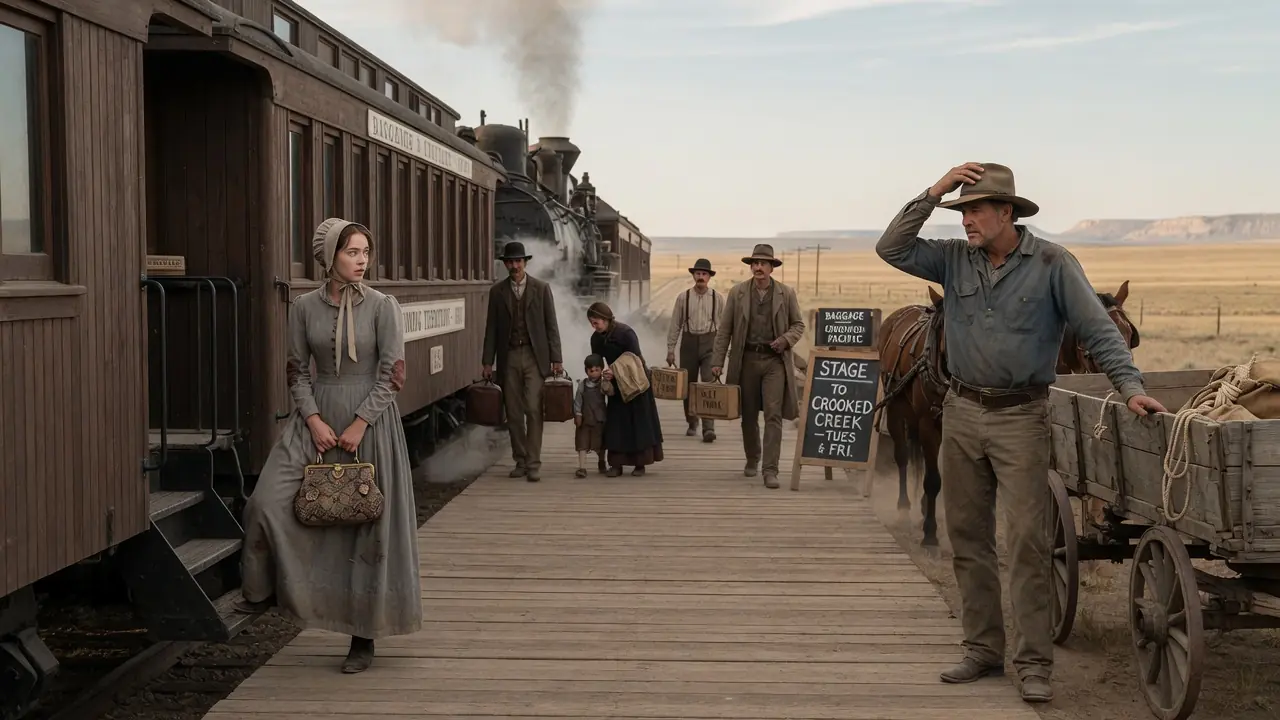
“This?” Beatrice gestured dismissively at the ranch. “This is hardly suitable for a young woman of any breeding. Living in the wilderness with a widowed man caring for his children like some kind of—”
She stopped herself, but Lena heard what she hadn’t said.
Like some kind of woman who’d sell herself for security.
“Mrs. Hartwell, I presume?”
Jonah’s voice, cold as winter ice, cut through the tension.
He’d approached from the house, the children clustered on the porch behind him, watching with wide eyes.
Beatrice turned, her chin lifting.
“Mr. Pierce, we’ve corresponded by telegram.”
“We have. Though I don’t recall any mention of you planning a visit.”
Jonah moved to stand beside Lena, and she felt the warmth of his presence like a shield.
“Is there something I can help you with?”
“You can help me by releasing my niece from this absurd arrangement. She’s needed elsewhere.”
“I’m not going,” Lena said, finding her voice.
The fear was still there, but underneath it was something stronger: certainty.
“I’m staying here, Aunt Beatrice, with this family.”
“Don’t be ridiculous. You can’t possibly want to stay in this godforsaken place.”
Beatrice’s voice rose.
“You’re wasting your youth on someone else’s children, working yourself to the bone for pennies. I’m offering you a real opportunity.”
“To be unwanted in someone else’s house again?” Lena interrupted, her own voice rising to match. “To spend my days caring for children who aren’t mine while being reminded constantly that I’m a burden? To have no home, no family, nothing that’s truly mine?”
She shook her head.
“I’ve done that my entire life and I’m done.”
“You ungrateful girl.”
“She said no.”
Jonah’s voice was quiet but carried absolute authority.
“Miss Hartwell is employed by me. She has a contract.”
“A handshake and a telegram are hardly a binding contract.” Beatrice snapped. “She’s my niece, my responsibility. I have every right to—”
“You have no rights where I’m concerned.” Lena stepped forward, her hands clenched into fists. “You gave up any claim to me when you shipped me off to the frontier without even asking if I wanted to come. You didn’t care then whether this was right for me. You just wanted me gone.”
“That’s not—”
“It’s true and you know it.”
Lena’s voice shook but she forced herself to keep talking.
“I was a problem you solved by sending me as far away as possible. Well, I like it here. I’m needed here. For the first time in seven years, I have a place where I belong. And you don’t get to take that away from me.”
Silence fell, broken only by the wind and the distant lowing of cattle.
Beatrice stared at Lena as if she’d never seen her before—and perhaps she hadn’t.
The meek, grateful girl who’d lived in her house was gone, replaced by someone who’d learned to fight for what mattered.
“If you stay here,” Beatrice said finally, her voice tight with fury, “you are no longer my concern, no longer family. I’ll wash my hands of you entirely.”
“Then wash them.” Lena said and felt simultaneously terrified and free. “I have a family now.”
Beatrice’s face went white then red. She opened her mouth, closed it, then turned sharply toward her hired driver.
“We’re leaving immediately.”
The wagon was turned around and rumbling back down the drive within minutes, dust rising in its wake.
Lena watched it go, her whole body trembling now that the confrontation was over.
She’d done it. She’d actually done it.
She’d chosen herself, chosen this life, chosen—
“Lena.”
She turned to find Jonah watching her with an expression of such profound emotion that it stole her breath.
Behind him, the children had left the porch and were running across the yard.
And then she was surrounded by them, Ruth and June clinging to her skirts, Caleb and Micah pressing close, Abigail wrapping her arms around Lena from behind.
“You stayed,” Abigail whispered fiercely. “You chose to stay.”
“Of course I did.” Lena managed through her tears. “I told you I would. I promised.”
That night, after the children were finally settled—it had taken hours, they’d been so wound up from the day’s drama—Lena found herself once again on the porch with Jonah.
But this time, he was the one who sought her out, carrying two cups of the precious coffee they usually saved for special occasions.
“You gave up your family for us,” he said without preamble.
“I gave up people who never wanted me for people who do,” Lena corrected. “There’s a difference.”
“Still.”
Jonah set his cup down and turned to face her fully.
“What you did today, standing up to her, choosing to stay even though she made it clear there’d be consequences, that took courage.”
“Or stubbornness.” Lena attempted a smile. “I’m not always sure which.”
“Both, probably.”
Jonah was quiet for a moment, then,
“Lena, I need to ask you something and I need you to be honest with me.”
Her heart began to pound.
“All right.”
“Are you staying because you have nowhere else to go or because you want to be here?”
Lena took a breath, knowing her answer would change everything.
“At first, it was because I had nowhere else. But now—”
She met his eyes.
“Now I stay because I can’t imagine being anywhere else, because these children have become my children, because this house has become my home, because you—”
She faltered, unable to finish.
“Because I what?”
Jonah’s voice was soft, his eyes intense.
“Because you’ve made me feel like I matter,” Lena whispered. “Like I’m more than just a burden or an obligation, like I’m essential.”
Jonah reached out and took her hand, his thumb brushing across her knuckles.
“You are essential to this family, to me.”
He paused.
“I never thought I’d feel this way about anyone after Sarah. Thought that part of me died with her, but you—you’ve brought this household back to life, Lena. You’ve brought me back to life.”
“Jonah.”
“I’m not asking for anything,” he said quickly. “I know this isn’t what you signed on for. You came here as hired help and if that’s all you want to be, I’ll respect that. But I need you to know you’re not just the housekeeper, not to me, not to any of us.”
Lena’s eyes burned with tears.
“What am I then?”
Jonah lifted her hand to his lips, pressing a kiss to her work-roughened knuckles.
“You’re ours.”
He said simply.
“If you’ll have us.”
And Lena, who’d spent her whole life belonging to no one, finally understood what it meant to be claimed.
Not as property but as something infinitely more precious: as family, as home, as someone worth fighting for.
“Yes,” she said through her tears. “Yes. I’ll have you, all of you.”
Jonah pulled her into his arms and Lena let herself be held, feeling safe and wanted in a way she’d never experienced before.
Tomorrow would bring new challenges, she knew that. The ranch was still struggling financially, winter was coming and with it all the hardships Jonah had warned her about.
There would be difficult days ahead.
But tonight, surrounded by the vast prairie darkness and held in the arms of a man who’d learned to hope again, Lena finally let herself believe that she’d found what she’d been searching for all along.
Not just a place to stay but a reason to fight for staying. Not just survival but a life worth living. Not just acceptance but love, fierce, protective and absolutely unshakeable.
She was home.
Finally, truly home.
And nothing, not storms or poverty or well-meaning relatives, would take that away from her.
The morning after Jonah’s declaration brought a strange new awareness between them, a heightened consciousness of every glance and accidental touch that left Lena feeling simultaneously exhilarated and terrified.
She woke earlier than usual, her mind too full of questions to allow for rest.
What did it mean, what Jonah had said? What did he expect from her now? What did she want?
She dressed in the pre-dawn darkness and made her way downstairs, seeking the comfort of familiar routines.
But when she entered the kitchen, she found Jonah already there, building up the fire in the stove.
He looked up at her entrance and the expression on his face—tender and uncertain and hopeful all at once—made her breath catch.
“Couldn’t sleep either?” he asked quietly.
“Too much to think about.”
Lena moved to the water bucket, needing something to do with her hands.
“Jonah—”
“About last night—”
“I meant every word,” he interrupted, straightening from the stove. “But I also meant what I said about not expecting anything. You don’t owe me—”
“I know I don’t.” Lena turned to face him. “But that doesn’t change the fact that everything’s different now. We can’t just pretend nothing was said.”
“No.” Jonah agreed. “We can’t.”
He crossed the kitchen to stand before her, close enough that she could see the gray threading through his dark hair or the fine lines around his eyes.
“So where does that leave us?”
Lena took a breath, reaching for honesty.
“I don’t know. I’ve never—”
She stopped, feeling heat rise in her cheeks.
“I’ve never been courted, never had anyone look at me the way you’re looking at me right now. I don’t know what I’m supposed to do or say or feel.”
“Then we’ll figure it out together.”
Jonah’s hand came up to cup her cheek, his thumb brushing across her cheekbone with infinite gentleness.
“No expectations, Lena. No pressure. We’ll just see where this goes. Is that all right?”
It was more than all right. It was everything she hadn’t known she needed.
Lena nodded, leaning slightly into his touch, and saw his eyes darken with emotion.
“Can I kiss you?” he asked, his voice rough.
“Yes,” Lena whispered.
He leaned down slowly, giving her time to change her mind, but Lena didn’t want to change her mind.
When his lips met hers, it was gentle and careful, a question rather than a demand.
Lena’s first kiss, given and received with all the tenderness of two people who’d learned not to take precious things for granted.
When they finally pulled apart, Jonah rested his forehead against hers, his breathing unsteady.
“I’ve wanted to do that for weeks,” he admitted.
“Since when?” Lena asked, surprised by her own boldness.
“Since the storm. Since I watched you run into that nightmare to save my son and realized you were the bravest person I’d ever met.”
His arms came around her waist, holding her close.
“Maybe even before that. Since you stood in my kitchen and refused to be intimidated by Abigail’s hostility. Since you read poetry to my children like it was the most natural thing in the world. Since you made me remember what it felt like to hope.”
Lena’s throat tightened with emotion.
“I’m not brave. I was terrified.”
“Being brave doesn’t mean you’re not afraid. It means you do what needs doing anyway.”
Jonah pulled back just enough to see her face.
“You’ve done that every single day since you arrived here, Lena. You’ve been brave when it would have been easier to run.”
They stood in the quiet kitchen holding each other as the sky outside began to lighten and Lena felt something settle in her chest, a sense of rightness, of being exactly where she was supposed to be.
The moment was broken by footsteps on the stairs.
They stepped apart just as Abigail appeared in the doorway, her hair still in its nighttime braid, her expression sleepy.
But she was observant enough to catch the charged atmosphere, the way Jonah and Lena were standing just a bit too far apart, the flush on Lena’s cheeks.
“Morning,” Abigail said slowly, her gaze moving between them with unmistakable speculation.
“Good morning.”
Lena forced herself to move naturally toward the pantry.
“I was just about to start breakfast. Would you help me with the biscuits?”
“Sure.”
Abigail moved to wash her hands, but Lena could feel the girl watching them both.
As Jonah excused himself to tend to the morning chores, Abigail waited until the door had closed behind him before turning to Lena with barely contained excitement.
“Something happened,” she said.
It wasn’t a question.
Lena felt heat creep up her neck.
“I don’t know what you mean.”
“Yes, you do. You and Father, you’re different this morning. Did he—” Abigail’s eyes went wide. “Did he tell you he cares for you?”
There was no point in lying to this perceptive child who’d learned to read adult emotions as a survival skill.
Lena nodded slowly.
“He did. Last night, after you all went to bed.”
Abigail’s face lit up with a joy so pure it took Lena’s breath away.
“I knew it. I told Caleb weeks ago that Father looked at you different than he looked at the other women, but he said I was imagining things.”
She grabbed Lena’s hands.
“So what happens now? Will you get married? Will you really be our mother?”
“Abigail, slow down.” Lena squeezed the girl’s hands gently. “Nothing’s decided. We’re just—we’re taking things slowly, seeing how we feel.”
“But you do care for him, don’t you?”
There was vulnerability beneath Abigail’s excitement, a fear that this too might be taken away.
“Yes,” Lena said honestly. “I do, very much.”
“And you’re still staying, even though Aunt Beatrice tried to take you away?”
“I’m staying,” Lena promised. “No matter what happens between your father and me, I’m staying. This is my home now.”
Abigail threw her arms around Lena’s waist, hugging her fiercely.
“Good. Because we need you. All of us need you.”
The other children appeared gradually, drawn by the smell of breakfast and the sounds of activity.
If they noticed anything different about the atmosphere, they didn’t comment on it.
But Lena caught Caleb watching her and Jonah with thoughtful eyes, and Ruth seemed to position herself between them whenever possible, as if trying to physically connect the two adults she’d come to depend on.
After breakfast, Jonah asked Lena to walk with him to check on the cattle in the north pasture.
It was a longer walk than strictly necessary for the task at hand, and Lena understood he wanted time alone with her, away from the curious eyes of five children.
They walked in comfortable silence for a while, the morning sun already hot on their shoulders despite the early hour.
The land stretched around them, brown grass rippling in the constant wind, and Lena found herself appreciating its stark beauty in a way she couldn’t have when she first arrived.
This place had seemed so empty then, so hostile.
Now it felt like possibility, wide open and full of space to build something new.
“I need to tell you about Sarah,” Jonah said abruptly, breaking the silence.
Lena glanced at him, seeing the tension in his shoulders.
“You don’t have to—”
“I do.”
“If we’re going to—” He stopped, searching for words. “If there’s going to be something between us, you need to understand what came before.”
They reached a fence line and Jonah leaned against it, staring out at the grazing cattle.
Lena stood beside him and waited, giving him time to gather his thoughts.
“I met Sarah when I was 22,” he began. “She came west with her family, and I fell for her the moment I saw her. She was beautiful and kind and stronger than she looked. We married within six months.”
His mouth curved in a small, sad smile.
“Everyone said we were too young, too hasty, but we knew what we wanted. We built this ranch together from almost nothing, had our children, made a life.”
“You loved her very much,” Lena said softly.
“I did. She was my partner in every way, not just a wife, but a true partner. When things were hard, she never complained. When I doubted, she believed.”
Jonah’s voice roughened.
“And when she died, I thought I’d died, too. The only thing that kept me going was the children needing me.”
Lena reached out and took his hand, lacing their fingers together.
“She sounds remarkable.”
“She was.”
Jonah turned to face Lena fully.
“But here’s what I need you to understand. What I feel for you isn’t about replacing her. Sarah will always be part of me, always be the mother of my children, but what I’m feeling now, what’s growing between us, it’s not some pale shadow of what I had before. It’s different, new, its own thing entirely.”
“I’m not her,” Lena said, needing him to hear it. “I’ll never be her, Jonah. I can’t fill the space she left.”
“I don’t want you to fill her space. I want you to make your own space.”
His free hand came up to frame her face.
“You already have, Lena. You’ve carved out a place in this family that’s entirely yours. The children don’t see you as a replacement for their mother. They see you as someone new who loves them anyway, and I—”
He stopped, his thumb tracing her jawline.
“I see you as the woman who made me believe I could live again instead of just surviving.”
Lena’s eyes filled with tears.
“I don’t know if I’m strong enough for this. For all of it. The ranch, the children, you. What if I fail? What if I can’t be what you need?”
“You already are what I need,” Jonah said fiercely. “You think you’re not strong? Lena, you’ve survived things that would have broken most people. You’ve made a home in a place that terrifies women who grew up in comfort. You’ve won over five grieving children who’d learned not to trust. You ran into a dust storm to save my son.”
He shook his head.
“If you’re not strong, I don’t know what strength looks like.”
Before Lena could respond, a shout came from the direction of the house.
They both turned to see Tom running toward them, waving his arms frantically.
“Boss!” he hollered. “We got trouble!”
Jonah was already moving, his long strides eating up the ground.
Lena hitched up her skirts and followed, her heart pounding with sudden fear.
Tom met them halfway, breathing hard.
“It’s Micah,” he gasped out. “The boy’s taken sick, real sick. Abigail sent me to fetch you quick.”
They ran the rest of the way to the house.
Inside, they found Abigail in the kitchen with Micah, who was curled up on a chair, his small face flushed and sweating.
The moment Lena touched his forehead, she knew this was serious. The child was burning with fever.
“How long has he been like this?” Lena asked, already moving into action, her mind cataloging symptoms and possible causes.
“He said his stomach hurt at breakfast, but I thought—” Abigail’s voice broke. “I thought he was just trying to get out of chores, but then he started vomiting and he’s so hot.”
“It’s all right,” Lena kept her voice calm even as fear clawed at her chest.
She’d seen fever like this before in the various households she’d lived in. Sometimes it passed quickly, sometimes it didn’t.
“Jonah, I need cold water, as much as you can pump. Abigail, get me clean cloths.”
They moved to obey while Lena carefully examined Micah.
His skin was dry despite the heat, a bad sign, and when she pressed gently on his abdomen, he whimpered with pain.
His breathing was shallow and rapid.
“Hurts,” Micah moaned. “Lena, it hurts so bad.”
“I know, sweetheart.” Lena smoothed his hair back from his forehead, her mind racing.
The symptoms pointed to several possibilities, none of them good.
She thought of Sarah’s notes, the remedies for common ailments, but nothing quite matched this.
Jonah returned with a bucket of cold water, his face gray with worry.
“What can I do?”
“Ride to town. Get the doctor.”
Lena began soaking cloths in the cold water, wringing them out and laying them on Micah’s forehead, his wrists, anywhere she could to try to bring down the fever.
“Tell him it’s urgent. Tell him the child has high fever, abdominal pain, vomiting. He’ll know what to bring.”
“That’s a four-hour round trip at best.”
“Then you’d better leave now,” Lena said, meeting his eyes.
She saw her own fear reflected there, but also trust.
He believed she could keep Micah alive until he returned with help.
“Go. We’ll manage here.”
Jonah hesitated for only a moment, then grabbed Micah’s hand.
“You hear me, son? You fight. You stay with Lena and you fight. I’ll be back with the doctor as fast as I can.”
“Okay, Papa,” Micah whispered, and the use of the word Papa, not Father, made Jonah’s eyes shine with tears he refused to let fall.
Then he was gone.
And Lena heard the thunder of hooves as he rode out at a gallop.
She turned back to Micah, forcing down her own fear, focusing on what needed to be done.
The next hours were a nightmare of helpless vigilance.
Lena kept the cold cloths coming, changing them as soon as they warmed from Micah’s burning skin.
She tried to get him to sip water, but he could barely swallow, and what little he got down came back up within minutes.
His fever climbed higher, and he began to slip in and out of consciousness, sometimes calling for his mother, sometimes for Lena, sometimes just whimpering wordlessly.
The other children hovered anxiously until Lena sent Abigail to take them upstairs, away from their brother’s suffering.
But she could hear their frightened whispers, could feel their fear like a physical presence in the house.
“Don’t let me die,” Micah begged during one of his lucid moments, his small hand clutching Lena’s with surprising strength. “Please, Lena. I don’t want to die like Mama.”
“You’re not going to die,” Lena’s voice was fierce, willing it to be true. “You’re going to fight this, Micah. You’re going to get better. Do you hear me?”
But as the afternoon wore on and the fever continued to climb, Lena began to doubt her own words.
She’d seen this before, seen how quickly a child could slip away, how fever could burn through them like wildfire.
She thought of Sarah’s notes about June’s birth, about childbed fever, about how quickly death could come despite every effort to prevent it.
No, she wouldn’t accept that. Not Micah, not this sweet, complicated boy who’d finally learned to trust her, who’d run into a storm for his cat, who called her by name and brought her treasures, and had just started to heal from his mother’s loss.
She prayed silently, not to any specific deity, but to the universe itself, to whatever force governed life and death.
Please, please not this child. Take anything else, but not him.
When the door finally burst open and Jonah returned with Dr. Morrison, Lena nearly collapsed with relief.
The doctor was an older man, grizzled and competent, who’d seen everything the frontier could throw at him, and had learned to meet it with steady hands and practical solutions.
He examined Micah quickly, his face grave.
“How long has he been like this?”
“Since midmorning, maybe six hours.”
Lena realized her voice was shaking and forced it steady.
“The fever started suddenly. He complained of stomach pain, then vomiting, then the fever just kept climbing.”
Dr. Morrison pressed carefully on Micah’s abdomen, watching the boy’s reaction.
When Micah cried out at the pressure on his lower right side, the doctor nodded grimly.
“Appendicitis,” he said flatly. “The appendix is inflamed. If it burst—”
He didn’t finish the sentence, but he didn’t need to.
Everyone in the room understood what would happen if the appendix ruptured.
“What do we do?” Jonah’s voice was hoarse.
“We keep him comfortable and pray it doesn’t rupture while the inflammation goes down. It’s too dangerous to try surgery out here without proper facilities.”
The doctor pulled supplies from his bag: laudanum for the pain, herbs to make a poultice for the abdomen.
“The next 24 hours will tell us whether he’ll make it.”
Whether he’ll make it.
The words hung in the air like a death sentence.
“I’ll stay with him,” Lena said immediately. “Whatever needs doing, I’ll do it.”
The doctor looked at her, really looked at her for the first time.
“You’re the new housekeeper Jonah mentioned?”
“I’m Lena Hartwell, and Micah is—” She stopped, realizing what she’d been about to say. “Micah is mine. I’ll take care of him.”
The doctor showed her how to administer the laudanum, how to apply the poultices, what signs to watch for that would indicate the appendix had ruptured.
Then he pulled Jonah aside, and though they spoke in low voices, Lena heard every word.
“I won’t lie to you, Jonah. This is bad. The fever’s high, the inflammation is severe. Even if the appendix doesn’t burst, infection could still kill him. All we can do is try to keep him comfortable and hope his body is strong enough to fight it.”
“He’s five years old,” Jonah said, his voice breaking. “He’s just a little boy.”
“I know. I’m sorry. I’ll stay tonight, monitor his condition, but you need to prepare yourself for the possibility that—”
“No.”
Jonah’s voice went hard.
“I won’t prepare myself for losing him. I’ll prepare myself to fight for him, and Lena will, too. We’ll fight for every breath, every heartbeat. That’s what we’ll do.”
The doctor nodded slowly.
“All right, then. We fight.”
The night that followed was the longest of Lena’s life.
She stayed by Micah’s bedside, sponging his burning skin, forcing drops of medicine between his lips, talking to him constantly even when he couldn’t respond.
She told him stories about her grandmother, about the places she’d lived, about the future they’d have together when he was well.
She promised him adventures and treats and all the time in the world to be the child he deserved to be.
Jonah sat on Micah’s other side, holding his son’s hand, his lips moving in silent words that might have been prayers or promises, or simply the desperate pleading of a father who couldn’t bear to lose another piece of his heart.
Somewhere past midnight, Micah’s fever broke.
One moment he was burning, delirious, struggling to breathe, and the next sweat was pouring from his skin, drenching the sheets.
His breathing eased. His eyes, when they fluttered open, were clear for the first time in hours.
“Lena?”
His voice was thread-thin, but lucid.
“Did I die?”
“No, baby.” Lena’s voice broke as she laughed and cried simultaneously. “No, you didn’t die. You’re going to be fine.”
Dr. Morrison checked him over with careful, practiced hands.
“The fever’s broken. That’s good, very good. But he’s not out of danger yet. We need to watch him closely for the next few days, make sure infection doesn’t set in, make sure the appendix doesn’t flare up again.”
“We’ll watch him,” Jonah said, his voice rough with emotion. “Every moment, whatever it takes.”
As dawn broke over the prairie, painting the sky in shades of gold and pink, Micah slept peacefully for the first time in 24 hours.
Dr. Morrison dozed in a chair, exhausted from his vigil.
And Jonah and Lena sat together beside the sleeping child, their hands clasped, united in their determination to protect this family they’d both come to love so fiercely.
“Thank you,” Jonah whispered, his thumb tracing circles on the back of Lena’s hand, “for fighting for him, for not giving up.”
“He’s mine to fight for,” Lena said simply, and realized as she spoke that it was absolutely true.
These children, all five of them, had become hers in the deepest sense, not by blood, not by law, but by choice, by love, by the fierce protective bond that had grown between them through shared struggles and small joys and moments exactly like this one, when the only thing standing between a child and death was the stubborn refusal of the people who loved him to let him go.
Over the next three days, Micah slowly recovered.
The crisis had passed, but he remained weak, requiring constant care.
Lena barely left his side, sleeping in snatches on a chair beside his bed, waking at his slightest sound.
The other children tiptoed around, their earlier boisterousness subdued by fear and the close brush with loss.
But on the fourth day, Micah sat up on his own and asked for food, real food, not just broth.
And when Lena brought him bread with butter and jam, he ate it all and asked for more, and she knew with absolute certainty that he would survive.
That evening, after the children were all in bed and the house had settled into quiet, Jonah found Lena on the porch.
She was exhausted, running on nothing but determination and love, but she couldn’t seem to settle enough to sleep.
“You should rest,” Jonah said, sitting beside her.
“I know. I just—I keep thinking about how close we came to losing him.”
“But we didn’t.” Jonah took her hand. “Because you refused to let it happen, because you stayed by his side and fought for every breath he took.”
“You did the same.”
“We did it together.”
Jonah turned to face her, his expression intense in the lamplight spilling from the window.
“Lena, these past few days watching you care for Micah, seeing your strength and your love, it made me certain of something I’ve been feeling for weeks now.”
Lena’s heart began to pound.
“What’s that?”
“I want you to stay, not as the housekeeper, not as hired help.”
He took both her hands in his.
“I want you to stay as my wife, as the children’s mother, as my partner in every way.”
He paused, searching her face.
“I know this is fast. I know we haven’t known each other long, but I also know that life is precious and time is uncertain, and I don’t want to waste another moment of either. I love you, Lena Hartwell. Will you marry me?”
Lena stared at him, her mind reeling.
Marriage.
He was asking her to marry him, to become his wife, to legally and permanently claim the place she’d been carving out for herself since the moment she’d arrived.
“I have nothing,” she said, the words tumbling out before she could stop them. “No dowry, no family connections, no—”
“You have everything that matters,” Jonah interrupted firmly. “You have courage and kindness and strength. You have a capacity for love that’s transformed this entire household. You have my children’s hearts and my own.”
He smiled slightly.
“Besides, I’m a widowed rancher with five children and a struggling operation. I’m hardly in a position to be particular about dowries.”
“The children,” Lena said, grasping at practical concerns because the emotional enormity was too much to process. “Shouldn’t we ask them? Make sure they—”
“They already know how they feel about you.”
“But if you need to hear it from them before you can answer, we’ll ask them tomorrow.”
Jonah squeezed her hands gently.
“But right now I’m asking you, not as their father, but as a man who’s fallen in love with you. Will you marry me, Lena?”
She looked at this man who’d given her a home when she had nowhere else to go, who trusted her with his children, who’d seen her at her worst and her best, and had chosen to love her anyway.
She thought of the life they could build together, the family they already were, the future that stretched out before them full of possibility.
“Yes,” she whispered, then louder, “Yes, Jonah. I’ll marry you.”
He pulled her into his arms, holding her so tightly she could barely breathe, and Lena felt something fundamental shift inside her.
She was no longer Lena Hartwell, the unwanted orphan passed from house to house.
She was becoming Lena Pierce, chosen and claimed and cherished.
When Jonah finally released her enough to see her face, his eyes were bright with emotion.
“There’s one condition,” he said seriously.
Lena’s stomach dropped.
“What condition?”
“Sarah’s memory stays part of this family. We don’t erase her. We don’t pretend she didn’t exist. The children should remember their mother, should know they came from love even if that love was taken too soon.”
His voice roughened.
“Can you live with that? With her ghost still in this house?”
“It’s not her ghost,” Lena said softly. “It’s her legacy. Everything good in these children came from her. How could I resent that?”
She touched Jonah’s face gently.
“I’m not threatened by what you had before, Jonah. I’m grateful for it because it made you the man you are. The man I love.”
Jonah kissed her then, deep and thorough and full of promise, and Lena kissed him back with all the pent-up emotion of weeks of growing feelings and careful restraint.
When they finally broke apart, both breathing hard, Jonah rested his forehead against hers.
“We’ll tell the children tomorrow,” he said. “Make it official. Plan a simple ceremony. Maybe Pastor Williams can come out from town next month.”
“Tomorrow,” Lena agreed, her heart so full it ached.
But as it turned out, the children already knew.
When Lena came down the next morning, she found all five of them clustered in the kitchen, clearly waiting for her.
Abigail was vibrating with barely contained excitement.
Even Micah, still pale and weak from his illness, was smiling.
“Father told us,” Abigail burst out the moment Lena appeared. “He told us he asked you to marry him, and you said yes, and you’re going to be our real mother, and—”
She stopped, suddenly uncertain.
“You did say yes, didn’t you? He didn’t misunderstand?”
“I said yes,” Lena confirmed, and was immediately mobbed by children.
They crowded around her, talking over each other, asking questions, making plans.
Ruth refused to let go of Lena’s hand.
June climbed into her arms and wouldn’t be put down.
Even Caleb, usually so reserved, allowed himself a genuine smile.
“Does this mean you can never leave?” Micah asked, his young face serious. “Even if things get hard? Marriage means you stay forever, right?”
“It does,” Lena said, looking at each child in turn. “It means I’m yours and you’re mine, and nothing will change that. Not hardship, not distance, not anything. Forever.”
“Good,” Micah said with satisfaction, settling back against Abigail’s shoulder. “Because I don’t want anyone else.”
Neither did Lena.
She’d spent 19 years feeling like she belonged nowhere, and now she belonged here, to these five children and the man who’d given her a chance when no one else would.
She belonged to this harsh, beautiful land that had tested her and found her worthy.
She belonged to a future she was choosing for herself rather than having chosen for her.
“Forever,” she promised again, and meant it with every fiber of her being.
The wedding was planned for the first Saturday in October, giving them just enough time to make the necessary arrangements without the delay feeling unbearable.
Lena had imagined something small and private, just herself and Jonah with the children as witnesses, but the community had other ideas.
News traveled fast across the prairie, carried by supply wagons and ranch hands in the invisible network of frontier communication.
Within a week of the engagement, neighbors Lena hadn’t even known existed began appearing at the ranch with offerings and advice.
Mrs. Henderson from five miles east brought fabric for a wedding dress, insisting that Lena couldn’t possibly marry in one of her worn gray work dresses.
Mr. Chen, who ran the general store in town, sent word that he’d ordered a proper wedding cake from a baker in Casper.
Even Tom, the usually taciturn hired hand, offered to butcher one of the steers for the wedding feast.
“I don’t understand,” Lena said one evening, overwhelmed by the outpouring. “These people don’t even know me.”
“They know what you’ve done for this family,” Jonah said, his arm around her waist as they watched the sun set from the porch. “Word got around about you staying through the storm, fighting for Micah when he was sick. Out here, that kind of loyalty means something. They’re celebrating because you’re one of them now.”
“One of them.”
The word settled warm in Lena’s chest.
She’d spent so long being an outsider that she’d forgotten what it felt like to belong to a community, to be welcomed rather than merely tolerated.
The children threw themselves into wedding preparations with enthusiasm that sometimes bordered on chaos.
Abigail appointed herself chief organizer, making lists and issuing instructions with the authority of a general marshaling troops.
She and Lena spent hours at the sewing machine Mrs. Henderson had lent them, working on the wedding dress—simple white cotton with lace at the collar and cuffs, nothing fancy but made with love.
Ruth picked wildflowers from the prairie every day, bringing them to Lena with solemn ceremony, and asking if they would be pretty enough for the wedding.
Lena assured her they would be perfect, privately thinking that Ruth’s eager face was worth more than any hothouse blooms from the city.
Caleb, with his quiet, artistic bent, made a sign to hang over the porch that read “Pierce Family Wedding” in careful letters, decorating it with drawings of horses and wildflowers.
When he showed it to Lena, his face anxious for her approval, she hugged him so hard he squeaked.
Even Micah, still recovering from his illness, contributed by testing every sweet thing that came into the house and declaring whether it was good enough for Lena’s wedding.
His standards were exacting, and more than one well-meaning neighbor’s contribution was rejected as “not special enough.”
June, at two years old, didn’t fully understand what was happening, but she absorbed the household’s excitement like a sponge.
She took to calling Lena “Mama,” the word slipping out naturally one morning, and then repeating with increasing frequency until it became her default.
The first time it happened, Lena’s eyes had filled with tears, and she’d looked to Jonah uncertainly, afraid she was overstepping.
“Sarah would have wanted her to have a mother,” Jonah had said quietly. “She would have wanted all of them to have someone who loved them the way you do.”
The mention of Sarah had become less painful as the weeks passed, not because her memory was fading, but because Lena had found a way to honor it rather than compete with it.
She kept Sarah’s recipe box on the kitchen counter and consulted it regularly.
She’d framed one of Sarah’s letters, one that talked about her hopes for her children, and hung it in the parlor.
And when the children wanted to talk about their mother, Lena listened with genuine interest, learning about the woman whose love had shaped this family before tragedy struck.
“Do you think Mama would like you?” Ruth asked one afternoon as she and Lena worked in the garden together, planting bulbs that would bloom in spring.
Lena considered the question carefully.
“I don’t know, sweetheart, but I hope she would. I hope she’d see that I love you all and want what’s best for you, just like she did.”
“I think she would,” Ruth said with the certainty of a seven-year-old. “Because you make Papa smile again. He stopped smiling after Mama died, but now he smiles all the time.”
It was true.
Jonah had transformed over the weeks of their engagement, shedding years of exhaustion and grief like a snake shedding old skin.
He still worked long hours on the ranch—that was unavoidable—but he no longer carried the weight of the world on his shoulders alone.
He’d learned to lean on Lena, to share his worries and plans, to accept help when it was offered.
The ranch itself had begun to recover, too.
With Lena managing the household efficiently, Jonah had been able to focus more attention on the cattle and land.
He’d sold off some of the weaker stock and used the money to repair fences and outbuildings.
Tom had proven more capable when properly directed, and together they’d started making plans for expanding the herd come spring.
It was slow progress, but it was progress nonetheless.
“We might actually make it,” Jonah had said one night, going over the accounts with Lena. “Another good year and we’ll be stable. Two good years and we might even prosper.”
“We’ll make it,” Lena had replied with certainty. “We have to. We’ve got too much to build together to fail now.”
As the wedding day approached, Lena found herself simultaneously excited and terrified.
She’d never imagined she would marry, had resigned herself to spinsterhood and a life of moving from household to household.
Now she was about to legally bind herself to a man, to become stepmother to five children, to take on responsibilities that would have seemed impossible just months ago.
The night before the wedding, unable to sleep, she slipped downstairs and found Abigail in the kitchen, also awake, sitting at the table with a cup of milk.
“Can’t sleep either?” Lena asked, joining her.
“I keep thinking about tomorrow,” Abigail admitted, “about how everything’s going to be different.”
“Everything’s already different,” Lena pointed out gently. “Tomorrow just makes it official.”
“I know, but—” Abigail twisted her cup in her hands. “What if you change? What if once you’re married to Father, you decide you don’t want to be bothered with us anymore? What if you become mean or distant or—”
“Abigail.”
Lena reached across the table and took the girl’s hand.
“Look at me.”
When Abigail’s eyes met hers, Lena continued firmly,
“I chose you before I chose your father. Do you understand that? I fell in love with you children first, with your strength and your sweetness and your resilience. Your father came later. So even if—and this is purely hypothetical—something went wrong between Jonah and me, I would still fight to stay in your lives because you’re mine now, all of you. Marriage certificate or not, you’re mine.”
Abigail’s eyes filled with tears.
“Promise?”
“I promise.” Lena squeezed her hand. “Now come here.”
She pulled Abigail into a hug and they sat together in the quiet kitchen, a soon-to-be mother and daughter finding comfort in each other on the eve of a day that would change everything.
The wedding day dawned clear and bright, the autumn air crisp with the promise of coming winter, but still warm enough in the afternoon sun to be pleasant.
Lena woke early, her stomach fluttering with nerves, and found Abigail already up and heating water for baths.
“Today you get to be pampered,” Abigail declared. “No cooking, no cleaning, no work at all. Ruth and I will handle everything.”
Lena wanted to protest, but the determined look on Abigail’s face stopped her.
Instead, she allowed herself to be shepherded through a leisurely bath, her hair washed and carefully braided with wildflowers woven through it.
The wedding dress fit perfectly, the simple style suiting her far better than anything elaborate would have.
When she finally looked at herself in the small mirror, Lena barely recognized the woman staring back.
Gone was the gaunt, frightened girl who’d stepped off the train three months ago.
In her place stood someone with color in her cheeks, strength in her shoulders, and hope shining in her eyes.
“You look beautiful,” Ruth whispered, standing in the doorway with June on her hip.
“Pretty, Mama,” June agreed, reaching for Lena.
Lena gathered the little girl into her arms, careful not to wrinkle her dress, and felt her throat tighten with emotion.
This was real.
This was happening.
In a few hours she would be married, would officially become part of this family she’d come to love so fiercely.
The ceremony was held in the yard under a framework Tom had built and decorated with pine boughs and wildflowers.
Neighbors began arriving around noon, their wagons raising dust clouds as they approached.
Lena was overwhelmed by the sheer number of people.
She’d expected perhaps a dozen, but more than thirty came to witness the wedding, bringing food and gifts and warm wishes.
Pastor Williams arrived from town mid-afternoon, a jovial man who’d married Sarah and Jonah fourteen years earlier and who greeted the occasion with genuine happiness.
He pulled Lena aside before the ceremony began.
“I knew Sarah Pierce,” he said gently. “She was a remarkable woman, and I know her loss was devastating to this family, but I want you to know she would have approved of you. She would have wanted Jonah and the children to find happiness again, to build a new future while honoring the past. Don’t let anyone make you feel like you’re replacing her. You’re not. You’re writing a new chapter in this family’s story.”
His words settled something in Lena that she hadn’t realized was still uncertain.
She thanked him with tears in her eyes and went to take her place for the ceremony.
Jonah stood waiting under the pine boughs, dressed in his best suit with his hair freshly cut and his boots polished to a shine.
When he saw Lena approaching, his expression transformed into something so tender and awed that she nearly stumbled.
He thought she was beautiful.
After everything, after seeing her covered in dust and flour, exhausted and frightened and pushed to her limits, he still looked at her like she was precious.
The children flanked them as they took their places.
Abigail stood on Lena’s right, holding June and openly crying happy tears.
Caleb, Micah, and Ruth arranged themselves around Jonah, their faces solemn with the importance of the moment.
Pastor Williams began the ceremony with a prayer, then launched into the traditional words about marriage and commitment.
But when he got to the vows, he paused and looked at Jonah and Lena with a gentle smile.
“I understand you’ve written your own vows,” he said. “Jonah, would you like to begin?”
Jonah took both of Lena’s hands in his, his grip strong and sure.
“Lena Hartwell, three months ago you arrived at my ranch with nothing but a carpet bag and more courage than any person I’d ever met. You could have run when you saw how hard things were. You could have left when better opportunities presented themselves. Instead, you stayed. You fought for my children, for this family, for me. You brought light back into a house that had forgotten how to hope.”
His voice roughened with emotion.
“I promise you this. I will honor the strength you’ve shown. I will cherish the love you’ve given so freely. I will stand beside you through whatever challenges come, and I will never, ever take for granted the gift of your presence in our lives. You came here as hired help, but you’ve become essential. You are my partner, my love, and from this day forward, you are my wife.”
Lena’s vision blurred with tears, but she blinked them back, determined to get through her own vows without breaking down completely.
“Jonah Pierce, when I stepped off that train, I was lost. I’d spent years believing I didn’t matter, that I was a burden to be shuffled from place to place with no real home to call my own. You gave me a chance when no one else would. You gave me a place to belong, and then you gave me something even more precious. You gave me a family to love and be loved by.”
She looked at the children, including them in her words.
“I promise to honor Sarah’s memory by loving the children she brought into this world. I promise to be a true partner to you, sharing the burdens and the joys. I promise to fight for this family, to stay when things are hard, to build a future worthy of all the hope we’re investing in it. I came here looking for survival, but I found a reason to live. You are my home, Jonah. All of you are my home.”
There wasn’t a dry eye under the pine bower by the time she finished. Even Tom was discreetly wiping at his face.
Pastor Williams cleared his throat, clearly moved.
“By the power vested in me, I now pronounce you husband and wife. Jonah, you may kiss your bride.”
Jonah pulled Lena close and kissed her thoroughly while the assembled crowd cheered and whistled.
The children mobbed them the moment they separated, and for several chaotic minutes it was impossible to tell where one person ended and another began.
They were simply a family bound together by love and choice and the formal vows they’d just exchanged.
The celebration that followed was like nothing Lena had ever experienced.
Tables had been set up in the yard laden with food that neighbors had brought: roasted beef and chicken, fresh bread, vegetables from late gardens, pies and cakes and cookies.
Someone produced a fiddle and dancing began as the sun started its descent toward the horizon.
Jonah led Lena in the first dance, his arm strong around her waist as they moved to the music.
He wasn’t a graceful dancer, but he was confident, and that was enough.
Lena followed his lead, laughing when he spun her and nearly sending them both tumbling.
“Happy?” he murmured into her ear during a slower song.
“Happier than I ever thought possible,” Lena admitted.
“Is this real, Jonah? Or am I going to wake up on that train, still on my way to a ranch where nobody wants me?”
“It’s real.”
He kissed her temple.
“You’re Lena Pierce now, my wife, their mother, and nobody can take that away from you.”
The party continued into the evening, neighbors reluctant to leave such a joyful occasion.
The children, overstimulated and exhausted, eventually collapsed in various corners: Ruth asleep on a blanket under the stars, Micah and Caleb dozing against each other on the porch steps, June passed out in Abigail’s arms.
As the last guests finally departed and the ranch settled into peaceful quiet, Jonah and Lena stood together in the yard, surveying the beautiful chaos of the celebration.
“We should probably clean up,” Lena said without much conviction.
“It’ll keep until morning.”
Jonah turned her to face him.
“Tonight, I just want to be with my wife.”
The word still felt strange and wonderful.
Wife.
Lena was someone’s wife, not by arrangement or desperation, but by genuine choice and love.
They put the children to bed together, a routine that felt both familiar and newly significant now that it was official.
Then Jonah led Lena to the room that had been his alone and was now theirs to share.
Lena’s few possessions had been moved in earlier, her mother’s ring now resting on the dresser beside a framed photograph of Sarah with the children.
“If this makes you uncomfortable,” Lena started, gesturing to Sarah’s photograph.
“It doesn’t,” Jonah said firmly. “Sarah was part of my past and I loved her, but you’re my future, Lena, and I love you just as much, just differently. There’s room in my heart for both.”
That night Jonah was gentle and patient with Lena’s inexperience, making her first time something tender rather than frightening.
Afterward, lying in his arms in the darkness, Lena marveled at how far she’d come—from unwanted orphan to cherished wife, from rootless wanderer to the heart of a family.
The transformation felt almost miraculous.
“What are you thinking?” Jonah asked, his fingers trailing through her unbraided hair.
“That I’m grateful,” Lena said honestly. “That I’m terrified of losing this. That I can’t believe this is my life now.”
“Believe it.” Jonah pulled her closer. “Because this is just the beginning, Lena. We’ve got years ahead of us, years to build this ranch into something prosperous, years to raise these children and maybe add more of our own, years to grow old together watching the seasons change over this land.”
More children.
The thought sent a thrill through Lena.
The possibility of carrying Jonah’s child, of adding to this family they were building, felt like the ultimate proof that she belonged here.
The weeks after the wedding settled into a new rhythm.
Lena was no longer the housekeeper, but the mistress of the household.
And while her daily tasks remained largely the same, the weight of them felt different.
She was working for her own home now, caring for her own family, building her own future.
The children adjusted to calling her Lena or Mama, so the formal shift in her status didn’t alter their relationships.
If anything, it seemed to give them permission to lean on her more fully, to trust that she wouldn’t disappear.
Abigail in particular bloomed under the certainty of Lena’s permanent presence.
She began to reclaim some of her childhood, spending time on things she enjoyed rather than constantly managing household crises.
She taught Lena to ride, the two of them taking long afternoon rides across the prairie while Ruth minded June.
She talked about her hopes for the future—maybe becoming a teacher someday, or learning to run a ranch of her own.
“You don’t have to leave to do that,” Lena pointed out one day. “This ranch will need running for a long time yet. You could stay, learn from your father, eventually take over.”
The possibility clearly hadn’t occurred to Abigail, but Lena could see the idea taking root.
A daughter running a ranch—it was unusual but not unheard of, and Abigail had the intelligence and determination to do it well.
Micah opened up in ways he hadn’t before, talking more freely about his feelings and fears.
He admitted that he’d been afraid to love Lena fully because everyone he loved seemed to leave him.
Lena’s marriage to his father had finally convinced him that she was truly staying, and the relief was palpable.
He started bringing her his drawings again, seeking her opinion and praise, and Lena made sure to display the best ones around the house.
Ruth lost her nervous habit of sucking her fingers, her general anxiety easing as the household stabilized.
She attached herself to Lena like a small shadow, following her from room to room, helping with chores, chattering about everything and nothing.
The transformation from the silent, watchful child Lena had first met was remarkable.
Caleb, fully recovered from his illness, channeled his energy into helping around the ranch.
He was still only five and couldn’t do much, but he took his small responsibilities seriously—feeding the chickens, collecting eggs, helping Tom with simple tasks around the barn.
The anger that had defined him when Lena first arrived was gone, replaced by the natural exuberance of a healthy, happy child.
And June—
June simply loved with the uncomplicated wholeness of toddlerhood.
She called Lena Mama and Jonah Papa, and seemed to have no memory of a time when they weren’t a complete family.
Sometimes Lena wondered if that should make her sad, that June wouldn’t remember Sarah.
But then she’d remember what Pastor Williams had said.
She wasn’t replacing Sarah, she was writing a new chapter.
Sarah would live on in the stories they told, in the recipes they used, in the love that had shaped these children from birth.
As autumn deepened into winter, Lena finally understood what Jonah had warned her about.
The isolation was real and sometimes oppressive.
Snow piled high around the house, cutting them off from town for weeks at a time.
The work was constant and exhausting: keeping the fires going, cooking for seven people, managing the household while Jonah and Tom fought to keep the livestock alive in brutal cold.
But Lena had been right when she told Jonah that loneliness was different when you weren’t alone.
The isolation didn’t crush her because she was surrounded by people she loved, by children who needed her, by a husband who cherished her.
The long winter evenings were spent reading together, playing games, working on projects.
Jonah taught the boys to carve wood, producing crude but enthusiastic animals and tools.
Lena taught the girls to knit, and they made scarves and mittens for everyone.
On the coldest nights, they all piled into the front room, sleeping near the fire for warmth.
And those nights, cramped and uncomfortable as they were, felt more like family than anything Lena had experienced in her previous life.
Christmas came and went, marked by simple gifts and a feast Lena and Abigail prepared together.
Jonah surprised Lena with a locket containing a tiny photograph of all seven of them taken in town the previous month.
Inside the other half was a piece of paper with Jonah’s handwriting: “My family, my heart, my home.”
Lena gave Jonah a new work jacket she’d sewn in secret using fabric she’d ordered months ago and hidden in her trunk.
It was practical but made with love, every stitch a promise of care and commitment.
For the children, there were small treasures: a new doll for June, a set of watercolors for Caleb, books for Ruth and Abigail, a pocketknife for Micah that made him feel impossibly grown-up.
But the best gift came unbidden and unexpected in late January when Lena woke one morning with a familiar queasiness and realized what it meant.
She was pregnant, carrying Jonah’s child, adding to the family they’d built together.
She told him that night after the children were asleep, watching his face carefully for his reaction.
What she saw there—pure joy mixed with tender concern—made her fall in love with him all over again.
“Are you happy?” she asked, needing to hear it.
“Happy?”
Jonah pulled her into his arms, his hand coming to rest protectively over her still-flat stomach.
“Lena, you’ve given me everything. You brought my children back to life. You saved this family, and now—now you’re giving me a future I never thought I’d have again. Happy doesn’t begin to cover it.”
They told the children together the next morning, and the reactions ranged from Abigail’s tearful excitement to June’s confused certainty that the baby should arrive immediately.
Even Tom, when he heard the news, offered gruff congratulations and promised to work extra hard come spring so Jonah could spend more time with his growing family.
Winter finally released its grip in late March, the snow melting into rushing streams that fed the parched earth.
The prairie turned green almost overnight, and wildflowers bloomed in impossible profusion.
Jonah and Tom began the work of spring roundup, checking the cattle that had survived the winter and planning for the future.
Lena’s pregnancy progressed smoothly, her body adapting with surprising ease.
By late spring, her condition was obvious, and she found herself both amused and touched by how protective everyone became.
The children treated her like she might shatter at any moment.
Jonah fussed over her constantly, insisting she rest more and work less.
Even the ranch hands who came through on various errands treated her with exaggerated courtesy.
“I’m pregnant, not dying,” Lena protested one day when Jonah tried to prevent her from carrying a basket of laundry.
“I know that,” Jonah said, taking the basket anyway. “But I lost Sarah to childbirth, and I’ll be damned if I lose you, too. So humor me, please, and let people help you.”
Lena understood then that his protectiveness came from fear, and she stopped protesting quite so much.
Instead, she accepted help gracefully and used her extra energy to plan for the future: sewing baby clothes with Abigail’s help, organizing the nursery that would be set up in their room, reading everything she could find about childbirth and infant care.
On a warm day in early May, Lena and Abigail decided to plant a tree in the pasture near the house.
It was Abigail’s idea, a marker of new growth and new beginnings, and Lena loved it immediately.
They chose a young cottonwood sapling that Tom had found near the creek and carried it carefully to a spot where it would have room to grow tall.
The whole family helped with the planting.
Jonah and Caleb dug the hole while Micah carried buckets of water from the pump.
Ruth and June collected rocks to mark the base, and Lena and Abigail carefully lowered the sapling into place and filled in the earth around its roots.
“What should we call it?” Ruth asked as they patted down the soil.
“The future tree,” Micah declared immediately. “Because it’s for the future.”
It was a child’s logic, simple and profound, and everyone agreed.
The future tree it would be, a living marker of this family’s journey from grief to joy, from brokenness to wholeness, from barely surviving to truly living.
As Lena stood back to admire their work, Jonah came up behind her and wrapped his arms around her, his hands resting on the swell of her stomach where their child grew.
The other children clustered around them, June demanding to be picked up, Micah showing off the dirt under his fingernails with pride, Ruth and Caleb arguing good-naturedly about whether the tree was perfectly straight, Abigail supervising everyone with the gentle authority she’d developed.
They were messy and loud and imperfect and absolutely beautiful.
This family that Lena had been given, that she’d chosen, that had chosen her in return.
This family that had formed from tragedy and luck and stubborn determination to find happiness again.
“What are you thinking?” Jonah murmured into her ear, his breath warm against her skin.
Lena looked at the tree they’d planted, imagining it tall and strong in years to come, providing shade for grandchildren not yet born.
She looked at the ranch buildings slowly being repaired and improved.
She looked at the prairie stretching in every direction, harsh and beautiful and full of promise.
“I’m thinking that I came here believing I was disposable,” Lena said quietly. “And somewhere along the way, I learned I was essential. That I mattered. That I was worth choosing and keeping and loving.”
“You were always worth that,” Jonah said fiercely. “The world just took too long to show you.”
“Maybe.” Lena allowed. “Or maybe I needed to come to this exact place, to this exact family, to finally understand what I was worth.”
She turned in his arms to face him.
“Either way, I’m here now. I’m yours. I’m home.”
“Home,” Jonah agreed, kissing her forehead. “Forever.”
And standing there in the Wyoming sunshine, surrounded by children and prairie grass and endless sky, Lena believed it.
She’d arrived at 19 years old with nothing but a carpet bag and a desperate need to belong.
She’d been tested by storms and sickness and her own deep-seated fear of abandonment.
She’d fought for a place in this family and had been fierce enough, brave enough, loving enough to earn it.
She had not been bought, traded, or borrowed.
She had been chosen—by a man who’d learned to love again, by five children who’d learned to trust again, by a harsh land that rewarded those stubborn enough to stay.
This time, finally, truly, Lena belonged.
And as the future tree took root in the rich earth, so too did Lena’s certainty that she had found what she’d been searching for all along.
Not just a place to stay, but a life worth living, a family worth fighting for, and a love that would endure through all the seasons yet to come.
The ranch still had its challenges. Money was tight, the work was hard, the land was unforgiving, but they would face those challenges together, as a family united by choice and strengthened by adversity.
They had survived the worst.
Now they would build toward the best.
And in the years that followed, that’s exactly what they did.
The baby, a girl they named Clara, was born healthy and strong in late summer.
More children followed in time, each one adding to the family’s joy and chaos.
The ranch prospered slowly but steadily, Jonah’s hard work and Lena’s careful management finally bearing fruit.
The older children grew and thrived, eventually making their own choices about their futures.
Abigail did indeed take over ranch management, becoming one of the most respected ranchers in the territory.
Caleb became an artist whose paintings of prairie life were exhibited across the country.
Ruth became a teacher, educating frontier children in the one-room schoolhouse.
Micah followed his father into ranching, eventually expanding the operation to neighboring land.
And through it all, Lena and Jonah built a partnership that lasted decades, weathering hardships and celebrating triumphs, growing old together under the vast Wyoming sky.
But that first year, that year of transformation from unwanted orphan to essential family member, from hired help to beloved wife and mother, from merely surviving to fully living—that year was the foundation upon which everything else was built.
Lena never forgot where she came from or how close she’d come to a very different life.
And she made sure her children, both the ones she’d inherited and the ones she bore, understood that family wasn’t just about blood.
It was about choice. About staying when leaving would be easier. About fighting for the people you loved. About making a place for yourself through courage and kindness and stubborn refusal to give up.
She had arrived at the edge of nowhere with nothing but a worn carpet bag and a desperate hope for something better.
She had found a family that didn’t want her and had loved them anyway.
She had faced storms and sickness and her own fear of abandonment.
She had stood her ground when her past came to reclaim her.
And she had chosen, actively, deliberately, courageously, to build a future in the last place anyone expected her to thrive.
The ranch became her legacy, passed down through generations who told stories of the woman who’d arrived with nothing and built everything.
The future tree grew tall and strong, just as Lena had imagined, its branches spreading wide to shelter those who came after.
And every year on their wedding anniversary, Lena and Jonah would stand beneath that tree and remember the year that changed everything.
The year Lena learned she was essential.
The year she finally came home.