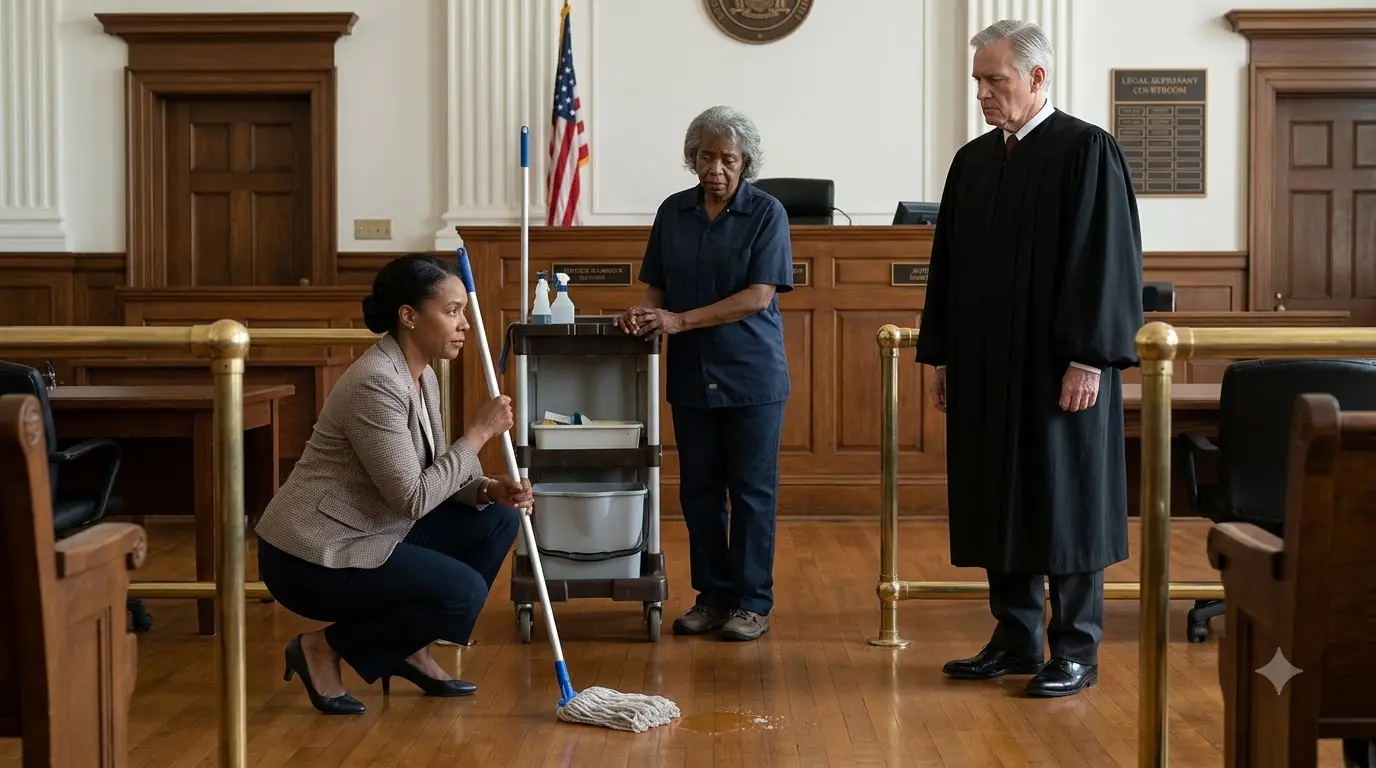
Get your black hands off my courtroom floor. Now! Jasmine Owens slowly rose, the mop still in her hand. Sir, we just— I don't care. Get out of here!
His lips curled as if he'd smelled something rotten. Margaret stood frozen behind her daughter, pale fingers gripping the cleaning cart. Sir, please. That's my daughter. She was just helping me.
Caldwell didn't even glance at the older woman. His gaze stayed fixed on Jasmine, cold and disgusted. She looked straight back at him, unblinking, unbowing. That seemed to enrage him even more. He stepped forward, finger pointed at her face.
Crawl back to that stinking pile of garbage you came from, or I'll drag you out of here. But come Monday morning, he would see Jasmine again. And that time, he would pay dearly for everything he'd done today. The morning had begun quietly, 500 miles away. Jasmine stood in her old federal chambers taping the last box shut.
26 years of legal practice fit into nine cardboard cubes stacked by the window. On her desk sat a photograph, edges worn soft from handling. A 7-year-old girl in pigtails holding the hand of a tired woman in a janitor's uniform, both squinting into the sun in front of a familiar limestone building. She slid the photo into her purse last. Outside the autumn wind pulled at her coat.
She drove the 400 miles east listening to a cassette her mother had burned for her in 2002. Marvin Gaye, Aretha, a scratch of static between every other song. By 3:00 in the afternoon, the State Supreme Court building rose at the end of Madison Avenue like something carved out of the last century. Limestone columns, a vaulted rotunda, an iron flagstaff turning slowly in the breeze. Inside the portrait gallery, every previous chief justice watched from a gilded frame.
17 of them, all men, all white. She did not stop to look. She used the staff entrance on the south side, two boxes under her arm, ID clipped to her blazer. The desk officer barely glanced up as she swiped in. Friday afternoons in October were always slow.
Most of the building had cleared out for the weekend. She found her mother in the side corridor near courtroom three. Margaret Owens, 73 years old, was reaching up to dust the top of a framed Senate proclamation she had been dusting for 32 years. Mama. Margaret turned and her whole face folded into a smile.
Look who finally showed up. They hugged in the empty hallway. Margaret smelled like the lavender hand soap she had used since the Clinton administration. Two weeks left, Jasmine whispered into her shoulder. Two weeks, Margaret laughed pulling back.
And not one day longer. I told them so. What you going to do with all that free time? Drive you crazy, baby. That's what.
Margaret turned back to her cart, then her eyes softened. You remember the first time I brought you here? Jasmine nodded. Seven years old. You stood right there under that big dome.
Your little neck craned all the way back looking at those murals. Margaret pointed with her duster. And I told you, one day, baby. One day. One day.
They stood for a moment in the quiet. A breeze moved through the high windows. Somewhere down the marble, an elevator hummed. I wouldn't be here without you, Mama. Hush, Margaret said, but her eyes were wet.
You did the work. I just held the door. Calvin Daniels rounded the corner then, his security uniform freshly pressed, coffee in hand. Margaret Owens, don't tell me you're still working. Don't tell me you're still drinking that cheap coffee.
Calvin laughed. He glanced at Jasmine politely, the way a man glances at a stranger he assumes is a relative, and tipped his cap. Ma'am. Calvin, you remember my daughter. He squinted.
The recognition did not quite land. Jasmine had been a Yale freshman the last time he saw her in this building, 20 years thinner and 20 years younger. Of course, he lied gently. How you been? I am well, Officer Daniels.
Thank you. He nodded, stepped back, and continued down the hall whistling a Stevie Wonder song slightly out of key. Jasmine smiled. He has no idea. He'll figure it out Monday, Margaret said.
They worked together for a few minutes. Jasmine carried boxes into the chambers down the hall. Margaret pushed her cart toward courtroom three to wipe it down for the week. The building was nearly empty now. 4:48 on a Friday in October.
The kind of hour where marble floors echoed every footstep. That was when the cart caught on the doorframe. A bottle of industrial floor cleaner tipped from the top tray. The cap, loose, popped off entirely. Oh, no.
Lord. No, no, no. Margaret dropped to her knees, but her old back caught halfway. A pool of pale blue liquid spread fast across the hardwood threshold of courtroom three. Jasmine was already moving.
She set her box down, crossed the hallway in three strides, knelt beside her mother and reached for the paper towels. "It's okay, Mama. I've got it. " "Baby, your blazer, it is fine. Just hand me the towels. " Margaret pressed a stack into her palm. Jasmine pushed up her sleeves, hair falling loose from its pin, and began blotting the spill in steady circles.
Just a daughter helping her mother. A Friday afternoon ending the way Friday afternoons should end. Then behind them footsteps. The footsteps belonged to Justice Harrison Caldwell. He returned from a 3-hour lunch with two associate justices, a long meal of bourbon, lamb chops, and bitter complaint.
For 6 weeks he had stewed over the governor's decision. 6 weeks since the appointment to Chief Justice, his appointment by every rule of seniority, had been handed to some unknown civil rights lawyer from out of state. He came back to the building only to grab a forgotten briefcase from the bench. He stopped at the open doorway of courtroom three. His eyes swept the floor and locked.
A black woman kneeling in his courtroom. He saw Margaret, too. He always saw Margaret. After 32 years she had become invisible to him, part of the furniture of the building, no more notable than the brass railings or the radiator vents. His brain registered her and discarded her in the same beat.
What it could not discard was the unfamiliar black woman with a mop and rolled up sleeves on the floorboards in front of his bench. He stepped through the doorway. "Margaret, what in God's name is this in my courtroom? " Margaret's hand flew to her chest. "Your honor, that's my daughter Jasmine. She was only helping me. " Caldwell did not look at Margaret.
He raised one hand, palm up, like a man silencing a barking dog. I was asking about the thing on the floor. Not you. Jasmine rose slowly. She set the wet paper towels on the cart beside her mother.
The mop she kept in her right hand. Her chin level. Her sleeves still pushed past her elbows. Caldwell let his eyes climb her. Shoes first, then trousers, then the loose strands of hair around her temples.
He took his time. The way a man inspects livestock he is considering rejecting. You don't even look like a janitor. Who are you pretending to be? Your honor, I don't The word cracked across the room.
Don't you dare put those two words in your mouth in this room. You have not earned the right to call me that. Jasmine did not lower her gaze. She had spent 26 years in courtrooms. She had clerked for a federal appellate judge.
She had argued before three circuit courts. She had been spoken to in many tones by many men, and she had learned the precise difference between a man losing his temper and a man enjoying it. Caldwell was enjoying it. He pointed at the bronze plaque mounted beside the door. Rules of the court.
Can you read that? Look at me. Can you read that? It's in English. I'm assuming English is something you have.